
Is Michigan a No-Fault State?
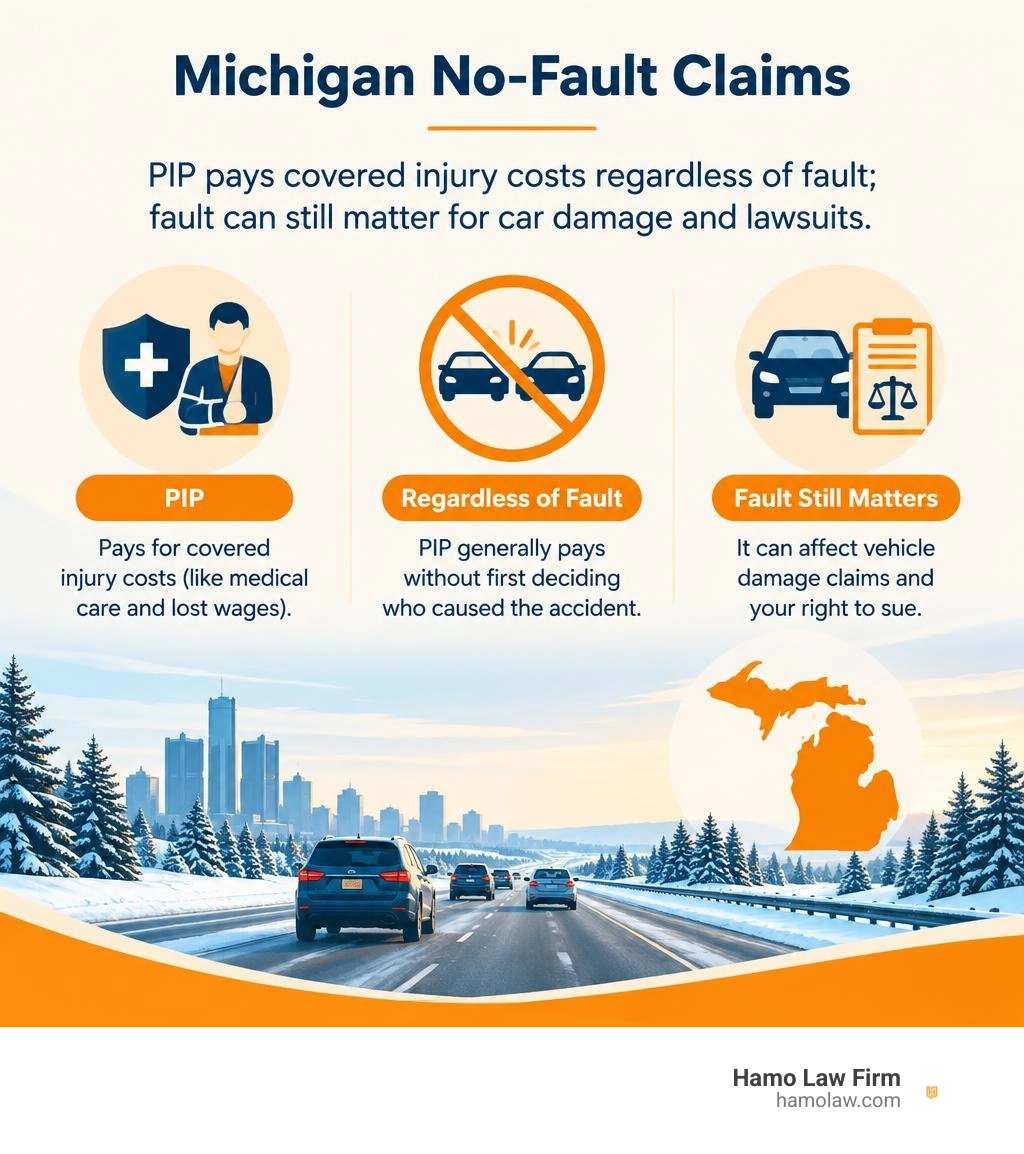
Yes. Michigan is a no-fault state for auto insurance. After a crash, Personal Injury Protection (PIP) generally pays for covered medical care and lost wages without first deciding who caused the accident. But “no-fault” does not mean fault never matters: it can still affect vehicle damage claims and your right to sue.
Your PIP coverage choice can shape what happens after an injury. I’m George Hamo, and I’ll explain the rules that matter most when you need to make a claim.
Is Michigan a No-Fault State and What Does That Mean?
When people ask us, is Michigan a no-fault state for auto accidents, they often assume the term means nobody is held responsible when a collision occurs. In reality, Michigan's no-fault system governs how insurance claims are paid, not whether a driver acted recklessly.
Under Michigan Compiled Laws Section 500.3101, every owner or registrant of a motor vehicle required to be registered in the state must maintain continuous security—meaning valid auto insurance coverage—while the vehicle is driven on public roadways. Michigan is one of just 12 mandatory no-fault states across the nation according to data tracking no-fault states.
In a pure no-fault jurisdiction like Michigan, your primary medical and financial recovery comes directly from your own insurance carrier, regardless of who ran the red light or caused the crash. This statutory structure ensures that immediate emergency care and essential financial support are never delayed by lengthy disputes between insurance adjusters over liability.
How the Michigan No-Fault System Operates
Understanding how Michigan no-fault insurance works requires looking at first-party benefits, legally called Personal Injury Protection (PIP). When you suffer an injury as a driver, passenger, or pedestrian involved in a motor vehicle accident, you file a claim directly with your auto insurer under state-mandated no-fault rules.
These no-fault benefits provide vital lifelines following a severe crash:
- Allowable Medical Expenses: Coverage for hospital stays, surgeries, physical therapy, prescription medication, medical equipment, and necessary home modifications up to your chosen policy limit.
- Wage Loss Reimbursement: Payment of up to 85% of your gross lost income for up to three years while you are medically unable to return to work, adjusted periodically for cost-of-living statutory caps.
- Replacement Services: Up to $20 per day for essential household services you would normally perform for yourself and your family, such as cleaning, cooking, lawn maintenance, and childcare.
- Attendant Care: Compensation for in-home nursing or non-professional daily living assistance if your injuries leave you unable to care for yourself independently.
Because you turn to your own insurer first, claim processing for essential care moves faster without having to prove the other driver was negligent.
Why Is Michigan a No-Fault State Compared to At-Fault States?
Traditional "at-fault" or tort-liability states operate on a fault-based model: if someone hits your vehicle, their insurance company is supposed to pay for your bodily injuries and vehicle damages. However, if the at-fault driver is uninsured, underinsured, or their insurer disputes who caused the crash, injury victims can wait months or years in litigation just to get basic emergency room bills paid.
Michigan enacted its no-fault system in the 1970s to eliminate that courtroom gridlock and ensure anyone injured on our roads receives immediate medical compensation.
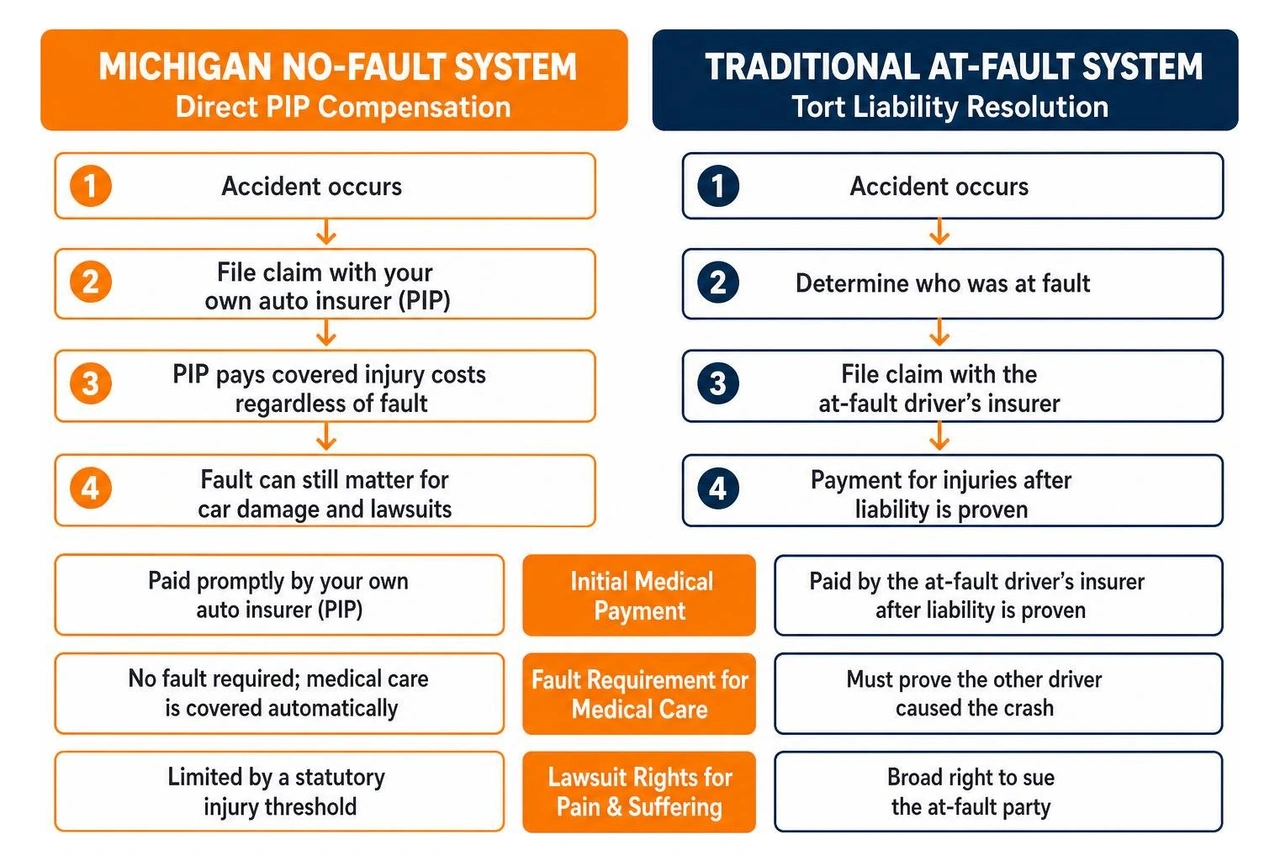
| Feature | Michigan No-Fault System | Traditional At-Fault (Tort) States |
|---|---|---|
| Initial Medical Payment | Paid promptly by your own auto insurer (PIP) | Paid by the at-fault driver's insurer after liability is proven |
| Fault Requirement for Medical Care | No fault required; medical care is covered automatically | Must prove the other driver caused the crash |
| Lawsuit Rights for Pain & Suffering | Limited by a statutory injury threshold | Broad right to sue the at-fault party |
| Property Damage to Other Fixed Objects | Covered up to $1,000,000 via mandatory PPI | Covered under standard property damage liability limits |
| Own Vehicle Damage Handling | Covered primarily by optional collision insurance | Paid by at-fault party's property damage liability |
Mandatory Auto Insurance Coverages Under Michigan Law
To legally drive on Michigan roads, every registered vehicle owner must maintain a policy that includes three core coverages outlined in our comprehensive Michigan no-fault insurance guide. Failing to purchase these mandatory coverages leaves you completely unprotected under state law.
Personal Injury Protection (PIP) Medical Choice Levels
Historically, Michigan required every motorist to buy lifetime, unlimited PIP medical benefits. While this gave Michiganders the best trauma and catastrophic injury coverage in the country, it also drove premiums sky-high. Comprehensive legislative reforms enacted in recent years modernized the system, allowing drivers to select from several distinct PIP medical coverage tiers.
Having your Michigan no-fault PIP benefits explained clearly is critical because selecting an inadequate tier can leave you personally responsible for tens of thousands of dollars in medical debt after a catastrophic crash.
| PIP Medical Choice Option | Who Is Eligible? | Scope of Protection |
|---|---|---|
| Unlimited Coverage | All Michigan drivers | Lifetime medical coverage for all reasonable and necessary care resulting from the crash. |
| $500,000 Limit | All Michigan drivers | Covers accident-related medical treatment up to $500,000 per person per crash. |
| $250,000 Limit | All Michigan drivers | Covers medical treatment up to $250,000 per person per crash. |
| $250,000 Limit with Exclusions | Drivers with Qualified Health Coverage (QHC) | Excludes named insureds whose private health insurance covers auto accident injuries. |
| $50,000 Limit | Drivers enrolled in Medicaid | Capped medical care; household members must also have qualifying coverage. |
| Complete PIP Opt-Out ($0) | Drivers enrolled in Medicare Parts A & B | Entirely waives auto PIP medical coverage; Medicare acts as primary payer. |
While choosing a lower limit or opting out reduces your insurance bill, it shifts medical costs to private health insurance or government programs, which often feature high deductibles, co-pays, provider network restrictions, and strict annual limits on physical therapy and rehabilitation.
Property Protection Insurance (PPI) and Residual Liability
The remaining two mandatory pillars of Michigan auto insurance protect against damage caused to property and catastrophic liability:
- Property Protection Insurance (PPI): Michigan policies include up to $1 million in Property Protection Insurance. PPI pays for physical damage your car accidentally inflicts on fixed, non-moving property within the state of Michigan—such as buildings, storefronts, fences, guardrails, and legally parked vehicles.
- Residual Bodily Injury and Property Damage Liability (BI/PD): While no-fault covers your medical care, you can still be sued if you cause an accident resulting in death, permanent serious disfigurement, or serious impairment of body function to someone else. Michigan's default baseline liability limits are $250,000 per person and $500,000 per accident for bodily injury, though drivers may sign a waiver to choose the absolute legal minimum limits of $50,000 per person / $100,000 per accident for bodily injury and $10,000 for property damage caused outside Michigan.

Exceptions and Lawsuits: Suing for Damages After a Crash
Because Michigan utilizes a no-fault framework, motorists trade away the broad right to sue for minor injuries in exchange for automatic, guaranteed medical payments. However, you are not entirely barred from legal recourse. When an accident causes catastrophic harm, you have the statutory right to pursue third-party claims against the negligent driver. Understanding the rules for filing a lawsuit after a crash can protect your family from devastating financial losses.
Is Michigan a No-Fault State for Vehicle Damage and Mini-Tort Claims?
A common area of confusion involves damage to your car. Many drivers ask: Does no-fault insurance pay to fix my vehicle if someone rear-ends me?
The answer is no. Personal Injury Protection and Property Protection Insurance do not pay to repair your moving vehicle. If you want your vehicle repaired after a crash, you must carry optional collision coverage on your own policy.
When dealing with handling deductibles and vehicle damage, Michigan’s Mini-Tort Law (MCL 500.3135) provides a specific exception. Under mini-tort rules:
- You can recover up to $3,000 for out-of-pocket, collision-related vehicle damages from the at-fault driver (or their insurer).
- This money typically covers your collision deductible or minor repairs if you carried no collision insurance.
- To collect mini-tort damages, you must establish that the other driver was at least 50% at fault for the crash. If you share partial fault, your recovery is reduced proportionally under comparative negligence principles.
Threshold for Pain and Suffering Lawsuits
To step outside the no-fault system and sue an at-fault driver for non-economic damages (pain, suffering, mental anguish, and loss of enjoyment of life), your injuries must meet a specific legal threshold under MCL 500.3135.
You can pursue a third-party tort claim against the at-fault motorist if the crash resulted in:
- Death (pursued as a wrongful death claim by surviving family members).
- Permanent Serious Disfigurement (such as severe facial scarring, loss of a limb, or major burn injuries).
- Serious Impairment of Body Function: Defined under Michigan law as an objectively manifested impairment of an important body function that affects your general ability to lead your normal life.
Additionally, if your medical expenses exceed your chosen PIP limit or your wage losses exceed the three-year statutory no-fault cap, you can sue the at-fault driver for those excess economic damages.
Michigan Auto Insurance Costs, Penalties, and Optional Coverages
Auto insurance premiums in Michigan have historically ranked among the highest in the country. In 2026, the average cost of full-coverage auto insurance in Michigan sits at approximately $229 per month ($2,748 annually). Several localized variables influence your specific premium rate:
- Your geographic location (drivers in urban centers like Detroit or Flint often face higher rates due to traffic density and claim frequency than rural areas in Genesee or Wayne County).
- Your driving history, past collisions, and moving violations.
- Your chosen PIP medical coverage limit and vehicle make and model.
Because basic no-fault insurance leaves significant gaps regarding your own vehicle repairs and non-medical losses, we strongly recommend evaluating essential optional coverages:
- Collision Coverage: Pays to repair or replace your vehicle after a crash. You can choose Broadened Collision (which waives your deductible if you are less than 50% at fault), Standard Collision, or Limited Collision.
- Comprehensive Coverage: Pays for vehicle damage resulting from non-collision incidents, including theft, vandalism, falling tree branches, windshield cracks, and collisions with animals such as deer.
- Uninsured/Underinsured Motorist (UM/UIM) Coverage: Vital protection that steps in to pay for your pain, suffering, and excess damages if you are struck by a hit-and-run driver or a motorist who carries insufficient liability coverage.
- Roadside Assistance and Rental Reimbursement: Offsets towing costs and rental vehicle fees while your car is in the repair shop.
Penalties for Uninsured Drivers in Michigan
Driving without valid auto insurance in Michigan is not just a traffic ticket—it is a serious criminal offense with catastrophic legal consequences.
Under Michigan law, operating an uninsured vehicle carries steep legal and administrative penalties:
- Criminal Charges: Driving without insurance is a misdemeanor punishable by fines up to $500, driver’s license suspension, and up to one year in jail.
- Vehicle Impoundment: Law enforcement officers can seize and impound your vehicle on the spot.
- Complete Loss of No-Fault Benefits: If you are injured while driving your own uninsured vehicle, you are completely disqualified from receiving no-fault PIP medical benefits and wage loss assistance, leaving you personally responsible for all hospital and rehabilitation bills.
- Civil Lawsuit Bar: An uninsured driver cannot sue an at-fault motorist for pain and suffering damages or mini-tort vehicle repairs, even if the other driver was 100% responsible for the collision.
- Personal Tort Exposure: If you cause an accident while uninsured, the other parties and their insurance companies can sue you personally, placing your home, bank accounts, and future earnings at severe risk.
Frequently Asked Questions About Michigan No-Fault Auto Insurance
What is the maximum payout under Michigan mini-tort?
The statutory maximum recovery under Michigan's mini-tort law is $3,000. This provision is designed to reimburse out-of-pocket expenses—primarily your collision insurance deductible or basic repairs for an uninsurable older vehicle—when an at-fault driver damages your car.
Can I opt out of PIP medical coverage in Michigan?
Yes, but only under specific statutory conditions. You can completely opt out of PIP medical coverage ($0 limit) if the named insured has Medicare Parts A and B, and any household spouse or resident relative has qualified health coverage (QHC) or another auto policy with PIP medical benefits. Drivers enrolled in Medicaid can choose a reduced $50,000 PIP limit.
What happens if an uninsured driver hits me in Michigan?
If an uninsured driver hits you, your own policy's PIP coverage still pays for your medical bills, wage loss, and replacement services regardless of their uninsured status. However, to recover for pain, suffering, and vehicle damage beyond the mini-tort limit, you must rely on your own collision coverage and optional Uninsured Motorist (UM) protection.
Protect Your Legal Rights After a Michigan Auto Accident
Michigan’s no-fault insurance system was designed to provide swift, dependable financial support when life takes an unexpected turn on our roads. However, navigating PIP coverage limits, mini-tort disputes, and strict statutory injury thresholds while dealing with aggressive insurance adjusters can be overwhelming.
At Hamo Law Firm, we have stood up for injured Michiganders across Flint, Detroit, Genesee County, and Wayne County for more than 40 years. Our dedicated trial attorneys understand how insurance carriers attempt to delay, dispute, or deny legitimate no-fault benefits. We operate on a contingency-fee basis—which means you pay absolutely no legal fees unless we win your case.
If you or a loved one has been injured in a crash, do not attempt to navigate complex insurance claims alone. Visit our Michigan no-fault coverage legal center today or contact our team to schedule your free, confidential consultation.