
Does Uninsured Motorist Have a Deductible? Understanding Policy Basics

When you are involved in a crash caused by a driver who lacks insurance, navigating your own policy can feel overwhelming. Many drivers immediately ask: does uninsured motorist have a deductible? The short answer depends entirely on whether your claim involves physical injuries or vehicle repairs. Understanding this distinction before an accident occurs can help you avoid unexpected out-of-pocket costs and make informed decisions about your coverage.
Uninsured motorist (UM) coverage is divided into two distinct components: Uninsured Motorist Bodily Injury (UMBI) and Uninsured Motorist Property Damage (UMPD). Each form handles out-of-pocket liabilities differently. While bodily injury claims generally do not require a deductible, property damage claims frequently do, depending on your jurisdiction and insurer. The deductible is the portion of a covered loss you agree to pay before your insurer contributes, and it directly affects both your premium and your financial exposure after a crash.
To understand how these first-party benefits work across the country, reviewing a comprehensive national uninsured motorist coverage guide provides valuable context on general coverage principles. First-party benefits are paid by your own insurer under your own policy, rather than by the at-fault driver's liability carrier. This distinction matters because the rules governing deductibles, coverage limits, and claim procedures are set by your policy language and state law, not by the other driver's insurance status.
| Coverage Type | Primary Purpose | Standard Deductible Requirement | Common Deductible Range |
|---|---|---|---|
| Uninsured Motorist Bodily Injury (UMBI) | Medical bills, lost income, pain & suffering | Typically $0 (No deductible) | $0 (Rarely $250–$500 in specific policies) |
| Uninsured Motorist Property Damage (UMPD) | Vehicle repair or replacement | Yes (Subject to state statutes) | $100 to $1,000 (Commonly $250) |
| Collision Coverage | Vehicle damage regardless of fault | Yes (Set by policyholder) | $250 to $2,000 ($500–$1,000 standard) |
Does Uninsured Motorist Have a Deductible for Bodily Injury Claims?
For the vast majority of policyholders, Uninsured Motorist Bodily Injury (UMBI) coverage carries no deductible. This means that when an uninsured or hit-and-run driver injures you, your UMBI coverage can begin paying for covered losses without requiring you to pay an upfront out-of-pocket sum first.
When an uninsured or hit-and-run driver injures you, your UMBI coverage steps in to pay for damages that the at-fault driver's bodily injury liability policy should have covered. This includes:
- Emergency medical expenses and hospitalization
- Rehabilitation and long-term care
- Lost wages and diminished future earning capacity
- Non-economic damages such as pain and suffering
Because bodily injury benefits are designed to compensate you for personal physical harm, insurers apply policy limits (such as $100,000 per person or $300,000 per accident) rather than requiring you to pay an upfront out-of-pocket sum before coverage starts. Policy limits represent the maximum amount your insurer will pay for a covered claim, and any damages above those limits may remain your responsibility unless other coverage applies. If you encounter difficulties getting your bodily injury claim approved, consulting an uninsured motorist lawyer ensures your rights and financial recovery remain protected.
Uninsured Motorist Property Damage (UMPD) Deductibles Explained
Unlike bodily injury, Uninsured Motorist Property Damage (UMPD) frequently includes a mandatory deductible. UMPD pays to repair or replace your vehicle if it is damaged by an uninsured motorist. This coverage is not available in every state, and where it is offered, the deductible rules can vary significantly.
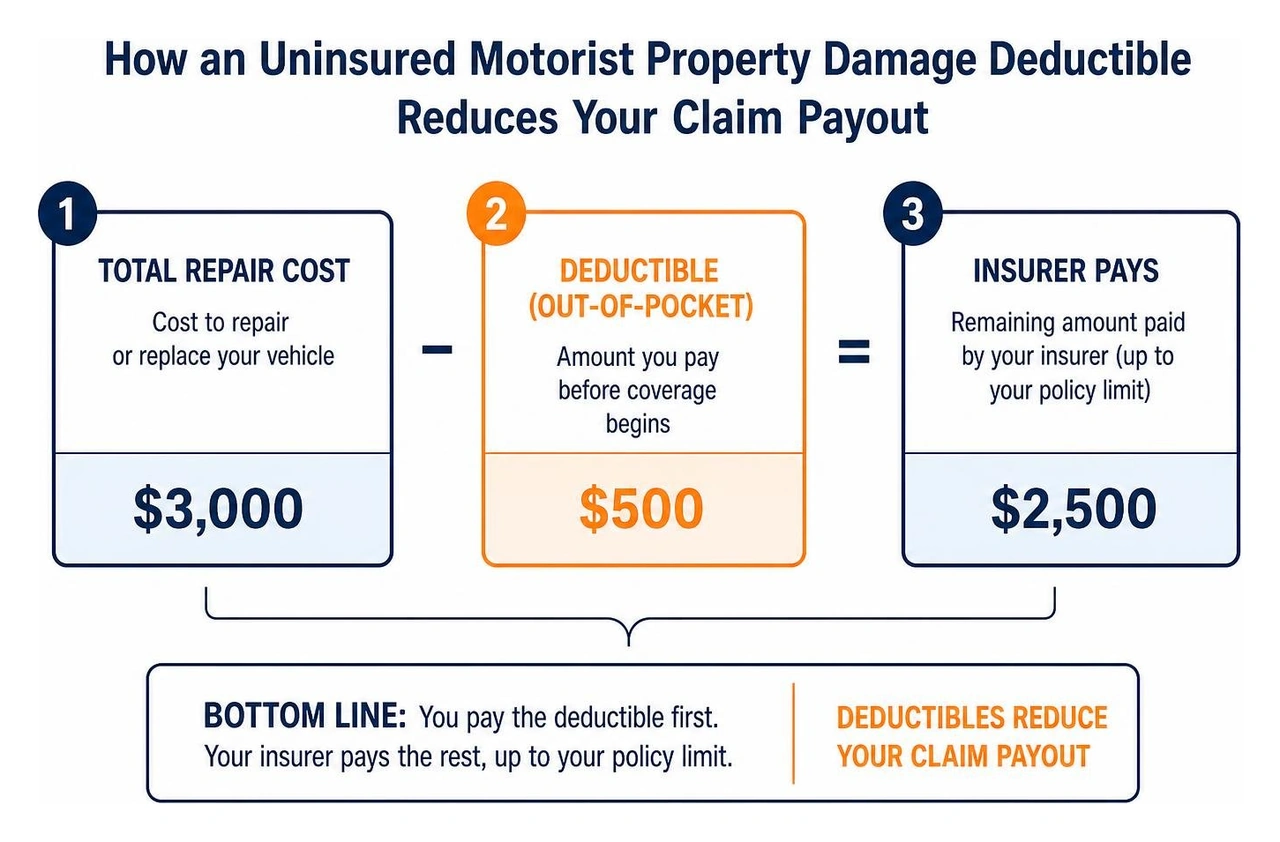
The deductible is the out-of-pocket amount you must pay before your insurer covers the remainder of the repair or replacement costs up to your policy limit. Deductible amounts for property damage claims are often established by state law or insurance regulatory baselines, typically landing at $250 or $500. For example, if your vehicle sustains $3,000 in damage and your UMPD deductible is $250, you pay the first $250 and your insurer pays the remaining $2,750, assuming your policy limit is sufficient to cover that amount.
State-by-State Breakdown of Uninsured Motorist Deductibles
Auto insurance regulations vary significantly across state lines. In traditional tort (fault-based) states, UMPD is common, whereas in no-fault states like Michigan, the framework for handling vehicle damage and injury costs is entirely distinct. Because each state sets its own rules for whether UMPD must be offered, what deductibles apply, and how claims are processed, drivers should review their policy declarations page and consult state-specific guidance to understand their exact obligations.
Texas, Washington, and Other Fault-Based State Rules
In fault-based states, statutory regulations dictate whether deductibles apply to property damage claims and how much insurers can charge. These rules are designed to balance consumer protection with insurer cost management, and they often establish maximum deductible amounts that insurers cannot exceed.
- Texas: Under the Texas uninsured motorist statute guide, insurers must offer UM/UIM coverage. For property damage, Texas law establishes a standard $250 deductible. If a crash results in $2,000 worth of damage, the insured pays $250 out of pocket, and the insurer covers the remaining $1,750.
- Washington: Under RCW 48.22.030, the state caps UMPD deductibles at no more than $100 for standard uninsured claims. However, if the crash involves an unidentified hit-and-run or "phantom vehicle," the deductible cap increases to $300. This higher cap reflects the added difficulty insurers face when the at-fault driver cannot be identified or located.
- Other Fault States: Insurers typically allow policyholders to choose deductibles ranging from $200 to $1,000 to adjust annual premium costs. Selecting a higher deductible generally lowers your premium, while a lower deductible increases your premium but reduces your out-of-pocket exposure after a crash.
Michigan No-Fault System and Mini-Tort Exceptions
Michigan operates under a unique auto insurance framework. Understanding how Michigan no-fault insurance works is essential when assessing deductibles and damage recovery. Under this system, your own insurer pays for covered losses regardless of who caused the accident, which changes how deductibles and damage claims are handled compared with fault-based states.
- Medical Care & Bodily Injury: Under Michigan's Personal Injury Protection (PIP) system, your own PIP coverage pays for your reasonable medical expenses, lost wages (up to statutory limits), and replacement services regardless of fault. However, if you suffer severe injuries and your economic or non-economic damages exceed PIP limits, an optional Uninsured Motorist Bodily Injury policy allows you to recover compensation for excess damages and pain and suffering without paying a deductible.
- Vehicle Damage & Collision Coverage: In Michigan, vehicle damage is generally not handled through traditional UMPD. Instead, drivers rely on their own Collision coverage (Broad Form, Standard, or Limited). Each collision option has its own deductible rules, and the deductible you select directly affects both your premium and your out-of-pocket costs after an accident.
- The Michigan Mini-Tort Exception: Michigan law allows drivers who are not at fault (or less than 50% at fault) to recover up to $3,000 for vehicle damage not covered by insurance from the at-fault driver. This mini-tort provision can be used to recover your collision deductible when hit by an uninsured driver, though collecting from an uninsured person directly can require formal legal action. In practice, many uninsured drivers lack the assets to pay a mini-tort judgment, which is why carrying adequate collision coverage remains important.
Uninsured Motorist vs. Collision Coverage: Which Deductible Applies?
A common area of confusion is deciding whether to file a vehicle damage claim under UMPD or your standard collision policy. The right choice depends on your state's rules, the deductible amounts on each coverage, and whether the at-fault driver has been identified. Understanding the differences can help you minimize out-of-pocket costs and avoid unnecessary premium increases.
If your state offers UMPD and you carry both coverages:
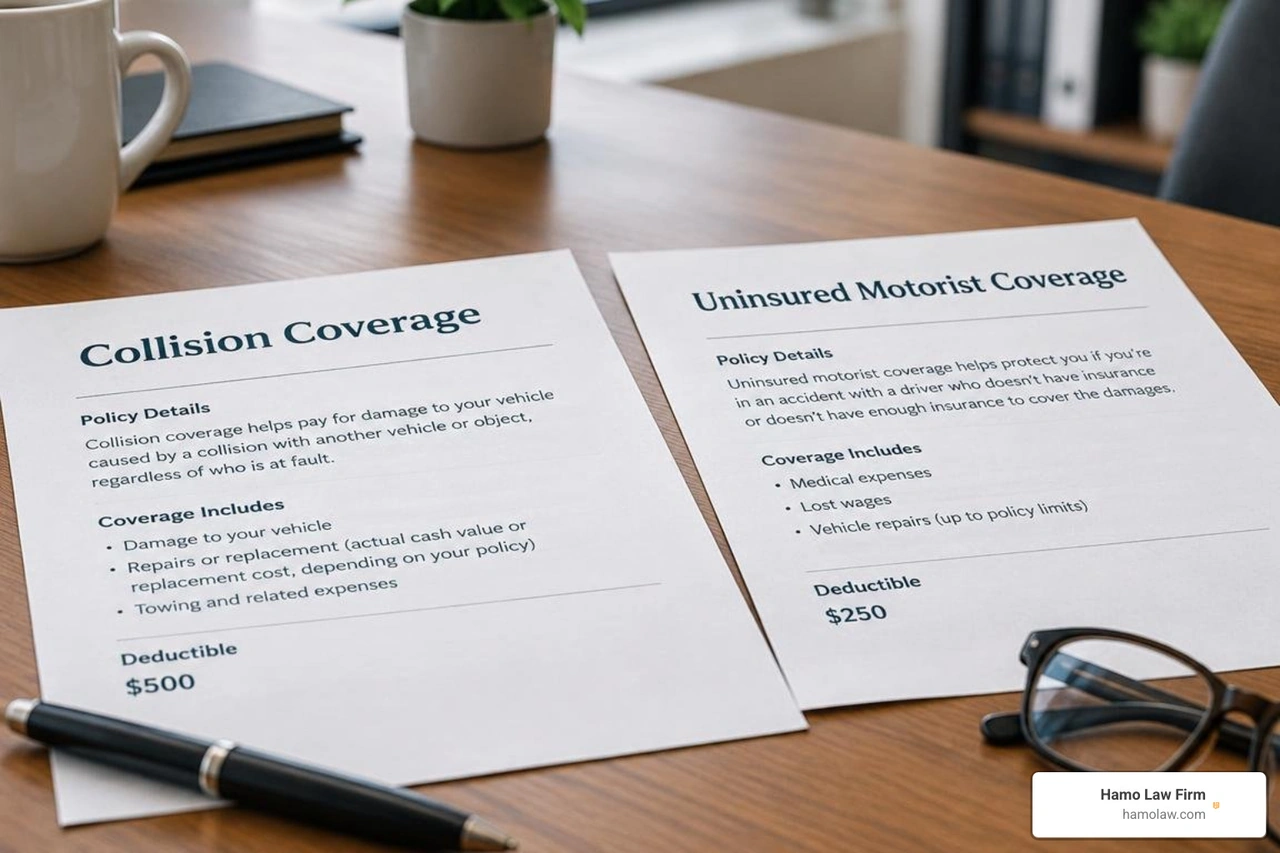
- Collision Coverage: Covers physical damage from an accident regardless of fault. The deductible is selected by you (often $500 or $1,000). Because collision applies even when you are at fault, it is broader than UMPD but often comes with a higher deductible.
- UMPD Coverage: Applies only when an uninsured driver is at fault. The deductible is often lower than collision (such as $250). In some states, UMPD is not available at all, leaving collision coverage as your only option for vehicle damage caused by an uninsured driver.
- Collision Deductible Waiver: Some insurers offer an endorsement that waives your collision deductible entirely if you are struck by an identified, uninsured at-fault driver. This endorsement can be a cost-effective alternative to carrying separate UMPD coverage, but it typically requires the at-fault driver to be identified and confirmed as uninsured.
Does Uninsured Motorist Have a Deductible in Hit-and-Run Accidents?
Hit-and-run accidents present special challenges for deductibles. Because the at-fault driver cannot be identified at the scene, insurers often apply stricter requirements before coverage applies, and the deductible may be higher than in a standard uninsured motorist claim.
- Bodily Injury: In hit-and-run crashes, UMBI applies with zero deductible, provided you promptly report the incident to the police within the required statutory window (often 24 hours). Failing to file a timely police report can jeopardize your ability to pursue a UMBI claim, so documentation is critical.
- Property Damage: In states that allow UMPD for hit-and-run incidents, statutes often require physical contact between the vehicles and may impose a higher deductible (such as Washington's $300 hit-and-run deductible compared to its $100 standard cap). The physical contact requirement is intended to prevent fraudulent claims, but it can create obstacles for drivers whose vehicles are damaged without direct contact.
- Unidentified Drivers: In certain jurisdictions, UMPD does not apply unless the uninsured driver is specifically identified. In those cases, you must use collision coverage, paying your standard collision deductible. This can be frustrating for victims of hit-and-run crashes, but it underscores the importance of carrying collision coverage even if you also have UMPD.
Choosing Your Deductible and Lowering Out-of-Pocket Costs
When structuring your auto policy, balancing deductible amounts against premium rates is a practical financial decision. The right choice depends on your savings, your tolerance for risk, and how likely you are to need vehicle repairs after an accident.
- Higher Deductible ($1,000+): Lowers your annual insurance premium, but increases your out-of-pocket burden immediately after a crash. If you have enough savings to cover a larger deductible comfortably, this option can reduce your long-term insurance costs.
- Lower Deductible ($100–$250): Slightly raises your recurring premium, but shields you from sudden out-of-pocket costs when hit by an uninsured driver. For drivers with limited emergency savings, a lower deductible can provide valuable financial protection.
If your claim is wrongfully delayed, reduced, or if your insurance company denies your claim, an experienced trial attorney can step in to hold the insurer accountable to its policy terms. Insurers sometimes undervalue property damage claims or dispute whether a driver was truly uninsured, and legal representation can help ensure you receive the full amount you are owed.
Frequently Asked Questions About Uninsured Motorist Deductibles
Can I choose my own uninsured motorist deductible amount?
In many states, statutory regulations establish a mandatory baseline deductible for UMPD (such as $250). In states where insurers allow flexibility, you can select your preferred deductible tier (commonly $200, $500, or $1,000). UMBI almost always has a default $0 deductible. When choosing a deductible, consider how much you could comfortably pay out of pocket after an accident, because a lower deductible means higher premiums and a higher deductible means lower premiums.
If I have collision insurance, do I still need UMPD coverage?
In states where both exist, collision covers vehicle repairs regardless of fault, while UMPD specifically covers uninsured scenarios, often with a lower deductible. If you have collision with a deductible waiver endorsement, you may not need separate UMPD coverage. However, if your state does not offer UMPD or you decline it, collision coverage remains your primary protection against damage caused by uninsured drivers, and you will be responsible for your collision deductible unless a waiver applies.
What happens to my deductible if the uninsured driver is later identified?
If an unidentified or uninsured driver is subsequently identified and found to have assets or applicable liability, your insurance carrier will attempt subrogation. If your insurer successfully recovers funds through the subrogation process, they are legally required to reimburse your deductible. Subrogation allows your insurer to step into your shoes and pursue the at-fault driver for amounts it paid on your claim, and any recovery is typically applied first to reimburse your out-of-pocket deductible before the insurer retains the remainder.
Conclusion
Understanding how deductibles apply to uninsured motorist claims ensures you are not caught off guard by unexpected out-of-pocket expenses. While bodily injury claims almost universally operate without a deductible, property damage claims vary widely by state statute and policy selection. Knowing which coverage applies to your situation, and what deductible you will owe, can make the difference between a smooth recovery and a stressful financial setback.
Review your policy declarations page annually to ensure your coverage limits match your family's needs. Pay particular attention to your UMBI and UMPD limits, your collision deductible, and whether any deductible waiver endorsements are available. If you are unsure whether your current policy adequately protects you against uninsured drivers, speaking with an experienced attorney can help you identify coverage gaps before an accident occurs.
For complex claims involving significant injuries, hit-and-run crashes, or questions surrounding Michigan no-fault insurance who pays deductible rules, our team at Hamo Law Firm brings over 40 years of dedicated trial experience to fight for your complete recovery—with no fees unless we win. We understand how insurers evaluate uninsured motorist claims and can help you pursue every dollar you are owed under your policy.