
What Your Car Insurance Deductible Means for Repair Costs

Your car insurance policy deductible is the amount you cover on a claim before your insurer pays the rest. It usually applies to collision and comprehensive claims, not liability claims. For example, with a $500 deductible and a $2,000 covered repair, you cover $500 and your insurer pays $1,500.
A higher deductible can lower your premium, but it also means a bigger bill after a loss. Choose an amount you could pay without straining your savings. If another driver caused the crash, do not assume your deductible disappears: it may still apply if you use your own collision coverage.
I'm George Hamo, and I'll walk you through how to weigh that trade-off and what to check before you file a claim.

Understanding Your Car Insurance Policy Deductible and How It Works

When you look at your policy declarations page, the deductible is the specific dollar figure representing your share of risk sharing with the carrier. Unlike health insurance—where you work toward an annual out-of-pocket maximum that resets each calendar year—auto insurance deductibles operate almost exclusively on a per-claim basis. If you hit a pothole on I-75 in Wayne County in January and back into a pole in Flint in November, you are responsible for paying the deductible for each separate incident.
The mechanics of the payment are simple: you do not write a check to your insurance carrier. Instead, the insurer subtracts your deductible from the total approved claim payout. If your local collision center provides an approved repair estimate of $4,500 and your policy carries a $1,000 deductible, the insurance company issues a disbursement of $3,500. You pay the remaining $1,000 directly to the repair facility when you pick up your fixed vehicle. Understanding these mechanics is essential for smart financial planning, as highlighted in the Wall Street Journal financial analysis on auto deductibles.
Physical Damage Coverages: Collision vs. Comprehensive
Deductibles primarily attach to first-party physical damage coverages. While you select these amounts when purchasing a policy, you can generally choose different thresholds for each coverage type:
- Collision Coverage: Applies whenever your car impacts another vehicle, a stationary object (like a guardrail or tree), or flips in a rollover accident.
- Comprehensive Coverage: Covers non-collision incidents outside your control, such as vehicle theft, storm damage, fallen tree branches, vandalism, cracked windshields, and animal strikes (such as hitting a deer on a rural Genesee County road).
Because comprehensive claims are less frequent and often involve smaller payouts than major traffic collisions, insurers typically charge less to maintain a low comprehensive deductible. Many savvy drivers choose a $1,000 collision deductible alongside a $250 comprehensive deductible to protect against frequent windshield repairs and road debris without driving up their baseline monthly rates.
Coverages That Do Not Require a Deductible
Not every line item on your policy comes with an out-of-pocket hurdle. Standard third-party protections never require you to pay a deductible:
- Bodily Injury and Property Damage Liability: When you cause a crash that harms someone else or damages their property, your liability insurance following a car accident responds from the first dollar up to your chosen policy limits. We consistently recommend securing robust bodily injury liability coverage to protect your personal assets without worrying about claim hurdles.
- Roadside Assistance: Emergency towing, jump-starts, flat tire changes, and lockout services are paid directly by the insurer without an initial charge.
- Rental Car Reimbursement: If your vehicle is in the shop for covered repairs, daily rental allowances kick in immediately if you have elected this optional rider.
The Financial Seesaw: Balancing Premiums and Deductibles

Auto insurance pricing acts like a financial seesaw: as you push your deductible higher, your monthly premium drops, and vice versa. By accepting more financial responsibility during a loss, you absorb smaller property claims and reduce the carrier's exposure.
Across the insurance industry, deductibles typically span from $100 up to $2,000, with $500 serving as the benchmark choice for most motorists. However, premium discounts follow a curve of diminishing returns:
| Deductible Transition | Typical Premium Reduction | Out-of-Pocket Increase | Primary Benefit |
|---|---|---|---|
| $250 to $500 | 15% – 30% | +$250 | Significant premium savings for low added risk |
| $500 to $1,000 | 7% – 28% | +$500 | Ideal for safe drivers with solid emergency funds |
| $1,000 to $2,000 | 2% – 15% | +$1,000 | Modest rate savings with substantial cash exposure |
Moving your deductible from $250 up to $500 yields a noticeable reduction in collision and comprehensive costs. Stepping from $500 to $1,000 offers solid ongoing savings, but pushing beyond $1,000 often saves very little extra per month while doubling your cash risk if an accident occurs.
Calculating Break-Even on Your Car Insurance Policy Deductible
Before adjusting your limits, run a simple break-even calculation to ensure the move makes mathematical sense:
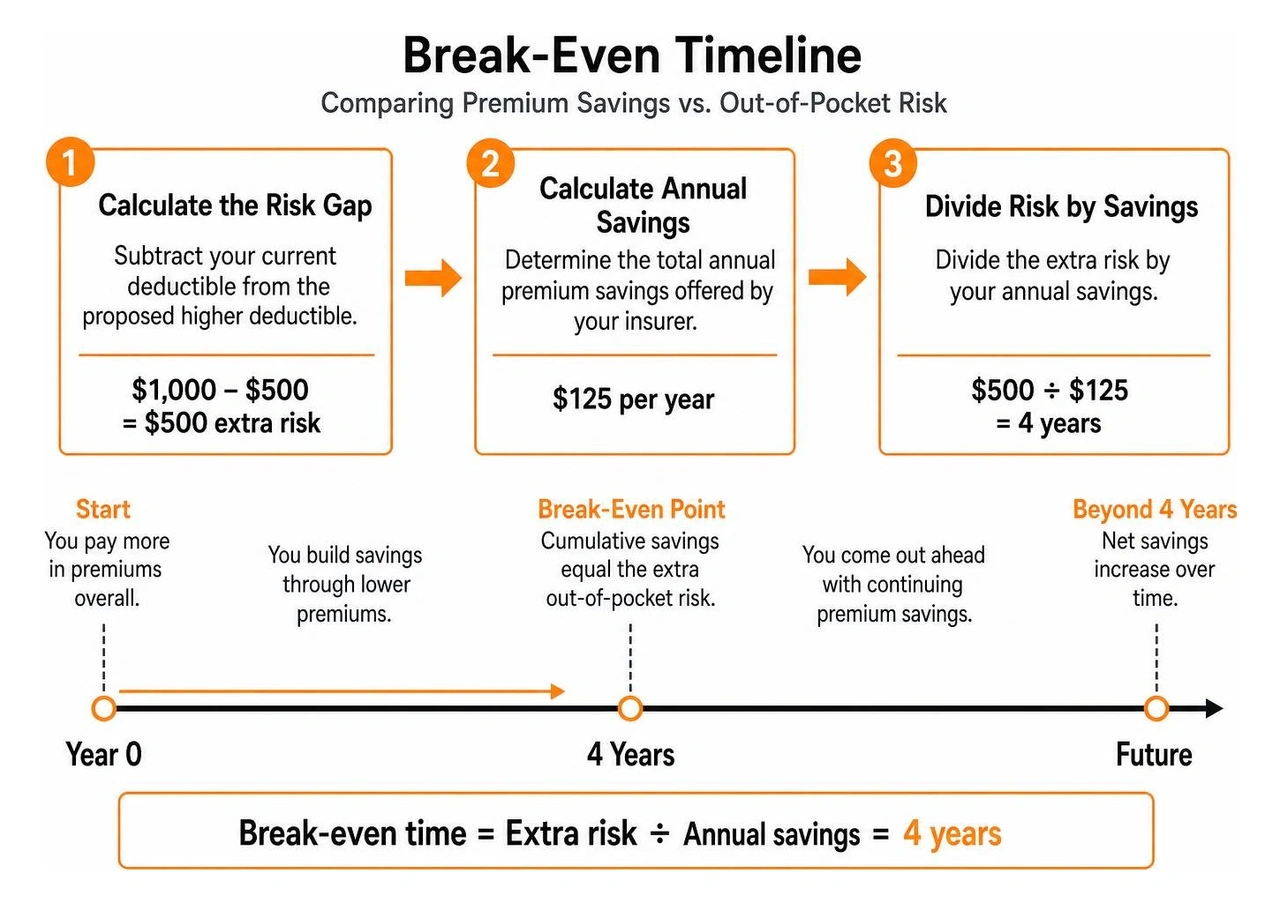
To calculate your personal break-even point:
- Calculate the Risk Gap: Subtract your current deductible from the proposed higher deductible (e.g., $1,000 − $500 = $500 extra risk).
- Calculate Annual Savings: Determine the total annual premium savings offered by your insurer for making the switch (e.g., $125 per year).
- Divide Risk by Savings: Divide the extra risk by your annual savings ($500 / $125 = 4 years).
In this scenario, if you drive claim-free for 4 years, the accumulated premium savings entirely offset the extra $500 you would pay after a crash. If your driving record is spotless and your daily commute throughout Metro Detroit is relatively low-risk, accepting a 3- to 4-year break-even horizon is a proven method to reduce ongoing ownership costs.
Comparing High-Deductible vs. Low-Deductible Strategies
Choosing between a high and low deductible comes down to matching policy terms with your household liquidity:
- The High-Deductible Approach ($1,000 to $2,000): Best suited for drivers who maintain an established emergency cash buffer, drive low annual mileage, have secure garage parking, and prioritize minimizing fixed monthly bills.
- The Low-Deductible Approach ($100 to $500): Ideal for households with tight monthly budgets, individuals without immediate access to liquid cash reserves, or drivers facing heavy daily traffic across congested freeway corridors. Paying slightly more each month prevents a sudden, unaffordable repair invoice from causing financial hardship.
What Happens to Your Deductible After an Accident?
The immediate aftermath of a motor vehicle collision brings plenty of questions regarding who pays what and when. The claims adjusters evaluate the damage estimate, confirm active coverages, and determine how the deductible applies based on your policy structure.
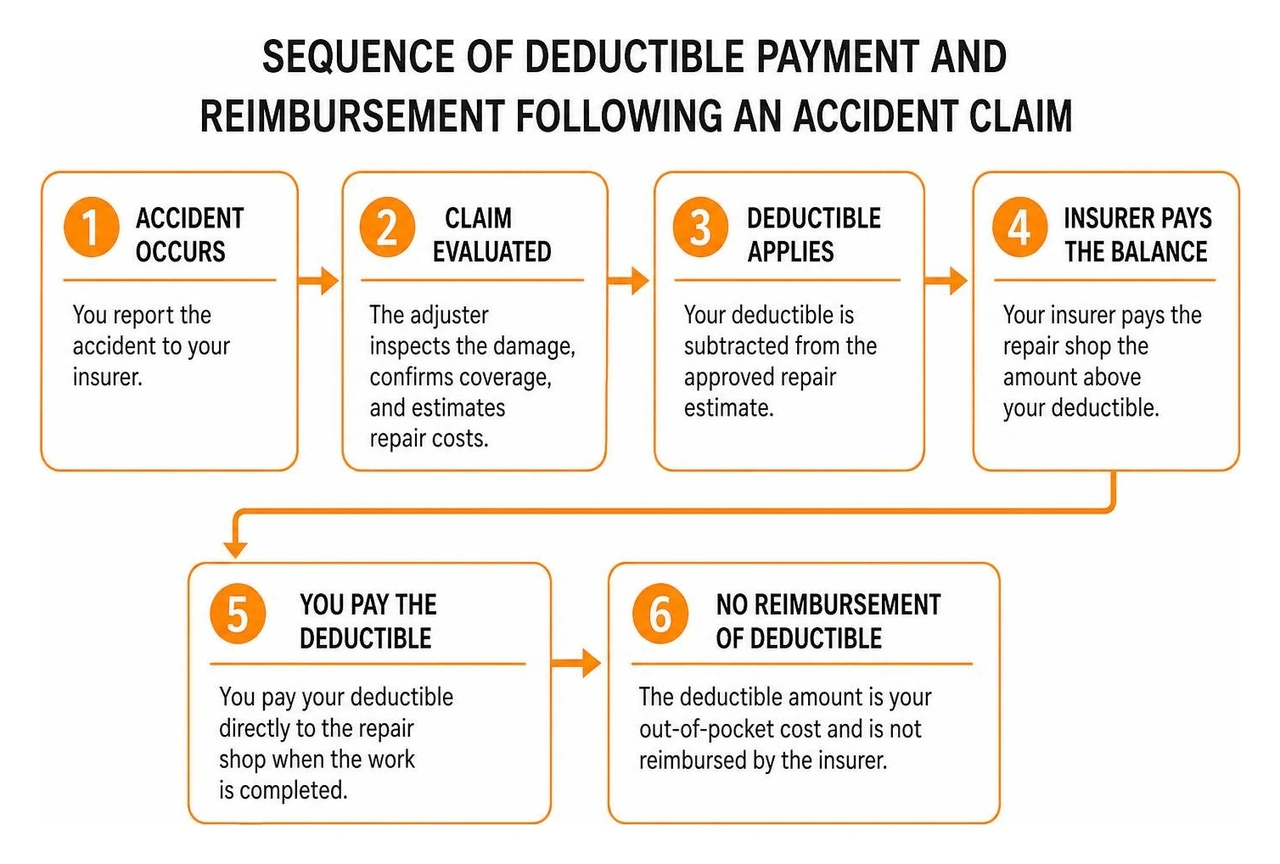
When you take your car in for repairs under your collision coverage, you are responsible for paying the deductible directly to the repair shop once work is completed. If you run into hurdles with adjusters disputing repair scope or delaying approvals, dealing with insurance companies after an accident with experienced legal support ensures your rights and property claim values remain protected.
Total Loss Settlements and Actual Cash Value
If the cost to repair your vehicle approaches or exceeds its fair market worth, your insurer declares the vehicle a total loss. In a total loss settlement:
- The carrier calculates the vehicle's Actual Cash Value (ACV) immediately prior to the crash.
- Your deductible is subtracted directly from that valuation settlement.
- The remaining funds are disbursed to your lienholder or directly to you if you own the vehicle outright.
For example, if your totaled vehicle holds an ACV of $18,000 and your collision policy carries a $1,000 deductible, the insurance check equals $17,000. If you owe $19,000 on an auto loan, you remain responsible for the remaining $2,000 balance unless you carry dedicated GAP insurance to bridge the shortfall.
Not-At-Fault Accidents and State-Specific Rules
If another motorist causes an accident, your responsibility for the deductible depends heavily on regional insurance frameworks and the specific claim path you pursue:
- Traditional Tort States (Subrogation): When an insured driver uses their own collision coverage after a crash caused by another party, their insurer pays the repair bill minus the deductible. The insurer then pursues the at-fault driver's carrier through a legal process called subrogation to recover the total repair expense, including the policyholder's deductible. Once recovered, the deductible is refunded to the driver.
- Michigan No-Fault Framework: Michigan operates under a unique auto insurance system. Vehicle damage is governed by specific collision coverage elections (Broadened, Standard, or Limited Collision). Under Broadened Collision, your deductible is automatically waived entirely if you are less than 50% at fault for the crash. To understand the exact recovery mechanisms available under state law, review how Michigan no-fault insurance deductible rules assign responsibility. If you suffer losses beyond your policy limits or face complex vehicle damage disputes, an experienced car property damage attorney can help recover your losses via mini-tort claims against the at-fault driver.
Steps to Optimize Your Car Insurance Policy Deductible
Finding the ideal deductible requires balancing your personal finances, vehicle equity, and contractual loan obligations.
Matching Deductible Levels to Liquid Emergency Funds
The golden rule of auto policy management is straightforward: never select a deductible higher than the liquid cash you have readily available in a dedicated emergency fund.
If you select a $1,000 deductible to save $15 a month on your premium, but do not have $1,000 in savings, your car could sit indefinitely at an auto body shop following a minor crash. Keep your deductible amount accessible in a standard savings account so an unexpected fender bender never threatens your household mobility or day-to-day budget.
Adjusting Deductibles During Policy Mid-Term
You do not have to wait for your annual policy renewal to modify your deductible limits. If your emergency savings grow—or if your budget tightens—you can contact your insurance agent or log into your policy portal to request a mid-term policy endorsement.
Your carrier will recalculate your premium on a pro-rated basis for the remainder of the policy period. However, any adjustment is strictly forward-looking; insurance regulations prevent backdating changes to reduce out-of-pocket costs on losses that have already occurred.
Frequently Asked Questions About Auto Policy Deductibles
Who pays the deductible if an accident is not my fault?
If you file a claim through your own collision coverage, you initially cover the deductible when paying the repair facility. If the other party is fully liable, your insurance provider pursues the at-fault driver's insurer through subrogation to recoup the claim costs. Once the third-party carrier accepts liability and settles the subrogation demand, your insurer reimburses your deductible. Under Michigan's Broadened Collision coverage, your insurer waives the deductible upfront if you are not substantially at fault.
What happens if the vehicle repair estimate is lower than the deductible?
If a body shop estimates repairs at $400 and your collision deductible is $500, your insurance company will not pay anything toward the claim. In this scenario, you cover the full repair cost out of pocket. Filing an insurance claim for an amount below your deductible is generally inadvisable, as the insurer pays zero dollars while the claim record still attaches to your vehicle history report, which could impact future rate calculations.
Can I adjust my deductible after an accident occurs?
No. Deductible adjustments are applied only on a prospective basis. The deductible that governs your claim is strictly the limit active on your declarations page at the exact date and time of the loss. Attempting to alter coverage limits retroactively or misrepresenting the date of an accident to take advantage of a lower deductible constitutes insurance fraud.
Conclusion
Mastering your auto policy deductibles gives you direct control over your vehicle ownership expenses. By balancing premium reductions against your liquid emergency savings, selecting targeted physical damage limits, and understanding how fault impacts out-of-pocket expenses, you can protect your vehicle without compromising your household financial security.
When serious accidents happen, dealing with complex insurance policies and disputed claims can quickly become overwhelming. For over 40 years, our team at Hamo Law Firm has stood up to insurance carriers on behalf of injury and accident victims across Flint, Detroit, Genesee County, and Wayne County. If you need dedicated guidance navigating no-fault insurance claims or determining who covers your expenses after a severe crash, contact our experienced team today for a free consultation. To learn more about your rights and recovery options under state law, explore our detailed resource on determining who pays your deductible under Michigan no-fault law.