
What Is Qualified Health Coverage Under Federal and State Law?

When people talk about healthcare rules, the terminology can quickly turn into a confusing alphabet soup. At the federal level, the baseline standard comes from the Affordable Care Act (ACA), specifically codified under 42 U.S. Code § 18021 - Qualified health plan defined. Under federal statute, a plan earned the designation of a Qualified Health Plan (QHP) only when certified by the Health Insurance Marketplace Exchange, offered by a licensed insurer in good standing, and structured to include mandatory consumer protections.
Federal minimum essential coverage rules establish that a qualified plan cannot arbitrarily deny coverage for pre-existing conditions, impose lifetime dollar limits on vital care, or drop policyholders simply because they get sick. Furthermore, health insurance issuers offering plans through an Exchange must make uniform offerings across rating areas and maintain equal premium pricing whether a consumer buys directly through the Exchange, through an independent insurance agent, or directly from the carrier.
In Michigan, state regulators work alongside federal frameworks to protect policyholders. The Michigan Department of Insurance and Financial Services (DIFS) oversees state insurance market compliance, ensuring that carriers operating in Wayne County, Genesee County, and throughout the state honor both federal standards and Michigan's distinct statutory requirements. When federal law and state regulations intersect, consumers gain a robust safety net—provided their specific policy fulfills every statutory benchmark.
Essential Health Benefits and Metal Tier Protections
To qualify under federal standards outlined in 42 USC CHAPTER 157, SUBCHAPTER III, Part A: Establishment of Qualified Health Plans, every plan must provide comprehensive coverage across ten essential health benefit categories:
- Ambulatory patient services (outpatient care received without hospital admission)
- Emergency services (urgent interventions without pre-authorization or out-of-network financial penalties)
- Hospitalization (inpatient surgical procedures, intensive care, and extended overnight recovery)
- Maternity and newborn care (comprehensive care provided before, during, and after childbirth)
- Mental health and substance use disorder services (behavioral health treatment, therapy, and inpatient recovery programs)
- Prescription drugs (coverage across comprehensive formularies for essential and life-saving medications)
- Rehabilitative and habilitative services and devices (therapies and equipment designed to help patients recover or maintain vital daily functioning)
- Laboratory services (diagnostic testing, blood work, and imaging)
- Preventive and wellness services and chronic disease management (routine screenings, immunizations, and annual physical checkups covered at zero out-of-pocket cost)
- Pediatric services (comprehensive healthcare for children, explicitly incorporating pediatric oral and vision care)
Beyond these mandatory categories, plans are organized into standard metal tiers based on actuarial value—the average percentage of total healthcare costs the plan pays:
- Bronze Tier: 60% actuarial value (lower monthly premiums, higher out-of-pocket costs at the point of care)
- Silver Tier: 70% actuarial value (moderate premiums; the sole tier eligible for additional cost-sharing reductions)
- Gold Tier: 80% actuarial value (higher monthly premiums with significantly reduced deductibles and copays)
- Platinum Tier: 90% actuarial value (highest monthly premiums with the lowest out-of-pocket expenses when accessing care)
Every qualified plan must also abide by strict annual statutory cost-sharing limits, setting a definitive ceiling on deductibles, copayments, and out-of-pocket maximums.
Understanding Excepted Benefits and Excluded Policies
Not every policy sold on the commercial market qualifies as true comprehensive health coverage. Federal law under 26 USC 9832: Definitions explicitly distinguishes standard group health plans from standalone products known as "excepted benefits."
Excepted benefits are specialized insurance policies that provide narrow, supplemental, or event-specific compensation. Under the Internal Revenue Code, these include:
- Standalone accident or disability income insurance
- Workers' compensation or similar statutory programs
- General liability and automobile medical payment insurance
- Standalone, limited-scope dental or vision policies sold independently from primary health plans
- Fixed-indemnity policies (such as hospital cash plans paying a set flat rate per day)
- Coverage limited to a specific named disease or illness (such as cancer-only policies)
Because these products are exempt from ACA market reforms, they do not have to provide the ten essential health benefits, cap member out-of-pocket expenses, or cover pre-existing conditions. While they may serve as useful financial supplements, excepted benefits do not constitute qualified coverage for federal purposes or Michigan no-fault auto insurance coordination.
Qualified Health Coverage Requirements for Michigan Auto Insurance
For motorists in Detroit, Flint, and across Michigan, qualified coverage carries enormous legal and financial significance beyond ordinary medical visits. Following major reforms to Michigan's no-fault insurance system, drivers are no longer forced to purchase mandatory unlimited Personal Injury Protection (PIP) medical coverage on their auto policies. Instead, drivers can select from tiered levels of PIP medical protection—or even opt out of PIP medical entirely—if they can establish that they hold health insurance meeting strict state criteria.
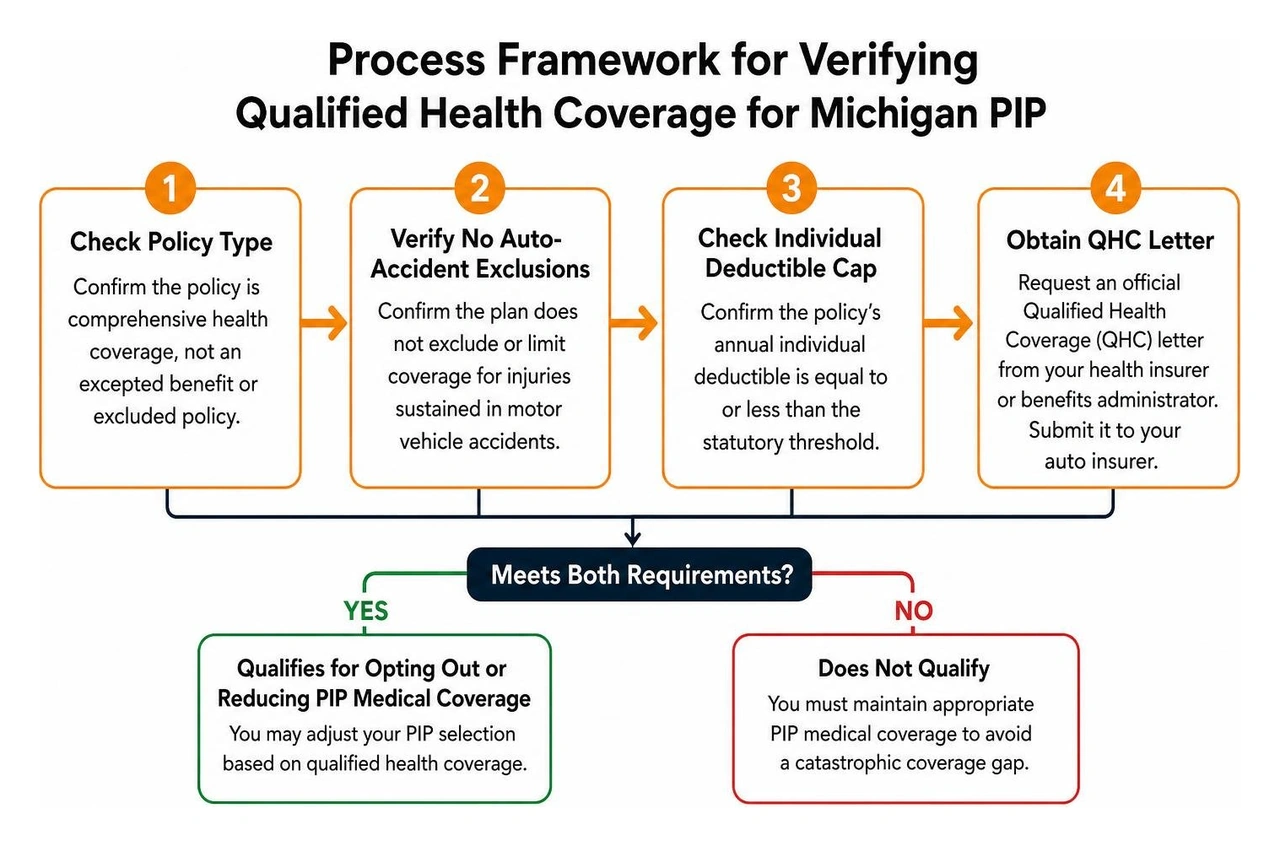
To satisfy the statutory definition of Qualified Health Coverage for Michigan auto insurance purposes, an individual's private health policy must meet two non-negotiable legal tests:
- No Auto-Accident Exclusions: The health insurance plan must not exclude or limit coverage for injuries sustained in motor vehicle accidents.
- Individual Deductible Cap: The policy's annual deductible must be equal to or less than the statutory threshold (for instance, $6,579 or less per individual as established in DIFS guidance).
If a policy excludes auto accidents, or if its individual deductible surpasses the state limit, it fails the statutory definition. In that scenario, attempting to opt out of auto PIP coverage leaves a catastrophic coverage gap. In our four decades of legal practice at Hamo Law Firm, we have seen injured victims face staggering personal liability because they opted out of PIP while mistakenly believing their standard employer health plan would cover their intensive rehabilitation, long-term attendant care, or residential modifications after a crash.
How to Obtain and Submit a Qualified Health Coverage Letter
Auto insurers in Michigan will not take your word for it, nor will they accept an insurance ID card as proof of compliance. To adjust your PIP selection, you must supply an official document known as a Qualified Health Coverage (QHC) letter directly from your health insurer or employer benefits administrator.
To secure this documentation properly:
- Access Your Health Portal: Log into your health plan's online member portal to check for an automated QHC letter download.
- Contact Member Services: If the document is not available online, call the member service number on the back of your health insurance card and explicitly request a Michigan No-Fault QHC letter.
- Verify Employer-Sponsored Coverage: If enrolled through an employer, university, or union plan, reach out to your human resources department for a certified benefits summary confirming deductible amounts and the absence of auto-injury exclusions.
- Review the Content: Confirm that the document matches the state's criteria, referencing the official Sample Qualified Health Coverage Documentation provided by DIFS.
- Submit Upon Renewal: Provide the verified letter directly to your auto insurance agent or carrier whenever you purchase a new policy or execute an annual renewal.
Personal Injury Protection (PIP) Opt-Out Options and Deductible Limits
When you prove your eligibility, Michigan law presents several options for structuring your auto insurance policy. Each selection directly shapes who pays your medical bills, wage loss, and attendant care needs if a severe collision occurs.
| PIP Medical Choice Level | Who Is Eligible? | Required Health Coverage Documentation | Scope of Protection After a Crash |
|---|---|---|---|
| Unlimited Coverage | All Michigan drivers (Default) | None required | Complete lifetime medical expenses, long-term rehabilitation, attendant care, and home modifications. |
| $500,000 Limit | All Michigan drivers | None required | Covers up to $500,000 in auto-related medical care per injured individual. |
| $250,000 Limit | All Michigan drivers | None required | Covers up to $250,000 in auto-related medical care per injured individual. |
| $250,000 Limit with Exclusion | Drivers with qualified health plans that cover auto injuries | Official QHC letter for excluded named household members | Excluded household members rely entirely on private health insurance for medical costs. |
| $50,000 Limit | Drivers enrolled in Medicaid | Proof of Medicaid enrollment for named insured; household members must have Medicaid or qualifying health plans | Covers up to $50,000 in emergency medical treatment; remaining costs shift to Medicaid. |
| Full PIP Opt-Out ($0 PIP) | Drivers with Medicare Parts A & B, or qualified commercial health plans | Proof of Medicare Parts A & B, or official QHC letter showing deductible within state limits and auto coverage | Driver relies 100% on private health insurance or Medicare for post-accident medical care. |
Choosing to reduce or eliminate PIP medical coverage should never be done lightly. While reducing PIP lowers your initial auto premium, private health plans frequently cap physical therapy visits, refuse coverage for in-home attendant care provided by family members, and do not compensate for lost income. To protect yourself and your family, review our detailed guide on understanding Michigan no-fault coverage options before signing an exclusion waiver.
Comparing and Enrolling in Qualified Health Plans
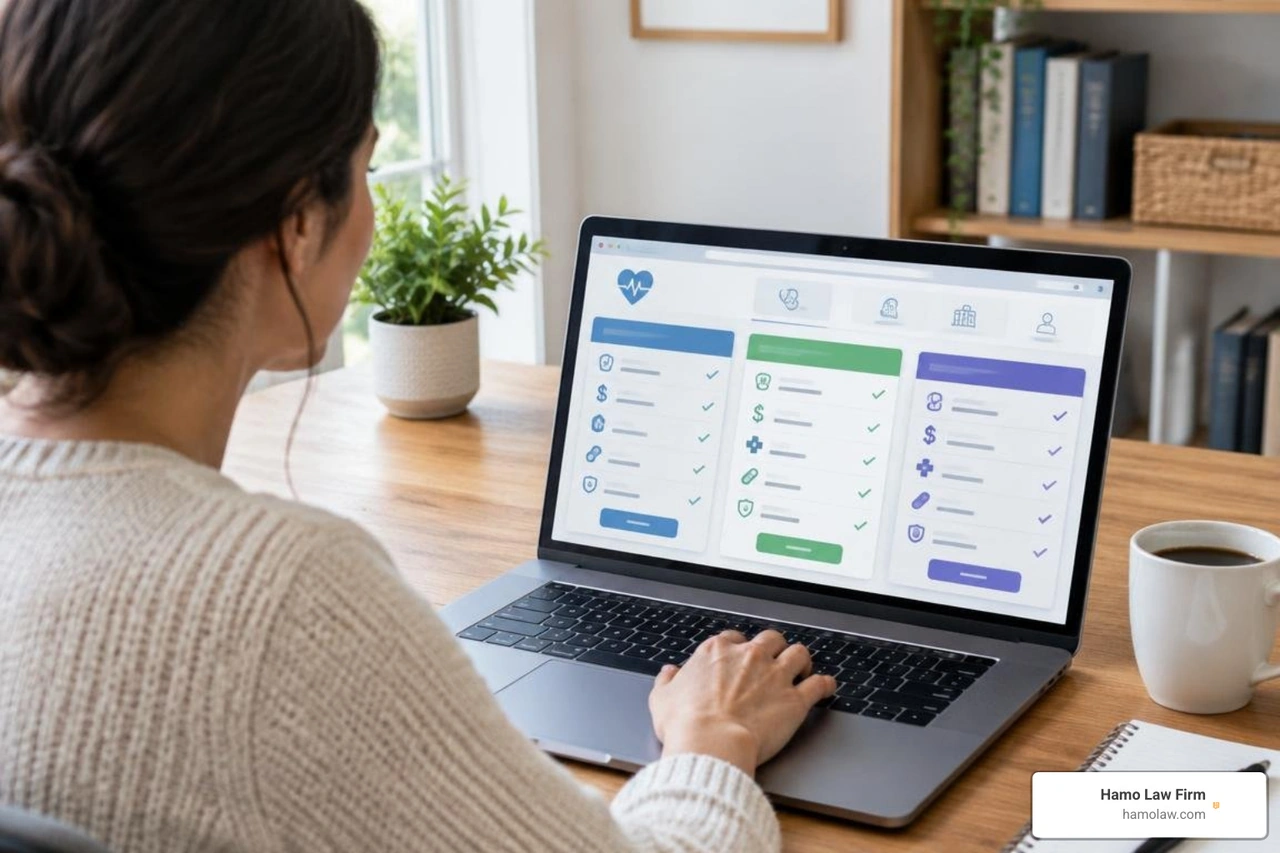
Choosing the right health plan requires a careful balance between upfront premiums and potential financial exposure during an unexpected medical emergency. Michigan residents evaluate and select certified Qualified Health Plans through HealthCare.gov during the standard annual Open Enrollment Period, which runs from November 1 through January 15 each year.
Outside of standard Open Enrollment, individuals can access coverage only by qualifying for a Special Enrollment Period (SEP). A Special Enrollment Period is triggered by major qualifying life events, including:
- Losing existing employer-sponsored health coverage
- Getting married, divorced, or legally separated
- Giving birth to a child, adopting, or placing a child in foster care
- Permanently moving to a new county or coverage rating area with different plan availability
- Experiencing a change in household income that alters eligibility for financial assistance
Enrolling through the official Marketplace provides access to vital federal subsidies designed to lower the cost of coverage:
- Premium Tax Credits (PTC): Sliding-scale tax credits that directly reduce your monthly premium payments based on your estimated annual household income.
- Cost-Sharing Reductions (CSR): Additional savings applied automatically to Silver-tier plans that lower your deductible, copayments, and coinsurance amounts, substantially minimizing out-of-pocket expenses when receiving treatment.
For community members seeking localized assistance, municipal and county programs provide essential enrollment support. Residents in the Flint area can review local options through Genesee County Healthcare Options, while drivers and families across Wayne County and Detroit can explore regional enrollment resources via Access to Care in Wayne County.
Frequently Asked Questions About Qualified Health Coverage
How do I know if my plan meets qualified health coverage criteria?
To confirm your plan qualifies under Michigan no-fault rules, you must verify two details in your policy contract:
- The Individual Deductible: Check your summary of benefits to confirm your individual annual deductible does not exceed the state threshold (e.g., $6,579 or less).
- Auto Exclusion Clauses: Carefully review the "General Exclusions" or "Coordination of Benefits" sections of your plan booklet. If the language states that the plan will not pay for, or limits benefits for, injuries arising from motor vehicle crashes, the plan is not qualified under Michigan auto reform laws.
If there is any ambiguity, contact your health insurer's member services department directly and request written confirmation via a formal QHC letter.
What happens if I lose my qualified coverage during my auto policy period?
If you opted out of auto PIP coverage based on your health plan and subsequently lose that healthcare coverage (for example, due to job loss, employer plan restructuring, or divorce), Michigan law imposes strict obligations:
- You have exactly 30 days to notify your automobile insurance carrier that you have lost your qualified health coverage.
- You must obtain replacement qualified coverage or purchase auto PIP medical coverage through your auto insurer within that 30-day window.
Failing to secure replacement coverage within 30 days leaves you unprotected. If you are injured in an auto collision during a coverage lapse after opting out, you will not receive benefits from your private insurer or your auto carrier. Furthermore, you will be excluded from claiming medical benefits through the Michigan Assigned Claims Plan (MACP), leaving you personally responsible for 100% of your medical expenses.
Are Medicare and Medicaid considered qualified health coverage in Michigan?
Yes, but they function differently under Michigan no-fault auto rules:
- Medicare: Enrollment in both Medicare Part A (Hospital Insurance) and Part B (Medical Insurance) allows a policyholder to completely opt out of auto PIP medical coverage. However, Medicare Part A alone is insufficient.
- Medicaid: Medicaid does not permit a full $0 PIP opt-out. Instead, an auto policyholder enrolled in Medicaid may select a reduced $50,000 PIP medical coverage limit, provided that all other household members are also enrolled in Medicaid or hold their own qualified health coverage.
Conclusion
Understanding the rules governing health insurance and state auto insurance reforms is crucial to protecting your family's financial future. Opting out of Personal Injury Protection to save a few dollars on monthly auto premiums can lead to disastrous financial hardship if your private health plan denies claims for attendant care, physical rehabilitation, or vehicular trauma.
Before modifying your insurance elections, take the time to review your policy documents, secure an official QHC letter, and fully evaluate your coverage risks. At Hamo Law Firm, our legal team has spent over 40 years standing up to insurance companies on behalf of injury victims across Flint, Detroit, Genesee County, and Wayne County. We operate on a contingency-fee model—meaning you pay no legal fees unless we win your case. If you or a loved one has suffered an injury in a motor vehicle accident and you are facing disputed medical claims or complex insurance questions, reach out to us today to ensure your legal rights and personal injury protections are fully enforced.