
Understanding Your Liability Insurance Car Accident Coverage
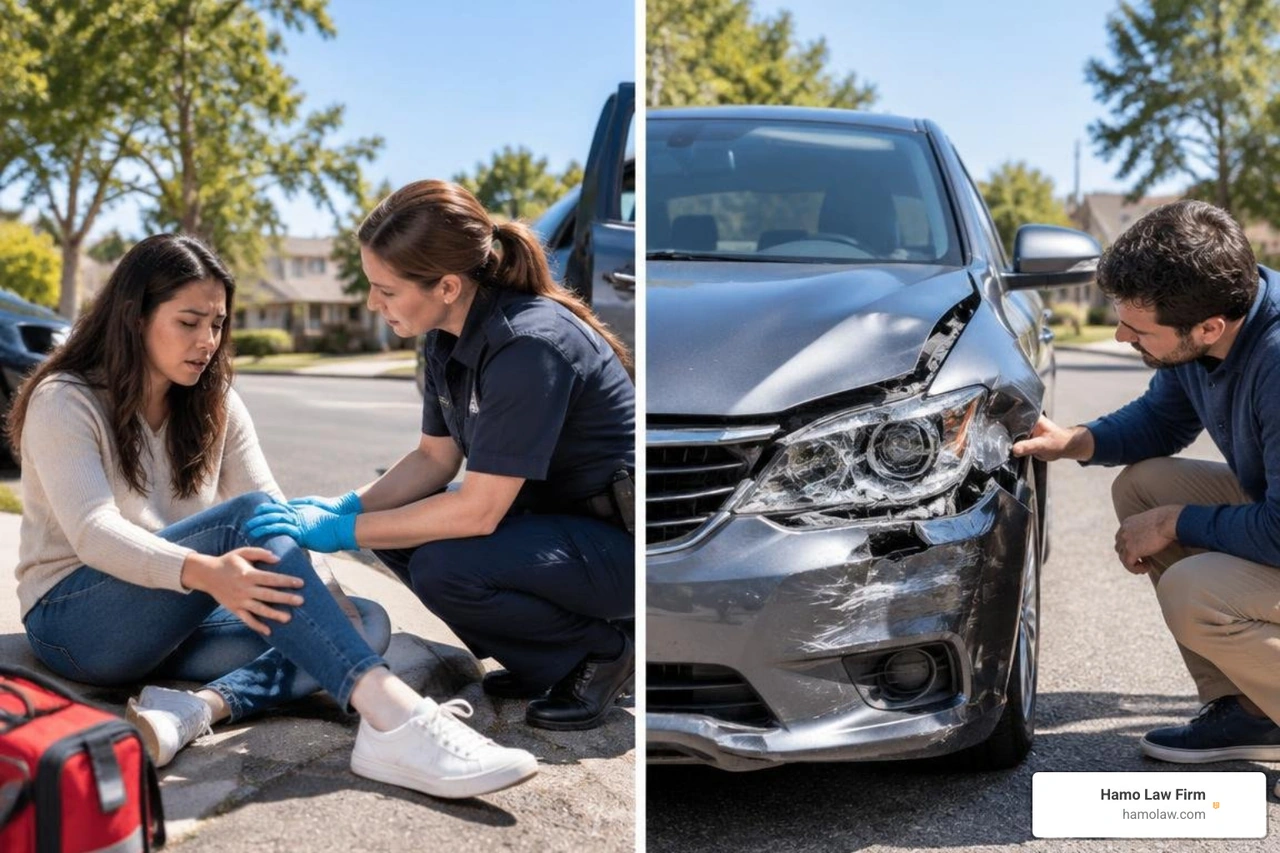
Auto liability coverage exists to safeguard your financial well-being when a mistake behind the wheel leads to harm. At its core, auto liability coverage is third-party protection. This means the policy pays compensation directly to the people you injure or whose property you damage—it never pays you directly.
When an at-fault driver triggers a crash, they carry legal and financial responsibility for the resulting harm. Standard policies provide two main layers of defense: paying for verified third-party losses up to policy caps and paying for legal defense fees if the injured party files a lawsuit against the driver.
When establishing car accident liability, insurance adjusters examine police reports, physical scene evidence, and traffic statutes to assign fault and distribute claim payouts accordingly.
Bodily Injury vs. Property Damage Liability
Auto liability insurance divides into two distinct categories:
- Bodily Injury Liability (BIL): This coverage pays for physical injuries caused to others when you are legally at fault for a crash. It covers the other driver's and their passengers' medical expenses, physical therapy, prescription medications, lost wages during recovery, and pain and suffering damages. Additionally, BIL funds your legal defense if the injured claimant files a personal injury lawsuit against you.
- Property Damage Liability (PDL): This portion pays for structural and mechanical repairs to third-party assets you damage. While it primarily covers the other driver's vehicle repairs or actual cash value if the car is totaled, it also extends to public infrastructure (like guardrails, traffic lights, and street signs), buildings, fences, and personal belongings inside the other car. Working with a dedicated car property damage attorney ensures these repair and replacement costs are accurately valued.
What Liability Coverage Does Not Pay For
A common misconception among motorists is that having an auto insurance policy means everything is paid for after a wreck. Auto liability coverage contains strict exclusions and will never pay for your own post-crash losses.
Specifically, liability insurance does not cover:
- Repairs to your own car if you cause a crash (requires Collision Coverage)
- Weather damage, vandalism, fire, or animal strikes to your vehicle (requires Comprehensive Coverage)
- Your own medical bills, emergency room visits, or lost income (covered by Personal Injury Protection (PIP) or Medical Payments (MedPay))
- Intentional vehicular damage or criminal acts
- Commercial driving or rideshare activities under a standard personal auto policy
The table below illustrates the structural differences between liability-only and full coverage options based on data from Liability Auto Insurance Coverage in 2026 (Rates & Exclusions) | AutoInsurance.org:
| Coverage Feature | Liability-Only Policy | Full Coverage Policy |
|---|---|---|
| Third-Party Bodily Injury | Yes (Up to policy limits) | Yes (Up to policy limits) |
| Third-Party Vehicle Repairs | Yes (Up to policy limits) | Yes (Up to policy limits) |
| Legal Defense for Lawsuits | Yes | Yes |
| Your Own Vehicle Repairs | No | Yes (Subject to deductible) |
| Vandalism / Weather / Theft | No | Yes (Subject to deductible) |
| Average Monthly Cost | ~$45 to $60 / month | ~$165+ / month |
Policy Limits, Requirements, and Out-of-Pocket Risk
Auto liability policies use a split-limit structure to define maximum claim payouts. Understanding these numbers helps you evaluate whether your coverage shields you or leaves your life savings exposed.
How Liability Insurance Car Accident Limits (25/50/10) Work
Split limits are expressed as three separate numbers (such as 25/50/10 or 100/300/50), representing thousands of dollars:
- First Number (Per-Person Bodily Injury): The maximum the insurer will pay for injuries sustained by any single individual in an accident.
- Second Number (Per-Accident Bodily Injury): The total maximum amount the insurer will pay for all combined injuries sustained by everyone in the crash.
- Third Number (Per-Accident Property Damage): The absolute maximum the insurer will pay to repair or replace all damaged property in that single event.
For example, with a 25/50/10 policy, the insurer pays up to $25,000 for one person's bodily injuries, capped at $50,000 total across all injured parties, and up to $10,000 for property damage. If you cause a crash that injures three people with $20,000 in medical bills each ($60,000 total), the insurer only pays $50,000. You remain personally responsible for the remaining $10,000.
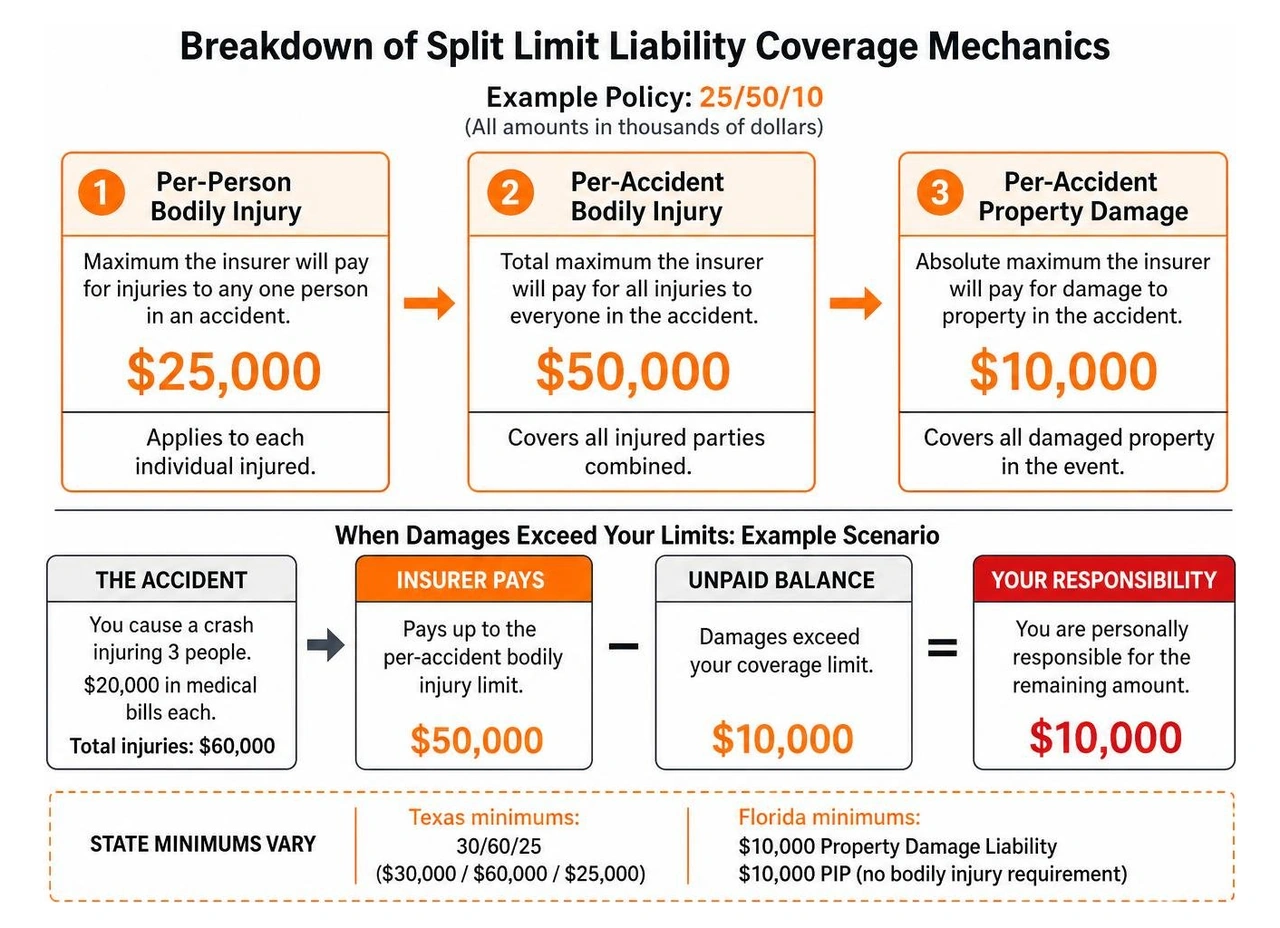
State minimums vary across the country. In Texas, state law mandates minimum limits of 30/60/25 ($30,000 per person, $60,000 per accident, $25,000 property damage). Conversely, statutes such as Chapter 324 Section 022 - 2023 Florida Statutes - The Florida Senate require drivers to carry $10,000 in property damage liability and $10,000 in PIP, but do not mandate bodily injury liability for private motorists.
What Happens When Damages Exceed Coverage Limits?
When a catastrophic accident occurs, damages can quickly exceed low statutory minimums. A short hospital stay, emergency surgery, or a totaled late-model SUV can exceed basic coverage limits in minutes.
If the at-fault driver's policy limits are exhausted:
- The insurance company pays out its full policy limit in exchange for a liability release or legal settlement.
- The injured party can pursue the at-fault driver's personal assets for any remaining balance.
- Courts may enter a judgment resulting in frozen bank accounts, property liens, or wage garnishments.
Evaluating how much is my car accident case worth requires analyzing total damages against available insurance limits to determine if umbrella coverage or personal assets come into play.
How Much Liability Insurance Do You Need and What Does It Cost?
While state-minimum liability insurance costs an average of $45 to $60 per month ($726 annually), carrying minimum coverage creates substantial financial risk.
The Insurance Information Institute and legal professionals strongly recommend carrying at least:
- $100,000 Bodily Injury Liability per person
- $300,000 Bodily Injury Liability per accident
- $500,000 or $100,000 Property Damage Liability
Securing recommended bodily injury liability coverage typically costs only $20 to $35 more per month than minimum policies. For drivers with substantial home equity, retirement accounts, or business assets, pairing a 250/500/100 auto policy with a $1 million to $2 million personal umbrella policy provides total financial security against excess judgments.
State Rules: At-Fault Tort vs. No-Fault Jurisdictions
How liability insurance applies depends heavily on whether your accident happens in a traditional at-fault state or a no-fault auto insurance state.
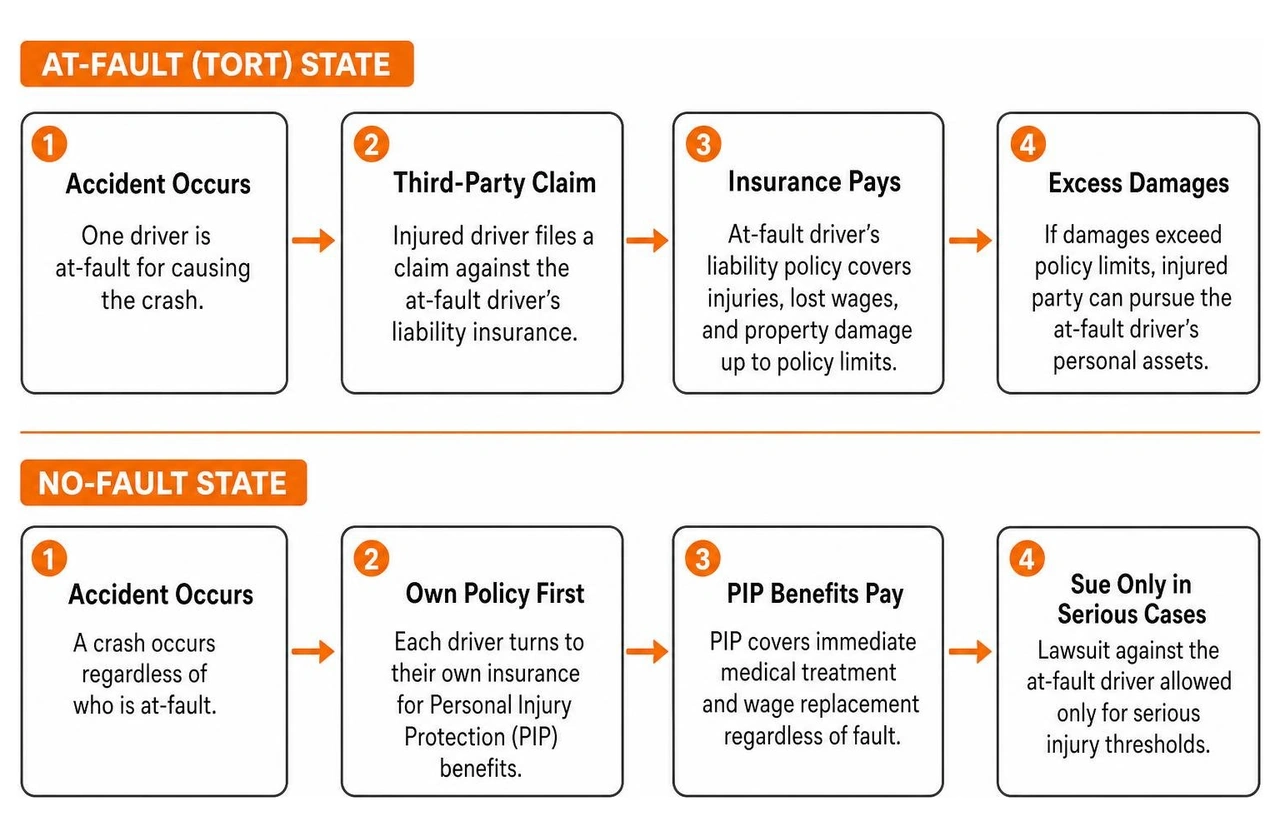
In traditional at-fault (tort) states, the driver who caused the collision pays for all resulting bodily injuries, lost wages, and vehicle damage through their liability policy. The injured driver files a third-party claim against the at-fault motorist's insurer or initiates a lawsuit to recover full compensation for economic and non-economic losses. When serious injuries occur in these accidents, retaining counsel for automobile truck motorcycle accidents is essential to preserve evidence and hold the liable parties accountable.
In no-fault states, each driver turns first to their own auto insurance policy to pay for their immediate medical treatment and wage replacement through Personal Injury Protection (PIP), regardless of who caused the wreck.
Filing a Liability Insurance Car Accident Claim in At-Fault vs. No-Fault States
The practical claims process varies significantly across these two systems:
- At-Fault Claims: Adjusters apply pure or modified comparative fault rules. If you are found 20% at fault and the other driver 80%, your final liability payout is reduced by your 20% share of blame. Third-party liability covers your medical costs, car repairs, and pain and suffering from day one.
- No-Fault Claims: Medical claims go directly through your own insurer. However, property damage and vehicle repairs are handled separately under state-specific rules. For example, the state provides official guidance in the Brief Explanation of Michigan No-Fault Insurance.
Understanding the fundamental mechanics of how Michigan no-fault insurance works after an accident helps injured motorists prevent processing delays and secure their rightful medical and wage benefits.
Navigating Michigan's Residual Liability and PIP Rules
Michigan operates under a unique no-fault system governed by the Michigan Insurance Code. Following auto insurance reforms, Michigan drivers can select from several PIP medical coverage tiers, ranging from $50,000 (for Medicaid recipients) up to uncapped lifetime medical benefits.
However, liability insurance—known in Michigan as Residual Bodily Injury Liability (Residual BI)—plays a critical role when serious crashes occur:
- Third-Party Pain and Suffering Lawsuits: Under Michigan law, an injured victim can sue an at-fault driver's bodily injury liability policy for non-economic damages (pain, suffering, and loss of enjoyment of life) only if they meet the statutory injury threshold: death, permanent serious disfigurement, or serious impairment of body function.
- Excess Economic Losses: If an injured driver chose a capped PIP option (such as $250,000) and their medical bills reach $600,000, the injured person can sue the at-fault driver's bodily injury liability policy to recover the remaining $350,000 in excess medical costs, plus excess wage loss.
- Mini-Tort Property Damage: Michigan law does not use standard property damage liability for moving vehicle-to-vehicle accidents. Instead, drivers utilize Michigan's Mini-Tort provision, which allows an accident victim to recover up to $3,000 from the at-fault driver's insurer to cover out-of-pocket vehicle repair costs or insurance deductibles.
For a detailed review of state statutes and coverage requirements, consult our Michigan no-fault insurance guide 2026, or review how does Michigan no-fault law affect my ability to sue after a crash to understand your legal rights after a collision.
Critical Steps to Protect Your Claim After a Crash
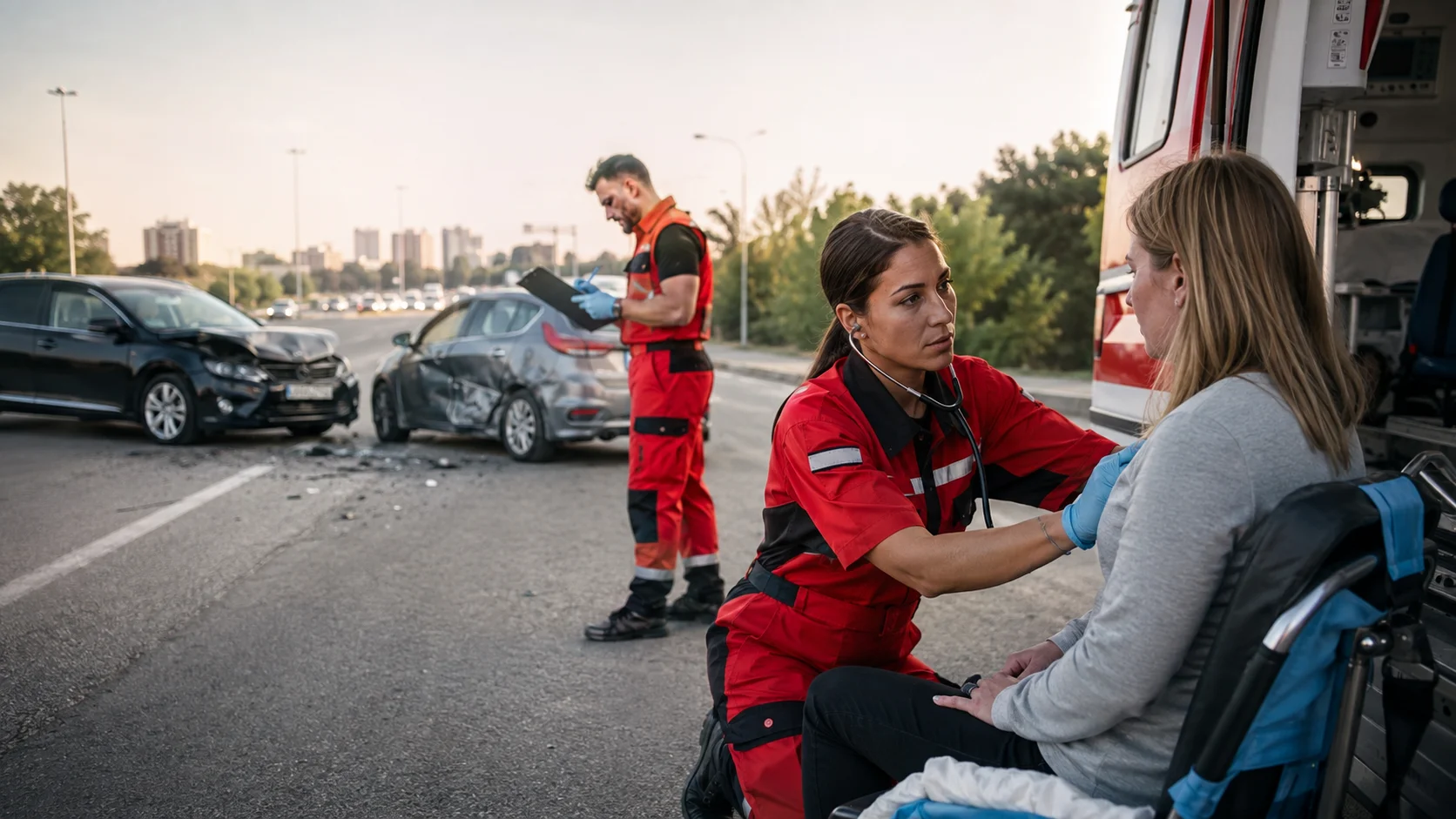
What you do immediately following an auto collision directly impacts whether the insurance adjuster accepts full liability or attempts to undervalue your claim. Knowing what to do after an accident or injury preserves critical evidence and protects your legal rights.
Evidence Gathering and Dealing with Insurance Adjusters
To build an unassailable liability claim, follow these essential steps at the crash scene:
- Call Law Enforcement: Ensure a responding police officer creates an official police report. A police report provides objective documentation of driver statements, citations issued, and initial fault assessments.
- Photograph Everything: Capture broad shots of the intersection, lane markings, skid marks, traffic signals, vehicle positioning, property damage, and visible bodily injuries.
- Collect Witness Information: Secure names, phone numbers, and statements from eyewitnesses before they leave the area.
- Seek Immediate Medical Evaluation: Even if you feel fine due to adrenaline, prompt medical documentation links your physical injuries directly to the collision.
- Avoid Giving Recorded Statements: Insurance adjusters are trained negotiators whose goal is to minimize company payouts. Review our guide on dealing with insurance companies after an accident and avoid the biggest mistakes people make after an injury accident, such as apologizing or discussing pre-existing conditions without legal representation.
Special Situations: Rental Cars and Permissive Drivers
Liability claims can become complex when the driver does not own the vehicle involved in the crash:
- Borrowed Cars (Permissive Use): Under the legal doctrine of permissive use, auto insurance follows the vehicle first. If you lend your car to a friend with permission and they cause a wreck, your auto liability policy acts as the primary coverage for damages to third parties. If damages exceed your policy caps, your friend's personal auto policy acts as secondary coverage.
- Rental Cars: Your personal auto liability insurance typically transfers to a standard rental vehicle driven for personal use within the United States. However, personal liability coverage covers only the harm you cause to other people and their cars. It does not cover physical damage to the rental car itself unless you have collision coverage or purchase the rental agency's Collision Damage Waiver (CDW).
Frequently Asked Questions About Car Accident Liability Insurance
How long does an at-fault accident stay on your insurance record?
In most jurisdictions, an at-fault collision remains on your motor vehicle and Comprehensive Loss Underwriting Exchange (C.L.U.E.) insurance report for three to five years. Insurers typically apply premium surcharges during this entire timeframe. To learn more about rate increases and underwriting timelines, read how long does at fault accident stay on insurance record.
Does liability insurance cover rental cars or borrowed vehicles?
Yes, your personal liability policy generally provides third-party coverage while operating rental vehicles or borrowed cars. However, it only pays for bodily injuries and property damage caused to third parties. It will not pay for physical damage sustained by the rental or borrowed vehicle itself unless you carry comprehensive and collision coverage or purchase supplemental waivers.
When should you contact a lawyer after a crash involving liability disputes?
You should consult legal counsel immediately if the other driver's insurer denies liability, claims you were at fault, or offers a quick, lowball settlement before the full extent of your injuries is known. Having seasoned trial attorneys involved early protects critical evidence and prevents insurance adjusters from exploiting policy loopholes. For strategic timing guidance, read our resource on when should you call a lawyer after a car accident in Michigan.
Conclusion
Understanding auto liability coverage ensures you carry adequate protection while equipping you to assert your rights if another driver injures you. Insurance policies contain complex exclusions, split limits, and statutory thresholds designed to minimize carrier payouts. You should never navigate these corporate tactics alone.
At Hamo Law Firm, our legal team brings more than 40 years of courtroom trial experience fighting insurance companies for injury victims across Michigan, including Flint, Detroit, Genesee County, and Wayne County. We operate on a strict contingency-fee model—you pay no upfront costs, and we collect no attorney fees unless we successfully win your case.
If you or a loved one has suffered injuries in a crash, contact Hamo Law Firm today for a free consultation. We will review your insurance policy limits, investigate the crash, and fight for the full financial compensation you deserve.