
What Is Bodily Injury Liability and What Does It Pay For?

For most drivers, the recommended bodily injury liability coverage is 100/300/100: $100,000 per person, $300,000 per accident, and $100,000 for property damage. This level protects your personal assets and net worth from severe medical and legal claims when you are found legally responsible for causing an auto accident that harms someone else. Rather than paying for the damage out of your own pocket, your insurance carrier steps in to defend you and pay covered damages up to the limits specified in your policy.
According to official guidelines on bodily injury liability coverage, this coverage pays third-party claims, meaning it covers the individuals you injured, not your own medical costs. Specifically, BIL covers:
- Medical Expenses: Emergency medical care, surgery, hospitalization, prescription medications, rehabilitation, and long-term physical therapy for injured victims.
- Lost Wages and Diminished Earning Capacity: Income the injured party loses while recovering, as well as future earnings lost if they suffer permanent disability.
- Pain and Suffering (Non-Economic Damages): Compensation for physical pain, emotional trauma, disfigurement, and loss of enjoyment of life caused by the crash.
- Funeral and Burial Costs: In the tragic event that a crash results in a fatality, BIL helps pay for burial and funeral expenses through a wrongful death claim.
- Legal Defense Costs: If the injured driver or passengers file a lawsuit against you, your insurance provider provides and pays for legal defense representation. These defense costs typically do not count against your overall policy limits.
Understanding these protections is critical during third-party settlement negotiations. Without adequate liability limits, an at-fault driver remains personally exposed if the costs to settle these claims exceed what the policy can provide.
Bodily Injury Liability vs. Personal Injury Protection (PIP)
Many motorists confuse bodily injury liability with personal injury protection (PIP). While both cover accident-related medical losses, they serve entirely different purposes and pay different parties.
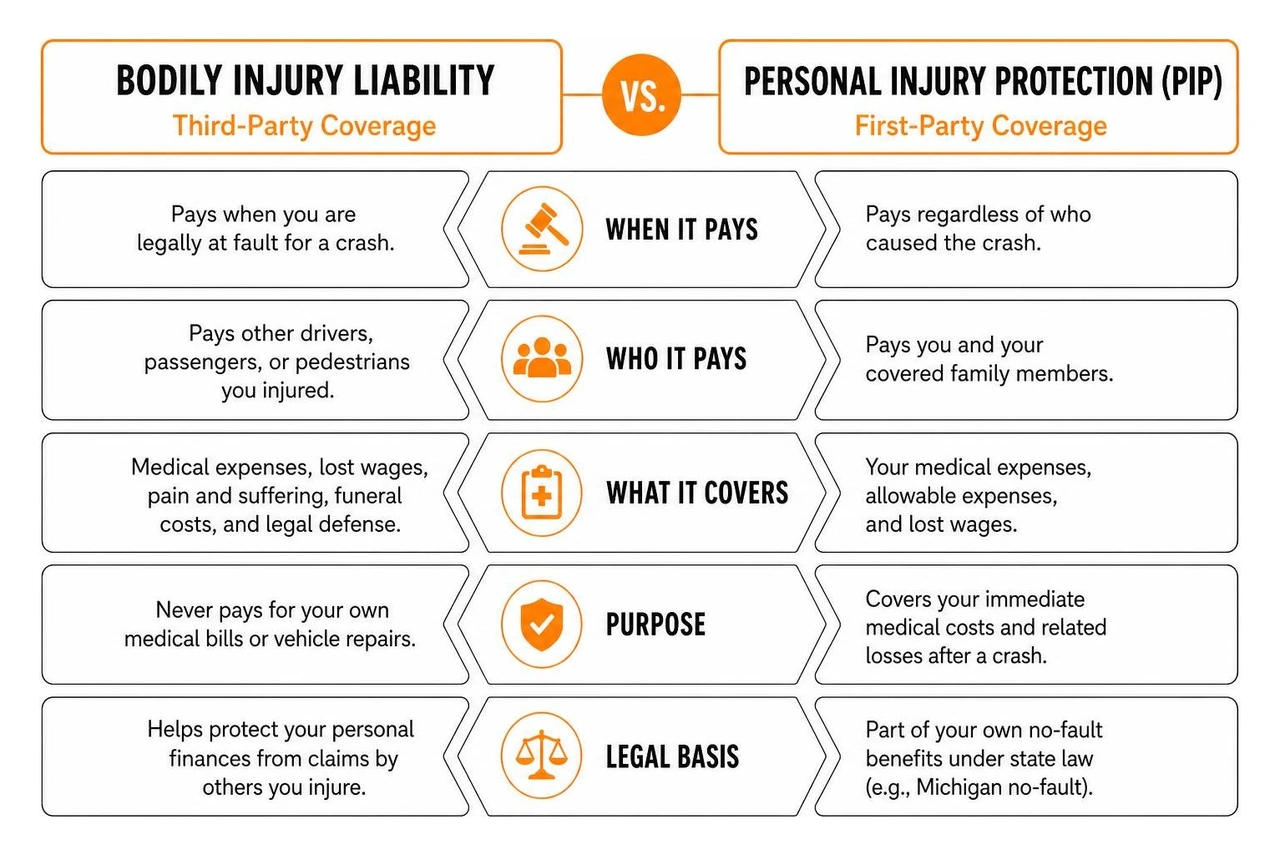
Bodily injury liability is a third-party coverage. It only pays out when you are legally at fault for a crash, and the proceeds go directly to the other drivers, passengers, or pedestrians you injured. It never pays a single dollar toward your own medical bills or vehicle repairs.
In contrast, Personal Injury Protection is a first-party coverage. Regardless of who caused the collision, your PIP policy pays for your own medical treatment, allowable expenses, and lost wages. Understanding how Michigan no-fault insurance works is vital because Michigan operates under a comprehensive no-fault system. Under our state laws, your own PIP policy covers your immediate medical bills up to your chosen PIP cap. However, if an injured party suffers a serious impairment of body function, permanent serious disfigurement, or death, they can step outside the no-fault system and pursue a third-party tort claim against the at-fault driver's bodily injury liability policy.
Why State Minimum Insurance Limits Put Your Assets at Risk
Every state sets statutory minimum requirements for auto liability coverage. These limits are typically expressed in a split-limit format, such as 25/50/100 or 50/100/10. These three numbers represent:
- Per-Person Bodily Injury Limit: The maximum amount your insurer will pay for injuries sustained by a single individual.
- Per-Accident Bodily Injury Limit: The total maximum amount your insurer will pay for all injured parties combined in a single collision, regardless of how many people are hurt.
- Property Damage Limit: The maximum amount paid for damage caused to vehicles, structures, or other personal property.
While purchasing state minimum coverage keeps you legally compliant to drive on public roads, carrying the bare minimum leaves your personal assets vulnerable. In an era where modern vehicle prices and healthcare costs continue to climb, minimum policies are quickly exhausted.
| Policy Level | Per Person Bodily Injury | Per Accident Bodily Injury | Property Damage Liability | Level of Asset Protection |
|---|---|---|---|---|
| State Minimum (Typical) | $25,000 – $50,000 | $50,000 – $100,000 | $10,000 – $25,000 | Very Low: High personal risk for modest accidents |
| Mid-Tier Coverage | $50,000 | $100,000 | $50,000 | Moderate: Easily exhausted by multi-vehicle crashes |
| Recommended Standard | $100,000 | $300,000 | $100,000 | High: Covers the vast majority of severe claims |
| High Asset / Umbrella Base | $250,000 | $500,000 | $100,000+ | Comprehensive: Optimal foundation for excess liability |
The Reality of Medical Costs After a Serious Crash
The primary reason state minimums fail drivers is simple: modern healthcare is remarkably expensive. The average bodily injury liability claim now exceeds $29,900 per injured person, with overall industry averages for major injury claims rising every year.
Consider what common injuries actually cost to treat in a clinical setting:
- Emergency Room Care & Observation: A basic ER intake involving advanced imaging (CT scans, MRIs) and an overnight hospital stay runs between $20,000 and $30,000.
- Fractures and Broken Bones: A broken leg or arm requiring orthopedic surgical hardware averages $30,000 to $100,000 in direct medical billing and physical therapy.
- Spinal Disc Injuries: A herniated or ruptured disc requiring spinal fusion surgery or ongoing epidural injections routinely costs $50,000 to $100,000 or more.
- Catastrophic Trauma: Traumatic brain injuries, severe burns, or Michigan catastrophic injury claims involving spinal cord damage and permanent paralysis regularly exceed $1,000,000 in lifetime care costs.
If you carry a low liability limit and cause a collision that results in a severe fracture or surgical intervention, your insurance coverage will be wiped out before the injured person even leaves the rehabilitation ward.
What Happens When Damages Exceed Policy Limits
When an auto accident results in damages that surpass your policy limits, your insurance company pays out its maximum limit and issues a formal release of its own obligations. However, your legal liability does not disappear.
You become personally responsible for paying any excess judgment awarded by a court. If an injured victim secures a $250,000 judgment against you and your bodily injury limit is only $50,000, you are personally on the hook for the remaining $200,000.
To collect that debt, the plaintiff's attorneys can pursue aggressive post-judgment collection measures:
- Wage Garnishment: A court can order a percentage of your regular paycheck withheld until the judgment is fully satisfied.
- Bank Account Levies: Funds in your checking and savings accounts can be frozen and seized to pay the debt.
- Property Liens: Judgment liens can be attached to your home, secondary properties, or land, preventing you from selling or refinancing without satisfying the judgment.
- Forced Asset Liquidation: Non-exempt personal property, investments, and titled assets can be seized and sold at auction.
Navigating these exposures is why dealing with auto insurance companies requires a clear understanding of your coverage thresholds before a life-altering accident occurs.
How to Choose the Recommended Bodily Injury Liability Coverage for Your Needs

Choosing the right insurance protection requires balancing risk, asset exposure, and monthly budget. The goal is to ensure that a single momentary lapse in attention behind the wheel does not undo decades of hard work, homeownership, and careful savings. When evaluating your policy, calculate your exposure based on what you stand to lose in a civil lawsuit, rather than simply selecting the cheapest premium displayed on a quote screen.
Why 100/300/100 Is the Recommended Bodily Injury Liability Coverage Standard
Consumer advocacy groups and organizations like the Insurance Information Institute (III) consistently advise drivers that carrying 100/300/100 limits is the benchmark standard. This configuration provides:
- $100,000 for bodily injury per individual.
- $300,000 total bodily injury per accident occurrence.
- $100,000 for property damage liability.
This structure provides a durable financial cushion. In a multi-vehicle crash involving several passengers, a $300,000 per-accident aggregate allows your carrier to resolve multiple claims simultaneously. It accounts for modern vehicle replacement values, hospital bills, and general damages while preventing plaintiff attorneys from needing to target your personal estate to make their clients whole. When assessing personal risk and reviewing how attorneys handle evaluating car accident claim value, having a 100/300 threshold provides the stability needed to settle complex claims within policy boundaries.
Assessing Net Worth to Find Your Recommended Bodily Injury Liability Coverage
To identify the optimal coverage for your household, perform a basic financial inventory:
- Home Equity: Calculate the current market value of your home minus your outstanding mortgage balance.
- Liquid Savings & Cash: Tally checking accounts, savings accounts, and certificates of deposit.
- Non-Retirement Investments: Include brokerage accounts, mutual funds, stocks, and secondary real estate holdings.
- Household Drivers: Factor in the number of vehicles in your driveway and whether you have young or newly licensed drivers in your household, which statistically elevates collision frequency.
Reviewing the official state auto insurance requirements will help you understand statutory minimums and default coverages. As a general rule of thumb, your total bodily injury liability per accident should equal or exceed your total exposed net worth. If your combined home equity, cash reserves, and non-exempt assets equal $250,000, carrying a 25/50 policy creates an unnecessary and dangerous gap.
The Modest Monthly Cost of Upgrading to 100/300 Limits
Many policyholders carry bare-minimum limits under the mistaken belief that robust coverage is unaffordable. In reality, bodily injury liability pricing is structured around risk tiers; the initial base layer of coverage carries the highest cost, while adding higher layers of protection costs comparatively little.
- The national average for basic liability-only policies is roughly $67 per month.
- Raising your bodily injury limits from a state minimum baseline like 25/50 up to 100/300 adds only $14 to $30 more per month with most carriers.
- Moving from 25/50 to 100/300 gives you three times more protection per person and six times more aggregate protection per crash for less than the cost of a weekly cup of coffee.
For an extra $15 to $30 each month, you buy complete peace of mind and insulate your family against devastating financial liability.
Umbrella Policies and Additional Protection Strategies
If your household net worth exceeds $300,000—or if you have substantial future earnings, rental properties, or teenage drivers—standard auto liability limits may still leave you vulnerable. In these situations, an umbrella insurance policy offers an essential layer of asset defense.
An umbrella policy sits on top of your underlying auto and homeowners insurance policies. It provides additional liability protection in increments of $1 million, typically ranging from $1,000,000 to $5,000,000 in excess coverage.
To purchase an umbrella policy, insurers require you to maintain specific underlying limits on your auto insurance, usually 100/300/100 or 250/500/100. If you cause an accident resulting in a $900,000 settlement:
- Your primary auto insurance pays its full $300,000 limit.
- Your personal umbrella policy activates seamlessly to pay the remaining $600,000.
- Your personal savings, retirement funds, and home equity remain untouched.
Because umbrella policies only pay after primary limits are completely exhausted, they are remarkably economical, often costing between $150 and $350 per year for a full $1 million in extra protection.
Frequently Asked Questions About Bodily Injury Liability
Does bodily injury liability cover my own injuries or vehicle damage?
No. Bodily injury liability is strictly a third-party coverage designed to protect other people you injure in a crash where you are at fault. It will never pay for your own medical bills, prescription costs, or physical therapy, nor does it cover physical damage to your own vehicle.
To cover your own accident-related expenses and property repairs, you must rely on:
- Personal Injury Protection (PIP) or Medical Payments (MedPay): Covers your medical treatment and allowable expenses regardless of fault.
- Collision Coverage: Pays to repair or replace your vehicle if you strike another car or stationary object.
- Comprehensive Coverage: Pays for vehicle damage caused by non-collision events such as theft, vandalism, storm damage, or animal strikes.
What is the difference between split limits and combined single limits?
Auto insurance liability limits are offered in two distinct structures:
- Split Limits (e.g., 100/300/100): Divides coverage into three separate caps: per-person bodily injury, per-accident bodily injury, and per-accident property damage. Under a 100/300/100 policy, no single injured individual can receive more than $100,000, even if the total crash payout remains well below the $300,000 aggregate cap.
- Combined Single Limit (CSL): Combines bodily injury and property damage into one single dollar limit per occurrence (such as a $300,000 or $500,000 CSL). A combined single limit provides maximum flexibility; if a crash causes $280,000 in medical bills for one person and $20,000 in property damage, a $300,000 CSL policy covers the entire loss without running into a per-person injury cap.
Can an injured party sue me personally if my liability limits run out?
Yes. Your insurance policy represents the maximum financial obligation of your insurer, not the maximum legal limit of your personal liability. If you cause a crash that results in severe trauma and your coverage limits are insufficient to settle the claim, the injured party's legal counsel can file a civil lawsuit against you directly.
If they obtain a court judgment that exceeds your policy limits, you become individually liable for the unpaid balance. The prevailing party can enforce this judgment by attaching liens to your real estate, seizing non-exempt bank accounts, and garnishing your future wages until the debt is paid in full.
Conclusion
Carrying proper auto insurance is about more than just staying street-legal; it is a fundamental pillar of personal financial security. While state minimum limits might satisfy legal mandates, they offer little real protection against modern medical expenses and severe crash damages. Upgrading to a 100/300/100 policy provides a reliable safety net that safeguards your home, income, and life savings for just pennies a day.
At Hamo Law Firm, our attorneys bring over 40 years of trial experience fighting insurance companies across Flint, Detroit, Genesee County, and Wayne County. We understand the complex interplay between Michigan no-fault laws and third-party liability claims. If you or a loved one has been injured in a collision, explore your legal options and learn more about holding at-fault drivers accountable by reviewing our comprehensive guide to car accident liability.