
What Premises Liability Means After an Injury

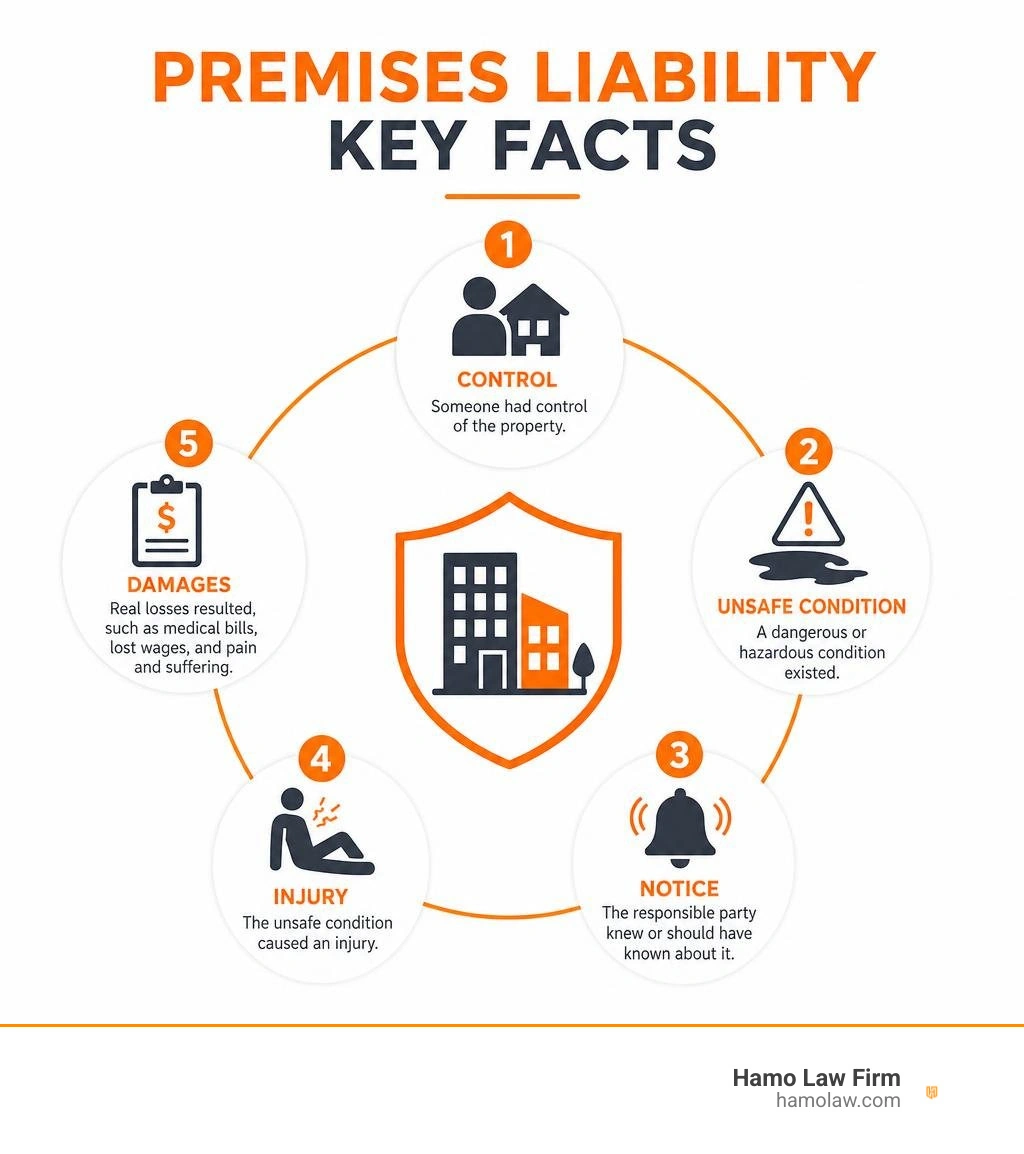
Premises liability is the legal rule that may hold a property owner, manager, tenant, or other party in control of a property responsible when an unsafe condition causes an injury.
| Quick answer | What it means |
|---|---|
| Who may be responsible? | The person or business that owned, occupied, managed, or controlled the property. |
| What must be shown? | A duty of care, a failure to use reasonable care, a link between that failure and the injury, and real damages. |
| What kinds of hazards qualify? | Wet floors, broken stairs, poor lighting, falling objects, unsafe parking lots, and other dangerous conditions. |
| Does every injury create a claim? | No. The facts, visitor status, notice of the hazard, and Michigan law all matter. |
These cases are not limited to slip-and-fall accidents. A dangerous stairway, an unsecured heavy object, an unlit parking lot, or neglected building condition can all raise the same core question: Who controlled the property, and did they take reasonable steps to keep people safe?
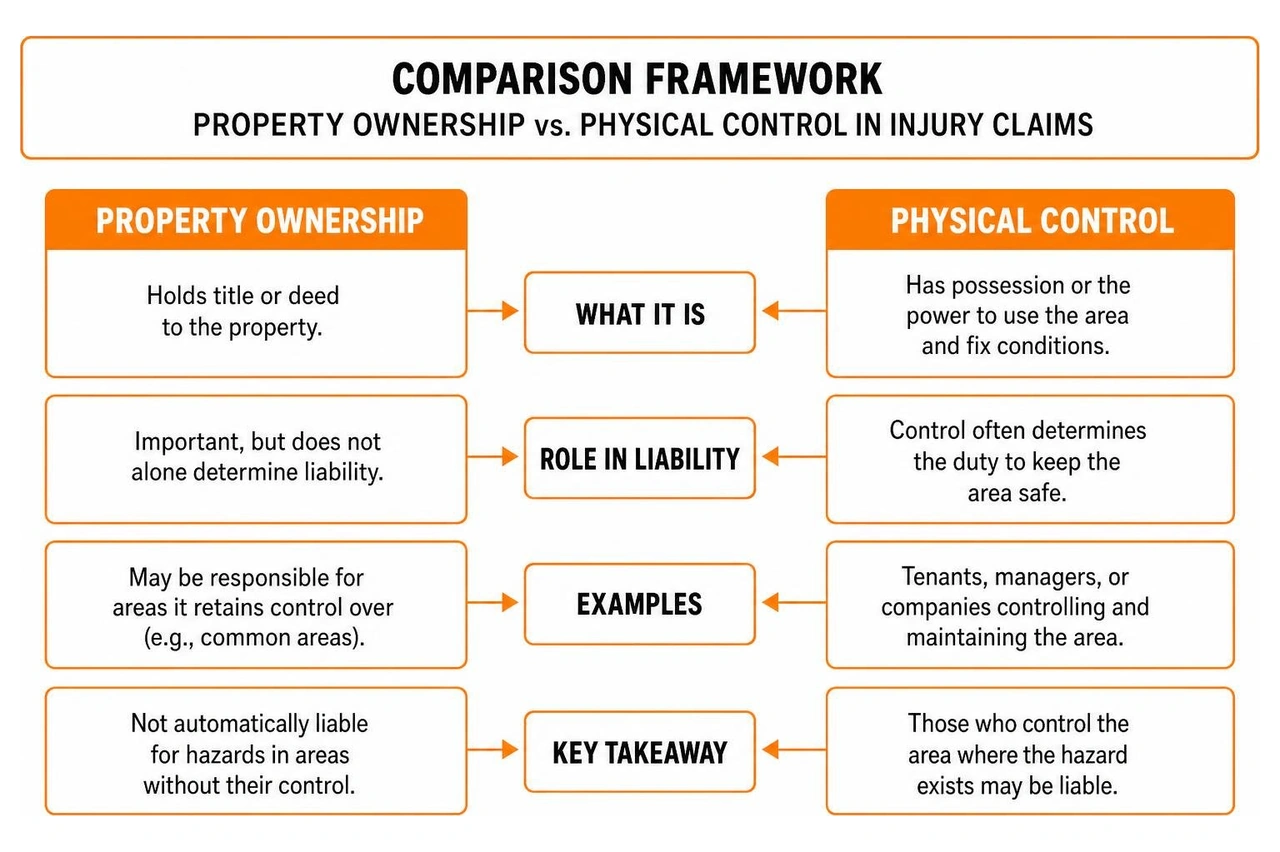
In Michigan, control can matter as much as formal ownership. A landlord, store operator, property manager, or maintenance company may have legal responsibility when it had possession of the area or the power to fix the danger.
I am George Hamo, and the sections below explain how these claims work, what can affect compensation, and what injured people should know before dealing with an insurance company.
Property Ownership and Legal Responsibility
When someone gets hurt on real property—whether in a grocery store aisle in Flint, an apartment complex hallway in Detroit, or a commercial parking lot anywhere across Genesee County or Wayne County—identifying who must answer for the condition of that property is step one. Many people assume that the name printed on the property deed automatically belongs to the sole responsible party. However, legal liability rarely works on paper title alone.
Under personal injury law, determining who is liable for injuries on someone elses property depends heavily on physical possession and active control over the space where the hazard existed. A property owner who leases a building to a tenant might retain responsibility for shared areas like common stairwells, while the commercial tenant exercises exclusive control over the retail sales floor. Knowing who is responsible for a premises liability accident requires unraveling contracts, management arrangements, and daily operational roles.
Defining Ownership vs. Property Control
To succeed in a legal claim, an injured victim must establish that the defendant exercised actual dominion, possession, and control over the site of the incident. In Michigan law, the entity maintaining physical control generally bears the duty of care to keep the area safe.
Several distinct parties often fall into the chain of legal responsibility:
- Land Possessors and Title Holders: While title ownership is important, land possessors—those living on, working from, or physically occupying the land—are usually the primary targets of a lawsuit if they maintain control.
- Property Management Companies: Property owners frequently hire professional management outfits to handle maintenance, snow removal, security, and repairs. If a management company neglects structural repairs or fails to fix known hazards, it can face direct liability.
- Commercial Tenants: Retail stores, restaurants, and office tenants control their leased spaces. If a store clerk spills liquid in an aisle and leaves it unaddressed, the tenant business is typically accountable, even if it does not own the commercial real estate.
- Maintenance Contractors: Third-party vendors hired to clean floors, service elevators, or clear ice from walkways can be held responsible if their negligent work directly creates an unsafe condition.
Common Hazardous Conditions in Premises Liability
Dangerous conditions on a property can take endless forms, but they all share a common thread: they create an unreasonable risk of harm to people visiting the site. If you are injured in a store or business your rights after a premises liability accident protect you when owners allow preventable risks to persist.
Some of the most frequent hazards leading to claims include:
- Slippery Floors: Leaking refrigeration units, freshly mopped tiles without warning cones, melted snow near entrances, or spilled products in retail aisles.
- Broken Stairs and Guardrails: Structural decay, missing handrails, cracked concrete steps, or uneven risers that cause sudden stumbles.
- Falling Merchandise: Improperly stacked warehouse pallets or overhead store shelves that drop heavy boxes onto unsuspecting shoppers.
- Inadequate Lighting: Dark stairwells, unlit parking structures, and dim walkways that obscure hidden obstacles or attract criminal activity.
- Negligent Security: Broken security gates, missing lock hardware, or lack of security guards in areas where criminal acts are foreseeable. Property possessors are held accountable when property owners are liable for third party crimes if inadequate security measures invite violent assaults or parking lot robberies.
Visitor Legal Status and Duty of Care
The standard of safety a property possessor must provide depends heavily on why the injured person was on the land in the first place. Traditionally, American personal injury law categorizes visitors into three distinct classes: invitees, licensees, and trespassers. Each category imposes a different level of legal obligation on the person controlling the property.
| Visitor Classification | Definition | Standard of Care Owed by Property Possessor |
|---|---|---|
| Invitee | Commercial customers, business patrons, or public visitors invited for the economic benefit of the possessor. | Highest duty: Must inspect property, fix hidden hazards, keep premises reasonably safe, and warn of dangers. |
| Licensee | Social guests, friends, or family visiting with express or implied permission for non-commercial reasons. | Moderate duty: Must warn of known hidden dangers that the visitor is unlikely to discover on their own. |
| Trespasser | Persons entering or remaining on the property without permission, invitation, or legal right. | Lowest duty: Must refrain from willful, wanton, or intentional misconduct (with exceptions for children). |
Rights of Invitees, Licensees, and Trespassers
Understanding these categories helps clarify what you must prove when asserting a personal injury claim:
Invitees
An invitee is owed the highest legal duty of care. Business owners who open their doors to the public implicitly promise that the property is reasonably safe. To protect invitees, possessors must actively inspect the premises to discover hidden structural defects or temporary hazards, take prompt steps to repair dangerous conditions, and post clear warnings near ongoing maintenance work.
Licensees
A licensee enters property with the owner's consent, but for their own pleasure or social purposes (such as a neighbor invited over for dinner). Land possessors do not owe social guests an ongoing duty to inspect the property for unknown defects. However, they must warn licensees about known dangerous conditions that the guest cannot reasonably be expected to see or anticipate.
Adult Trespassers
As a general rule, property owners owe no legal duty to inspect or maintain safe premises for adult trespassers who enter land without permission. Possessors need only refrain from intentionally setting traps or committing willful and wanton acts of violence against a trespasser. However, if a possessor actively knows that trespassers routinely cut across a specific section of land, a limited duty to warn of hidden, lethal artificial hazards may arise.
Child Trespassers and the Attractive Nuisance Doctrine
Because young children lack the maturity to appreciate inherent physical risks, the legal system created a vital exception to the general trespasser rules known as the attractive nuisance doctrine.
Under this rule, a land possessor can be held liable for injuries to trespassing children caused by dangerous artificial conditions on the land if the owner knows or should know that children are likely to trespass. Common examples include unfenced swimming pools, unsecured construction sites, abandoned machinery, or exposed scaffolding.
If the danger posed by the artificial condition outweighs the practical burden or cost of fixing it—such as simply latching a gate around a pool—the property owner must take reasonable steps to safeguard curious children. Various state frameworks, including the Illinois Pattern Jury Instructions on Premises Liability, demonstrate how standard jury instructions evaluate owner negligence when child trespassers face preventable hazards.
Key Elements Needed to Prove Premises Liability

Winning a personal injury case requires far more than showing that an accident happened on someone else's land. Property possessors are not automatic insurers of public safety. To secure financial recovery, an injured party must prove four basic legal elements by a preponderance of the evidence:
- Duty of Care: The defendant possessed or controlled the property and owed a legal duty to protect the plaintiff based on visitor classification.
- Breach of Duty: The defendant failed to exercise reasonable care by creating, failing to repair, or failing to warn about an unreasonable hazard.
- Causation (Proximate Cause): The defendant's breach was a direct and substantial factor in causing the victim's fall or accident.
- Actual Damages: The plaintiff suffered measurable physical, financial, or emotional harm as a direct result.
Model legal frameworks across the country, such as the Massachusetts guide on Overview of Premises Liability Elements and Duty, reinforce that every element must link together seamlessly to establish legal responsibility.
Actual vs. Constructive Notice
A cornerstone of proving a breach of duty in premises cases is establishing that the property owner had notice of the hazard. A store owner cannot fix a spill if they could not have known it existed. Courts evaluate notice using two legal standards:
- Actual Notice: The property owner, manager, or employee knew directly about the hazardous condition. For instance, a customer reported a broken jar of oil in aisle three to the store manager 20 minutes before an accident, or an employee directly caused the hazard by spilling water while cleaning.
- Constructive Notice: The hazard existed for a long enough time that a reasonable property owner conducting routine safety inspections should have discovered and corrected it. If a freezer unit leaks across a main walkway for four hours uninterrupted, the owner has constructive notice, even if no employee claims to have seen the puddle.
Understanding slip and fall accidents how do you prove negligence in michigan requires evaluating surveillance videos, cleaning logs, and witness testimony to pinpoint exactly how long a hazard lingered before causing harm.
Proving Essential Elements Under State Jury Instructions
When personal injury lawsuits proceed to trial, judges instruct juries on the exact legal standards required to render a verdict. These civil jury instructions distill complex common-law concepts into strict legal tests.
For example, standard rules set forth in sources like CACI No. 1000 Premises Liability Elements require plaintiffs to demonstrate that the defendant's control and maintenance of the property was a substantial factor in causing their injuries. Similarly, instructions such as the Colorado Pattern Civil Jury Instructions on Premises Liability highlight how judges categorize visitor status and assign the legal burden of proof.
Legal Defenses and Financial Recovery

When an injured party files a property claim, insurance defense attorneys rarely hand over compensation without a fight. Instead, they raise powerful legal defenses designed to shift fault onto the victim or wipe out financial recovery entirely.
Affirmative Defenses in Premises Liability Claims
Property possessors commonly rely on several key defense doctrines:
Comparative Negligence
Under comparative fault rules, defense lawyers argue that the injured person failed to exercise ordinary care for their own safety—such as texting while walking or ignoring visible safety signs. If a jury finds a plaintiff 20% at fault for an accident, their total financial recovery is reduced by 20%. In Michigan, if a plaintiff's own negligence exceeds 50%, their non-economic damages (pain and suffering) can be barred completely.
Open and Obvious Doctrine
Historically, property owners asserted that if a hazard was so obvious that an average person would notice and avoid it upon casual inspection, the owner owed no duty to warn or fix it. In recent years, Michigan legal precedent updated how this defense operates. An open and obvious hazard no longer acts as a total threshold bar that dismisses a lawsuit out of court; instead, it is evaluated by the jury as part of comparative fault calculations.
Furthermore, courts recognize key exceptions:
- Distraction Exception: The owner should anticipate that visitors might become distracted by store displays or surroundings, preventing them from noticing an obvious danger.
- Deliberate Encounter Exception: The visitor had no choice but to encounter the obvious hazard because the benefits of proceeding outweighed the apparent risk (such as a worker navigating the only available entrance to a job site).
Assumption of Risk
This defense asserts that the visitor voluntarily and knowingly exposed themselves to a recognized danger, such as diving into shallow water despite clear depth markers.
Financial Compensation in Property Injury Lawsuits
Victims who sustain life-altering injuries due to negligent property upkeep are entitled to seek monetary damages. Compensation falls into three primary buckets:
- Economic Damages: Verifiable out-of-pocket financial losses, including emergency room bills, surgical expenses, physical therapy costs, future medical care, lost wages, and loss of earning capacity.
- Non-Economic Damages: Intangible personal losses, such as physical pain and suffering, mental anguish, emotional distress, loss of enjoyment of life, and permanent physical disfigurement.
- Punitive Damages: Reserved for rare cases involving egregious, willful, or intentional misconduct intended to punish the wrongdoer.
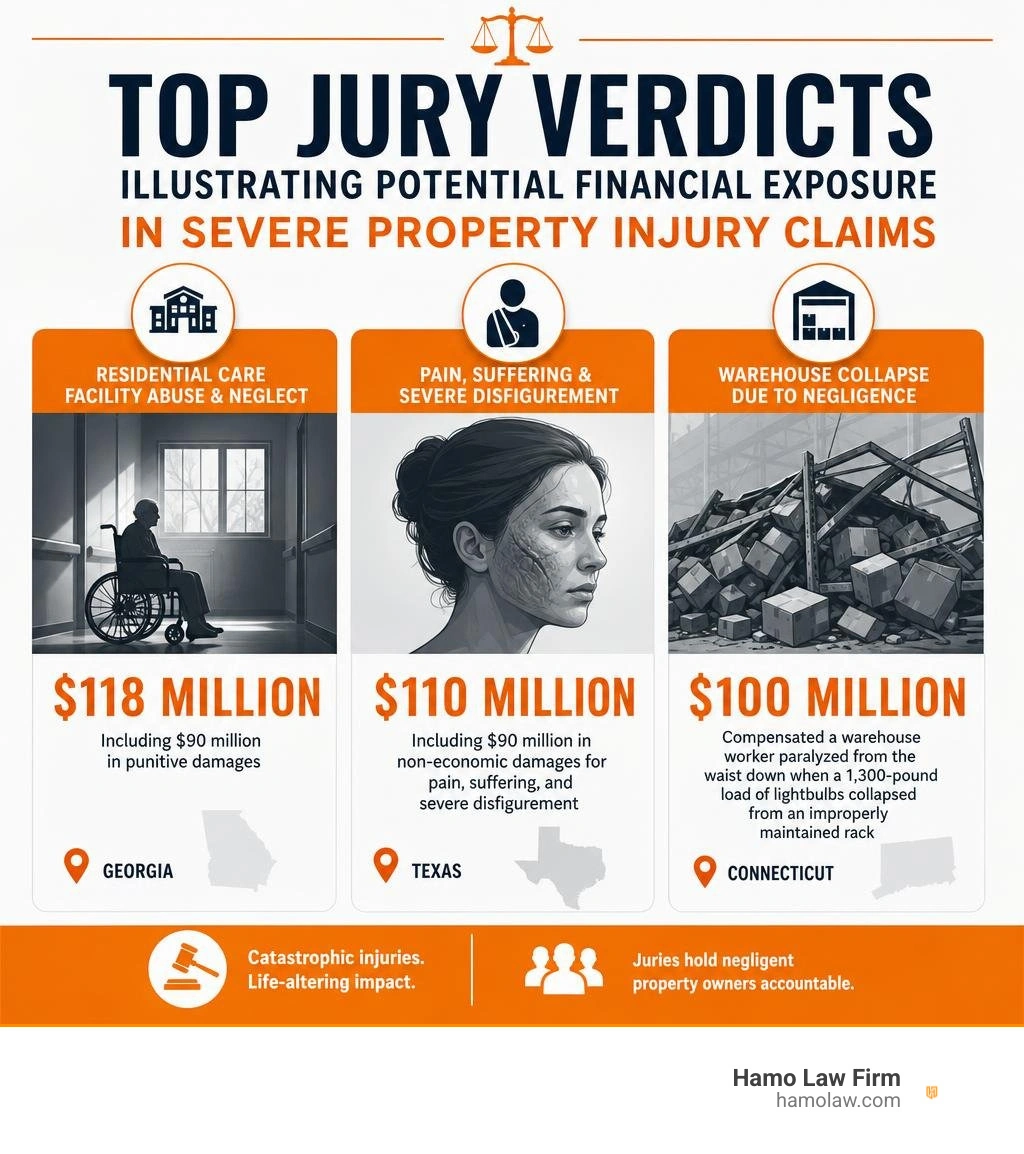
When property defects cause catastrophic harm—such as spinal cord trauma, traumatic brain injuries, or leg amputations—juries across the United States have handed down massive jury verdicts to hold negligent property managers accountable. In recent years:
- A $118 million verdict (including $90 million in punitive damages) was awarded in Georgia after severe abuse and neglect occurred in a residential care facility.
- A $110 million verdict in Texas included $90 million in non-economic damages for pain, suffering, and severe disfigurement.
- A $100 million verdict in Connecticut compensated a warehouse worker paralyzed from the waist down when a 1,300-pound load of lightbulbs collapsed from an improperly maintained rack.
- A $60.5 million verdict in California ballooned to roughly $100 million after the court added $30 million in prejudgment interest because the defendant rejected a pre-trial settlement offer.
- A $40.25 million verdict was returned in Texas for an apartment resident who suffered bilateral leg amputations following a parking lot shooting where the complex failed to provide basic security.
- A $22 million verdict was handed down in Georgia after a falling tree branch killed a dirt bike rider at an off-road park.
These significant jury awards underscore how devastating unsafe property conditions can be and why thorough legal representation matters.
State Law Differences and Litigation Trends
While general principles of duty and causation exist across the country, premises laws vary considerably from state to state. Statutory provisions, court precedents, and local court rules shape how claims are handled. A broad overview of national legal standards, such as the Overview of Premises Liability Law published by Forbes Advisor, illustrates how visitor classifications, notice requirements, and building codes interact differently depending on jurisdiction.
For residents in Michigan, understanding local rules is vital. State statutes govern strict filing deadlines—known as the statute of limitations—which typically give injured victims three years from the date of an accident to file a personal injury lawsuit. Missing this hard deadline forever bars your right to recover compensation.
Key Steps to Take Following an Injury
The actions you take immediately following a property accident can make or break your legal claim. If you are hurt on commercial or private property, follow these critical steps:
- Seek Immediate Medical Attention: Your health comes first. Get evaluated by paramedics or go to an emergency room right away. Medical records provide immediate, unbiased documentation of your physical injuries.
- Report the Incident: Notify the store manager, landlord, or property owner immediately. Request that an official written incident report be filed, and ask for a copy before leaving.
- Document the Hazard: Take clear photos and videos of the dangerous condition from multiple angles. Capture details like puddle length, ice accumulation, broken stairs, absent warning signs, or poor lighting before the owner cleans up the evidence.
- Gather Witness Contact Information: Get names, phone numbers, and statements from anyone who saw the incident or noticed the hazard prior to your fall.
- Preserve Physical Evidence: Keep the shoes and clothing you were wearing in an unwashed state. Store them safely, as they can serve as physical evidence in court.
- Follow Post-Accident Guidance: Review detailed resources on what to do after a slip and fall accident in michigan to avoid common mistakes, such as giving recorded statements to insurance adjusters without legal counsel.
Frequently Asked Questions About Property Injury Claims
What is the difference between an invitee and a licensee?
An invitee is a person invited onto property for the business benefit of the owner (like a shopper in a grocery store) or as a member of the public on public land. Property possessors owe invitees the highest duty of care, which includes inspecting the grounds for hidden hazards. A licensee is a social guest invited onto private property for non-commercial purposes. Property possessors owe licensees a duty to warn about known hidden hazards, but they are not required to conduct routine inspections to find unknown dangers for social visitors.
Can a property owner be held liable for third-party criminal attacks?
Yes. Property owners and commercial possessors can be held legally responsible for third-party criminal assaults, muggings, or robberies occurring on their premises under the legal doctrine of negligent security. To win a negligent security claim, the victim must show that criminal activity was reasonably foreseeable (due to prior crime at the location or high-risk business operations) and that the owner failed to implement reasonable safety measures, such as adequate lighting, working door locks, security cameras, or trained security staff.
What should I do immediately after getting injured on someone else's property?
First, seek prompt medical care for your injuries. Second, report the accident to the property owner, store manager, or landlord, and demand an incident report. Third, take photographs of the hazard, your injuries, and the surrounding scene. Fourth, collect contact details from any witnesses. Finally, consult an experienced personal injury attorney before talking to the property owner's insurance company or signing any settlement releases.
Getting the Legal Help You Need After an Injury
Navigating a premises liability claim requires demonstrating complex legal elements, fighting off aggressive corporate defense tactics, and proving the true value of your injuries. Insurance companies frequently try to blame victims for their own falls or claim that dangerous conditions popped up out of nowhere.
At Hamo Law Firm, we have spent more than 40 years standing up for injury victims and fighting insurance companies across Flint, Detroit, Genesee County, and Wayne County. Our legal team operates on a contingency fee model—which means you pay zero upfront costs and absolutely no attorney fees unless we successfully win your case.
If you or a loved one suffered harm due to a dangerous property condition, reach out to our team today to explore your rights. Visit our premises liability practice area page to schedule a free, no-obligation case evaluation with a trial attorney ready to fight for you.