
Immediate Steps to Protect Your Rights After a Crash
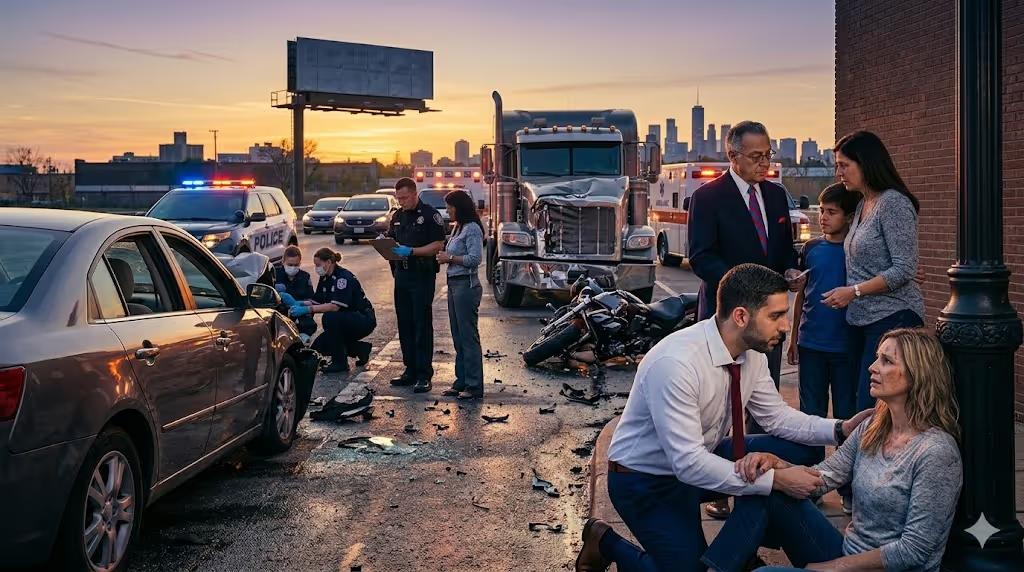
When a motorcycle crash occurs, the moments following the collision are often chaotic. Physical trauma, adrenaline, and confusion can make it difficult to think clearly. However, taking deliberate steps immediately after an accident is crucial to protect your physical health and preserve your legal rights.
Insurance companies often move quickly to investigate crash sites, seeking any opportunity to limit their payout. By taking control of the scene early, you establish a factual foundation that prevents insurance adjusters from rewriting the narrative against you.
Critical Evidence to Collect at the Scene
Evidence at a crash scene degrades rapidly. Weather conditions, traffic patterns, and road cleanup crews can erase vital proof within hours. If you are physically capable—or if a companion can assist you—gathering physical evidence right away is vital for your claim:
- Skid mark and road hazard photography: Photograph tire marks, oil slicks, loose gravel, or potholes that contributed to the crash. Skid marks help crash reconstruction experts determine vehicle speeds and braking attempts.
- Vehicle positioning and point of impact: Take wide photos of the entire intersection or roadway showing where all vehicles came to rest, as well as close-ups of the direct impact zones on both your motorcycle and the other vehicle.
- Witness contact details: Bystanders often provide the most neutral accounts of what occurred. Collect names, phone numbers, and email addresses before witnesses leave the area.
- Helmet and protective gear documentation: Do not discard or repair your helmet, jacket, boots, or gloves. Photos of torn leather, gouged helmets, and shattered face shields serve as powerful evidence of the physical forces involved in the collision.
To learn more about how evidence builds a compelling claim, explore our resources on Motorcycle Accidents and how tailored legal strategies defend injured riders.
Seeking Immediate Medical Care and Documenting Injuries
Your health must be your top priority. Even if you believe you only sustained minor scrapes or bruises, seeking emergency medical evaluation immediately is essential. Adrenaline can mask symptoms of severe internal conditions, such as internal bleeding or traumatic brain injuries (TBIs).
Medical documentation serves two distinct purposes: it ensures your health and safety, and it creates an official timeline connecting your injuries directly to the accident.
- Emergency Room Evaluation: Visit an emergency department or urgent care facility right away. Report every symptom, no matter how insignificant it may seem.
- Continuous Medical Records: Follow every doctor recommendation, attend all follow-up appointments, and participate fully in prescribed physical therapy. Gaps in medical treatment allow insurance companies to argue that your injuries were not serious or were caused by a separate event.
- Symptom Journaling: Keep a daily record detailing your pain levels, mobility restrictions, sleep disruptions, and psychological distress.
Understanding Liability, Insurance, and State Laws
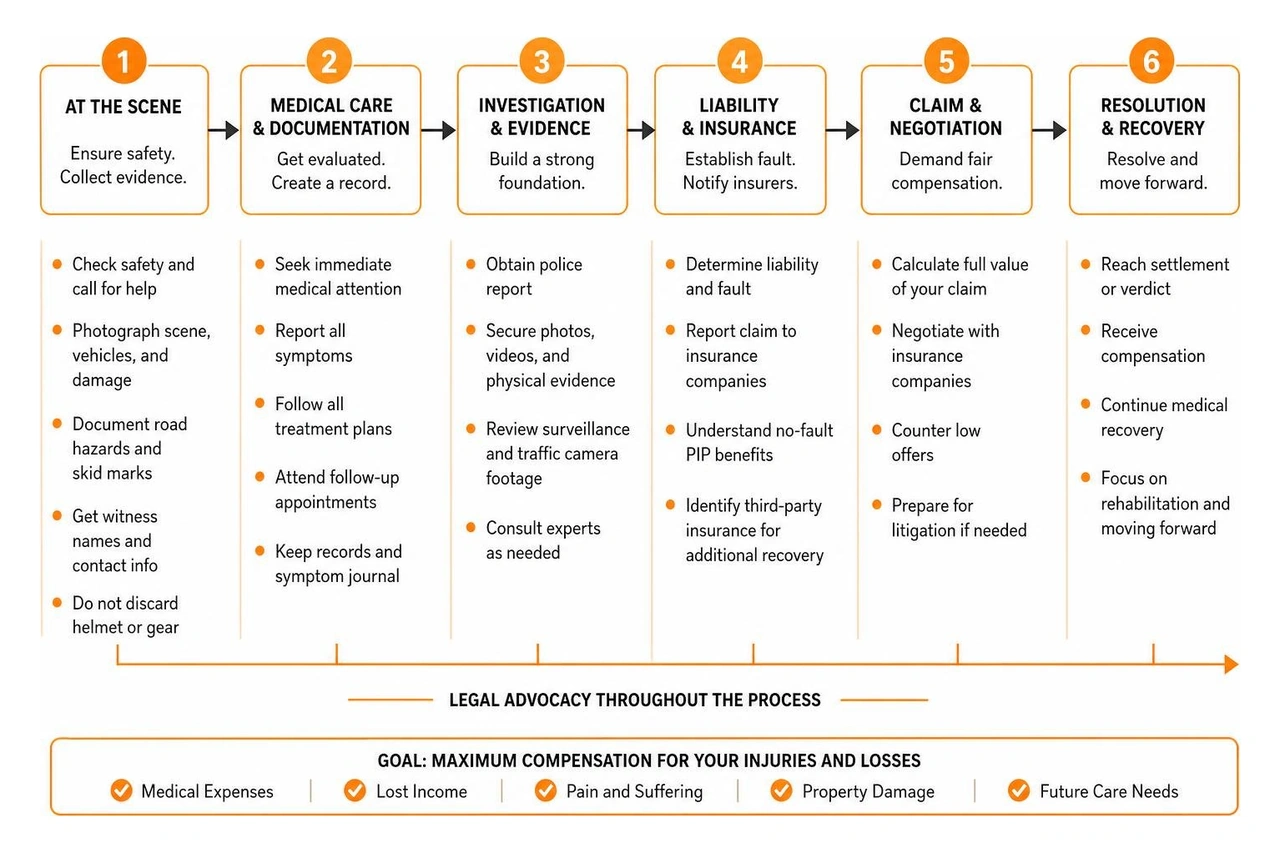
Proving liability in a motorcycle crash requires establishing that another party breached their duty of reasonable care on the road. Distracted drivers, speeding motorists, and drivers who fail to check their blind spots frequently cause severe accidents. To understand the primary factors that lead to these life-altering events, read about What Causes Most Motorcycle Accidents in Michigan.
Left-turn collisions represent one of the most common and dangerous crash scenarios. Drivers making left-hand turns across oncoming traffic often misjudge a motorcycle's speed or fail to see the motorcycle entirely, cutting directly into the rider's right-of-way.
No-Fault PIP Coverage and Third-Party Lawsuits
Understanding how insurance claims function after a motorcycle accident can be complex. Unlike standard passenger vehicle accidents where Personal Injury Protection (PIP) rules automatically apply to covered drivers, motorcycle insurance operates under unique statutory rules.
When a motorcycle is involved in a collision with a motor vehicle (such as a car or truck), the rider's eligibility for medical coverage typically follows a specific order of priority under state law. In many instances, primary medical benefits (PIP) are paid through the insurer of the motor vehicle involved in the crash. For detailed answers on how first-party medical benefits are structured for riders, read Do Motorcyclists Receive No-Fault PIP Benefits in Michigan?.
When first-party PIP benefits fall short - or when you face substantial non-economic loss such as pain and suffering - you can file a third-party lawsuit against the at-fault driver. To succeed in a third-party claim, we must demonstrate:
- The driver owed you a duty of care.
- The driver breached that duty (e.g., failing to yield, texting while driving).
- The breach directly caused your injuries.
- You sustained compensable damages (excess medical costs, pain and suffering, lost earning capacity).
How Comparative Negligence and Helmet Laws Affect Compensation
Insurance adjusters frequently rely on shared fault arguments to minimize payouts to injured motorcyclists. Under modified comparative fault rules, your recoverable compensation is reduced by your percentage of fault. If a court or jury finds you 20% responsible for a crash because you were driving slightly over the speed limit, your final financial award is reduced by 20%.
Crucially, if your shared fault reaches 51% or higher, you are legally barred from recovering non-economic damages (such as pain, suffering, and mental anguish) from the other party.
Helmet laws also interact with comparative negligence defenses. For general motorcycle safety information, the National Highway Traffic Safety Administration provides rider-focused resources on visibility, protective gear, and crash prevention.
| Helmet Compliance Scenario | Impact on Legal Claim |
|---|---|
| Wearing an Approved Helmet | Eliminates helmet-related comparative fault arguments from defense adjusters. |
| Riding Without a Helmet (Legally Compliant) | If eligible under state law to ride helmet-free, not wearing one is legal, but defense lawyers may argue unhelmeted status aggravated head injuries. |
| Injury Causation Distinction | Helmet usage is relevant only to head, neck, or traumatic brain injuries; it has no legal bearing on injuries to limbs, spine, or internal organs. |
Why Hiring a Specialized Motorcycle Injury Law Firm Is Critical
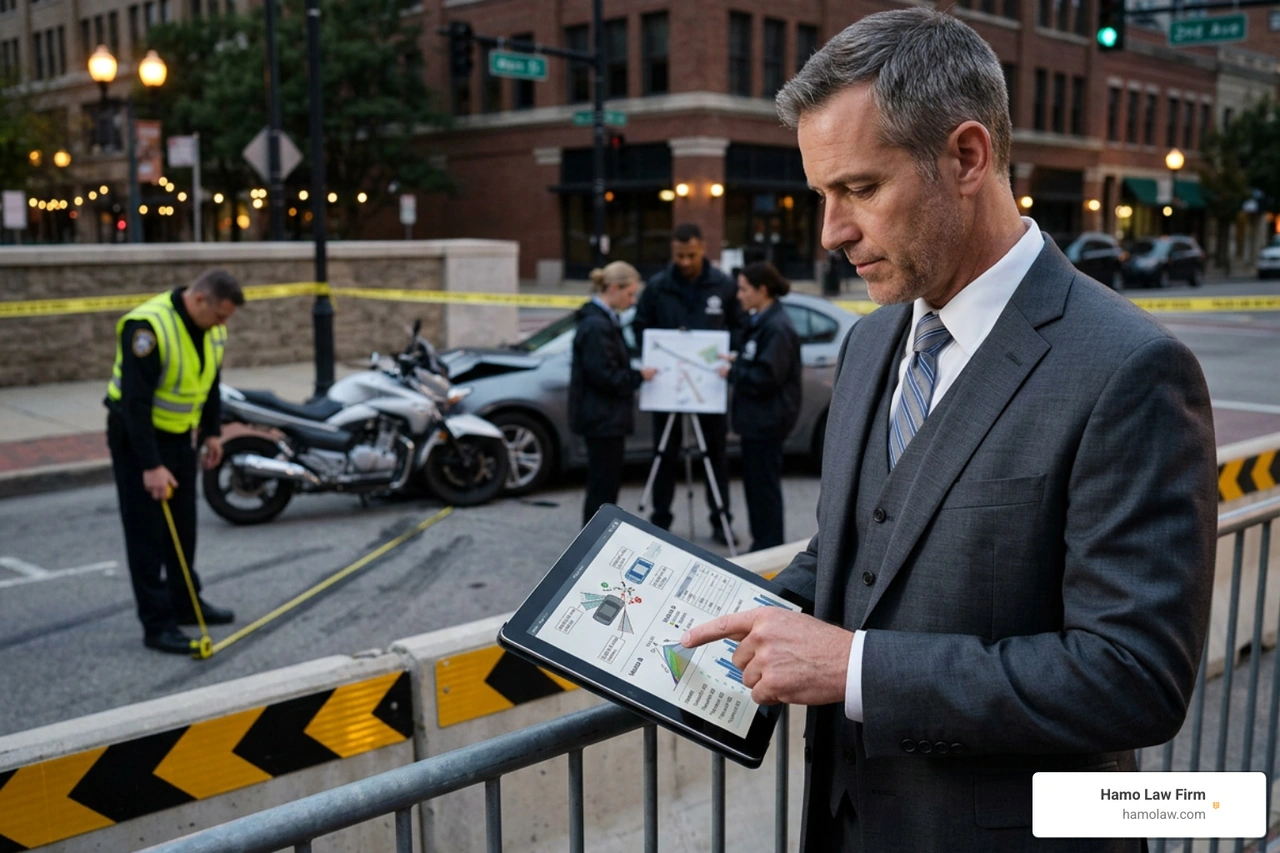
Motorcycle injury claims are distinctly different from typical auto accident cases. A general personal injury law firm may treat a motorcycle crash like a standard fender-bender, overlooking the distinct dynamics of motorcycle operation, roadway physics, and societal bias. Partnering with a specialized motorcycle injury law firm ensures your attorney understands how bikes maneuver, brake, and react to external hazards.
How a Dedicated Motorcycle Injury Law Firm Combats Insurance Bias
One of the greatest hurdles injured riders face is prejudice. Insurance adjusters and defense lawyers often rely on outdated stereotypes, assuming motorcyclists are inherently reckless, aggressive, or speed-obsessed. When an accident occurs, insurance companies routinely try to shift blame onto the rider before evaluating the objective evidence.
A dedicated motorcycle injury law firm counters this anti-biker bias by:
- Deploying Crash Reconstruction Specialists: Utilizing independent engineers to analyze skid marks, vehicle momentum, crush patterns, and impact trajectories to prove the motorist was at fault.
- Demonstrating Rider Skill: Establishing that you held proper endorsements, completed rider safety training, and executed correct defensive maneuvers prior to impact.
- Neutralizing Defense Tactics: Shutting down unsubstantiated claims that lane positioning or minor throttle adjustments caused the crash.
If you want dedicated advocacy tailored specifically to riders, explore how our team at Biker Accident Lawyer Michigan stands up against insurance company tactics.
What to Expect During Your Consultation with a Motorcycle Injury Law Firm
When you schedule an initial consultation with a specialized firm, you should expect an in-depth review designed to protect your interests.
During your case evaluation, we will review:
- Official crash reports and officer notes
- Photographic evidence of the scene, vehicles, and protective gear
- Initial emergency medical records and diagnostic scans
- All communications and policy declarations from involved insurance carriers
If severe injuries prevent you from traveling, our legal team routinely provides home, hospital, and virtual consultations to ensure your rights are protected from day one.
Compensation and Timeline: What Your Case Is Worth
Calculating the total financial value of a motorcycle accident claim requires assessing both immediate out-of-pocket costs and long-term future impact.
Recoverable Damages and Contingency Fee Structures
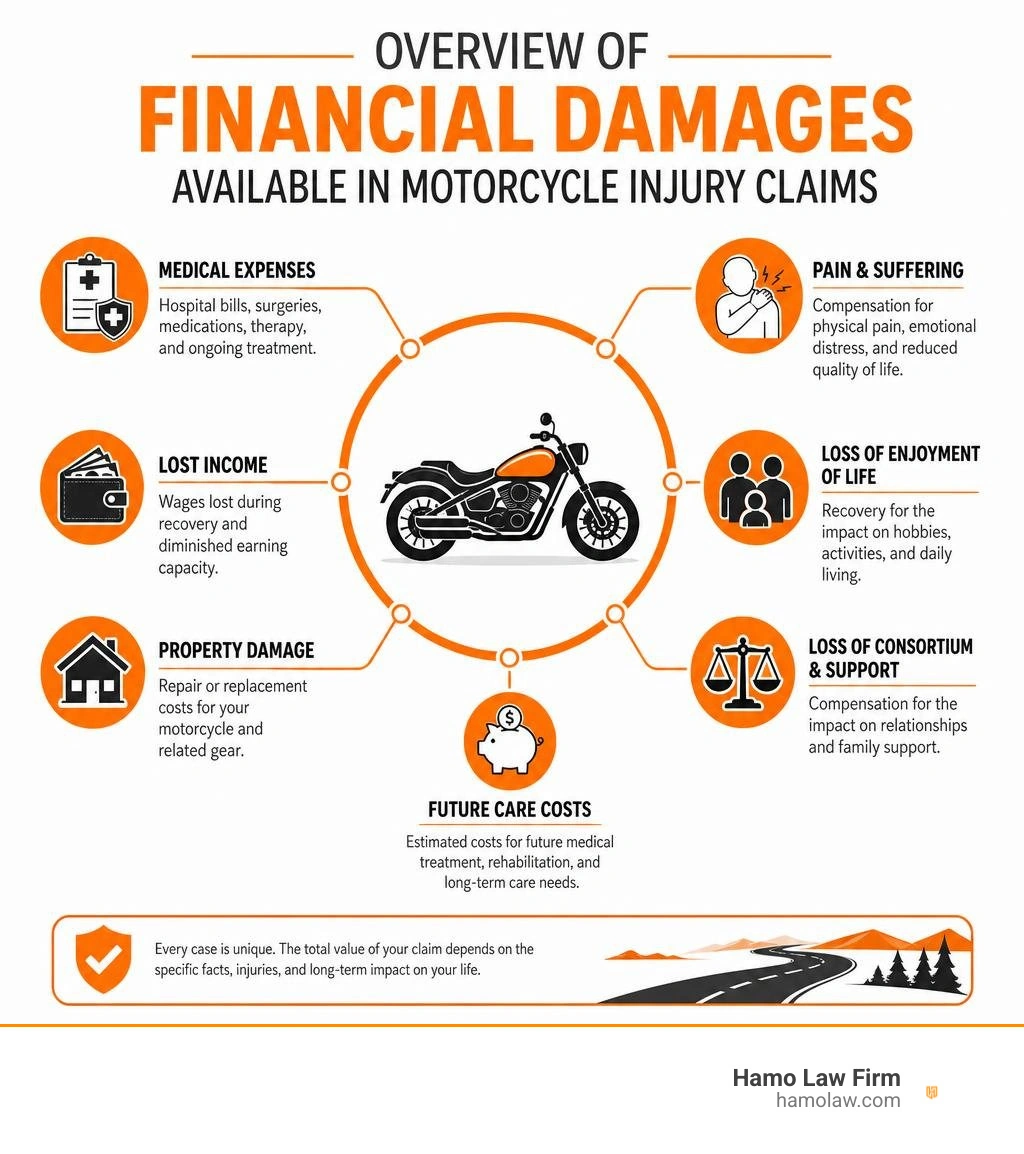
A comprehensive claim accounts for both economic and non-economic harm suffered by the rider and their family:
Economic Damages (Measurable Financial Losses):
- Past, present, and future medical bills (surgeries, hospital stays, medication)
- Rehabilitation and long-term physical therapy costs
- Lost wages and loss of future earning capacity
- Repair or total replacement costs for your motorcycle and protective gear
Non-Economic Damages (Quality of Life Impacts):
- Physical pain and suffering
- Traumatic brain injury complications and physical impairment
- Emotional distress, anxiety, and post-traumatic stress
- Loss of enjoyment of life and loss of consortium
To protect injured clients from financial stress during recovery, we operate on a contingency fee structure. This means you pay zero upfront costs or legal fees. We cover all upfront litigation expenses, and our fee is deducted as a percentage of the final settlement or court verdict. If we do not recover money for you, you owe us nothing.
Learn more about comprehensive auto accident representation at Car, Truck, & Motorcycle Accident Lawyers Michigan.
Expected Timelines and Statute of Limitations
Every legal claim is bound by strict statutory deadlines known as the statute of limitations. In Michigan personal injury claims, riders generally have three years from the date of the crash to file a formal personal injury lawsuit against the at-fault driver. Failing to file within this legal window permanently bars you from seeking financial recovery.
The total timeline of a claim varies depending on whether a settlement is reached out of court or if full litigation is required:
| Claim Phase | Average Timeline | Primary Activities |
|---|---|---|
| Immediate Investigation | Weeks 1 – 8 | Evidence gathering, crash reconstruction, witness interviews. |
| Medical Treatment & MMI | Months 2 – 12+ | Reaching Maximum Medical Improvement (MMI) to quantify future care needs. |
| Settlement Negotiations | Months 6 – 14 | Issuing a formal demand package and negotiating with insurers. |
| Formal Litigation / Trial | Months 12 – 24+ | Filing a court complaint, discovery, depositions, and jury trial if needed. |
Frequently Asked Questions About Motorcycle Accident Claims
Do I need to wear a helmet to file a personal injury claim?
No. You are not automatically disqualified from recovering compensation if you were not wearing a helmet at the time of the crash. If you were legally permitted to ride without a helmet under state law, not wearing one is not illegal. However, insurance companies may argue that unhelmeted riding contributed to severe head or neck injuries under comparative fault rules. An experienced motorcycle injury law firm will combat this argument by demonstrating that the at-fault driver caused the collision itself.
What if I am partially at fault for the motorcycle crash?
You can still recover compensation as long as your fault does not exceed the legal threshold. Under modified comparative negligence rules, your financial award is reduced by your assigned percentage of fault. If you are awarded $100,000 in damages but found 15% at fault, you receive $85,000. However, if your share of fault reaches 51% or more, you are barred from recovering non-economic damages.
How much does it cost to retain legal representation?
Hiring our firm costs nothing out-of-pocket. We work entirely on a contingency fee basis. We advance all case expenses—including expert witness fees, police report costs, and medical record retrieval—and only receive payment if we successfully negotiate a settlement or secure a favorable verdict in court.
Cruising Toward Full Justice with Hamo Law Firm
Navigating the legal aftermath of a severe crash while trying to heal physically can be overwhelming. At Hamo Law Firm, based in Flint and serving clients across Detroit, Wayne County, Genesee County, and all of Michigan, we bring over 40 years of trial experience to your corner. We know the games insurance companies play, and we refuse to let them take advantage of injured riders.
We take on the legal burden so you can focus entirely on your physical recovery. With zero upfront fees and a proven track record fighting for accident victims, our team is ready to stand up for your rights.
If you or a loved one was injured in a crash, schedule a free consultation with an experienced motorcycle accident lawyer today. Let us help you recover the financial support you need to get back on the road to recovery.