
How a Car Insurance Deductible Works and Impacts Your Premium
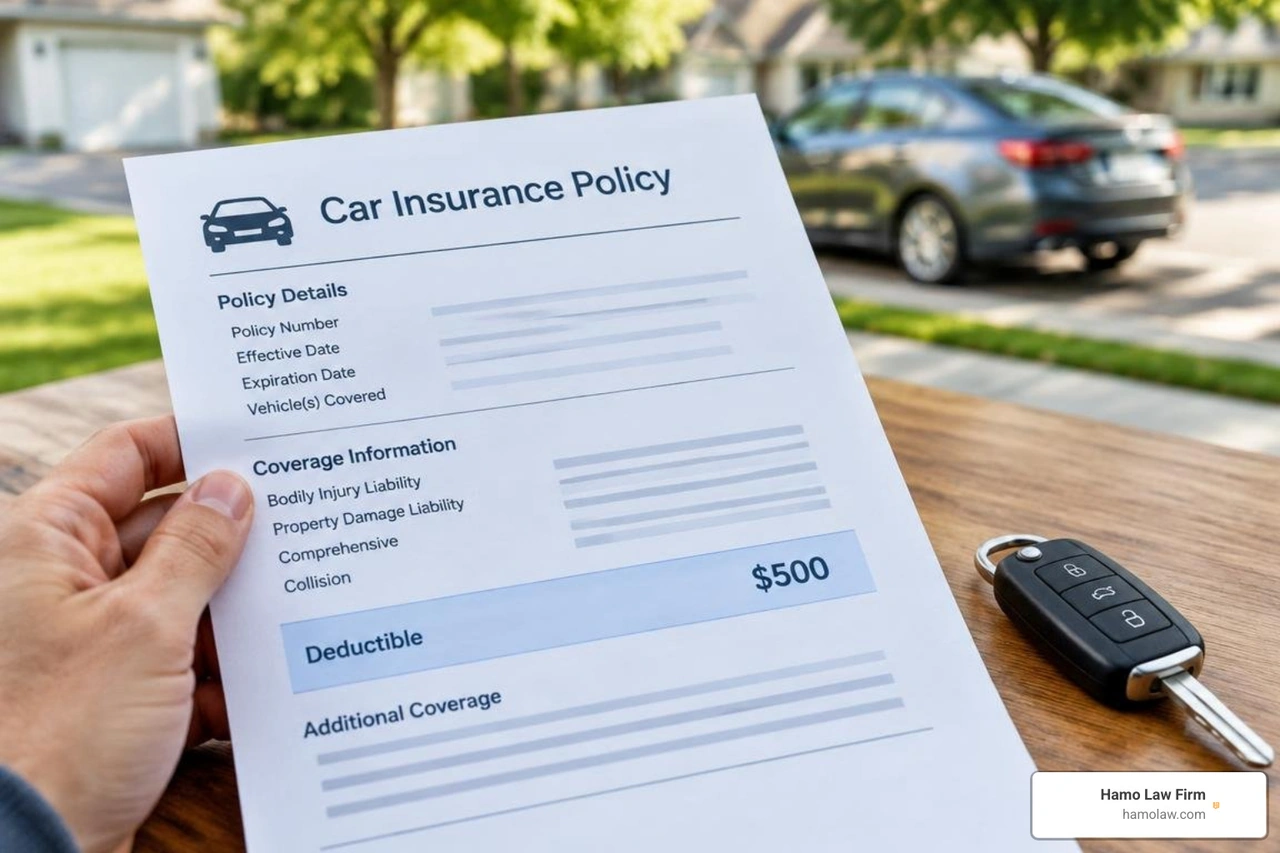
When you purchase an auto policy, you and your insurance carrier enter an agreement about who pays what if something goes wrong. At its core, a deductible serves as your out-of-pocket threshold before insurance benefits kick in. It represents a form of risk sharing: you agree to absorb smaller losses yourself, and the insurer covers the major damage above that specified amount.
Understanding how car insurance deductibles work helps you make sense of why insurers structure policies this way. Underwriters calculate risk by assessing the likelihood that a driver will file a claim. When you take on a larger share of that financial burden, you reduce the carrier's exposure to minor property damage payouts and processing costs.
Out-of-Pocket Costs and Claim Thresholds
A deductible applies per claim event, not as an annual pool like health insurance. If you file two separate claims in the same year, you are responsible for paying the deductible on each incident before receiving benefits.
When a covered loss occurs, the claim payment process follows a standard sequence:
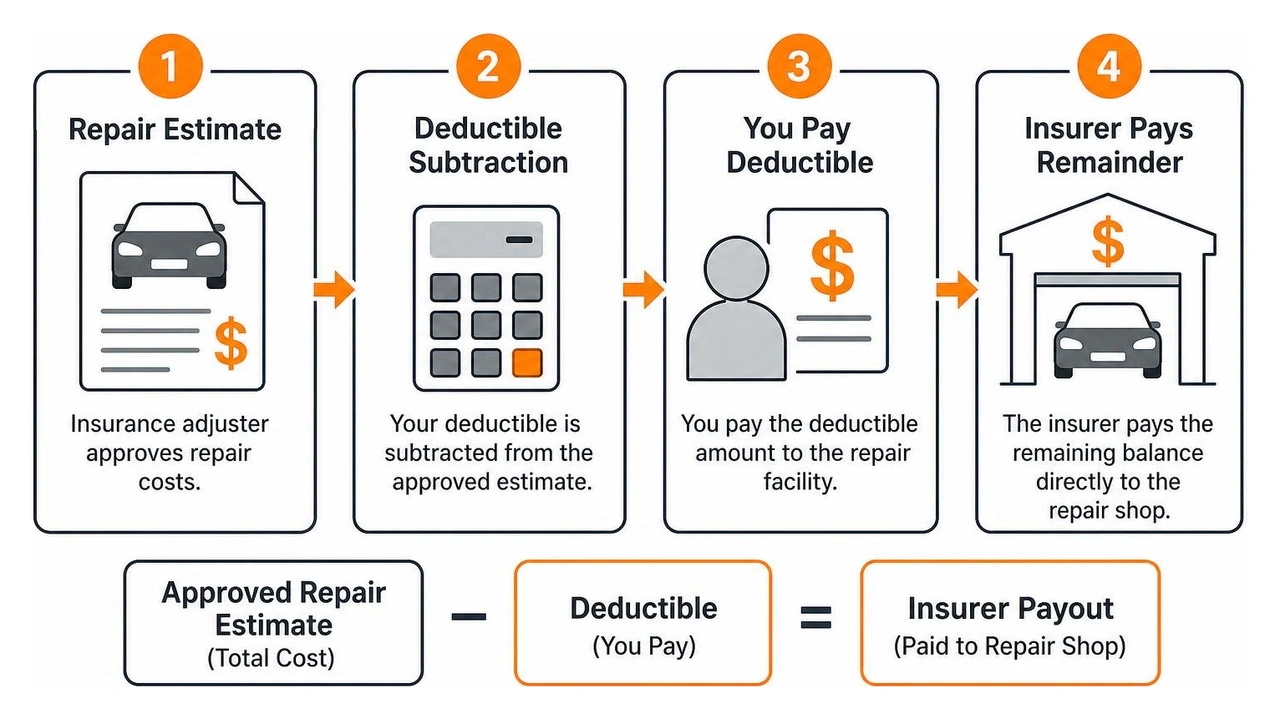
- You take the vehicle to a licensed repair facility for a comprehensive damage estimate.
- An insurance adjuster inspects the vehicle and approves the repair costs or declares a total loss based on the actual cash value (ACV).
- The body shop completes the work and bills you directly for your deductible amount.
- The insurer pays the remaining balance directly to the repair shop.
In the event of a total loss—which now occurs in roughly 27% of collision claims—you do not write a check to the body shop. Instead, the insurance adjuster subtracts your car insurance policy deductible directly from the vehicle’s actual cash value settlement check.
If another driver damages your vehicle, you might pay your deductible initially to get repairs moving quickly under your own policy. Your insurer will then attempt to recover that cost from the at-fault driver's insurance carrier through a legal process known as subrogation recovery. If successful, your insurer refunds your deductible amount once the claim settles.
The Premium vs. Deductible Inverse Relationship
Your deductible and your regular insurance premium share an inverse relationship: as your deductible rises, your monthly or annual premium decreases. Conversely, choosing a rock-bottom deductible drives your ongoing premium higher.
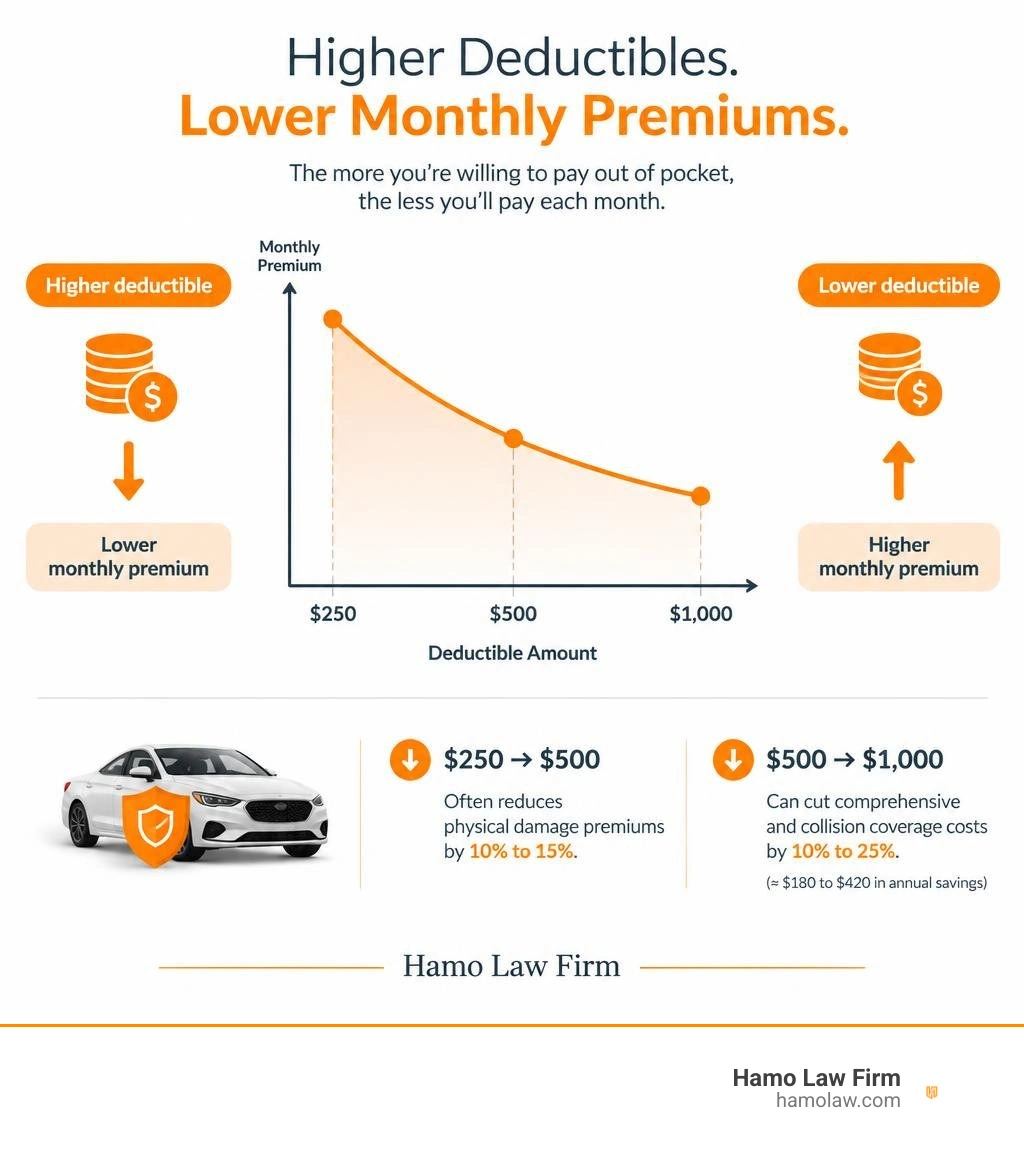
Insurers offer lower rates for higher deductibles because it discourages drivers from filing small claims for minor scrapes. Policyholders are far less likely to report a $450 parking lot dent if they carry a $1,000 deductible. Fewer small claims drastically cut administrative overhead for insurance providers.
Moving between rate brackets can produce tangible savings:
- Shifting from a $250 deductible to a $500 deductible often reduces physical damage premiums by 10% to 15%.
- Increasing from a $500 deductible to a $1,000 deductible can cut comprehensive and collision coverage costs by 10% to 25%, translating to roughly $180 to $420 in annual savings depending on your driving profile and location.
How Deductibles Apply Across Different Policy Coverages
Many drivers assume a single deductible applies universally across their entire policy. In reality, deductibles only attach to specific coverage types within your policy structure. Reviewing the official Purchasing Auto Insurance FAQ - State of Michigan confirms that property damage policies treat out-of-pocket costs differently depending on the specific cause of loss.
Comprehensive vs. Collision: Setting Your Car Insurance Deductible
Physical damage coverage splits into two distinct categories: collision and comprehensive. You can establish different deductible amounts for each, a strategy known as split deductibles.
- Collision coverage pays for damage when your vehicle hits another car, an inanimate object like a guardrail or tree, or rolls over. It also covers single-vehicle pothole damage.
- Comprehensive coverage protects against non-collision events outside your direct control, such as theft, vandalism, windshield cracks, hail, falling tree branches, and animal strikes (like hitting a deer).
Because comprehensive claims are statistically less frequent and often involve lower repair bills, comprehensive coverage is typically much cheaper than collision coverage. As a result, many drivers keep their comprehensive deductible low (such as $100 or $250) while setting their collision deductible higher (such as $1,000) to maximize premium savings without exposing themselves to high costs if a stray rock chips their windshield.
| Coverage Type | Common Triggers | Typical Deductible Options | Impact on Premium When Lowered |
|---|---|---|---|
| Collision | Multi-vehicle crashes, hitting a tree, backing into a pole, rollover accidents | $500, $1,000, $2,000 | High (significantly raises monthly premium) |
| Comprehensive | Hitting a deer, storm damage, broken windshield, theft, vandalism | $100, $250, $500 | Low to Moderate (minimal impact on premium) |
Liability, PIP, and Uninsured Motorist Deductible Rules
Deductible rules change completely when dealing with liability, medical claims, and injuries:
- Third-Party Liability: Property Protection Insurance (PPI) and Residual Bodily Injury Liability cover damage or harm you cause to other people and their property. Liability coverages never carry a deductible. You do not pay out-of-pocket to cover the other party's damages up to your policy limits.
- Personal Injury Protection (PIP): Under no-fault laws, your own insurer covers your medical expenses and lost wages regardless of who caused the crash. PIP policies may offer optional medical deductibles (often ranging from $0 to $500), which coordinate with your private health insurance to lower auto premiums.
- Uninsured Motorist Coverage: Uninsured or underinsured motorist policies protect you if a negligent driver without adequate coverage hits you. Whether an out-of-pocket expense applies depends on policy terms and whether the claim covers bodily injury or vehicle repairs.
Understanding how no-fault insurance works after an accident ensures you do not get surprised by unexpected medical or collision costs while recovering from an injury.
Evaluating the High vs. Low Deductible Trade-Off

Choosing an auto insurance deductible requires balancing steady monthly savings against the risk of an unexpected emergency expense. Neither option is universally superior; the right choice reflects your liquid savings, credit stability, and daily driving environment.
Choosing a High vs. Low Car Insurance Deductible
The average American motorist files a collision claim roughly once every 18 years. If you maintain a clean driving record and drive predominantly on low-risk routes, carrying a higher deductible allows you to pocket hundreds of dollars in premium savings each year.
However, if an unexpected $1,000 expense would force you to carry high-interest credit card debt or delay essential car repairs, a lower $500 deductible provides valuable financial peace of mind.
| Feature / Metric | $500 Deductible | $1,000 Deductible |
|---|---|---|
| Monthly Premium Cost | Higher regular expense | Lower regular expense (10–25% savings) |
| Out-of-Pocket Risk Per Claim | $500 per incident | $1,000 per incident |
| Best Suited For | Drivers with minimal emergency savings, tight monthly budgets | Drivers with $1,000+ in liquid savings, low-risk commute |
| Small Claim Usability | Covers repairs above $500 | You pay for repairs under $1,000 yourself |
| Annual Premium Impact | Baseline cost | Saves ~$180 to $420 annually |
Break-Even Calculations and Emergency Fund Math
To determine whether raising your deductible makes financial sense, calculate your break-even point. This tells you exactly how many claim-free years you need to offset the added out-of-pocket risk.
Follow this simple calculation:
- Calculate the extra out-of-pocket exposure: Subtract your current deductible from your proposed higher deductible (e.g., $1,000 - $500 = $500 extra exposure).
- Determine your annual premium savings: Request a quote from your insurer showing the annual price difference between the two deductible levels (e.g., $200 annual savings).
- Divide the exposure by the annual savings: Divide the additional risk by your annual savings ($500 ÷ $200 = 2.5 years).
In this example, if you go 2.5 years without an at-fault or single-vehicle collision claim, the cumulative premium savings will completely cover the extra $500 out-of-pocket cost if you ever need to file a claim. If you go five years without an incident, you remain $500 ahead even after paying the higher deductible.
Keep your deductible amount in an accessible, high-yield emergency savings account so you are always prepared if an accident happens.
Financed Vehicles, Leases, and Gap Insurance Restrictions
If you lease or finance your vehicle, you do not have complete freedom when setting your deductible. Lienholders and leasing institutions require physical damage coverage to protect their financial stake in the asset.
- Lender Maximums: Most auto loan agreements and lease contracts explicitly prohibit deductibles higher than $1,000, and some cap deductibles at $500. Choosing a $2,000 or $2,500 deductible may violate your loan terms.
- Gap Insurance Integration: Guaranteed Auto Protection (Gap) insurance covers the "gap" between your vehicle's actual cash value and the remaining loan balance if the car is totaled. While gap insurance pays off that remaining balance, some standard gap policies do not cover your primary physical damage deductible, leaving that portion as an out-of-pocket expense. Always review your contract to see if deductible reimbursement is included.
Frequently Asked Questions About Auto Deductibles
What happens if repair costs are less than my deductible?
If a body shop quotes $400 to fix a scratched bumper and your collision deductible is $500, your insurance policy pays $0 toward the repair.
In this scenario, you should pay for the repairs out of pocket and avoid filing a claim. Reporting minor damage that falls below your deductible provides no financial reimbursement and adds a claim entry to your Comprehensive Loss Underwriting Exchange (C.L.U.E.) report, which could cause your future premium rates to rise.
Do I pay a deductible if the other driver is at fault?
If another motorist causes an accident, how your deductible is handled depends on which insurance channel you use:
- Filing through the at-fault driver's carrier: If the other insurer immediately accepts full liability, they cover your vehicle repairs directly with no deductible required from you.
- Filing through your own collision coverage: If liability is disputed or the other carrier is slow to respond, you can file under your own collision policy to repair your car quickly. You must pay your deductible to the body shop upfront. Your insurer will then pursue subrogation against the at-fault driver's carrier and refund your deductible once they recover the funds.
Determining who ultimately covers vehicle damage and deductibles after a crash involves specific legal steps. In severe collisions, you may also have questions about who pays the deductible in a collision and how mini-tort claims or fault determinations apply to property damage.
Can I change my deductible amount mid-policy?
Yes. You do not have to wait for your annual or semi-annual policy renewal to adjust your deductible. You can contact your insurance carrier or log into your online policy portal at any time to request a policy endorsement changing your collision or comprehensive deductibles.
Your insurer will calculate a prorated adjustment to your premium for the remainder of the policy term. However, you cannot retroactively change a deductible to reduce out-of-pocket costs for an accident or damage that has already occurred. Any pending or existing claims remain subject to the deductible that was active at the exact time of the loss.
Conclusion
Your car insurance deductible is more than just a line item on your policy declaration page; it is a fundamental tool for managing your personal finances and out-of-pocket risk. Opting for a $1,000 deductible can trim your annual premiums significantly, provided you maintain an emergency cushion to cover repairs when life takes an unexpected turn. Conversely, maintaining a $500 deductible provides dependable security for drivers operating on strict monthly budgets.
Take time each year to evaluate your driving habits, check your vehicle's current market value, and confirm your lender's policy requirements. If you or a loved one has suffered an injury in a collision and you are facing difficult questions about insurance bad faith, liability disputes, or unrecovered crash expenses, reach out to our team at Hamo Law Firm. With more than 40 years of courtroom trial experience, we stand up to insurance companies on a contingency-fee basis—meaning you pay no legal fees unless we secure a recovery for you.