
What Car Insurance No Fault Means After a Crash

Car insurance no fault means your own insurer pays certain injury-related costs after a covered crash, even when someone else caused it. This coverage is usually called Personal Injury Protection (PIP). It can help pay medical bills, lost income, and necessary replacement services without waiting for the other driver's insurer to accept blame.
That does not mean fault disappears. Police, insurers, and courts can still determine who caused the collision. Fault also still matters for vehicle damage and for lawsuits involving serious injuries.
In a traditional tort system, an injured person generally pursues the at-fault driver's liability insurance. In a no-fault system, you normally start with your own PIP coverage. Michigan is one of 12 states with no-fault insurance laws, though each state sets its own benefits, deadlines, coverage limits, and rules for suing.
For an injured Michigan driver, the key is simple: get medical care, report the crash promptly, preserve your records, and understand which benefits your own policy must provide before dealing with broader claims against the negligent driver.
I am George Hamo, and the sections below explain how no-fault benefits, vehicle-damage claims, and serious-injury lawsuits work in plain English.
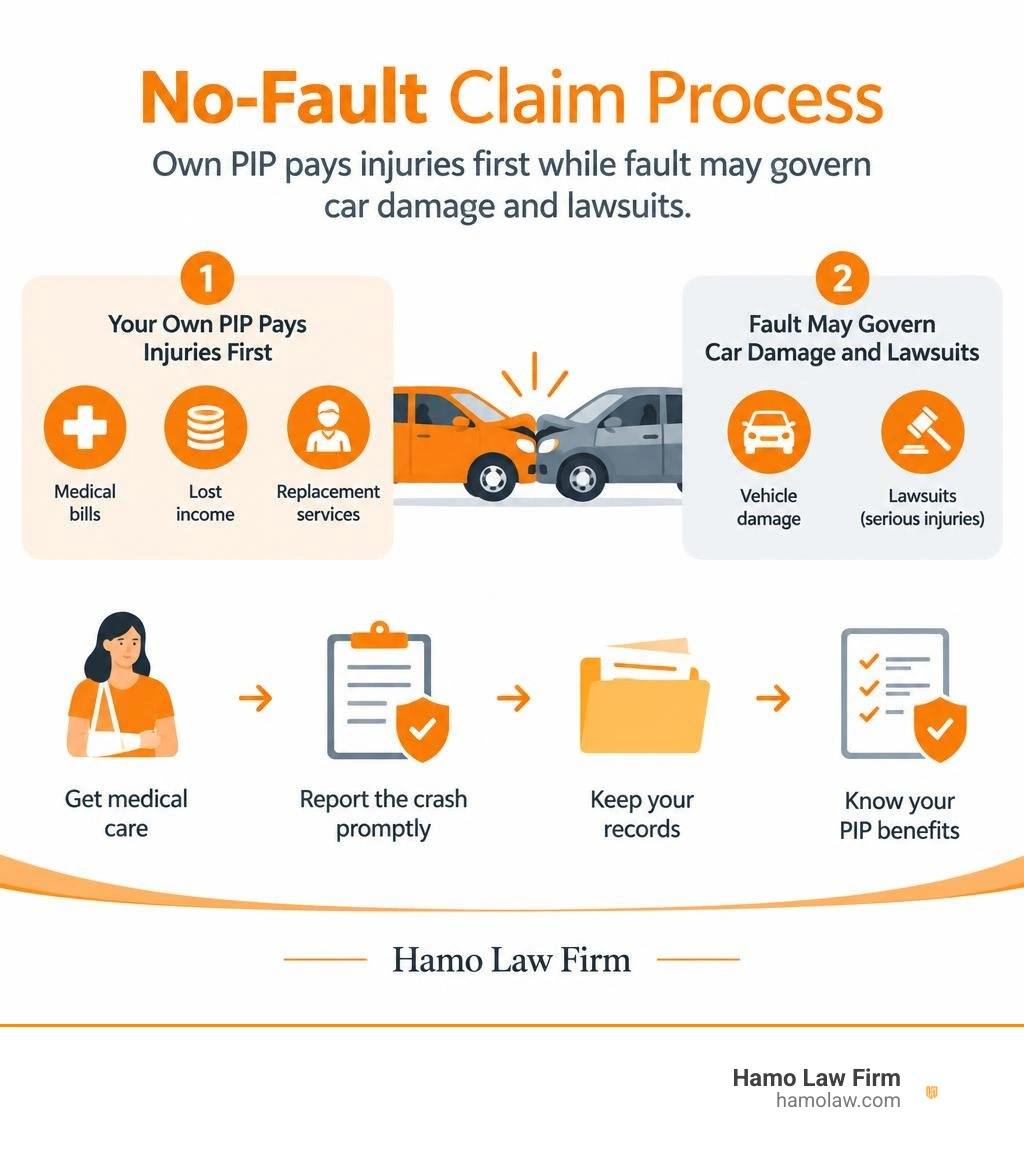
How Car Insurance No Fault Systems Work vs. Traditional Tort Systems
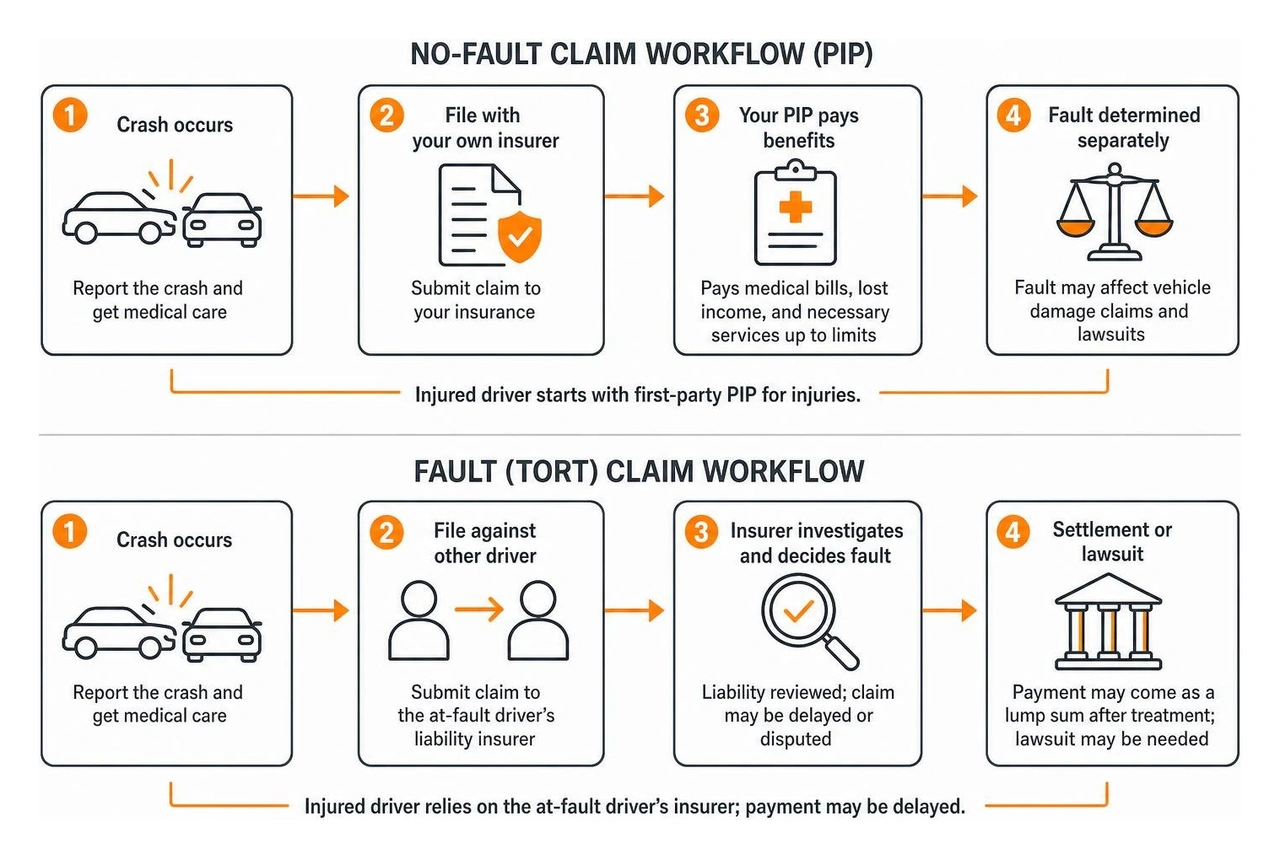
Understanding the difference between an at-fault (tort) insurance structure and a no-fault system comes down to one core question: Who writes the check for your immediate medical treatment?

In a traditional tort system, the driver who caused the collision is financially liable for all resultant losses, including hospital bills, wage loss, and car repairs. If you are injured in an at-fault state, you must file a third-party claim against the other driver’s bodily injury liability policy. However, their insurance carrier will not pay your doctor bills as they arrive. Instead, they will investigate liability, assess blame, and typically issue a single lump-sum settlement at the end of your treatment. If the insurer denies liability, you may face months or years of litigation while medical debts pile up.
A no-fault system handles bodily injury through first-party coverage. Regardless of who ran the red light or failed to yield, your own auto insurer is statutorily obligated to process and pay your allowable medical bills and essential economic losses up to your chosen policy limits. By removing the need to establish fault before medical benefits are disbursed, no-fault laws aim to provide immediate financial support and keep routine injury claims out of overburdened court systems.
As detailed in financial overviews like the Wall Street Journal analysis on no-fault auto coverage, no-fault systems trade certain rights to immediate tort litigation for rapid first-party medical reimbursement.
Defining Personal Injury Protection (PIP) in Car Insurance No Fault Claims
The cornerstone of any no-fault policy is Personal Injury Protection (PIP). PIP is mandatory first-party coverage that steps in immediately after a motor vehicle accident. Rather than waiting for adjusters from competing carriers to argue over police reports, your PIP coverage covers the economic fallout of your physical injuries.
Depending on statutory rules and your individual policy selections, PIP benefits generally cover:
- Medical Treatment: Emergency room visits, surgical procedures, hospitalizations, prescription medications, diagnostic imaging, and physical therapy.
- Attendant Care and Nursing Services: In-home medical assistance or daily personal care when severe trauma prevents self-care.
- Work Loss (Wage Reimbursement): A percentage of the gross income you lost because your injuries prevented you from performing your job.
- Replacement Services: Compensation for ordinary and necessary domestic tasks—such as house cleaning, snow removal, and childcare—that you would have performed yourself had you not been injured.
- Survivor’s Loss & Funeral Benefits: Essential economic support for surviving dependents and contributions toward funeral expenses if an accident results in a wrongful death.
For a deeper dive into how these benefits function on a day-to-day level, review our breakdown of Michigan No-Fault PIP benefits.
Understanding Pure, Choice, and Add-On State Insurance Models
Auto insurance legislation across the United States falls into distinct frameworks:
| System Type | Mandatory States / Jurisdictions | Core Mechanism | Lawsuit Rights |
|---|---|---|---|
| Mandatory No-Fault | 12 States (FL, HI, KS, KY*, MA, MI, MN, NJ*, NY, ND, PA*, UT) + Puerto Rico | First-party PIP is mandatory for medical losses; claims go to own insurer first. | Limited; must satisfy a statutory verbal or monetary injury threshold. |
| Choice No-Fault | 3 States (Kentucky, New Jersey, Pennsylvania) | Policyholders choose between a no-fault policy or a traditional tort liability policy. | Retained fully under tort policies; restricted under no-fault election. |
| Add-On No-Fault | 11 States + Washington, D.C. | Drivers can purchase optional first-party PIP/MedPay coverage. | Full lawsuit rights retained; no statutory threshold restrictions. |
| Traditional Tort | Remaining States | Injured parties pursue at-fault driver's insurer; fault must be proven. | Full tort rights subject to comparative/contributory negligence laws. |
*Note: Kentucky, New Jersey, and Pennsylvania operate as choice no-fault states within the broader mandatory framework.
By 2025 and into 2026, no state operates under a "pure" no-fault model where civil tort claims for catastrophic injuries are completely barred. Every no-fault jurisdiction preserves an injured victim's legal right to sue an at-fault driver once their damages or physical injuries exceed specific statutory limits.
What No-Fault Coverage Pays For (and Critical Exclusions)
While no-fault insurance provides vital economic security, it is not an all-inclusive policy that pays for every possible loss after a collision. Understanding the strict statutory boundaries between allowable economic expenses and excluded non-economic damages is vital.
Covered Benefits: Medical Expenses, Lost Wages, and Replacement Services
In Michigan, PIP coverage is divided into distinct, legally enforceable categories:
- Allowable Medical Expenses: Covers all reasonable and necessary medical treatments, rehabilitation therapies, medical equipment, home accessibility modifications, and transportation for medical appointments.
- Work Loss Benefits: Under Michigan law, injured individuals can receive up to 85% of their lost gross earnings (subject to an annually adjusted statutory monthly cap) for up to three years from the date of the crash.
- Replacement Services: Pays up to $20 per day for up to three years to hire someone to handle routine household maintenance, childcare, or home upkeep that the injured driver can no longer perform.
- Attendant Care: Pays for personal care services (such as bathing, dressing, and mobility assistance) provided to a catastrophically injured victim.
Critically, no-fault PIP does not pay for non-economic damages. PIP never reimburses you for physical pain, emotional trauma, disfigurement, loss of companionship, or reduced quality of life. Those damages must be recovered through a third-party personal injury lawsuit against the at-fault driver.
Property Damage and Theft: Why Car Insurance No Fault Excludes Vehicle Repairs
A common misconception among drivers is that "no-fault" means their insurer pays for all damage to their vehicle without question. No-fault insurance does not cover damage to your own automobile.

If your car is wrecked in an accident, your PIP policy will not pay a single dollar toward auto body repairs, mechanical reconstruction, or towing fees. Instead, physical damage to motor vehicles is governed by separate coverages:
- Collision Coverage: An optional policy addition that pays to repair or replace your vehicle after a crash, regardless of fault (subject to your deductible).
- Comprehensive Coverage: Covers non-collision vehicle loss, such as auto theft, vandalism, falling tree branches, hail, fire, or animal strikes.
- Property Protection Insurance (PPI): A mandatory part of Michigan no-fault insurance that pays up to $1 million for damage your car causes to other people's fixed property (such as buildings, fences, guardrails) or properly parked vehicles.
- The Mini-Tort Exception: In Michigan, you can recover a limited statutory amount (up to $3,000) from an at-fault driver to cover out-of-pocket vehicle damage expenses, such as your collision deductible.
To understand how out-of-pocket costs are handled after a crash, see our guide on who pays the deductible in no-fault accidents.
State-by-State Rules: Navigating Differences in Michigan, New York, and Florida
Because insurance laws are enacted at the state level, no-fault systems differ across state lines. Here is how Michigan compares to other major no-fault jurisdictions:
Michigan No-Fault PIP Choice and Property Protection Insurance
Historically, Michigan was the only state in the nation that mandated unlimited lifetime medical PIP coverage for every insured driver. Following legislative overhauls and current 2026 regulations, Michigan drivers can choose their level of medical PIP coverage:
- Unlimited Lifetime Medical: Provides full, uncapped medical coverage for all reasonable and necessary care resulting from accident-related injuries.
- $500,000 Limit: Caps allowable medical expenses at half a million dollars per person per accident.
- $250,000 Limit: Caps allowable medical expenses at $250,000.
- $50,000 Limit: Available only to motorists enrolled in Medicaid whose household members meet specific statutory coverage criteria.
- Complete PIP Medical Opt-Out: Available to drivers with commercial Medicare parts A and B or qualifying private health insurance that covers motor vehicle accident injuries without exclusions.
Michigan policies also mandate Property Protection Insurance (PPI) with a $1 million limit for damage to stationary objects, as outlined by the Michigan Department of Insurance and Financial Services guidance. For a complete overview of the current legal environment, read our Michigan no-fault insurance guide.
New York and Florida PIP Requirements and Deadlines
Other prominent no-fault states take a different approach to coverage limits and statutory deadlines:
- New York: Mandates a minimum of $50,000 in Basic Economic Loss (PIP) per person. Under the New York Department of Financial Services claim filing rules, accident victims must submit a formal written notice of claim within 30 calendar days of the collision to preserve their benefits. If an injured party is struck by an uninsured or hit-and-run driver, claims may be processed through the Motor Vehicle Accident Indemnification Corporation (MVAIC).
- Florida: Requires a mandatory $10,000 PIP limit. However, Florida enforces a strict 14-day emergency medical condition rule: an injured driver must seek medical treatment from an approved healthcare provider within 14 calendar days of the accident. If a qualified physician does not determine that the injury constitutes an Emergency Medical Condition (EMC), the available PIP medical benefit is statutorily reduced from $10,000 down to $2,500.
Lawsuits and the Serious Injury Threshold: When Can You Sue?
Because no-fault systems are intended to limit court congestion, you cannot file a personal injury lawsuit against an at-fault driver for minor aches or minor vehicle incidents. To bring a third-party tort claim for non-economic damages (pain and suffering), your injuries must cross a statutory threshold.
Verbal vs. Monetary Injury Thresholds
States establish their lawsuit thresholds using one of two statutory tests:
- Monetary Thresholds: A lawsuit is permitted once the victim’s accident-related medical expenses exceed a specific dollar amount. For example, in Massachusetts, medical damages must exceed $2,000 before a tort lawsuit for pain and suffering can be filed.
- Verbal (Qualitative) Thresholds: Rather than focusing on medical bill totals, verbal threshold states look at the physical nature and long-term diagnostic severity of the injury itself.
Michigan operates under a strict verbal threshold. Under Michigan Compiled Laws (MCL § 500.3135), an injured motorist may only sue the negligent driver for pain and suffering if the trauma resulted in:
- Death;
- Permanent serious disfigurement (such as severe facial scarring or amputation); or
- An objective impairment of an important body function that affects the person's general ability to lead their normal life.
Pursuing Third-Party Claims for Pain and Suffering
When an injury crosses the serious injury threshold, the victim can file a third-party tort claim against the at-fault driver’s Bodily Injury Liability (BI) insurance policy. This allows the injured party to seek compensation for:
- Physical pain and physical suffering;
- Mental anguish, anxiety, depression, and loss of life enjoyment;
- Excess economic damages (medical costs and lost wages that exceed their chosen PIP policy limits or the 3-year statutory window).
To learn more about how fault and liability thresholds intersect in court, read our detailed guide on how no-fault laws affect the ability to sue.
What to Do After an Accident in a No-Fault State
The steps you take immediately following an auto collision will directly impact your access to PIP benefits and your right to pursue a bodily injury claim.
Immediate Post-Accident Checklist and Medical Timelines
- Call 911 and Secure a Police Report: Ensure local law enforcement or Michigan State Police respond to the crash. A formal police report creates an official record of the date, time, weather, vehicle positions, and involved parties.
- Seek Immediate Medical Evaluation: Even if you feel fine initially, adrenaline often masks severe soft tissue trauma, internal bleeding, or closed head injuries. Prompt medical diagnosis is critical for your health and creates a direct paper trail linking your injuries to the collision.
- Document the Accident Scene: Use your smartphone to take photographs and video footage of vehicle damage, road skid marks, traffic signals, property debris, and visible injuries.
- Collect Driver and Witness Information: Obtain the full name, phone number, address, license plate number, and insurance policy details of all motorists involved, as well as contact details for independent eyewitnesses.
- Comply with Insurer Requirements: Cooperate with your own insurer regarding reasonable requests for documentation, but avoid giving recorded statements to the at-fault driver's insurance adjuster without consulting an attorney.
How to File a PIP Claim and Avoid Insurer Delays
To trigger your no-fault benefits, you must submit a formal Application for No-Fault Benefits (often called an Application for PIP Benefits) directly to your own insurance company.
When filing:
- Provide all identifying information for yourself and household members.
- Submit itemized medical bills, prescription receipts, and formal physician disability certificates outlining your work restrictions.
- Have your employer complete an official wage verification form documenting lost earnings.
Under Michigan law, once your insurer receives reasonable proof of an allowable expense, they have 30 calendar days to pay the claim. If they fail to disburse payment within 30 days, overdue benefits are subject to a statutory penalty interest rate (and potential liability for attorney fees).
Additionally, you must remain vigilant regarding the strict One-Year-Back Rule. Under Michigan law, you cannot recover PIP benefits for any medical service, wage loss, or replacement expense incurred more than one year before the date a legal action is filed in court. Learn more about protecting your claims from forfeiture in our guide to the one-year-back rule for Michigan PIP benefits.
Frequently Asked Questions About No-Fault Insurance
Does no-fault insurance mean nobody is blamed for the crash?
No. The term "no-fault" applies solely to how your initial medical treatment and basic economic losses are paid. Law enforcement officers, insurance adjusters, and courts still investigate the accident to establish liability. The driver at fault can receive traffic citations, face increased premium rates, and be held financially accountable through third-party lawsuits for serious physical injuries, wrongful death, and vehicle property damage.
Is no-fault car insurance more expensive than traditional liability insurance?
In many cases, yes. Auto insurance premiums in mandatory no-fault states tend to run higher than in pure tort states. Because insurance carriers in no-fault states are required to pay comprehensive medical and wage benefits regardless of fault—and are exposed to higher medical payouts and potential billing inflation—the baseline cost of issuing personal injury protection policies is higher.
How long do I have to file a no-fault insurance claim after an accident?
Deadlines depend strictly on the state in which the accident occurs. In Michigan, you have exactly one year from the date of the accident to submit formal written notice of your claim to your no-fault insurance carrier. Missing this absolute one-year deadline permanently bars you from receiving any PIP benefits for your injuries. In other states, like New York, written notice of a no-fault claim must be filed within 30 days.
Protect Your Legal Rights After a Michigan Auto Accident
The no-fault insurance claims process is full of rigid statutory filing deadlines, complex benefit structures, and aggressive insurance adjusters whose primary goal is to minimize their company's financial exposure. When you are dealing with painful injuries, lost income, and mounting hospital bills, you should not have to fight an insurance carrier alone.
At Hamo Law Firm, our Flint-based personal injury team brings more than 40 years of courtroom trial experience fighting for accident victims across Genesee County, Wayne County, Detroit, and throughout the State of Michigan. We handle all insurance bad faith disputes, no-fault PIP claims, and third-party wrongful death and serious injury lawsuits on a strict contingency-fee basis—which means you pay zero upfront costs and no legal fees unless we successfully win your case.
If you or a loved one has suffered an injury in an auto crash, protect your family's future today. Contact us for a free, comprehensive case evaluation, or explore our dedicated practice area for no-fault insurance claims to learn how we can help you recover the full compensation you are owed.