
Michigan Accident Legal Advice Starts With Fast, Documented Action

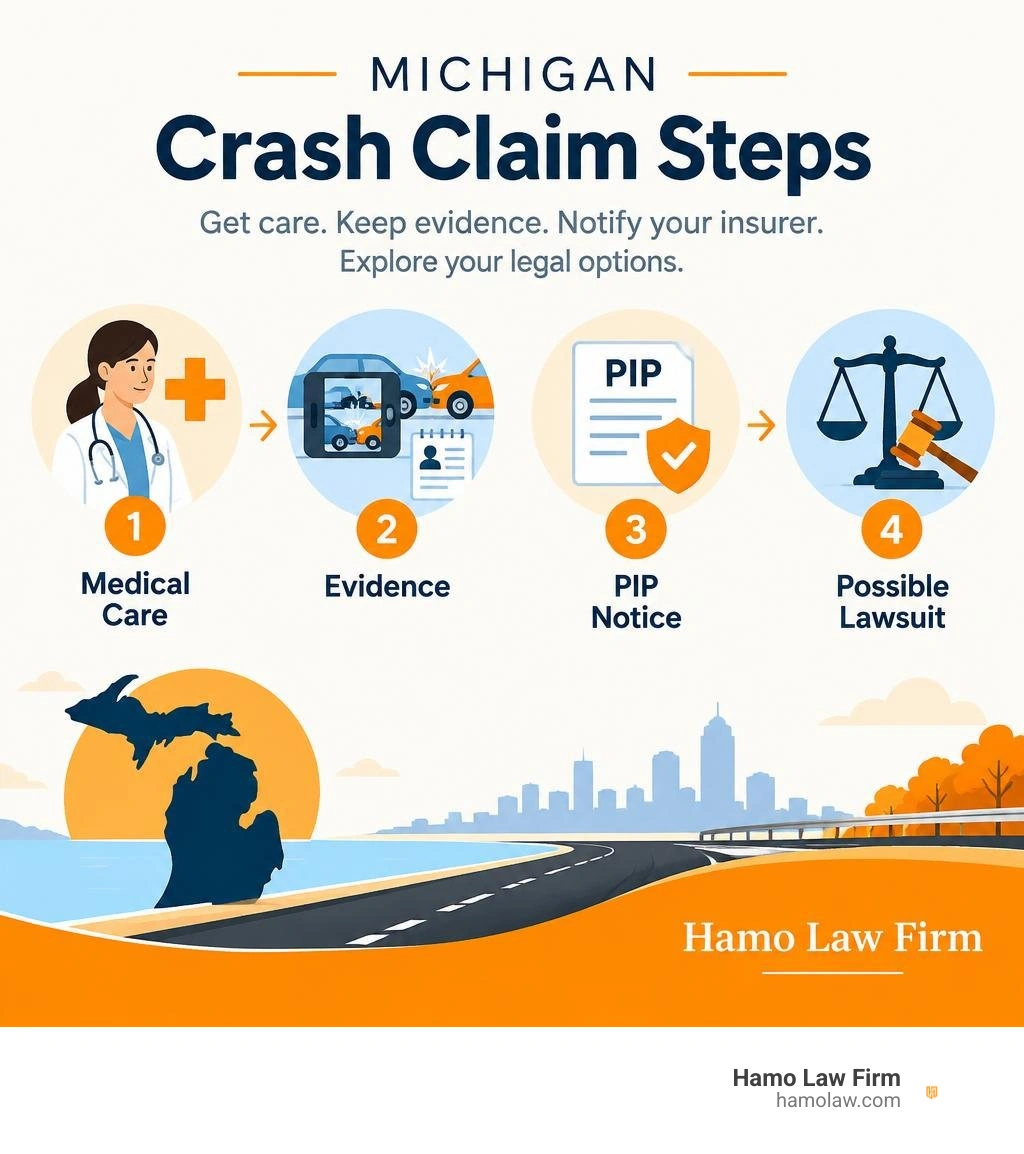
After a Michigan crash, protect your claim by getting medical care, reporting the collision, saving photos and witness details, and notifying your own insurer promptly. Your Personal Injury Protection (PIP) benefits generally pay first for covered medical care, regardless of who caused the crash. But deadlines matter: PIP claims have strict one-year rules, while most injury lawsuits must be filed within three years.
Michigan's system is no-fault, not fault-free. The other driver may still be responsible for vehicle damage, medical costs above your selected PIP limit, and pain and suffering when an injury meets Michigan's serious-injury threshold. Do not assume an insurer's early offer covers the full cost of your recovery.
I am George Hamo, and this guide explains the key choices, deadlines, and legal options that can shape a Michigan crash claim.
Understanding Michigan No-Fault Law and PIP Medical Coverage Tiers
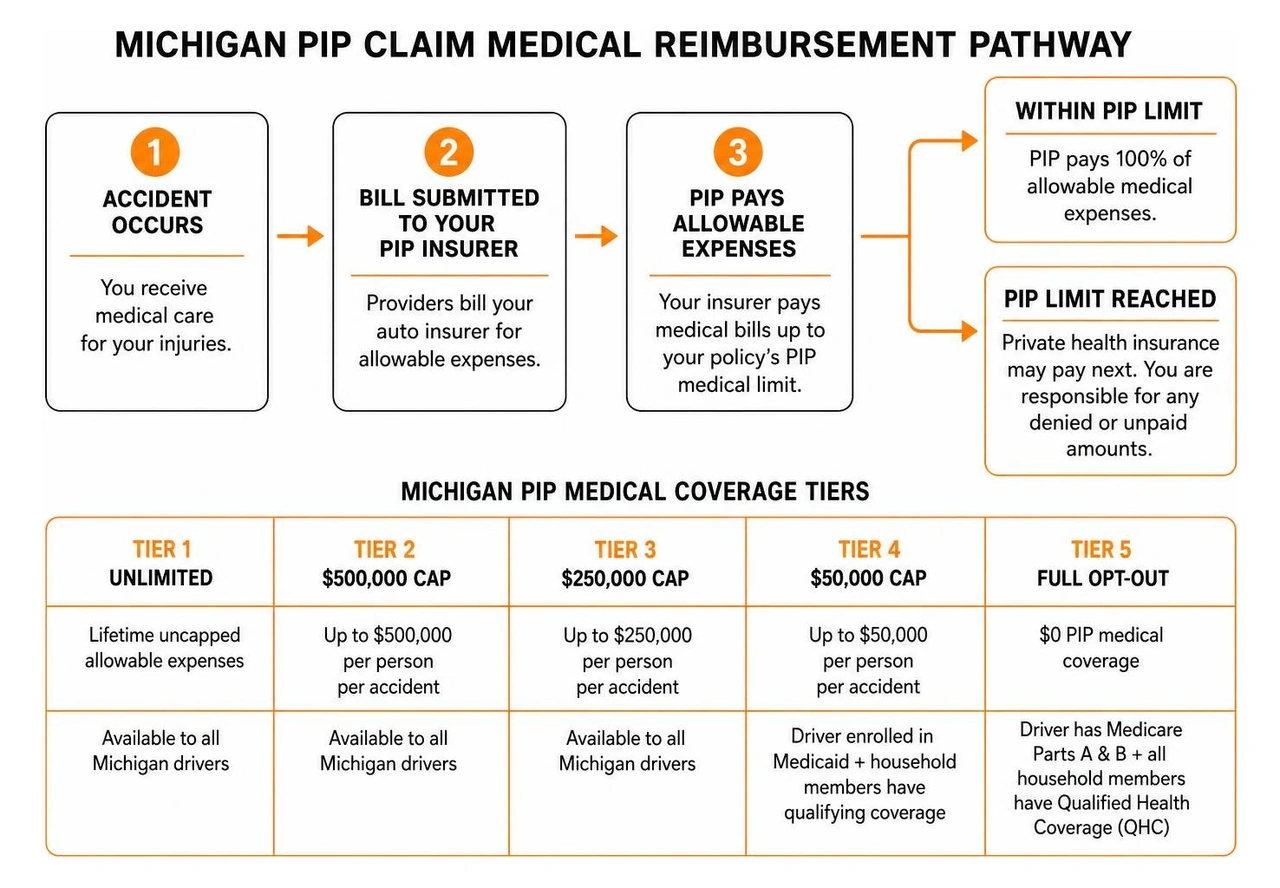
Michigan’s auto insurance system is unique. Unlike traditional tort states where you immediately sue the other driver's insurance to pay for an emergency room visit, Michigan relies on first-party coverage. When an accident happens, your own auto insurer pays your medical bills, lost wages, and essential service expenses under Personal Injury Protection (PIP), regardless of who caused the wreck.
Understanding how Michigan no-fault insurance works after an accident is vital because the coverage choices you made when purchasing your policy dictate how your medical bills are handled today.
| PIP Medical Coverage Tier | Maximum Medical Benefit | Who Qualifies / Requirements |
|---|---|---|
| Tier 1: Unlimited | Lifetime uncapped allowable expenses | Available to all Michigan drivers (highest protection) |
| Tier 2: $500,000 Cap | Up to $500,000 per person per accident | Available to all Michigan drivers |
| Tier 3: $250,000 Cap | Up to $250,000 per person per accident | Available to all Michigan drivers |
| Tier 4: $50,000 Cap | Up to $50,000 per person per accident | Driver enrolled in Medicaid + household members have qualifying coverage |
| Tier 5: Full Opt-Out | $0 PIP medical coverage | Driver has Medicare Parts A & B + all household members have Qualified Health Coverage (QHC) |
In addition to medical coverage, Michigan PIP provides:
- Work Loss Benefits: Up to 85% of your lost gross income (subject to an annual statutory maximum cap) for up to three years.
- Replacement Services: Up to $20 per day for chores and household tasks you can no longer perform (such as cleaning, childcare, or yard maintenance) for up to three years.
- Attendant Care: In-home nursing and personal care services if your injuries require assistance with activities of daily living.
How PIP Benefits and Medical Coverage Levels Work
Before the historic auto reform took effect, every driver received mandatory lifetime unlimited medical benefits. Today, drivers can tailor their coverage to save on premiums, but doing so carries serious trade-offs.
If you select a capped tier—such as $250,000 or $500,000—a severe crash requiring surgical intervention, extended ICU stays, or long-term rehabilitation can exhaust your policy limits in days. Once your PIP limit is reached, your private health insurance must step in. If your health insurer denies coverage or imposes high copays and deductibles, you are left personally responsible for the remaining balance. To learn more about how these levels affect policyholders, review our comprehensive Michigan no-fault insurance guide.
Michigan Accident Legal Advice on Choosing PIP and Residual Liability Limits
A major side effect of the auto insurance reforms involves your exposure to personal liability. If you injure someone else and they have a capped PIP policy (or no PIP coverage), they can sue you for their excess medical expenses.
Under Michigan law, standard default Bodily Injury / Residual Liability limits are $250,000 per person / $500,000 per accident / $10,000 property damage. While drivers are permitted to sign a written waiver electing down to the statutory minimum floor of $50,000 per person / $100,000 per accident, doing so leaves your personal assets vulnerable. For detailed statutory background, consult statutory insights on Michigan car accident laws.
We strongly recommend carrying:
- Unlimited or High-Tier PIP Medical: To ensure lifetime care without medical bankruptcy.
- Residual Bodily Injury Limits of at least $250k/$500k: To protect your family's financial security from third-party lawsuits.
- Uninsured and Underinsured Motorist (UM/UIM) Coverage: UM/UIM is optional in Michigan, but it is critical. If a hit-and-run driver or a motorist with state-minimum $50,000 liability limits causes you life-altering harm, your own UIM policy pays the difference.
Critical Steps and Michigan Accident Legal Advice Following a Crash
The chaotic moments following a crash in Flint, Detroit, or anywhere across Genesee and Wayne Counties can overwhelm anyone. Knowing the correct protocol prevents insurance adjusters from exploiting your situation. For a complete procedural breakdown, read our summary on what to do after an accident or injury.
Immediate Actions at the Scene and Reporting Requirements
- Check for Injuries and Call 911: Ensure emergency services are dispatched. A formal police report is vital for both no-fault and liability claims.
- Collect Comprehensive Evidence: Photograph vehicle damage, skid marks, road hazards, traffic signals, and weather conditions. Capture license plates, driver’s licenses, and insurance certificates.
- Identify Witnesses: Independent witnesses often disappear before police arrive. Gather names, phone numbers, and addresses immediately.
- Preserve Dashcam Footage: Save internal vehicle dashcam footage or note nearby business security cameras.
- Seek Immediate Medical Attention: Never tell an officer or adjuster "I'm totally fine." Soft-tissue injuries, concussions, and internal trauma often mask symptoms due to adrenaline. A prompt medical triage creates a clear paper trail connecting your injuries to the collision. Knowing when to contact an attorney after a crash can prevent costly missteps with your insurer.
Preserving Strict One-Year PIP and Three-Year Tort Deadlines
Michigan enforces unforgiving procedural deadlines:
- The One-Year PIP Written Notice Rule (MCL 500.3145): You must give written notice of your injury to your auto insurer within one year of the accident date. Failure to provide this notice completely bars you from recovering no-fault PIP benefits forever. Additionally, under the "one-year-back rule," you cannot recover PIP benefits for any medical expense incurred more than one year prior to filing a lawsuit against your insurer.
- The Three-Year Tort Statute of Limitations (MCL 600.5805(2)): If you are pursuing a third-party claim for pain and suffering or excess economic damages against the negligent driver, your lawsuit must be filed within three years of the crash date.
For full details on exceptions and timing, refer to our Michigan personal injury statute of limitations guidelines.
When Can You Sue? The Verbal Threshold and Comparative Fault
While PIP covers your direct medical bills and limited wage loss, it does not compensate you for physical pain, emotional trauma, or loss of life enjoyment. To pursue a lawsuit for noneconomic damages against the at-fault driver, Michigan law requires you to meet the statutory "verbal threshold." You can explore these litigation requirements in our Michigan car accident legal guide.
Meeting the Serious Impairment Threshold for Noneconomic Damages
Under MCL 500.3135, an injured victim can recover noneconomic damages (pain and suffering) only if their injury results in:
- Death;
- Permanent serious disfigurement (such as severe facial scarring, burns, or limb loss); or
- Serious impairment of body function.
Michigan law defines a "serious impairment of body function" as an impairment that:
- Is objectively manifested (medically identifiable through clinical examination, X-rays, MRIs, or CT scans);
- Involves an important body function (such as walking, lifting, or cognitive processing); and
- Affects the injured person's general ability to lead their normal life (the injury must influence your capacity to live your normal pre-accident lifestyle).
There is no monetary or medical-bill threshold in Michigan; proving a serious impairment requires comprehensive medical documentation and lifestyle testimony. Learn more about developing this evidence in our guide on navigating car accident claims in Michigan.
Michigan Accident Legal Advice for Navigating Comparative Negligence
Even if the other driver ran a red light, insurance adjusters frequently argue that you share partial blame. Michigan applies a modified comparative fault standard under MCL 600.2959.
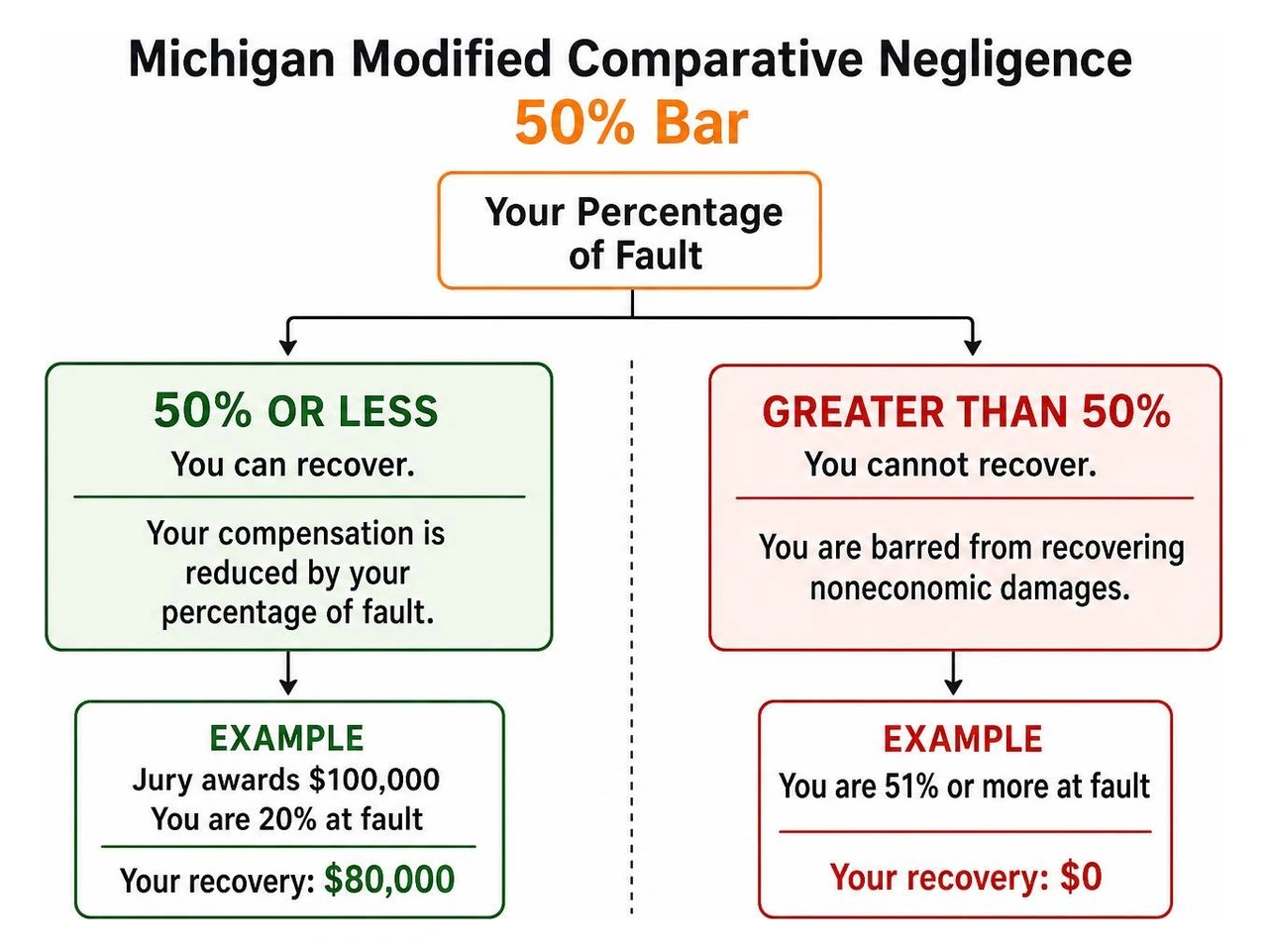
- Fault at 50% or Less: Your recovery for pain and suffering is reduced in direct proportion to your percentage of fault. If a jury awards you $100,000 but finds you 20% at fault (perhaps for driving slightly over the speed limit), your recovery is reduced by 20%, leaving you with $80,000.
- Fault Greater than 50%: If you are found to be 51% or more at fault, you are completely barred from recovering noneconomic damages.
If you are navigating localized legal issues in the Flint area, you can review local court procedures via the Genesee County Legal Resource Center self-help resources.
Maximizing Crash Compensation: Mini-Tort, UM/UIM, and Claim Valuation
Vehicle damage and out-of-pocket expenses create immediate financial stress. To maximize your financial recovery, you must coordinate all available legal remedies. For an in-depth review of full case valuation strategies, read our automobile accidents guide.
Utilizing Mini-Tort for Vehicle Damage up to $3,000
Because Michigan is a no-fault state, your collision insurance covers physical damage to your vehicle. However, under MCL 500.3135(7)—known as the mini-tort provision—you can recover up to $3,000 for unreimbursed vehicle damage directly from the at-fault driver (or their insurer).
Mini-tort is commonly used to:
- Recover your standard collision deductible (e.g., $500 or $1,000).
- Cover out-of-pocket repair costs if you carry broad collision or basic/limited coverage.
To succeed in a mini-tort claim, you must demonstrate that the other driver was at least 50% at fault and provide repair estimates or proof of your paid deductible. You can read more about these claims from our Michigan no-fault lawyer insights.
Calculating Economic and Pain and Suffering Damages
Valuing a crash claim requires calculating both tangible financial losses and intangible suffering:
- Economic Damages (Above PIP Limits):
- Medical expenses exceeding your PIP tier cap.
- Lost earnings exceeding the three-year PIP limit or monthly statutory wage caps.
- Loss of future earning capacity.
- Noneconomic Damages:
- Physical pain, emotional distress, and loss of consortium.
- Ongoing disability, scarring, or loss of mobility.
Obtaining tailored legal counsel is essential to evaluating how much your car accident case is worth, allowing you to secure fair compensation with experienced Michigan car accident lawyer representation.
Frequently Asked Questions About Michigan Crash Claims
Is Michigan a no-fault or at-fault state for car accidents?
Michigan is a true no-fault state. Your own auto insurance policy covers your medical bills and lost earnings through PIP benefits regardless of who caused the collision. However, you retain the legal right to file a third-party fault-based lawsuit against the negligent driver for pain and suffering if your injuries meet the serious impairment threshold, as well as for medical expenses that exceed your PIP coverage limit.
What is the statute of limitations for filing a claim in Michigan?
Michigan has two distinct deadlines:
- 1 Year: For filing written notice of a no-fault PIP claim with your insurer (MCL 500.3145).
- 3 Years: For filing a third-party personal injury lawsuit against the at-fault driver (MCL 600.5805(2)).
How does comparative fault affect my financial recovery?
Under Michigan’s modified comparative negligence rule (MCL 600.2959), your pain and suffering compensation is reduced by your percentage of fault. If you are 50% or less at fault, you receive a reduced payout. If you are found to be 51% or more at fault, you are legally barred from receiving any noneconomic compensation.
Conclusion and Legal Assistance
Dealing with severe injuries and aggressive insurance adjusters requires proven advocacy. At Hamo Law Firm, our legal team brings more than 40 years of courtroom trial experience across Genesee County, Wayne County, Flint, and Detroit. We operate on a contingency-fee model—meaning you pay nothing unless we recover money for you.
Do not let an insurance company diminish your claim. Contact us today to begin maximizing your recovery through no-fault insurance claims.