
What Is Torts Law — and Why It Matters If You've Been Hurt in Michigan

Torts law is the area of civil law that lets everyday people seek compensation when someone else's wrongful act causes them harm. In plain terms: if another person, business, or property owner injures you through carelessness, recklessness, or intentional misconduct — tort law gives you the legal tools to hold them accountable.
Here is a quick overview of the key things to know:
- What is a tort? A civil wrong — other than a breach of contract — that causes injury or harm to another person
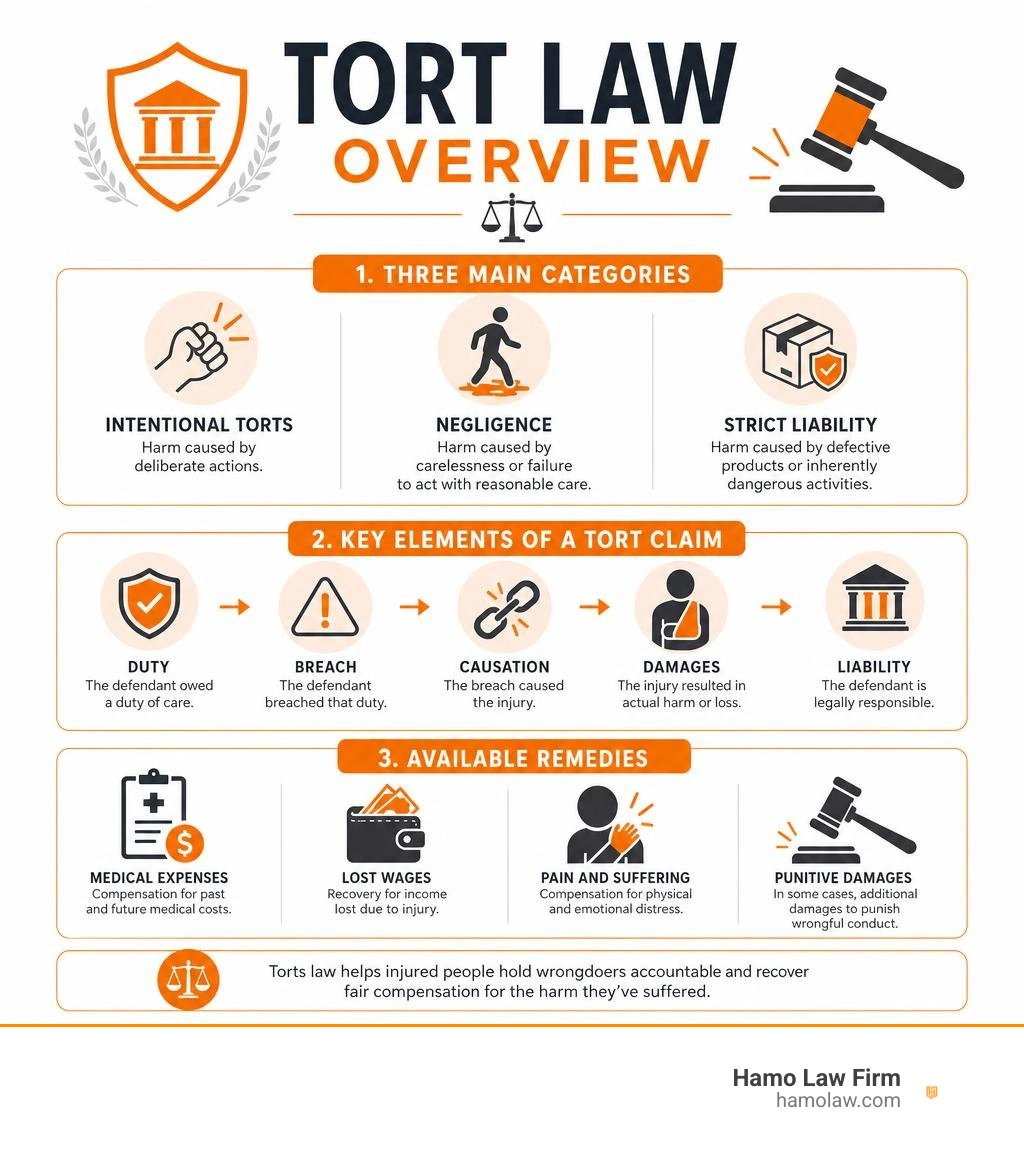
- Three main categories: Intentional torts, negligence, and strict liability
- Who brings the case? The injured person (plaintiff), not the government
- What can you recover? Medical bills, lost wages, pain and suffering, and sometimes punitive damages
- Standard of proof: "More likely than not" — a lower bar than criminal court
Most people first encounter tort law after a car accident, a slip and fall, a dog bite, or a defective product injury. You may not know the legal term for what happened to you — but if someone else's actions caused your injury, tort law is almost certainly relevant to your situation.
I'm George Hamo, a Michigan trial attorney, and in this guide I'll walk you through everything you need to know about tort and premises liability law so you can understand your rights and make informed decisions.
Understanding Torts Law: Definitions, Purpose, and Civil vs. Criminal Acts
When we talk about torts law, we are referring to the civil legal framework governing non-contractual wrongs committed against individuals or their property. At its core, a tort occurs when someone acts or fails to act in a way that breaches a legal duty, resulting in legally cognizable harm to another person.
The legal system makes a subtle but crucial distinction between injury and harm. In standard civil jurisprudence, an injury refers to the violation or invasion of a legally protected right, whereas harm refers to the actual loss, physical damage, or detriment suffered as a result. For a valid civil suit, the law generally requires that an illegal invasion of rights produces tangible or recognized physical, financial, or emotional harm.
The primary purposes of civil liability under tort principles are threefold:
- Victim Compensation: Ensuring that an injured person receives financial resources to cover medical bills, lost wages, and personal suffering, helping restore them as close to their original state as possible.
- Deterrence: Discouraging individuals, corporations, and property managers from engaging in reckless, careless, or dangerous actions.
- Loss Distribution: Placing the economic burden of an accident on the party best positioned to prevent it or bear the cost, rather than forcing the innocent victim to shoulder the entire financial blow.
Historically, civil wrongs are governed by state common law court decisions and specific statutes rather than overarching federal legislation. You can learn more about these foundational legal concepts through resources like the Legal Information Institute on Torts and explore theoretical legal foundations via the Stanford Encyclopedia of Philosophy on Common Law Tort Theories.
Understanding Civil Wrongs in Torts Law
A civil wrong occurs when a legal obligation owed to a person is broken. Unlike contract disputes—which stem from broken voluntary agreements between specific parties—a tort arises from duties created automatically by law.
For instance, every driver operating a vehicle in Flint or Detroit owes a legal duty to other road users to drive attentively and obey traffic signals. When a driver breaches that duty by texting behind the wheel and causing a collision, they commit a civil wrong. The injured victim then has a private right of recourse in civil court to demand financial compensation from the wrongdoer or their insurance provider.
Torts vs. Criminal Acts
One of the most frequent points of confusion for accident victims is the distinction between a civil tort and a criminal offense. While a single event—such as a drunk driving collision or an assault—can trigger both criminal proceedings and a civil lawsuit, they serve entirely distinct roles in the justice system.

| Aspect | Civil Tort Law | Criminal Law |
|---|---|---|
| Purpose | To compensate the injured victim for private losses | To enforce public order and punish societal wrongdoing |
| Brought By | The injured individual (Plaintiff) represented by private counsel | State or county prosecutors representing the government |
| Standard of Proof | Preponderance of the evidence (50%+ likelihood) | Beyond a reasonable doubt (highest legal bar) |
| Outcome / Remedy | Financial compensation (damages) or court injunctions | Fines, probation, community service, or jail time |
In criminal court, the state prosecutes a wrongdoer to uphold society's laws. The victim is merely a witness for the prosecution and does not receive financial recovery through the criminal verdict itself. Conversely, a civil suit is initiated directly by you, allowing us to seek monetary redress specifically tailored to your personal physical and financial injuries.
The Three Main Categories of Torts
To establish legal liability, courts group civil wrongs into three major legal classifications based on the wrongdoer's level of fault or mental state: intentional torts, negligence, and strict liability.
Intentional Torts: Defamation, Libel, and Slander
An intentional tort occurs when a person acts deliberately with the intent to cause harm or with substantial certainty that specific harmful consequences will result. Unlike accidental injuries, intentional torts stem from purposeful conduct.
Common examples of intentional torts include:
- Assault: Intentionally placing someone in reasonable apprehension of immediate harmful or offensive physical contact.
- Battery: Intentionally causing harmful or offensive physical contact with another person (even if the victim is unconscious or unaware at the precise moment of contact).
- False Imprisonment: Intentionally restricting someone's freedom of movement without legal authorization or consent.
- Intentional Infliction of Emotional Distress (IIED): Engaging in extreme and outrageous conduct that intentionally or recklessly causes severe emotional trauma.
- Invasion of Privacy: Unlawfully intruding upon someone's private affairs or publicly disclosing private facts.
Another major area of intentional wrong is defamation, which covers false statements that cause harm to a person's reputation. Defamation is split into two distinct subcategories:
- Libel: A defamatory statement made in a permanent written, printed, or published format (including online articles and social media posts).
- Slander: A defamatory statement conveyed orally through spoken words or temporary gestures.
To succeed in a defamation claim, a plaintiff must establish that the defendant communicated an unprivileged false statement of fact to a third party, causing measurable reputational or financial harm.
Negligence and Proof Requirements in Torts Law
Negligence represents the vast majority of personal injury litigation across Michigan. A negligent tort does not require proof that the defendant intended to cause injury; rather, it focuses on whether the defendant failed to act with the degree of care that an ordinarily prudent, "reasonable person" would have exercised under similar circumstances.
Typical examples of negligence claims include motor vehicle collisions, commercial truck crashes, pedestrian knockdowns, and medical errors. To secure financial recovery in a negligence suit, an injured plaintiff must satisfy four fundamental legal elements:
- Duty: The defendant owed a legal obligation to adhere to a specific standard of care.
- Breach: The defendant failed to fulfill that legal obligation.
- Causation: The defendant's breach directly and proximately caused the plaintiff's harm.
- Damages: The plaintiff suffered legally recognizable physical injuries or financial losses.
Navigating these requirements step-by-step is crucial when building an effective case. You can see how these claims unfold in practice by reading about How a Personal Injury Case Moves from Claim to Settlement Step by Step. Furthermore, evaluating case values depends heavily on the extent of medical treatment and financial losses incurred, as explained in our guide on How Much Is My Michigan Car Accident Case Worth. In complex traffic collisions, establishing responsibility may require evaluating multiple entities, particularly when determining Who Is Liable in a Truck Accident Driver Company or Both.
Strict Liability and Products Liability
Strict liability is a legal standard where a defendant is held legally liable for injuries caused by their actions regardless of how careful or prudent they were. Under strict liability, the plaintiff does not need to prove that the defendant was negligent or intended to cause harm; liability attaches simply because the inherently dangerous event occurred.
Strict liability typically applies to three main areas:
- Products Liability: Holding commercial manufacturers, distributors, and retailers accountable when a consumer is harmed by a defective product. Product defects fall into three primary categories:
- Manufacturing Defects: Errors occurring during the assembly process that make a specific item dangerously different from its intended design.
- Design Defects: Inherent flaws in the product's overall engineering that make the entire product line unreasonably unsafe.
- Failure to Warn (Marketing Defects): Inadequate instructions or missing warning labels regarding non-obvious hazards.
- Abnormally Dangerous Activities: Conducting high-risk activities that carry an inherent hazard of severe harm that cannot be eliminated even with extreme care (such as handling commercial pyrotechnics, industrial blasting, or transporting toxic chemicals).
- Dog Bites and Animal Attacks: Under Michigan statutory law (MCL 287.351), dog owners face strict liability when their dog bites an individual who is lawfully on public or private property, without needing to prove the dog had a prior history of aggression. Learn more about these specific rules by reading What Michigan Law Says About Dog Bite Cases and What It Means for You.
Key Elements of a Negligence Claim: Causation, Defenses, and Damages
Understanding how a negligence case is constructed requires looking deeply at how courts evaluate conduct, cause, and loss. Legal casebooks, such as the comprehensive TORTS: THEORY AND PRACTICE Text Overview, emphasize that proving a breach of duty is only half the legal battle—linkage and verifiable losses are equally vital.
Causation and Damages
To win a negligence suit, a plaintiff must link the defendant's breach of duty directly to their injuries using two distinct standards of legal causation:
- Cause-in-Fact (Actual Cause): Established using the traditional "but-for" test. The court asks: But for the defendant's negligent conduct, would the plaintiff's injuries have occurred? If the injury would have happened regardless of the defendant's act, actual causation is lacking.
- Proximate Cause (Legal Cause): Focuses on policy considerations and fairness, specifically evaluating foreseeability. The law asks whether the plaintiff's injury was a natural and foreseeable result of the defendant's breach, or whether an unpredictable intervening act broke the chain of legal responsibility.
Once causation is proven, the plaintiff must demonstrate legally cognizable damages. In civil court, damages represent the monetary compensation awarded to repair the harm suffered.
Damages are primarily divided into two main categories:
- Economic Damages: Direct, verifiable financial losses resulting from the accident. This includes emergency room bills, ongoing surgical costs, physical therapy expenses, past lost wages, loss of future earning capacity, and out-of-pocket property repairs. Severe injuries often involve lifelong treatment expenses, as outlined in our analysis of The Hidden Costs of a Traumatic Brain Injury After an Accident.
- Non-Economic Damages: Intangible personal losses, including physical pain and suffering, emotional distress, loss of enjoyment of life, physical impairment, disfigurement, and mental anguish.
In the most catastrophic circumstances where negligent conduct results in a fatality, surviving family members can seek financial recovery through a specialized civil action, detailed in our resource on What Qualifies as Wrongful Death in Michigan.
Comparative Fault, Consent, and Legal Defenses
Defendants in torts law cases frequently raise affirmative defenses to eliminate or reduce their financial liability.

Key legal defenses include:
- Comparative Negligence: A doctrine that evaluates whether the injured plaintiff contributed to their own accident.
- Pure Comparative Fault: The plaintiff's monetary recovery is reduced in direct proportion to their percentage of fault. For example, if a jury awards $100,000 in total damages but finds the plaintiff was 20% responsible, the plaintiff receives $80,000.
- Modified Comparative Fault: Michigan applies a modified comparative fault rule (MCL 600.2959). If an injured plaintiff is found to be more than 50% at fault for their injury, their right to recover non-economic damages (pain and suffering) is completely barred, though economic damages remain recoverable in reduced proportion.
- Assumption of Risk / Express & Implied Consent: Demonstrating that the plaintiff voluntarily accepted a known danger or explicitly consented to the risk (e.g., signing a liability waiver before participating in extreme recreational sports).
- Self-Defense and Defense of Property: Justifying reasonable physical force to protect oneself or one's land from imminent harm.
- Necessity Defense: Acting out of emergency to prevent a greater societal or physical harm.
In vehicle collision cases across Michigan, these traditional tort defenses interact closely with statutory auto regulations. You can explore how these rules function in practice by reading How Michigan No-Fault Insurance Works After an Accident.
Focus on Premises Liability: Holding Property Owners Accountable
Premises liability is a specialized branch of torts law governing injuries that occur on property owned, leased, or managed by someone else. Property owners and business operators owe a legal duty to keep their premises reasonably safe for people who enter.

Under Michigan common law, the standard of care owed by a property possessor depends strictly on the legal visitor classification of the injured person at the time of the incident:
- Business Invitees: Individuals who enter property for commercial purposes that benefit the property owner (e.g., shoppers in a retail store, diners at a restaurant, or hotel guests). Property owners owe invitees the highest standard of care: they must inspect the premises, fix known dangers, and give clear warnings about non-obvious hazards.
- Licensees: Social guests visiting a residential property with permission. Property owners owe licensees a duty to warn them of known dangerous conditions that the guest is unlikely to discover on their own, but owners are not required to conduct active safety inspections.
- Trespassers: Persons entering property without permission or legal right. Landowners generally owe no duty of care to adult trespassers except to refrain from injuring them through willful or wanton misconduct.
Property hazards frequently leading to premises claims include icy walkways, dark stairwells, broken handrails, uncleaned liquid spills in grocery stores, and unsafe building conditions.
For years, property owners aggressively defended against slip-and-fall claims using the legal defense known as the "Open and Obvious" doctrine. Property managers argued that if a hazard (like a patch of ice or a large hole) was visible to a casual observer upon reasonable inspection, the owner owed no duty to warn or protect visitors. However, recent developments in Michigan Supreme Court jurisprudence shifted this doctrine: open and obvious hazards are no longer a complete bar to owner liability, but are instead evaluated as part of comparative fault calculations.
To understand how these safety rules protect you, review our guides on What is Premises Liability in Michigan and When You Have a Case and learn immediate steps to protect your rights in What to Do After a Slip and Fall Accident in Michigan. Additional academic context on property liability standards can be found in the University of Michigan Law School Torts Overview.
Economic Impact, Tort Costs, and Legal Remedies
While civil court actions provide vital redress for individuals, the civil justice system carries substantial macroeconomic consequences. According to research from the U.S. Chamber Institute for Legal Reform, the U.S. civil litigation system cost $443 billion in 2020, representing roughly 2.1% of national Gross Domestic Product (GDP)—equivalent to $3,621 per American household.
A closer analysis reveals significant system inefficiencies:
- System Efficiency: Only 53 cents of every dollar flowing through the civil litigation system reaches injured victims in compensation. The remaining 47 percent is absorbed by legal expenses, court administrative costs, and defense fees.
- Small Business Burden: Businesses earning $10 million or less annually represent only 20% of commercial revenue nationwide, yet they bear 48% of commercial tort costs—totaling an estimated $160 billion in 2021.
- Historical Verdict Inflation: In the 1930s, court damage awards exceeding $10,000 were extremely rare. Just two decades later in the 1950s, 53 verdicts of $100,000 or more occurred within a single nine-month window, reflecting cumulative inflation in civil verdicts over time.
To resolve these legal disputes, courts grant specific types of relief:
| Remedy Type | Primary Purpose | Standard Example |
|---|---|---|
| Compensatory Damages | Reimbursing direct physical, emotional, and financial losses | Covering hospital stays, rehabilitation, and lost wage checks |
| Punitive Damages | Punishing intentional, willful, or egregious misconduct | Penalizing a corporation that intentionally concealed dangerous product risks |
| Injunctions | Ordering a party to perform or refrain from specific actions | Halting industrial pollution affecting a neighboring neighborhood |
| Restitution | Restoring ill-gotten financial gains back to the rightful owner | Returning money obtained through fraudulent or deceptive business practices |
Frequently Asked Questions
How do civil torts differ from criminal offenses?
A civil tort is a private wrong committed against an individual or business entity, where the primary objective is securing financial compensation for the victim's personal losses. A criminal offense is a public wrong against society prosecuted by government authorities to punish the wrongdoer through imprisonment, fines, or probation. Because the outcomes differ, a person can face a civil personal injury lawsuit and criminal charges for the exact same event.
What standard of proof is required in a tort lawsuit?
In civil tort lawsuits, the plaintiff must establish liability under the preponderance of the evidence standard. This means demonstrating that your legal claims are "more likely true than not" (greater than a 50% probability). This civil threshold is significantly lower than the criminal court standard of "beyond a reasonable doubt."
How does comparative fault affect financial compensation?
Comparative fault adjusts your monetary settlement or court award based on your percentage of responsibility for the accident. Under Michigan's modified comparative fault framework (MCL 600.2959), if you are awarded $100,000 in damages but found 30% at fault, your recovery is reduced by 30%, yielding $70,000. However, if you are found more than 50% responsible for the accident, you are legally barred from recovering any non-economic damages for pain and suffering.
Conclusion
Understanding the basics of torts law is essential for protecting your health, family, and financial stability. Whether you are recovering from a motor vehicle crash, a slip and fall on hazardous commercial property, or an injury caused by a defective consumer product, knowing how duty, negligence, and comparative fault interact puts you in control of your recovery.
At Hamo Law Firm, we have fought for accident victims across Flint, Genesee County, Detroit, and Wayne County for over 40 years. We understand how aggressive insurance companies try to minimize payouts or push unfair blame onto injured victims. Our experienced trial team handles complex personal injury litigation using a contingency-fee model—meaning you pay absolutely no legal fees unless we win your case.
To discover what an experienced advocate can do for you, read our article on What Does a Personal Injury Trial Lawyer Actually Do. If you or a family member suffered injuries due to unsafe conditions on someone else's property, contact us today to learn about our Michigan Premises Liability Legal Services and schedule a free legal consultation.