
Can You Cancel Insurance Outside of Open Enrollment? Plan-by-Plan Rules

When clients come to us asking whether they can walk away from a policy, we remind them that health insurance is governed by distinct legal frameworks depending on who provides the policy. Navigating the rules requires understanding how your plan is funded and administered.
| Plan Type | Can You Cancel Mid-Year? | Primary Requirements & Conditions | Re-Enrollment Restrictions |
|---|---|---|---|
| Employer-Sponsored (Pre-Tax) | No (with exceptions) | Requires a verified Qualifying Life Event (QLE) under IRS Section 125 | Must wait for the next annual open enrollment or a new QLE |
| ACA Marketplace (HealthCare.gov) | Yes (anytime) | Voluntary termination allowed via online account or phone | Cannot re-enroll until Open Enrollment unless you have a QLE |
| COBRA Continuation | Yes (anytime) | Written notice to the plan administrator; ends on request | Irreversible: You generally cannot restart COBRA once dropped |
| Private / Off-Exchange Individual | Yes (anytime) | Direct notice to carrier; cancellation usually ends at month-end | Re-enrollment restricted to Open Enrollment periods |
Employer Plans: Why Can You Cancel Insurance Outside of Open Enrollment Only with a QLE?
If you get your health coverage through work, your premiums are almost certainly deducted from your paycheck before taxes are calculated. This arrangement is legally governed by Section 125 of the Internal Revenue Code, commonly known as a "cafeteria plan."
Under IRS Section 125, you agree to an annual election that lowers your taxable income. In exchange for this significant tax advantage, the federal government locks that election in place for the full 12-month plan year. Your employer cannot simply allow you to drop the plan whenever you choose; doing so could jeopardize the tax-exempt status of the entire company's benefits program.
Therefore, you must demonstrate a formal life change. Local municipalities and public employers enforce these exact standards; for instance, the Genesee County dependent addition and removal policies require documentation of a qualifying event before altering benefit elections mid-year.
ACA Marketplace: How Can You Cancel Insurance Outside of Open Enrollment Without Penalties?
Individual coverage purchased through HealthCare.gov gives you far more freedom to initiate a cancellation. Because these policies are private contracts between you and the carrier (even if subsidized by federal tax credits), you can voluntarily end your plan at any point in the year without paying a cancellation penalty.
The process is managed directly online or by calling the exchange helpline. Following the official HealthCare.gov cancellation steps ensures your advance premium tax credits (APTC) are discontinued simultaneously. If you cancel your policy, you must ensure you do not leave yourself without catastrophic protection, especially if you drive or commute across Michigan daily.
COBRA Continuation and Private Off-Exchange Policies
COBRA coverage allows workers who leave a job to pay out-of-pocket (up to 102% of the full premium cost) to keep their group health plan active for 18 to 36 months. Because you pay the full premium after taxes, you can terminate COBRA whenever you wish.
However, dropping COBRA carries a major legal catch: it is irreversible. If you terminate COBRA voluntarily, you cannot change your mind later, nor does voluntary termination grant you an immediate Special Enrollment Period to buy an ACA plan. You will be uninsured until the next federal Open Enrollment window unless you experience an independent qualifying event.
Private individual policies purchased directly from an insurance carrier off-exchange function similarly to standard commercial contracts. You can notify the carrier to terminate coverage, typically effective on the final day of the current billing cycle.
Qualifying Life Events: Exceptions That Allow Mid-Year Policy Changes
If you are enrolled in an employer-sponsored plan or need to pick up new coverage after dropping a policy, you must rely on a Qualifying Life Event (QLE). A QLE triggers a 60-day Special Enrollment Period (SEP), giving you a brief window to adjust your coverage.
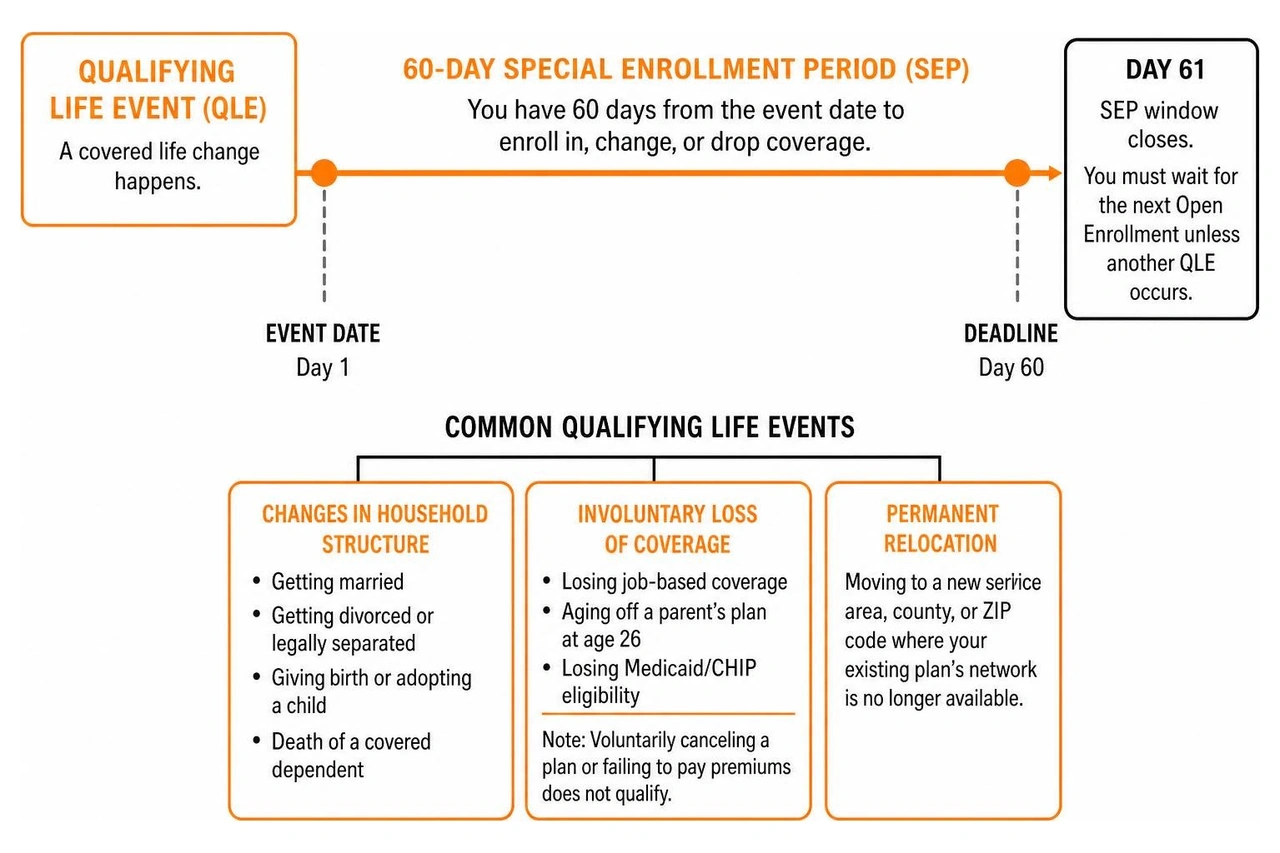
Common events that qualify under federal and state rules include:
- Changes in Household Structure: Getting married, getting divorced or legally separated, giving birth, adopting a child, or experiencing the death of a covered dependent.
- Involuntary Loss of Coverage: Losing job-based coverage, aging off a parent's plan at age 26, or losing Medicaid/CHIP eligibility. Note: Voluntarily canceling a plan or failing to pay premiums does not qualify as an involuntary loss.
- Permanent Relocation: Moving to a new service area, county, or ZIP code where your existing plan's network is no longer available.
- Non-Calendar-Year Renewals: Some small group policies or health reimbursement arrangements renew mid-year; review these guidelines on non-calendar-year renewals to see how anniversary dates create enrollment opportunities.
Step-by-Step Guide to Canceling Your Health Insurance Safely
Canceling insurance without creating administrative headaches requires careful execution. Follow these actionable steps to protect your health and legal rights:
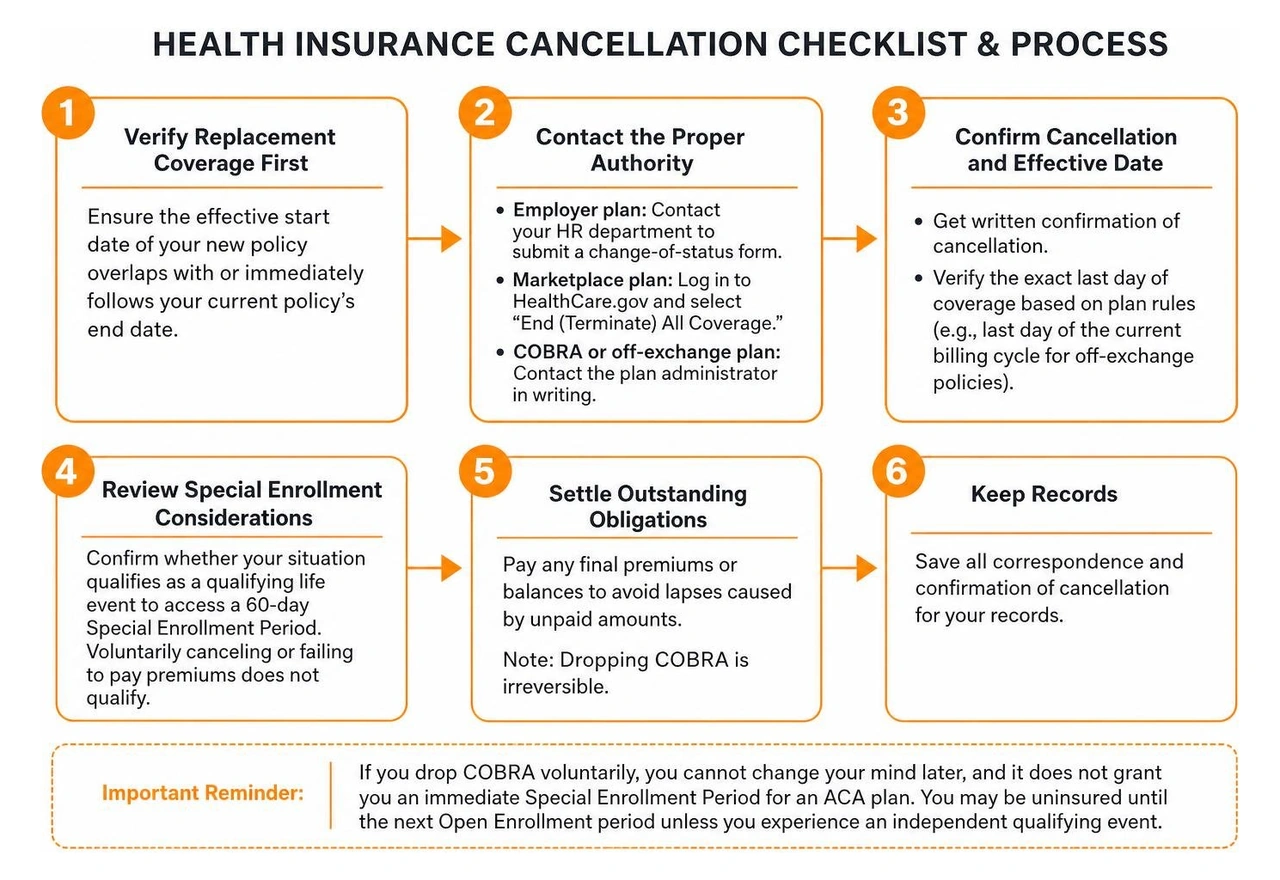
- Verify Replacement Coverage First: Ensure the effective start date of your new policy overlaps with or immediately follows your current policy's end date.
- Contact the Proper Authority:
- For employer plans, contact your Human Resources department to submit a change-of-status form.
- For Marketplace coverage, log in to HealthCare.gov and select "End (Terminate) All Coverage."
- For COBRA or off-exchange plans, contact the plan administrator in writing.
- Submit Verification Documents Promptly: If canceling an employer plan due to a life change, provide your marriage certificate, birth certificate, or loss-of-coverage letter within 30 to 60 days.
- Obtain Written Confirmation: Request a formal letter or email showing the exact date coverage ends. Check future pay stubs or bank statements to confirm premium deductions have stopped.
Financial and Legal Risks of Dropping Health Coverage Mid-Year
Dropping health coverage mid-year without an immediate, robust replacement exposes you to serious financial and legal liabilities.
1. The Catastrophic Uninsured Gap
An emergency room visit, severe illness, or auto collision can result in tens of thousands of dollars in medical debt. In Michigan, personal injury cases often intersect heavily with health coverage. Coordinating medical bills becomes complicated if you lack basic health insurance to handle non-accident-related treatments or immediate hospital charges.
2. Tax Credit Reconciliation and HSA Traps
If you drop an ACA Marketplace plan without properly notifying the exchange, premium subsidies paid on your behalf to the insurer may continue. When you file your federal taxes, you could be forced to repay thousands of dollars in advance premium tax credits.
Furthermore, if you leave a High Deductible Health Plan (HDHP) mid-year, your allowable Health Savings Account (HSA) contribution limit is prorated by the number of months you were actually covered. Depositing excess funds can trigger an IRS tax penalty.
3. Deductibles Reset to Zero
When you switch plans mid-year, any money you paid toward your previous plan's deductible or out-of-pocket maximum is wiped clean. You start at zero with your new carrier, substantially increasing your total medical spending for the remainder of the calendar year.
Frequently Asked Questions About Canceling Insurance Mid-Year
What happens if I just stop paying my health insurance premiums?
Simply canceling your auto-pay or ignoring monthly invoices is one of the worst ways to end coverage. Individual and ACA plans provide a grace period (ranging from 30 days up to 90 days for subsidized Marketplace plans). During this window, your coverage technically remains active, but the insurer may hold your medical claims.
If you do not pay, the insurer terminates your coverage retroactively. You may still be legally liable for unpaid premiums accrued during the active grace period, and outstanding balances can be referred to debt collection agencies, harming your credit score.
Can I cancel health coverage for just one dependent while keeping my own?
Yes, but the exact mechanism depends on your plan. On the ACA Marketplace, you can log in, edit your household application, and remove a specific family member (for example, a child who secured their own employer plan).
For workplace plans, you must demonstrate a Qualifying Life Event specific to that dependent to remove them mid-year. Public and private employers, such as those governed by Wayne County employee benefit enrollment guidelines, require formal notification and proof of alternative coverage before dropping dependents outside the annual open enrollment window.
What are my options if I cancel my plan and have no Special Enrollment Period?
If you voluntarily canceled your insurance and cannot qualify for an SEP, your immediate options are limited until the federal Marketplace Open Enrollment opens on November 1:
- Medicaid and CHIP: Enrollment for low-income individuals and families is open year-round with no open enrollment deadlines.
- Healthcare Sharing Ministries or Short-Term Plans: While these non-ACA options exist, be aware they often exclude pre-existing conditions and are not comprehensive health insurance.
Conclusion
Understanding when you can step away from a health insurance plan protects both your physical well-being and your financial security. Whether you are dealing with employer cafeteria plans, navigating HealthCare.gov, or managing COBRA continuation, always verify your dates, document your requests, and avoid uninsured gaps.
At Hamo Law Firm, we see how sudden injuries and complex insurance rules impact Michigan families. Ensuring seamless coordination between your primary health coverage and Michigan no-fault coverage is critical if you are injured in an accident. If you find yourself facing unpaid medical bills, wrongful insurance claim denials, or a severe personal injury, our team brings over 40 years of dedicated trial experience to fight for the compensation you deserve. Contact us today for a free consultation.