
What Is an Auto Insurance Deductible?

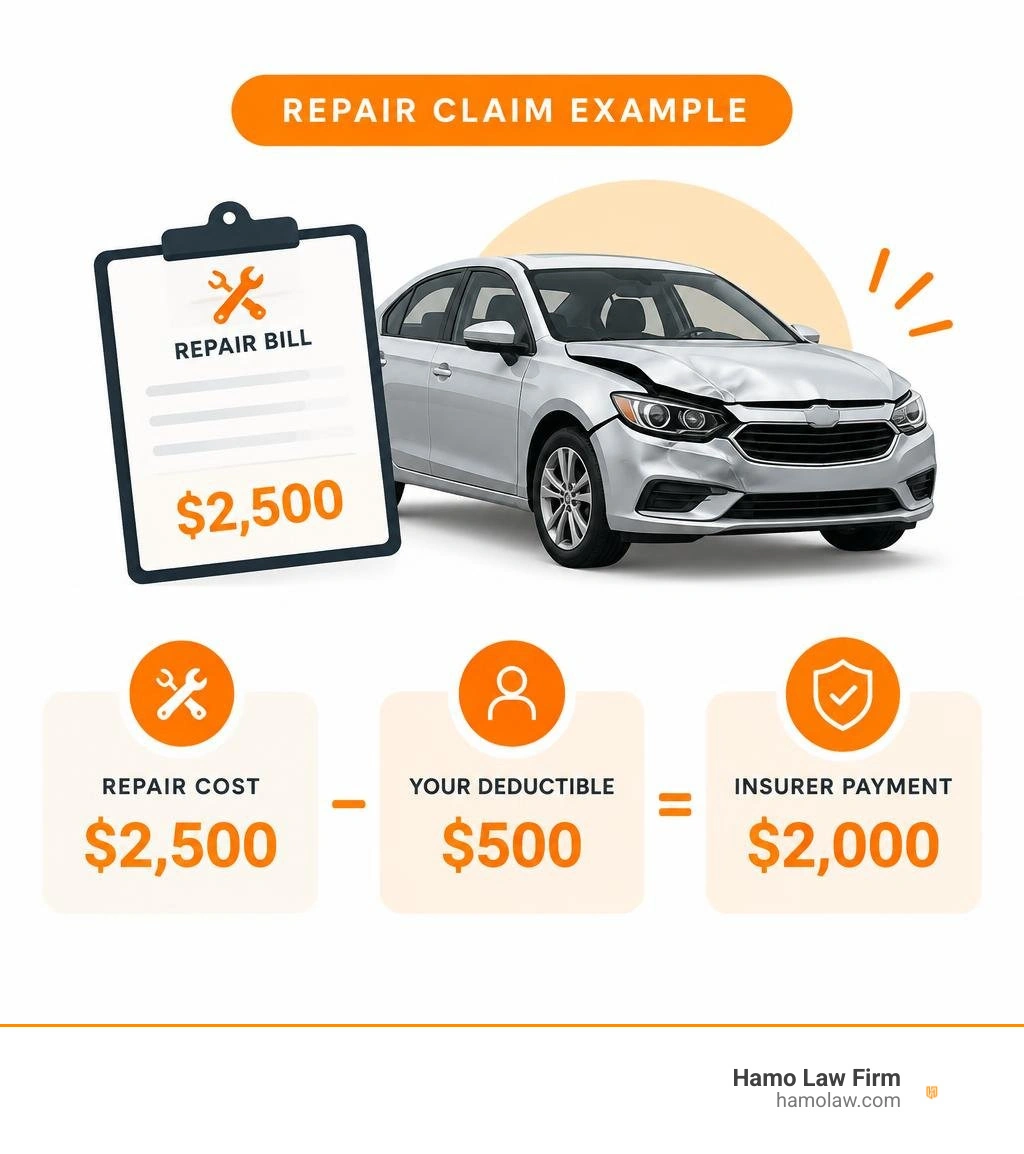
An auto insurance deductible is the amount you cover on a claim for damage to your car. If repairs cost $2,500 and your collision deductible is $500, your insurer generally pays $2,000 and you cover $500. Collision and comprehensive coverage usually have separate deductibles.
A higher deductible often lowers your monthly premium, but it leaves you with more to pay after a claim. The right choice is one you could afford on short notice. In Michigan, whether you owe a deductible after a crash can also depend on your collision coverage and how the claim is handled.
I'm George Hamo, and this guide will help you weigh those choices before you need to file a claim.
How an Auto Insurance Deductible Works and When You Pay
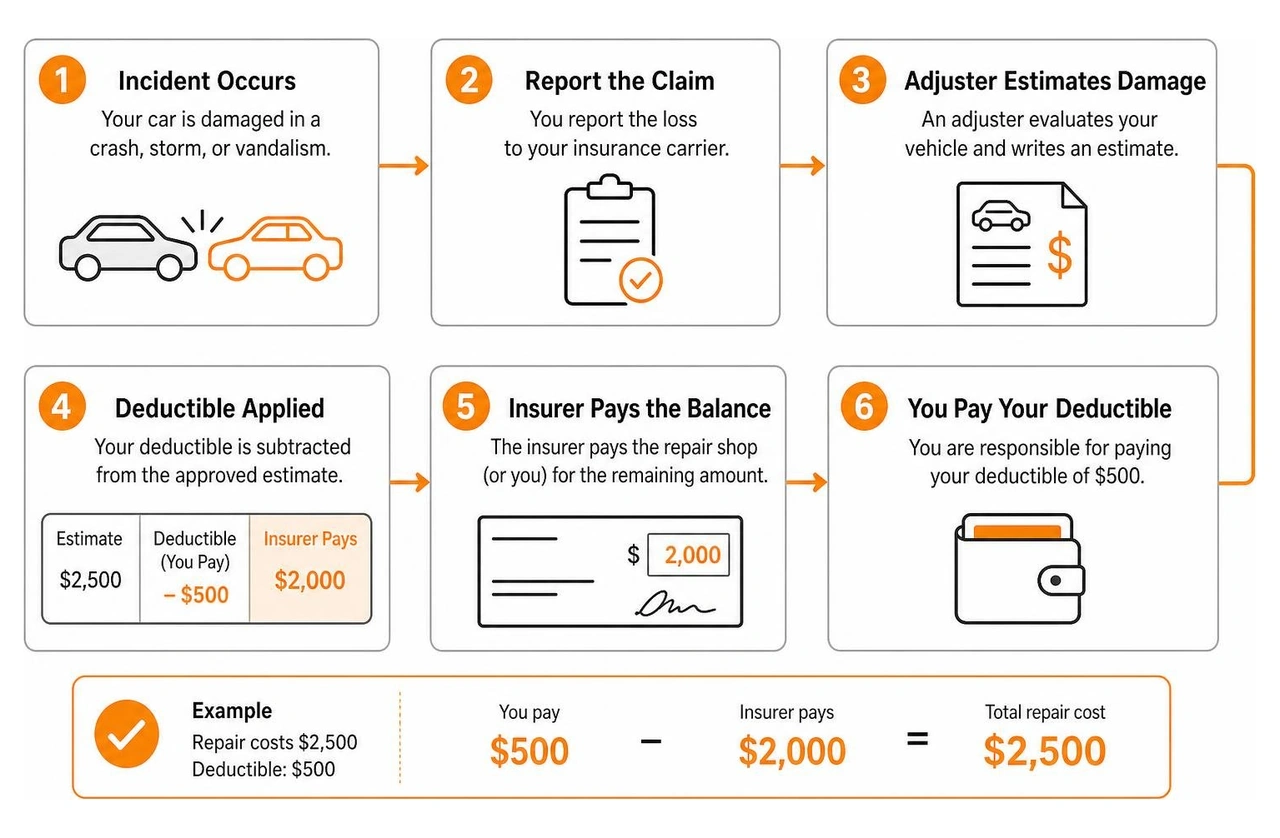
Gaining a solid foundation by understanding how car insurance deductibles work is essential whenever you set up a policy or submit a claim. When your car suffers physical damage from a crash, a severe storm, or vandalism, you report the loss to your carrier. An insurance adjuster evaluates the vehicle and writes an estimate.
Your deductible is the portion of that approved estimate you remain responsible for before the insurance carrier steps in to pay the balance. Rather than sending a separate check to your insurance company, the deductible is subtracted directly from the settlement. If the vehicle is repairable, the carrier issues payment minus your deductible. In scenarios where a car is deemed a total loss—which now happens in roughly 27% of all auto claims nationwide—the insurer calculates the vehicle’s actual cash value (ACV) immediately before the crash, subtracts your deductible, and cuts a check for the remaining equity.
Collision vs. Comprehensive: Types of Auto Insurance Deductible Coverage
Only specific policy provisions carry a deductible. Physical damage protections require you to share in the financial risk of vehicle repairs, including:
- Collision Coverage: Covers physical impact damage when your vehicle hits another vehicle, a stationary object like a guardrail or tree, or rolls over. With an average repairable collision claim reaching $4,768, collision coverage protects you against substantial out-of-pocket repair costs.
- Comprehensive Coverage: Covers non-collision incidents outside your immediate control, such as vehicle theft, windshield cracks, vandalism, hail, fire, fallen tree branches, or animal strikes (with the average animal-strike repair costing $5,600).
- Uninsured Motorist Property Damage (UMPD): In certain jurisdictions, drivers might wonder does uninsured motorist have a deductible. Where available, UMPD policies often carry lower deductibles (typically $100 to $250) when an uninsured driver damages your vehicle.
By contrast, third-party liability coverages—such as Bodily Injury Liability and Property Damage Liability—never require you to pay a deductible. If you cause an accident that injures someone else or damages municipal property, your insurer covers the losses up to your chosen policy limits starting from dollar one.
When and How You Actually Pay the Deductible
A common misconception is that you write a check to your insurer when filing a claim. In reality, you pay your deductible directly to the licensed auto repair facility when you pick up your restored vehicle.
When handling car insurance policy deductibles, the insurer pays the body shop its approved portion, and the shop collects your designated deductible amount before handing back your keys. If your car is declared a total loss, no body shop is involved; instead, the insurer simply reduces your final settlement payout by the exact amount of your deductible.
Comparing Auto Insurance Deductible Amounts: $500 vs. $1,000
Choosing between a standard $500 deductible and a higher $1,000 deductible is one of the most common decisions policyholders face.
| Deductible Amount | Average Monthly Full Coverage Premium | Estimated Annual Premium | Out-of-Pocket Risk Per Claim | Typical Break-Even Horizon |
|---|---|---|---|---|
| $250 | $155 | $1,860 | $250 | Baseline |
| $500 | $135 | $1,620 | $500 | 1.0 to 1.5 Years |
| $1,000 | $110 | $1,320 | $1,000 | 1.5 to 2.5 Years |
| $2,000+ | $95 | $1,140 | $2,000 | 4.0+ Years |
Looking at market research and average costs for car insurance with a $500 deductible, full coverage with a $500 deductible averages approximately $135 per month. Increasing your deductible from $200 to $500 can lower your collision and comprehensive premiums by 15% to 30%, while jumping to a $1,000 deductible can trim your costs by up to 40%.
The Premium vs. Out-of-Pocket Trade-Off
The financial mechanism is straightforward: insurers reward policyholders who take on greater financial responsibility by lowering monthly rates. Selecting a $500 deductible provides a balanced safety net, ensuring you won't face an overwhelming bill if an unexpected crash occurs.
Opting for a $1,000 deductible puts extra cash back into your pocket each month, but it requires you to maintain at least $1,000 in liquid emergency reserves so an unexpected accident doesn't disrupt your household finances.
Running the Break-Even Math
To determine if raising your deductible makes financial sense, compare your annual premium savings against the additional out-of-pocket risk:
- Calculate the Risk Gap: Moving from a $500 deductible to a $1,000 deductible exposes you to an additional $500 of out-of-pocket expense if you file a claim.
- Calculate Annual Premium Savings: If increasing your deductible saves you $25 per month, your annual savings equal $300.
- Find the Break-Even Point: Divide the $500 risk gap by the $300 annual savings. Your break-even period is 1.67 years (approximately 20 months).
Given that the average U.S. driver files a collision claim only once every 17.9 years, a driver with clean driving habits and an adequate emergency fund will often save money over the long term by selecting a $1,000 deductible.
Selecting the Best Deductible Strategy for Your Driving Habits
Before locking in your policy limits and deductibles, evaluate these core lifestyle and financial factors:
- Emergency Cash Reserves: Never choose a deductible higher than what you can comfortably pay from liquid savings on 24 hours' notice.
- Annual Commute & Mileage: Long daily highway commutes through congested corridors like I-75 or I-69 increase collision exposure, making lower deductibles more sensible.
- Vehicle Market Value: If your older vehicle is worth less than $3,000 to $4,000, paying high premiums for low deductibles may not make financial sense.
- Lender & Lease Obligations: Auto loan and lease contracts commonly cap collision and comprehensive deductibles at $1,000 to protect the lienholder's collateral.
How to Choose the Right Auto Insurance Deductible for Your Budget
You do not have to select matching deductibles across every coverage category. A split-deductible strategy allows you to carry a $1,000 collision deductible alongside a $250 or $500 comprehensive deductible. Comprehensive coverage is typically less expensive, meaning you can maintain a low out-of-pocket threshold for cracked windshields, storm damage, or animal impacts without significantly raising your monthly payment.
When unexpected losses arise, knowing effective strategies when dealing with insurance companies ensures adjusters do not improperly apply multiple deductibles to a single chain of events.
Pros and Cons of High vs. Low Deductibles
- High Deductible ($1,000 to $1,500+)
- Pros: Lowers monthly premiums, generates long-term savings for safe drivers, discourages filing small claims that could raise your rates.
- Cons: Requires substantial cash on hand after a crash, increases financial strain if multiple claims occur close together.
- Low Deductible ($100 to $500)
- Pros: Minimizes out-of-pocket expenses during a stressful repair, allows prompt vehicle restoration even with tight personal cash flow.
- Cons: Results in higher monthly premiums, which can lead to overpaying over several claim-free years.
Deductibles in Not-At-Fault Accidents and Special State Rules

Understanding how fault is determined in a Michigan car accident is critical when evaluating who pays out-of-pocket repair costs. Fault assessments establish which insurer bears primary financial responsibility for physical property damage.
Who Pays the Deductible When You Are Not at Fault?
Outside of pure no-fault jurisdictions, if another driver clearly causes an accident, their property damage liability coverage should cover your repairs without requiring a deductible from you.
However, if third-party liability disputes arise, you may choose to process the repair through your own collision coverage to get your car back on the road quickly. Your carrier will initially deduct your collision amount from the payout and then pursue the at-fault driver's carrier through subrogation. Once subrogation succeeds, your insurer refunds your deductible. When recovery disputes occur, consulting a skilled car property damage attorney helps protect your rights and recover out-of-pocket losses.
Michigan No-Fault and Property Damage Rules
Michigan operates under a unique auto insurance framework. Under official Michigan auto insurance law updates, vehicle damage is handled differently than personal injury claims. While Personal Injury Protection (PIP) covers medical costs regardless of fault, vehicle body damage relies heavily on the specific collision coverage you purchased:
- Broadened (Broad Form) Collision: Your deductible is waived entirely if you were 50% or less at fault for the crash. You only pay your deductible if you were substantially at fault.
- Standard (Basic) Collision: You must pay your deductible regardless of who caused the collision.
- Limited Collision: Your vehicle repairs are covered (subject to your deductible) only if you were 50% or less at fault. If you caused the accident, your insurer pays nothing toward your vehicle's physical repairs.
Learning how Michigan no-fault insurance works allows motorists in Wayne County, Genesee County, and across the state to utilize the Mini-Tort provision. Under Michigan mini-tort rules, if you are involved in an accident where the other motorist is at least 51% at fault, you can recover up to $3,000 from the at-fault driver's insurance to reimburse your unpaid collision deductible or cover uninsured vehicle damage.
Frequently Asked Questions About Auto Insurance Deductibles
What happens if my vehicle repair costs are less than my deductible?
If an auto body shop provides an estimate of $350 to fix a minor bumper scrape and your collision deductible is $500, your insurance company will issue a zero-dollar payout because the damage does not exceed your out-of-pocket threshold. In these scenarios, paying for the repair directly makes the most sense. Filing a claim that pays out zero dollars creates an unnecessary entry on your claims history that could influence future rates.
Can I choose different deductibles for collision and comprehensive?
Yes. Insurers allow policyholders to customize their deductible structures independently. Because comprehensive claims (such as cracked auto glass or deer strikes) often occur without driver error, many policyholders select a $250 or $500 comprehensive deductible while setting their collision deductible at $1,000 to maximize ongoing premium savings.
Does a deductible apply to liability or bodily injury claims?
No. Auto insurance deductibles apply strictly to physical damage coverages on your own vehicle (collision, comprehensive, and specific optional protections). Bodily injury liability, property damage liability, and statutory personal injury protection coverages provide first-dollar coverage up to your chosen policy limits without requiring an out-of-pocket deductible.
Conclusion
Selecting the right auto insurance deductible requires balancing affordable monthly premiums with manageable out-of-pocket risk after an unexpected crash. Whether you opt for a standard $500 threshold or take advantage of annual savings with a $1,000 deductible, your decision should align with your driving habits, vehicle value, and emergency savings.
At Hamo Law Firm, our team brings more than 40 years of trial experience fighting for accident victims across Flint, Detroit, and communities throughout Michigan. If you have questions regarding your rights after a crash, visit our detailed guide to Michigan no-fault insurance and who pays the deductible or contact our office for a free consultation. We operate on a contingency-fee model—meaning you pay no legal fees unless we win your case.