
Is Michigan a No-Fault State for Auto Accidents?

Yes. Michigan is a no-fault state. If you are hurt in a car crash, no-fault benefits can help pay for medical care and lost wages without first proving who caused the accident. That rule comes from Michigan law, MCL 500.3105.
But no-fault does not mean fault never matters. You may still have a claim against a negligent driver for certain losses, and different rules apply to damage to your car. Knowing which claim to make matters, especially when you are injured and dealing with insurers.
I’m George Hamo, and this guide will help you understand what Michigan’s no-fault rules mean for your claim.

Is Michigan a No-Fault State for Auto Accidents? Legal Framework and Mandatory Coverage
Michigan first adopted its comprehensive system under the Insurance Code of 1956 (Act 218), with MCL 500.3179 establishing that the framework applies to motor vehicle crashes taking place since October 1, 1973. Michigan is one of a distinct group of no-fault insurance states that require motorists to purchase first-party injury protections.
Early on, drivers challenged whether the state government could legally force everyone to buy auto insurance. In the landmark case Shavers v. Attorney General, the Michigan Supreme Court affirmed that a compulsory auto insurance system is a constitutional exercise of state authority designed to make sure crash victims receive prompt medical care. The state published a detailed state regulatory guide to no-fault insurance outlining how these consumer safeguards operate.
Understanding how Michigan no-fault insurance works requires looking closely at the specific coverages every registered owner must carry. Driving without them is a misdemeanor offense punishable by fines up to $500, a suspended driver's license, and up to one year in jail.
The Three Mandatory Auto Insurance Coverages in Michigan
To legally operate a vehicle on Michigan roadways—from Flint down through Wayne County and Detroit—every policy must carry three mandatory components under the umbrella of Michigan no-fault coverage:
- Personal Injury Protection (PIP): Covers reasonable and necessary medical treatments, attendant care, lost earnings, and replacement services if you are injured in an accident, regardless of who caused it.
- Property Protection Insurance (PPI): Pays up to $1 million for accidental damage your vehicle inflicts on fixed physical structures, such as buildings, utility poles, guardrails, and properly parked vehicles within Michigan.
- Residual Bodily Injury and Property Damage Liability (BI/PD): Protects you if you are sued by another person following a serious accident. State law sets default liability limits of $250,000 per person and $500,000 per crash for bodily injury, alongside $10,000 for out-of-state property damage. Drivers may choose lower minimum limits of $50,000 per person and $100,000 per crash only by signing an explicit waiver.
How the Question "Is Michigan a No-Fault State for Auto Accidents?" Shapes Injury Claims
Because Michigan operates under this model, your first step after a crash is almost always a "first-party" claim against your own insurance policy rather than the other driver's carrier. Under MCL 500.3105, benefits are payable without regard to fault for accidental bodily injuries arising out of the ownership, operation, maintenance, or use of a motor vehicle.
This means you do not have to wait months for insurance adjusters to argue over traffic camera footage or police reports before getting your hospital bills paid. First-party PIP covers:
- Medical costs (surgeries, physical therapy, hospital visits, prescriptions)
- 85% of your gross lost wages for up to three years (subject to statutory monthly maximum caps)
- Up to $20 per day in ordinary and necessary household replacement services
- Mileage to and from medical treatment appointments
Knowing these distinctions is crucial when handling no-fault insurance claims so you can receive the financial relief you are entitled to without delay.
Personal Injury Protection (PIP) Choices and the 2019 Reforms
Historically, Michigan required all motorists to buy unlimited, lifetime medical PIP coverage. While that provided world-class catastrophic medical support, it also contributed to high rates. In 2019, Michigan had the highest average auto premiums in the nation at $2,611—roughly 79% above the national average—and a staggering 25.5% of Michigan drivers were uninsured.
Major legislative reforms took effect to provide rate relief and choice. By 2021, the statewide average premium fell by 19.1% to $2,112. By 2022, Michigan's uninsured driver rate dropped to 19.6%, and more than 202,000 previously uninsured motorists took advantage of an amnesty program to obtain coverage. In Detroit, representative annual premiums dropped 13.5%, moving from $5,464 down to $4,726. As of October 2026, the average annual cost of full-coverage auto insurance in Michigan is around $2,748 (about $229 per month).
The reforms replaced the old mandatory unlimited model with tiered options. Drivers can now select the amount of PIP medical coverage that best fits their financial risk profile and healthcare situation:
| PIP Medical Choice Level | Eligibility Requirements | Key Policy Considerations |
|---|---|---|
| Unlimited Coverage | Open to all drivers; no special health insurance required | Provides full lifetime medical care with no dollar cap; subject to statutory fee schedules |
| $500,000 Limit | Open to all drivers | Pays up to $500,000 per person per accident for crash-related medical expenses |
| $250,000 Limit | Open to all drivers | Sets a $250,000 cap; can also be paired with exclusions for certain household members with Qualified Health Coverage |
| $50,000 Limit | Driver must be enrolled in Medicaid and household members must have qualifying health coverage or their own PIP | Keeps auto premiums low, but catastrophic medical costs exceeding $50k must be covered by other means |
| Complete PIP Medical Opt-Out | Driver must have Medicare Parts A & B, and all household members must have Qualified Health Coverage or separate PIP | Eliminates the PIP medical premium portion; Medicare or commercial health insurance becomes the primary payer |
The reform also preserved the Michigan Catastrophic Claims Association (MCCA), a non-profit association that reimburses insurers for catastrophic PIP claims exceeding specific statutory thresholds. MCCA assessments are charged per vehicle annually on policies choosing unlimited coverage to keep the catastrophic care fund solvent. To see how these selections play out after an accident, review our practical guide on how no-fault benefits work after a crash as well as our detailed Michigan no-fault insurance overview.
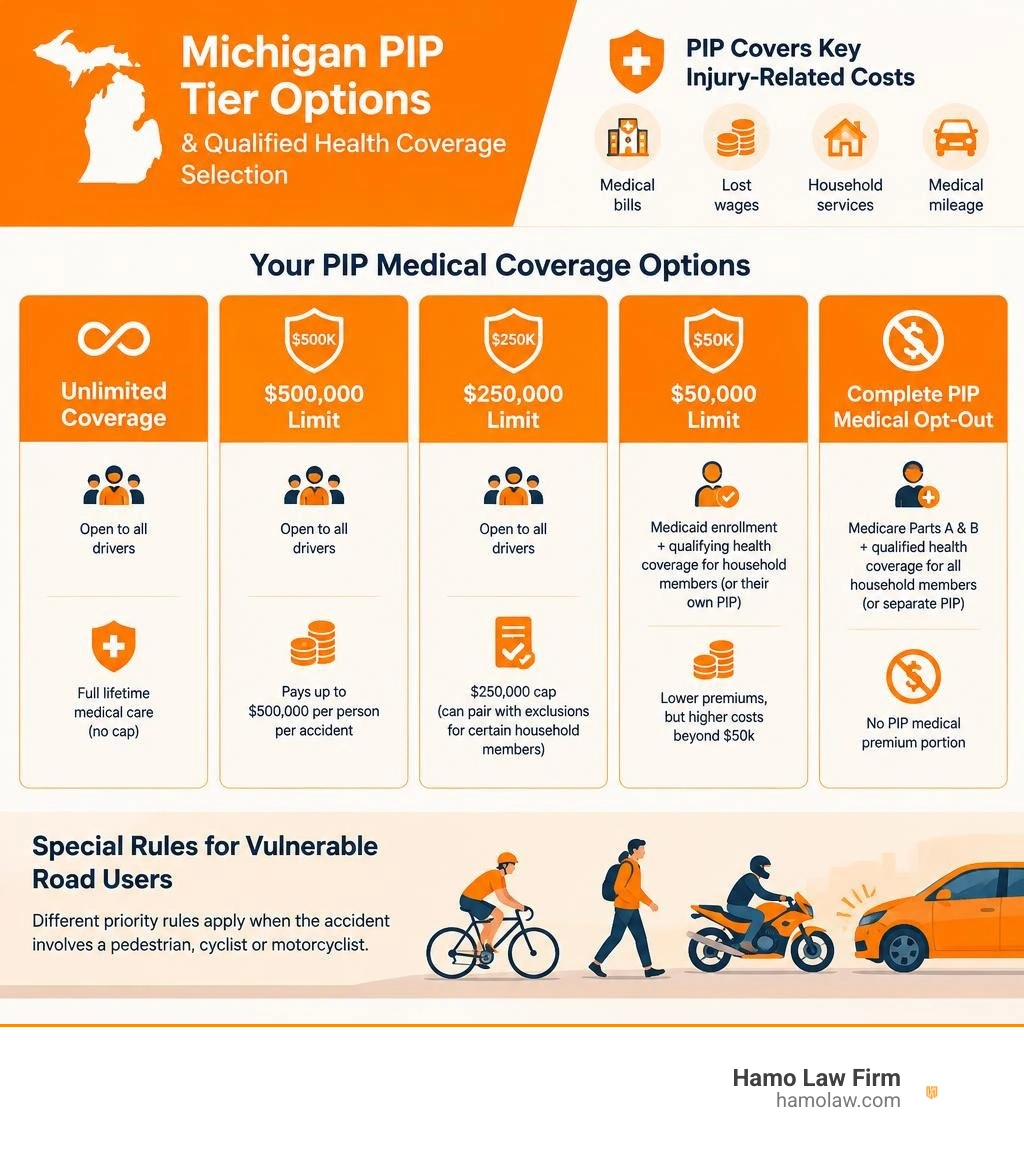
Special PIP Claim Rules for Vulnerable Road Users
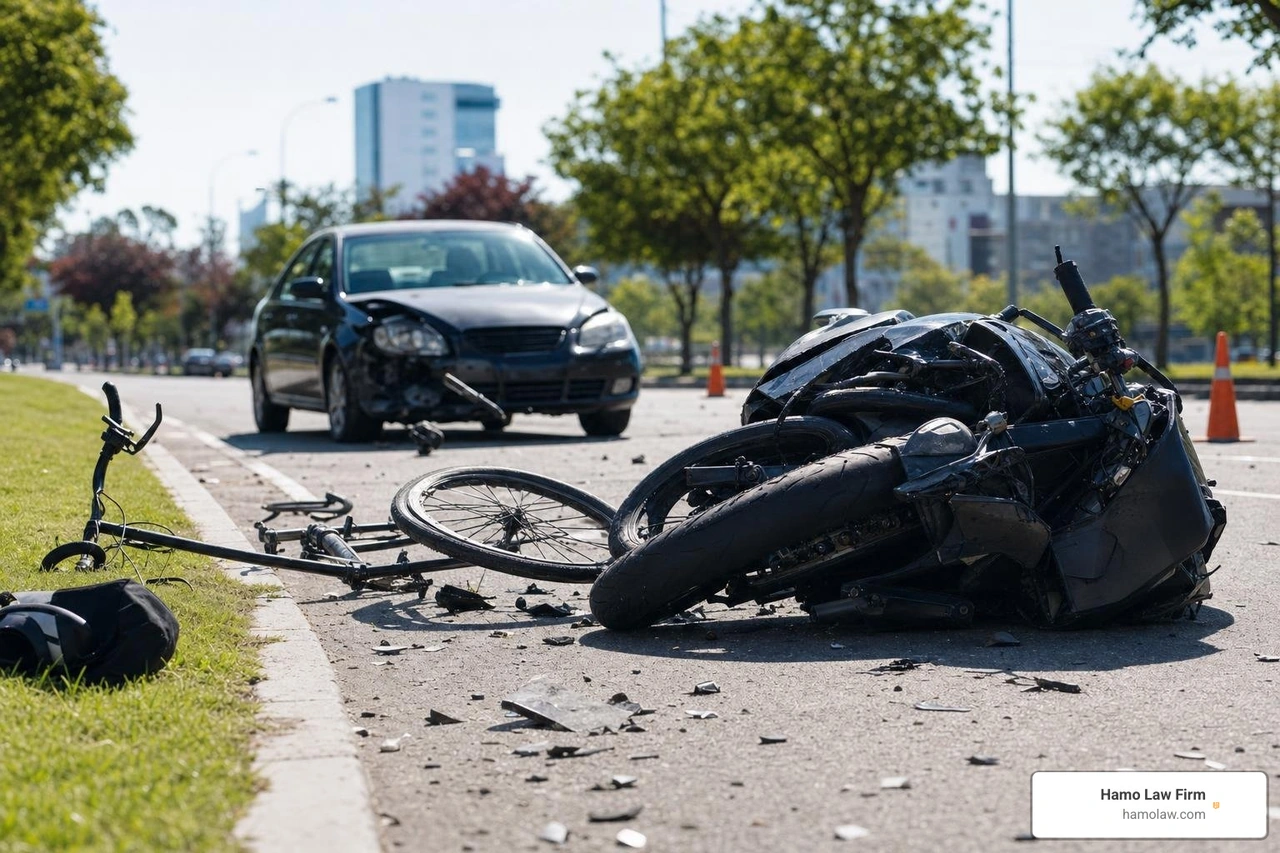
When an accident involves vulnerable road users who might not be sitting inside a standard four-wheeled automobile, Michigan applies specific priority rules to determine who pays PIP benefits:
- Pedestrians: When a vehicle strikes a pedestrian, the pedestrian turns first to their own auto policy or a policy in their household. If no household policy exists, the pedestrian claims PIP benefits from the Michigan Assigned Claims Plan (MACP), capped at $250,000. Learn more about PIP coverage when a pedestrian is hit.
- Bicyclists: Non-motorized cyclists follow the exact same statutory order of priority as pedestrians. Explore how injured cyclists receive no-fault benefits.
- Motorcyclists: Motorcycles are not defined as "motor vehicles" under the Michigan No-Fault Act. If a motorcyclist is injured in a crash involving an automobile, they do not collect from their own motorcycle policy. Instead, priority flows from the insurer of the owner of the motor vehicle involved, to the insurer of the operator of the motor vehicle, and down to the MACP. Read the full details on motorcyclist PIP benefit rules.
Suing for Damages: Tort Thresholds, Comparative Fault, and Mini-Tort
While first-party no-fault benefits cover your immediate financial losses regardless of fault, the law allows you to hold negligent drivers accountable through a "third-party" tort lawsuit under specific legal conditions.

To sue the at-fault driver for non-economic damages—commonly referred to as pain, suffering, and mental anguish—your injuries must meet Michigan's statutory threshold under MCL 500.3135:
- Death
- Permanent serious disfigurement (such as significant scarring or loss of a limb)
- Serious impairment of body function
Under Michigan jurisprudence, demonstrating a serious impairment of body function requires showing an objectively manifested impairment of an important body function that affects your general ability to lead your normal life. Read our detailed breakdown on how no-fault limits your ability to sue. You can also sue an at-fault driver for excess economic losses, such as wage losses that exceed the three-year statutory duration or monthly no-fault caps, or medical bills that exceed your chosen PIP limit.
Establishing liability remains critical for third-party tort claims; see our analysis of how fault is determined in Michigan crashes.
Modified Comparative Negligence and Non-Economic Damages
Michigan uses a modified comparative negligence standard (specifically a 51% bar rule) for third-party auto accident lawsuits:
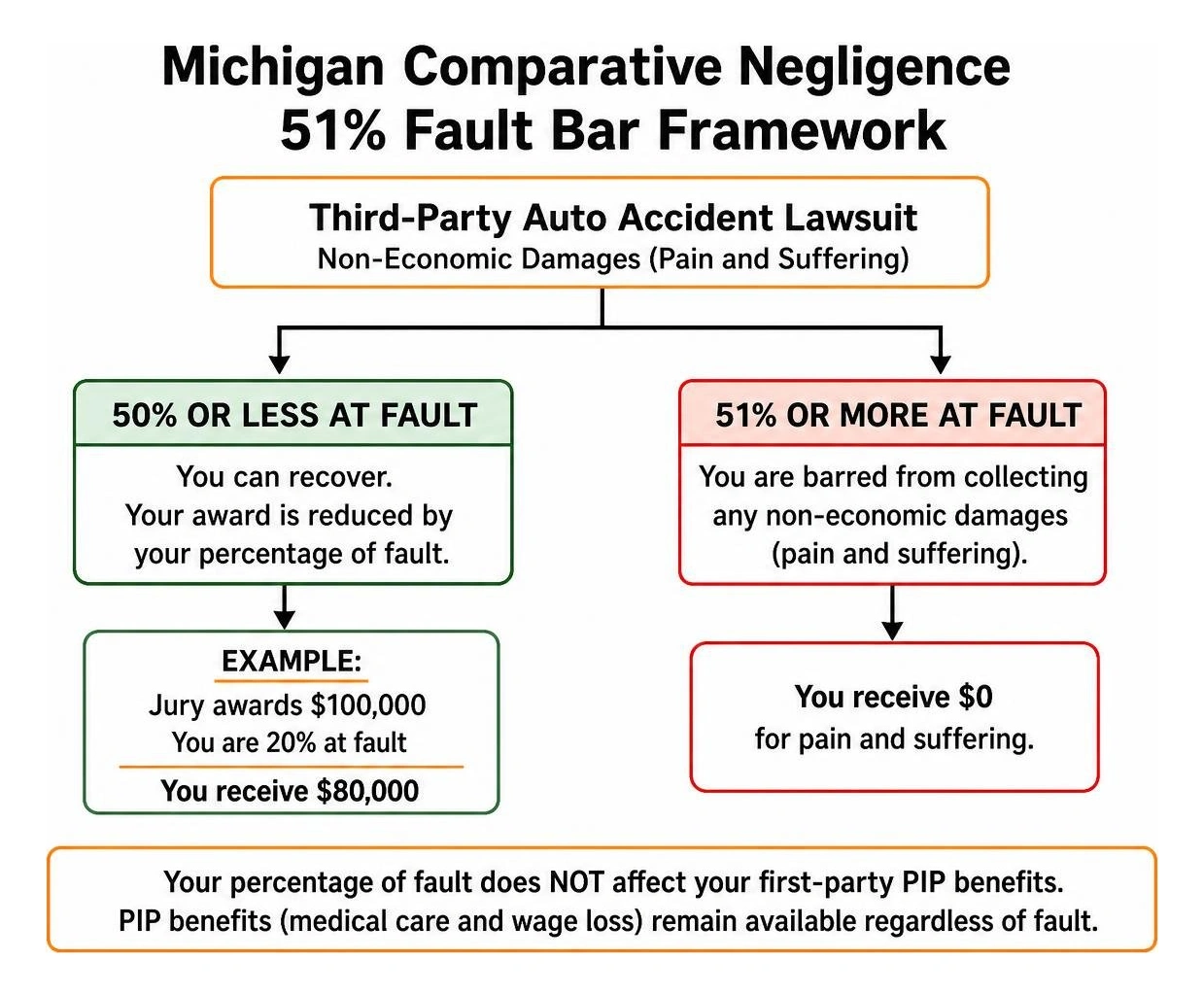
- If you are 50% or less at fault, your recovery for non-economic damages (pain and suffering) is reduced proportionally by your percentage of fault. For example, if a jury awards $100,000 but finds you 20% responsible for the crash, you will receive $80,000.
- If you are 51% or more at fault, you are completely barred from collecting any compensation for pain and suffering.
- However, your share of fault does not bar you from receiving your regular first-party PIP benefits (medical care and wage loss) through your own insurer, because PIP is entirely fault-independent.
Insurance adjusters often try to assign blame to injured claimants to push their liability percentage past 50% and avoid paying settlements. Having a skilled legal advocate ensures fault is properly investigated and represented.
Why Asking "Is Michigan a No-Fault State for Auto Accidents?" Matters for Vehicle Damage
A frequent point of confusion is vehicle damage. Michigan no-fault insurance does not pay to repair your vehicle if it is damaged in a standard moving collision.
To get your car repaired after a crash, you must rely on:
- Your Own Optional Collision Coverage: Broad form, standard, or limited collision coverage purchased on your policy.
- The Michigan Mini-Tort Law (MCL 500.3135(3)(e)): If another driver is at least 50% at fault for the crash, you can sue that driver (or their insurer's limited property damage liability rider) for up to $3,000 to cover your unpaid vehicle damage or collision deductible.
If you are wondering how out-of-pocket costs are resolved, read our guide on who pays the deductible under Michigan no-fault rules.
Crucial Deadlines and Steps After a Michigan Auto Accident
Taking prompt action after a motor vehicle accident protects both your health and your legal rights under Michigan's strict deadlines.
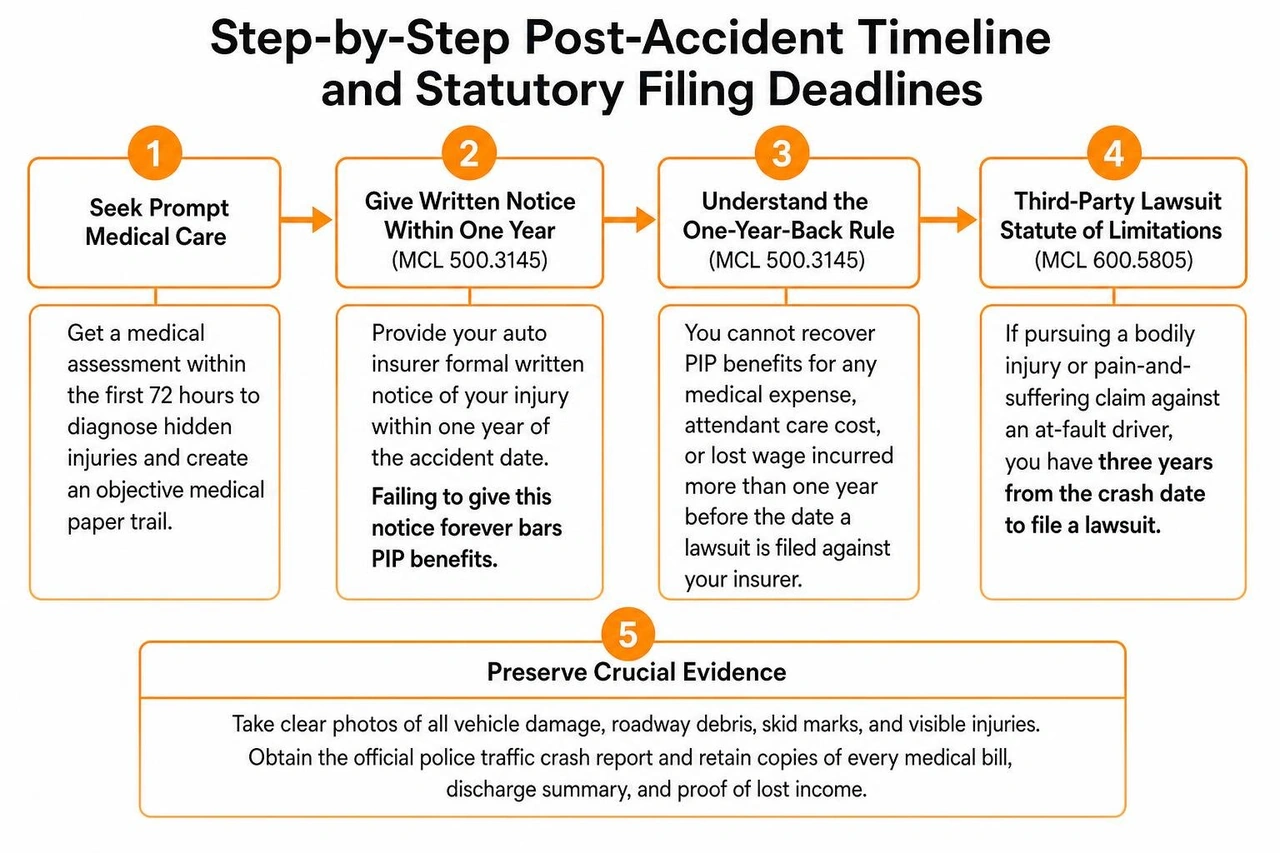
- Seek Prompt Medical Care: Adrenaline frequently masks pain and soft-tissue trauma immediately after a crash. Getting a thorough medical assessment within the first 72 hours helps diagnose hidden injuries like whiplash or herniations and creates an objective medical paper trail.
- Give Written Notice Within One Year (MCL 500.3145): You must provide your auto insurer formal written notice of your injury within one year of the accident date. Failing to give this notice forever bars you from claiming PIP benefits for that accident.
- Understand the One-Year-Back Rule: Under MCL 500.3145, you cannot recover PIP benefits for any medical expense, attendant care cost, or lost wage incurred more than one year before the date a lawsuit is filed against your insurer. Learn more about the one-year-back rule for PIP benefits.
- Third-Party Lawsuit Statute of Limitations: If you are pursuing a bodily injury or pain-and-suffering claim against an at-fault driver, you have three years from the crash date to file a lawsuit under Michigan's general personal injury statute of limitations (MCL 600.5805).
- Preserve Crucial Evidence: Take clear photos of all vehicle damage, roadway debris, skid marks, and visible injuries. Obtain the official police traffic crash report and retain copies of every medical bill, discharge summary, and proof of lost income.
Frequently Asked Questions About Michigan No-Fault Insurance
Does Michigan No-Fault Insurance Cover Vehicle Damage?
No. Standard mandatory no-fault insurance covers medical care, wage replacement, and third-party property damage to stationary objects, but it does not pay for damage to your own vehicle in a crash. You need optional collision coverage to pay for car repairs, or you can pursue a mini-tort claim against the at-fault driver for up to $3,000 of your out-of-pocket repair costs or insurance deductible.
Can You Sue the At-Fault Driver for Pain and Suffering in Michigan?
Yes, but only if your injuries qualify as a "threshold injury" under Michigan law—meaning the crash resulted in death, permanent serious disfigurement, or serious impairment of body function. Additionally, under Michigan's comparative fault rules, you cannot recover non-economic damages if you are found to be 51% or more at fault for the accident.
What Happens If an Uninsured Driver Causes an Accident in Michigan?
If you carry auto insurance, your own PIP coverage will pay your medical bills and lost wages regardless of the other driver's uninsured status. If you do not have an auto policy in your household, your claim is submitted through the Michigan Assigned Claims Plan (MACP), which provides up to $250,000 in PIP medical coverage. Uninsured drivers who cause crashes face misdemeanor charges, are barred from suing for their own injuries, and can be held personally liable for damages.
Conclusion
Understanding Michigan’s no-fault system is essential if you want to protect your physical recovery and your financial security after an auto collision. While the law ensures immediate access to medical support and wage benefits regardless of fault, navigating insurance paperwork, strict statutory deadlines, and third-party liability thresholds can quickly become overwhelming.
At Hamo Law Firm, our legal team brings more than 40 years of trial experience fighting for accident victims across Flint, Detroit, Genesee County, and Wayne County. We understand the tactics insurance carriers use to minimize or deny valid claims, and we work on a contingency-fee model—meaning you pay no legal fees unless we successfully win your case.
If you or a loved one has been injured in a crash, explore your options for Michigan no-fault coverage and legal representation or reach out to our team today for a free consultation.