
What Happens to Your Insurance After an At-Fault Accident?

How long does an at-fault accident stay on your insurance record is one of the most common questions drivers ask after a crash — and the answer directly affects how much you pay for coverage over the next several years.
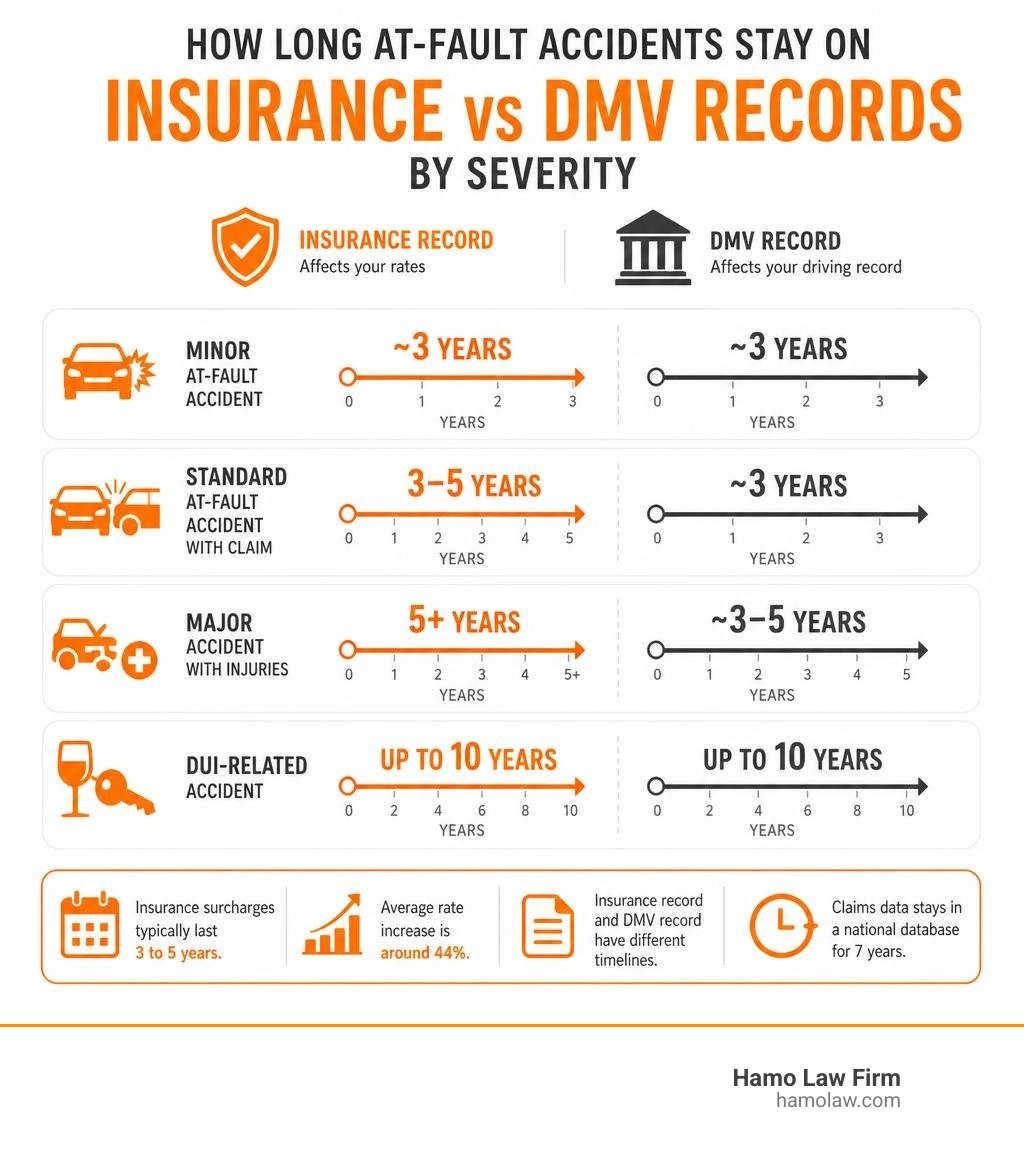
Here's the short answer:
| Accident Type | Typical Time on Insurance Record |
|---|---|
| Minor at-fault accident | ~3 years |
| Standard at-fault accident with claim | 3–5 years |
| Major accident with injuries | 5+ years |
| DUI-related accident | Up to 10 years |
Key facts to know right away:
- Most insurers apply a premium surcharge for 3 to 5 years after an at-fault accident
- The average rate increase is around 44% — roughly $660 more per year on a $1,500 policy
- Your DMV driving record and your insurance claims record are two separate things with different timelines
- A national claims database called the CLUE report (maintained by LexisNexis) retains accident data for 7 years, even after your insurer stops surcharging you
If you're a Michigan driver dealing with the aftermath of a crash, understanding these timelines matters. Insurance companies use your accident history to set your rates — and the longer a serious incident stays on your record, the more you pay.
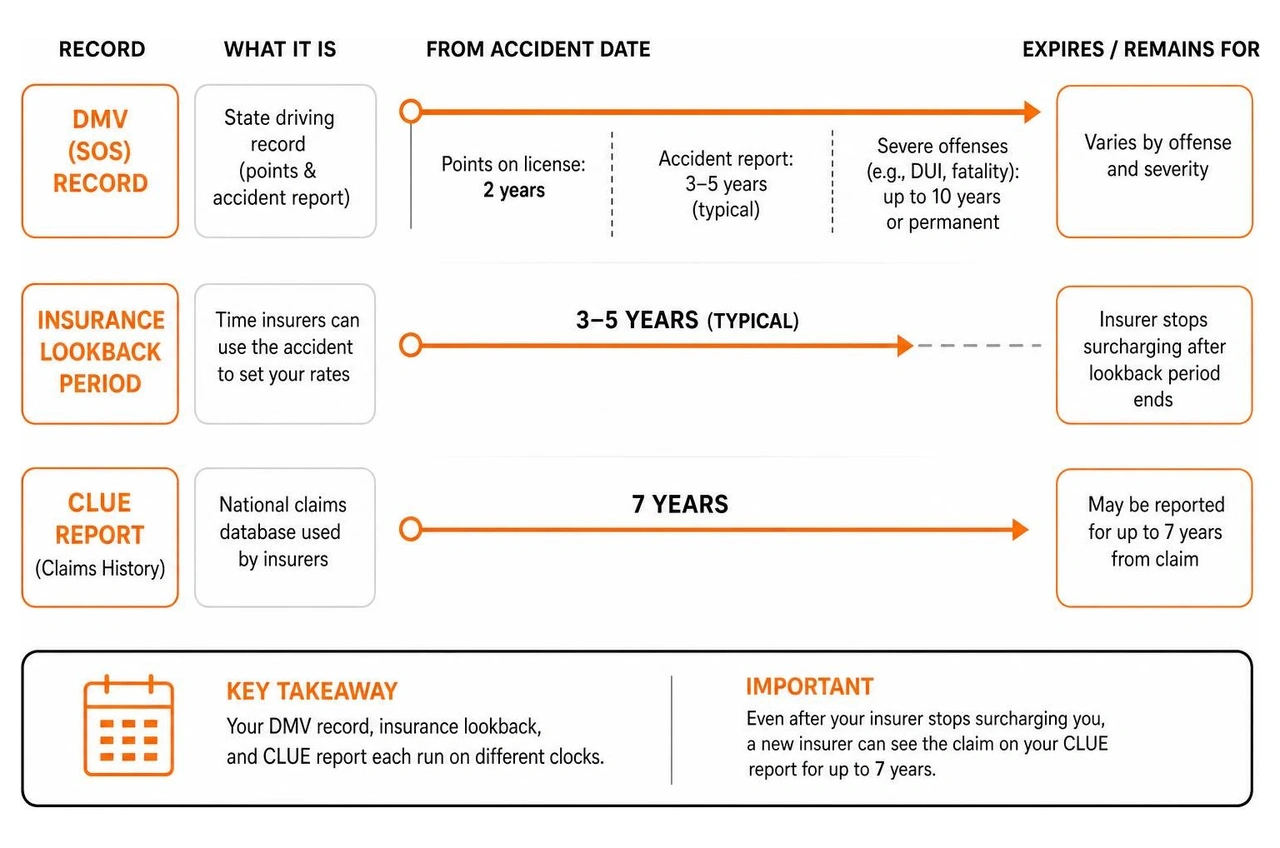
DMV Record vs. Insurance Lookback: Two Different Clocks
When you are involved in a collision in Michigan, the incident is recorded in more than one place. Many drivers mistakenly believe that once points clear from their driver's license, their car insurance rates will automatically drop. In reality, you are dealing with two entirely different clocks: your official state driving record and your insurance lookback window.
The Michigan Secretary of State (SOS) Record
In Michigan, the Secretary of State (our version of the DMV) manages your official driving record. If you are convicted of a traffic violation associated with an accident (such as speeding, tailgating, or reckless driving), points are added to your license.
Under Michigan law, these points generally remain on your driving record for two years from the date of conviction. However, the actual accident report itself—which indicates that a crash occurred—typically remains on your public Secretary of State record for at least three to five years, and sometimes up to ten years or permanently for severe offenses like a DUI or a crash resulting in a fatality.
The Insurance Lookback Period
Insurance companies do not rely solely on state DMV records to determine your premium. Instead, they use an internal rating system called a "lookback period." This is the window of time during which an insurer can legally and contractually consider past accidents and violations when calculating your premium.
For most standard auto insurance providers, the lookback period for an at-fault accident is between three and five years. During this time, the insurer applies an "at-fault surcharge" to your policy. Even if the points on your Michigan driver's license have expired, your insurance company can continue to charge you a higher rate until the lookback period closes.
The CLUE Report (The Insurance Industry's Shared Memory)
How do insurance companies know about your accident history even if you switch carriers? They use the Comprehensive Loss Underwriting Exchange (CLUE) report, a national database maintained by LexisNexis.
Whenever you file a claim, inquire about a claim, or are involved in an accident reported to an insurer, that data is uploaded to your CLUE report. Under federal law, LexisNexis can retain this claims history data for seven years.
Even if your current insurer has a three-year lookback window and stops surcharging you, a new insurance company you get a quote from can pull your CLUE report and see the accident for up to seven years. To learn more about how these records interact, you can read about How Long Does an Accident Stay on Your Record? (2026) - InsureMojo.
How Long Does an At-Fault Accident Stay on Your Insurance Record?
If you are determined to be at fault for a car accident, your premium will almost certainly increase at your next policy renewal. The exact duration of this financial impact depends heavily on your insurer’s specific lookback window and the laws of your state.
In Michigan, the question of how long does an at-fault accident stay on your insurance record is heavily tied to how the claim is filed under our unique no-fault system. Generally, you can expect an at-fault surcharge to remain on your policy for three to five years.
The severity of the accident plays a massive role in how much your premium increases. Minor "fender benders" with minimal property damage will cost you much less over time than a major collision involving severe bodily injury or a DUI.
To give you an idea of the financial impact, here is a breakdown of average premium increases based on accident severity:
| Accident Severity | Average National Premium (Before) | Average National Premium (After) | Average Annual Increase ($) | Average Percentage Increase (%) |
|---|---|---|---|---|
| No Prior Accidents (Clean Record) | $3,475 | $3,475 | $0 | 0% |
| Minor At-Fault Property Damage | $3,475 | $4,135 | $660 | ~19% |
| Standard At-Fault Accident | $3,475 | $5,040 | $1,565 | ~45% |
| At-Fault Accident with Bodily Injury | $3,475 | $5,386 | $1,911 | ~55% |
| DUI-Related At-Fault Accident | $3,475 | $6,324 | $2,849 | ~82% |
To explore these rate changes in deeper detail, check out How Much Does Insurance Go Up After an At-Fault Accident?.
How Long Does At-Fault Accident Stay on Insurance Record After a Minor Crash?
A minor crash is typically defined as an accident that involves only property damage (usually under a certain dollar threshold, like $1,500) and no bodily injuries. Examples include backing into a parked car in a Flint parking lot or rear-ending someone at a very low speed on a slick winter morning.
For minor at-fault accidents, most insurance companies will apply a surcharge to your premium for exactly three years. Because Michigan is a no-fault state, minor property damage claims to other vehicles are often handled through what is known as the "mini-tort" provision. Under Michigan's mini-tort law, if you are at fault in an accident, the other driver can sue you in small claims court for up to $3,000 to cover their out-of-pocket collision deductible.
If your insurance company pays out a mini-tort claim or a collision claim for your own vehicle, this triggers the three-year surcharge clock. To better understand how these claims are structured, you can read our guide on How Does Michigan No-Fault Insurance Work.
How Long Does At-Fault Accident Stay on Insurance Record After a Serious Crash?
A serious crash involving significant property damage, bodily injury, or wrongful death is treated much differently by insurers. If you cause an accident in Genesee County or Wayne County that results in another person being hospitalized, your insurance company will face a substantial payout under your Residual Liability (bodily injury) coverage.
For serious crashes, insurers almost always enforce a full five-year lookback and surcharge period. Furthermore, the rate increase will be significantly higher than it would be for a minor dent. While a minor crash might raise your rates by 20% to 30%, a serious injury accident can cause your premiums to spike by 50% or more.
The most severe scenario is a DUI-related at-fault accident. If you are convicted of operating while intoxicated (OWI) in Michigan and cause an accident, the financial consequences are catastrophic. A DUI-related accident can stay on your insurance record and affect your rates for seven to ten years. Some mutual insurance carriers may even refuse to insure you permanently, forcing you into high-risk, high-cost insurance pools.
Understanding how responsibility is assigned in these high-stakes scenarios is critical; you can read about How Fault Is Determined In A Michigan Car Accident to see how insurance adjusters and courts evaluate these crashes.
Does a Not-At-Fault Accident Go on Your Record?
One of the most frustrating aspects of auto insurance is discovering that even when you did absolutely nothing wrong, an accident can still find its way onto your record.
If another driver runs a red light in Detroit and smashes into your car, the accident is classified as "not-at-fault" for you. However, this incident will still be recorded on your CLUE report. LexisNexis retains not-at-fault accidents for the standard seven-year period, just like at-fault claims.
Why Do Not-At-Fault Accidents Affect Your Rates?
You might wonder: If I wasn't at fault, why does the insurance company care?
Insurers are in the business of evaluating risk. Statistically, insurance databases show that drivers who have been involved in a not-at-fault accident are slightly more likely to be involved in another accident in the future compared to drivers with completely blank records. This could be due to factors like their daily commute route, the times of day they drive, or simply bad luck.
While Michigan law prevents insurers from raising your rates solely because you filed a clean PIP (Personal Injury Protection) claim after a crash you didn't cause, insurers can still adjust your overall risk tier. A not-at-fault accident can raise your annual premium by a small margin—typically around 7% to 12% (roughly $225 per year)—depending on the carrier.
Additionally, having a not-at-fault accident on your CLUE report can strip away your "claims-free discount," which indirectly causes your premiums to rise.
How to Manage and Reduce the Impact of an Accident on Your Rates
If you have an at-fault accident on your record, you aren't completely helpless. There are several proactive steps you can take to minimize the financial damage and lower your premiums while you wait out the three-to-five-year lookback window.
- Inquire About Accident Forgiveness: Some insurance policies include "accident forgiveness" coverage. If you purchased this protection before your crash, your insurer will forgive your first at-fault accident, meaning your rates won't increase. That accident forgiveness does not erase the crash from your CLUE report or your driving record; it simply prevents your current insurer from surcharging you.
- Complete a Defensive Driving Course: Many insurance companies offer a discount (usually 5% to 10%) if you complete an approved, state-certified defensive driving or driver improvement course. This is an easy way to offset a portion of your post-accident surcharge.
- Increase Your Deductibles: If you carry comprehensive and collision coverage, raising your deductible from $500 to $1,000 can lower your monthly premium by 10% to 15%. Just make sure you keep enough money in emergency savings to cover the higher deductible if you get into another accident.
- Shop Around at Renewal Time: Different insurance companies weight at-fault accidents differently. For example, some carriers look back only three years, while others look back five. If your accident occurred three and a half years ago, switching to a carrier with a three-year lookback window could instantly save you hundreds of dollars. Always wait until your policy renewal date to compare quotes.
- Keep Your Record Spotless Moving Forward: The absolute best way to lower your rates is to avoid further violations and claims. As an at-fault accident ages, its impact on your premium gradually decreases, provided you don't add new tickets or crashes to your record.
When navigating these post-accident discussions with claims adjusters, it helps to be prepared. For practical tips, read our guide on Dealing With Insurance Companies After An Accident What You Need To Know.
Frequently Asked Questions About Accident Records
Can an accident be removed from your insurance record early?
Generally, no. You cannot remove a valid, accurate at-fault accident from your insurance record or your CLUE report before the standard lookback period expires.
However, you can and should dispute errors. If your CLUE report incorrectly lists you as at-fault for an accident where you were actually the victim, or if an accident is listed twice, you have the right to file a formal dispute with LexisNexis. You will need to provide supporting evidence, such as a police report, a letter from your insurer, or a court judgment.
If your insurance company is acting in bad faith or denying a legitimate claim, it is wise to consult a lawyer. For more information, see our resource on What If My Insurance Company Denies My Claim.
How much does your insurance go up after an at-fault accident?
On average, a single at-fault accident will increase your car insurance premium by 44% to 47%, which translates to roughly $660 to $1,565 more per year depending on your base rate. In Michigan, where auto insurance premiums are already among the highest in the nation due to unlimited PIP medical coverage options, an at-fault crash can easily add $100 or more to your monthly bill.
If you are injured in a crash and are worried about covering these rising costs alongside your medical bills, you may want to evaluate the overall value of your personal injury case. To learn more, read our breakdown on How Much Is My Michigan Car Accident Case Worth.
Does accident forgiveness remove the crash from your CLUE report?
No. Accident forgiveness is strictly a pricing benefit offered by your specific insurance company. It prevents that carrier from raising your rates after a crash, but it does not alter reality.
The accident will still be reported to the CLUE database and will remain on your record for seven years. If you decide to switch insurance companies, your new insurer will see the accident on your CLUE report and will likely apply a surcharge, since accident forgiveness benefits do not transfer between competitors.
Conclusion
Car accidents are stressful, painful, and expensive. Knowing how long does an at-fault accident stay on your insurance record helps you plan for the financial road ahead, but managing the immediate fallout of a crash requires professional guidance.
At Hamo Law Firm, we have spent more than 40 years helping accident victims in Flint, Detroit, Genesee County, and Wayne County fight back against insurance companies that try to deny claims or minimize payouts. We operate on a contingency-fee model, meaning you pay absolutely nothing unless we win your case.
If you have been injured in a car accident and are facing rising insurance rates, unpaid medical bills, or a disputed fault determination, we are here to help. Contact us today for a free legal consultation.