
What Michigan No-Fault Insurance Means for Your Deductible After a Crash

Understanding michigan no-fault insurance who pays deductible is one of the most confusing parts of getting into a car accident in the Great Lakes State — and the answer is not the same for every situation.
Here is the short answer:
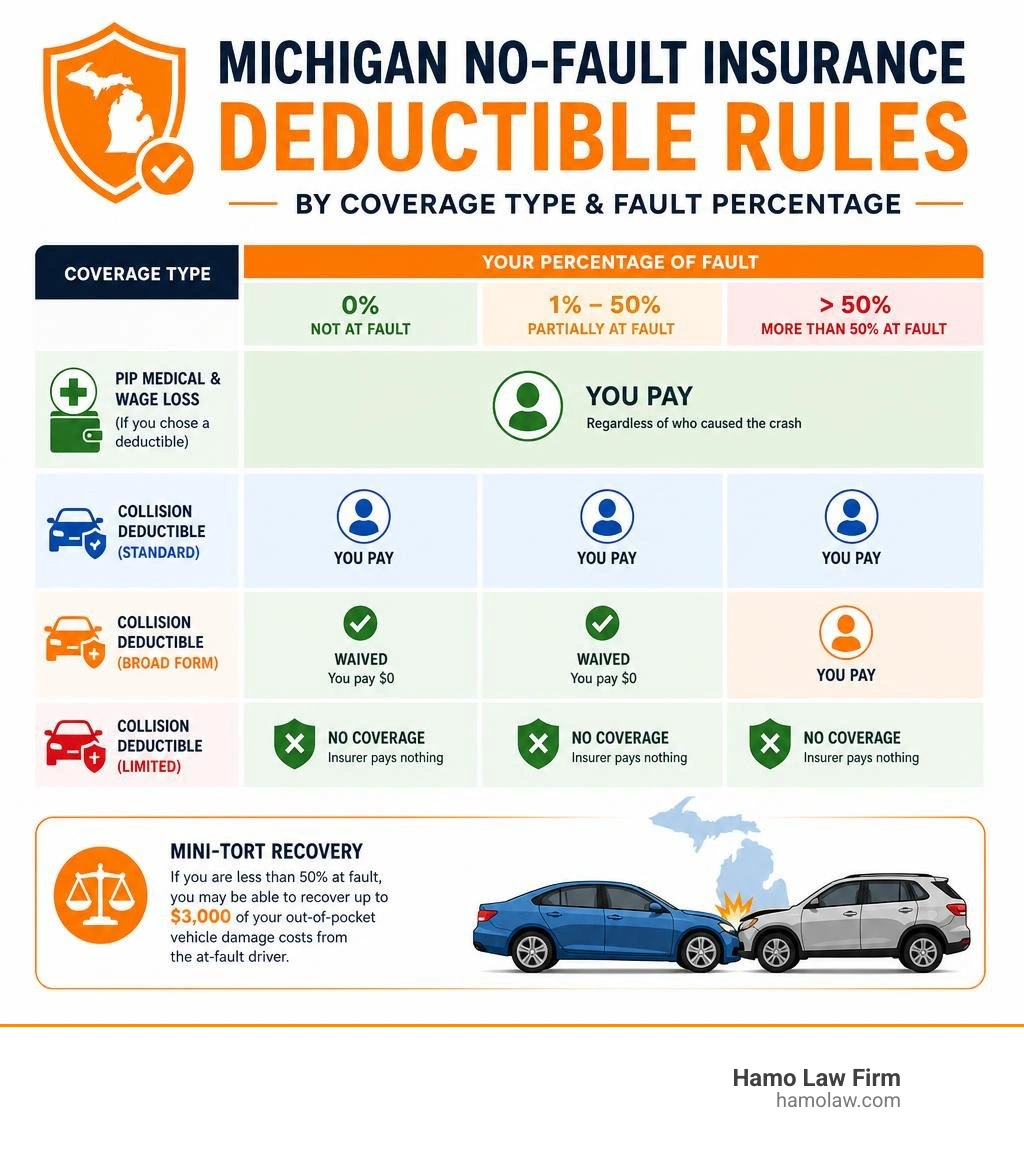
- PIP medical and wage loss deductibles: You pay them — regardless of who caused the crash — if you chose a deductible on your policy in exchange for lower premiums.
- Collision deductible (Standard coverage): You pay it — even if you are 100% not at fault.
- Collision deductible (Broad Form coverage): You pay it only if you are more than 50% at fault. If you are not at fault, it is waived.
- Collision deductible (Limited coverage): If you are more than 50% at fault, your insurer pays nothing — so there is no deductible, but there is also no coverage.
- Mini-tort recovery: If you are less than 50% at fault, you may be able to recover up to $3,000 of your out-of-pocket vehicle damage costs from the at-fault driver.
Michigan has the highest average auto insurance premiums in the country — $3,096 per car — and yet many drivers still do not know which type of collision coverage they carry, or what deductible they agreed to when they signed up. After a crash, that confusion can cost you real money.
Michigan's no-fault law has also changed significantly. Since the July 1, 2020 reforms, drivers can choose PIP medical coverage limits ranging from $50,000 to unlimited — and each choice comes with different deductible implications. As of July 2026, many drivers are still navigating the fallout from those changes without fully understanding their rights.
This guide breaks it all down in plain language.
Michigan No-Fault Insurance Who Pays Deductible for Medical and Wage Loss?
Under Michigan's auto insurance system, Personal Injury Protection (PIP) is the cornerstone of your policy. PIP covers your medical expenses, a portion of your lost wages, and replacement services if you are injured in an auto accident.
But when it comes to the deductible for these benefits, many drivers are shocked to find out that they are on the hook for these costs even if they did absolutely nothing to cause the crash.
If you opted for a deductible on your PIP medical or wage loss benefits when you purchased or renewed your policy, you must pay that deductible out of pocket before your auto insurance provider begins paying out benefits. This is true regardless of fault. Even if you were sitting at a red light in Flint and got rear-ended by a distracted driver, your own insurance carrier will require you to meet your policy's deductible first.
Why would a driver choose to have a PIP deductible? The answer is simple: to save money on their monthly premiums.
Under Michigan law, specifically MCL 500.3109(3), auto insurance companies are legally required to offer "appropriately reduced premium rates" to policyholders who agree to a deductible on their PIP medical or wage loss coverages.
For many Michigan families trying to manage the highest auto insurance rates in the country, opting for a $500 PIP deductible (the most common deductible amount chosen by drivers) is a calculated risk to keep their monthly bills manageable.
However, choosing this path means you must be prepared to pay that amount if an accident happens.
If you are trying to understand how these benefits coordinate with your regular health insurance, or how to navigate the claims process, you can read more on the Michigan Gov Auto Insurance FAQ.
Additionally, we have put together a comprehensive guide on How Michigan No-Fault Insurance Works to help you understand how these coverages interact to protect you and your family.
Who Pays the Collision Deductible After a Michigan Car Accident?
While PIP covers your body, collision coverage is what protects your vehicle. In Michigan, because we are a no-fault state, you do not look to the at-fault driver's insurance company to pay for your car repairs right away. Instead, you must turn to your own auto insurance policy's collision coverage.
Whether you have to pay a deductible for your vehicle repairs depends entirely on two factors:
- The percentage of fault attributed to you for the accident.
- The specific type of collision coverage you chose when you purchased your policy.
Under Michigan law (MCL 500.3037), insurance companies must offer three distinct types of collision coverage: Standard, Broad Form, and Limited. Each handles deductibles and fault in completely different ways, particularly around the critical 50% fault threshold.

To help visualize how these coverages differ, review this comparison table:
| Collision Coverage Type | Your Fault is 50% or Less (Not At Fault) | Your Fault is More Than 50% (At Fault) |
|---|---|---|
| Standard Collision | You must pay your deductible. Insurer covers the rest. | You must pay your deductible. Insurer covers the rest. |
| Broad Form Collision | Your deductible is completely waived. Insurer covers 100%. | You must pay your deductible. Insurer covers the rest. |
| Limited Collision | Insurer covers repairs (minus deductible, if applicable). | No coverage. Insurer pays $0. You pay all repairs. |
If you have recently been in a crash and are wondering what steps to take next to protect your vehicle damage claim, check out our guide on How Does Michigan No-Fault Insurance Work After an Accident.
Standard Collision Coverage: Why You Pay the Deductible Even If Not at Fault
Standard collision coverage (sometimes called regular collision) is one of the most common policies in Michigan, but it also causes the most frustration for innocent drivers.
Under a Standard collision policy, you must pay your deductible every single time you file a claim, regardless of who caused the accident.
For example, if you are safely parked at a grocery store in Genesee County and another vehicle backs into your car, leaving you with $2,000 in damage, you will have to pay your $500 deductible to get your car fixed through your Standard collision policy. Your insurance company will pay the remaining $1,500.
While this feels incredibly unfair, it is simply how Standard collision is written under Michigan law. Fortunately, as we will discuss later, you are not completely out of options; you can use Michigan's mini-tort law to try and claw that deductible back from the negligent driver.
Broad Form Collision Coverage: How Fault Determines Who Pays the Deductible
Broad Form collision coverage is widely considered the gold standard for Michigan drivers because it rewards you for safe driving. Under Broad Form, your responsibility for the deductible is tied directly to the 50% fault threshold.
- If you are 50% or less at fault: Your insurance company will completely waive your deductible. They will pay for 100% of your vehicle's repair costs, and you will pay $0 out of pocket.
- If you are more than 50% at fault: You must pay your chosen deductible, and your insurer will cover the rest of the repair costs up to your policy limits.
If you want peace of mind knowing that an accident caused by someone else won't instantly drain your bank account, Broad Form collision is highly recommended. It prevents you from having to pay out-of-pocket for repairs when you did nothing wrong.
Limited Collision Coverage: What Happens If You Are More Than 50% At Fault?
Limited collision coverage is the cheapest option, but it carries the highest financial risk. This coverage only pays out if you are less than 50% at fault for the crash.
- If you are less than 50% at fault: Your insurer will pay to repair your vehicle, subject to whatever deductible you chose for the policy (some limited policies have deductibles, while others do not).
- If you are more than 50% at fault: Your insurance company pays absolutely nothing. You receive zero benefits, and you are entirely responsible for paying to repair or replace your vehicle out of your own pocket. Because the insurer is not paying a dime, there is technically "no deductible" to pay to them — but that is cold comfort when you are left holding a bill for a totaled car.
Limited collision is typically chosen by drivers with older, lower-value vehicles where the cost of comprehensive or broad form coverage doesn't make financial sense relative to the car's actual cash value.
How the Michigan Mini-Tort Law Helps Recover Your Deductible
If you have Standard collision coverage (meaning you had to pay your deductible despite being innocent) or if you did not carry collision coverage at all, Michigan's mini-tort law is your saving grace.
Under Michigan's unique auto insurance laws, you are generally barred from suing other drivers for vehicle damage. However, the mini-tort provision acts as a legal exception.
If you are less than 50% at fault for an accident, you can sue the at-fault driver to recover up to $3,000 in out-of-pocket expenses related to your vehicle damage.
This $3,000 limit is designed specifically to help drivers recover:
- The collision deductible they were forced to pay under a Standard policy.
- The out-of-pocket repair costs they incurred if they did not carry collision coverage.
To successfully collect a mini-tort payment, you must be able to prove that the other driver was more than 50% at fault for the accident. If you are found to be partially at fault, your recovery may be reduced under Michigan's comparative negligence rules.
For a deeper dive into how our state's no-fault rules compare to other parts of the country, you can consult the Insurify Michigan No-Fault Guide.
Because proving fault is the key to unlocking mini-tort recovery, it is crucial to understand how insurance adjusters and courts evaluate crashes. You can read our detailed breakdown on How Fault Is Determined in a Michigan Car Accident to learn how evidence like police reports, witness statements, and dashcam footage can make or break your case.
Frequently Asked Questions About Michigan No-Fault Insurance and Deductibles
Auto insurance rules in Michigan are notoriously complex. Below are answers to some of the most common questions we receive from drivers in Flint and across Genesee and Wayne Counties.
Under Michigan No-Fault Insurance Who Pays Deductible for PIP Medical Benefits?
If you chose a deductible for your PIP medical benefits when setting up your policy, you are responsible for paying it. This deductible must be met before your auto insurance company will begin paying your medical bills.
Additionally, many drivers choose to coordinate their PIP medical benefits with their private health insurance to secure lower auto premiums. If your benefits are coordinated, your health insurance is considered the primary payer for your accident injuries.
In this scenario, you must first navigate your health insurance plan's deductibles, co-pays, and network restrictions before your auto PIP coverage steps in to cover the remaining "allowable expenses."
Be aware that under state guidelines, your health coverage must meet specific "Qualified Health Coverage" (QHC) criteria to allow you to opt out of or exclude PIP medical benefits entirely.
Under Michigan No-Fault Insurance Who Pays Deductible for Wage Loss Claims?
Just like PIP medical benefits, you pay the deductible for PIP wage loss claims if you opted for one on your policy.
Michigan PIP wage loss benefits are designed to reimburse you for 85% of your lost income (up to a statutory monthly cap) for up to three years from the date of the accident if your injuries prevent you from working.
If you chose a wage loss deductible or a specific "waiting period" (such as a policy that doesn't pay for the first 14 days of missed work), you must absorb those initial lost wages yourself. Choosing these deductibles reduces your monthly auto premium, but it means you must have a financial safety net in place to cover your bills immediately following a disabling crash.
Can I recover my collision deductible from the at-fault driver?
Yes, you can recover your collision deductible through a mini-tort claim, up to the statutory limit of $3,000.
To do this, you must first establish that the other driver was more than 50% at fault. You can then request the payment directly from the at-fault driver or their insurance company.
If they refuse to pay, your recourse is to file a lawsuit in Small Claims Court. Many auto insurance companies will handle the mini-tort recovery process on your behalf through a process called subrogation, but if they do not, you have the legal right to pursue the at-fault driver independently to get your money back.
Conclusion
Navigating the aftermath of a car accident in Michigan is stressful enough without having to decode complex insurance policies and argue over who pays your deductibles. Whether you are dealing with unpaid PIP medical benefits, lost wages, or vehicle damage disputes, you do not have to fight the insurance companies alone.
At Hamo Law Firm, we have spent more than 40 years fighting for accident victims in Flint, Detroit, Genesee County, and Wayne County. We understand the tactics insurance companies use to delay, lowball, or deny legitimate claims.
Our experienced trial attorneys operate on a contingency-fee model — which means we do not charge you a single penny in legal fees unless we successfully win your case.
If you have been injured in an accident and are struggling to get your insurance company to pay what you are owed, contact us today for a free, no-obligation consultation. Let us put our decades of trial experience to work for you. Visit our No-Fault Insurance Claims Practice Areas page to learn more about how we can help you secure the compensation and peace of mind you deserve.