
When Medical Care Goes Wrong: How to Find the Best Lawyers for Malpractice Suits Near Me

Finding the right lawyers for malpractice suits near me is one of the most important steps you can take after a healthcare provider's mistake leaves you injured, disabled, or grieving. Here is a quick-start guide to help you act fast:
How to find local malpractice lawyers:
- Search for attorneys with specific medical malpractice experience — not just general personal injury lawyers
- Look for free consultations — most reputable malpractice attorneys offer them at no cost
- Confirm they work on contingency — you should pay nothing upfront; fees only come out of your recovery
- Check local court knowledge — a lawyer familiar with your county's courts has a real strategic edge
- Act quickly — filing deadlines (statutes of limitations) can be as short as one to two years depending on your state
Medical errors are now the third-leading cause of death in the United States, claiming more than 250,000 lives every year, according to Johns Hopkins Medicine. For every death, countless more patients are left with serious, lasting injuries.
If you are a Michigan resident who has been harmed by a doctor, hospital, or another healthcare provider, you are not alone — and you may have the right to fight back.
But navigating a malpractice case is not simple. These are among the most legally and medically complex cases in the civil court system. Insurance companies and hospital legal teams work quickly to minimize what they pay out. Without an experienced attorney in your corner, you are at a serious disadvantage.
This guide walks you through everything you need to know — from understanding what legally counts as malpractice, to finding the right local attorney, to knowing what compensation you can recover.
Understanding Medical Malpractice: Definitions and Key Elements
When we step into a doctor's office, check into a hospital in Detroit, or undergo surgery in Flint, we place our lives and well-being in the hands of trained medical professionals. We expect them to treat us with a high level of care.
Unfortunately, healthcare providers are human, and they make mistakes. But in medicine, a simple mistake can lead to catastrophic, life-altering patient harm. When a healthcare provider's care falls below the accepted standards of the medical community and causes injury, it crosses the line from an unfortunate outcome into medical negligence.
Defining Medical Negligence in Washington, New York, and Michigan
To understand if you have a case, it helps to look at how different states define medical malpractice. While we primary serve and represent clients in Michigan (especially across Genesee County and Wayne County), understanding the broader legal landscape shows how strict and complex these laws can be.
- Michigan Law: Under Michigan law, medical malpractice occurs when a healthcare professional fails to provide the standard of care that a similarly trained, reasonable professional would provide under similar circumstances, directly causing injury. Michigan has some of the most rigorous and aggressive procedural requirements in the country. Before you can even file a lawsuit, you must serve the defendant with a 182-day Notice of Intent (NOI) and file a formal Affidavit of Merit signed by a qualified, board-certified healthcare professional in the same specialty.
- New York Law: Under the New York Civil Practice Law and Rules (CPLR), medical malpractice is defined as a deviation or departure from accepted community standards of practice that causes injury or death. New York requires plaintiff attorneys to file a "Certificate of Merit" (under CPLR § 3012-a) within 90 days of filing the complaint, confirming that they have consulted with a licensed physician and believe there is a reasonable basis for the lawsuit.
- Washington Law: Washington state law defines malpractice as a healthcare provider's failure to follow the accepted standard of care, or promising a result that was not met. Like other states, the plaintiff must prove that the injury resulted from a failure to exercise that degree of care, skill, and learning expected of a reasonably prudent provider.
No matter where the negligence occurs, one of the most devastating forms of malpractice involves misdiagnosis claims. Whether a doctor completely misses a cancer diagnosis, delays diagnosing an infection, or misidentifies a heart attack as indigestion, diagnostic failures can delay critical treatment and lead to permanent harm or wrongful death.
The Four Pillars of Proving a Malpractice Claim
To build a successful medical negligence case, your legal team must establish four fundamental pillars. If even one of these pillars is missing, your lawsuit cannot succeed.
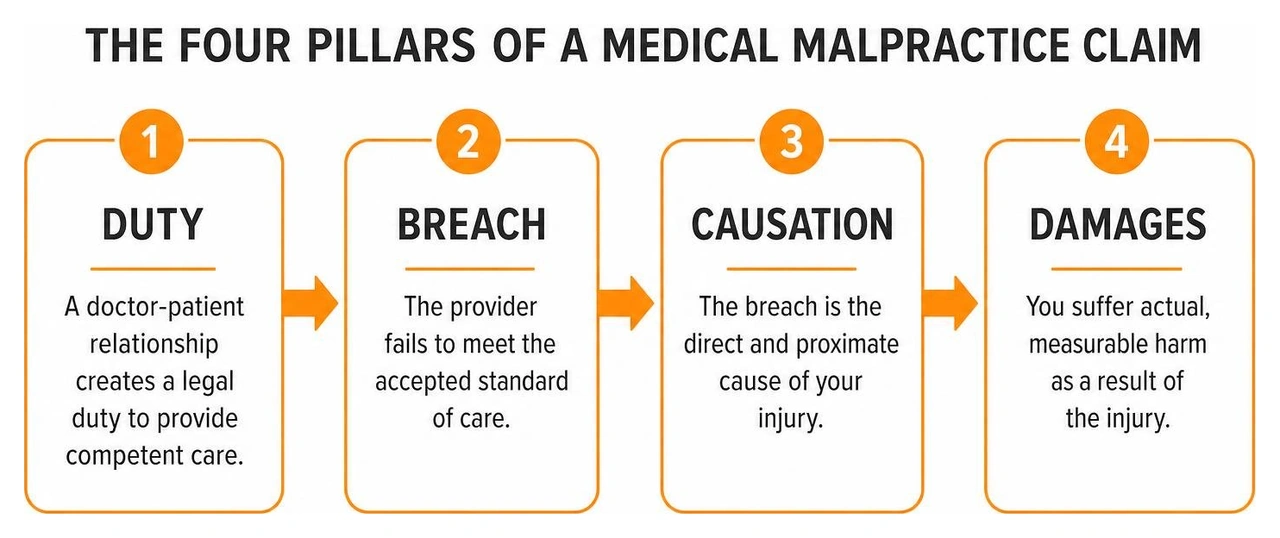
- Duty of Care: You must prove that a professional doctor-patient relationship existed. Once this relationship is established, the provider owes you a legal duty to provide competent care.
- Breach of Duty: You must show that the provider failed to meet the accepted standard of care. This means their actions (or lack of action) deviated from what a reasonably competent peer would have done in the same situation.
- Proximate Causation: You must prove that the provider's breach of duty was the direct and proximate cause of your injury. It is not enough to show that the doctor made a mistake; you must prove that the mistake directly caused your medical complications.
- Damages: You must have suffered actual, measurable harm as a result of the injury. This includes physical pain, mental anguish, additional medical bills, lost wages, or permanent disability.
For a deeper dive into how these elements are assessed in local courts, read our comprehensive guide on how to prove medical malpractice in Michigan.
Does Signing a Surgical Consent Form Prevent You From Suing?
One of the most common myths we hear from injured patients is: "I signed a consent form before my procedure, so I guess I can't sue."
This is absolutely false.
A surgical consent form is designed to inform you of the inherent, known risks of a procedure (such as the risk of infection or bleeding even when everything goes perfectly). It is a tool for informed consent. However, signing a form does not give a surgeon or medical team a "free pass" to be negligent.
If a surgeon commits clear surgical errors—such as operating on the wrong body part, leaving a surgical instrument inside you, or accidentally puncturing an unrelated organ due to carelessness—that is negligence, not an inherent risk. A consent form does not shield a practitioner from the consequences of substandard care.
How to Find and Choose the Best Lawyers for Malpractice Suits Near Me
If you suspect you are a victim of a medical error, you should not try to handle the hospital, their insurance adjusters, or their high-powered legal teams on your own. You need an advocate. But how do you sort through the endless search results for lawyers for malpractice suits near me to find the right one?

What to Look For in Lawyers for Malpractice Suits Near Me
When evaluating local attorneys, look for the following qualifications:
- Extensive Trial Experience: Many personal injury lawyers prefer quick, easy settlements and rarely step foot in a courtroom. Medical malpractice cases are fiercely defended by insurance companies; you need a firm with decades of actual trial experience that is always prepared to take your case to a jury.
- Deep Local Court Knowledge: Laws are state-specific, and local court procedures can vary by county. If your injury occurred in Genesee County or Wayne County, you want an attorney who knows the local judges, understands county-specific court rules, and has a strong reputation in the local community.
- Resources to Hire Elite Medical Experts: Because malpractice cases require proving a deviation from the standard of care, your lawyer must have the financial resources to hire credible, board-certified medical experts to review your records and testify on your behalf.
- A Proven Track Record: Look for a firm with a history of securing significant settlements and verdicts in complex medical negligence cases.
If you are looking for representation in Flint, Genesee County, or Wayne County, you can compare top-rated local advocates on the Flint malpractice attorneys directory, or view regional listings such as Best Medical Malpractice Lawyers in Genesee County, MI and Best Medical Malpractice Lawyers in Wayne County, MI - Justia.
What to Expect During Your Free Consultation with Lawyers for Malpractice Suits Near Me
Your first meeting with a medical malpractice lawyer is a two-way street. It is an opportunity for the attorney to evaluate the strength of your claim, and for you to decide if the firm is the right fit for you.
During this free, confidential case evaluation, you should expect to:
- Share Your Story: You will walk the attorney through what happened, including the timeline of your medical treatment, when you noticed something was wrong, and how the injury has affected your daily life.
- Provide Documentation: Bring any medical records, discharge instructions, prescriptions, photos of physical injuries, and insurance communications you have gathered.
- Receive a Preliminary Assessment: The attorney will explain whether your case meets the legal criteria for malpractice and outline the potential legal strategies.
- Ask Questions: Don't be shy! Ask about their experience with similar cases, their fee structure, and who will be handling your file day-to-day.
Understanding Attorney Fees and Contingency Agreements
Many people avoid calling a lawyer because they are terrified of receiving a massive bill for hourly fees. Fortunately, reputable medical malpractice lawyers operate on a contingency-fee model.
Under a contingency agreement:
- No Upfront Costs: You do not pay anything out-of-pocket to hire the firm or get your case started.
- We Only Get Paid If You Win: The attorney's fees are calculated as a percentage of the final settlement or court verdict. If the case is unsuccessful and you receive no compensation, you owe your lawyer nothing for their time.
- Advancing Litigation Costs: Medical malpractice lawsuits are incredibly expensive to prosecute, often costing tens of thousands of dollars in expert witness fees, medical record retrieval costs, and court filing fees. A dedicated firm will advance these litigation costs on your behalf and recover them from the final settlement.
- Standard Fee Percentages: In medical malpractice cases, contingency fee rates typically range from 33 1/3% to 45% of the total recovery, depending on the complexity of the case and state-specific statutory limits.
Damages, Timelines, and Statutes of Limitations
When a medical error derails your health, the financial and emotional consequences can be overwhelming. A successful lawsuit aims to secure the financial recovery you need to put your life back together.

Recoverable Damages in a Malpractice Lawsuit
In a medical malpractice lawsuit, the compensation you can recover is divided into two primary categories:
1. Economic Damages (Objective Financial Losses)
These are measurable, out-of-pocket financial losses resulting from your injury:
- Medical Expenses: Coverage for all past, current, and future medical care, including corrective surgeries, hospital stays, physical therapy, prescription medications, and adaptive medical equipment.
- Lost Wages: Compensation for the income you lost while recovering from your injuries.
- Loss of Earning Capacity: If your injury leaves you permanently disabled or unable to return to your previous line of work, you can recover the income you would have reasonably earned over the rest of your career.
2. Non-Economic Damages (Subjective Personal Losses)
These represent the human cost of negligence, which do not come with a neat receipt:
- Pain and Suffering: Compensation for the physical pain and discomfort caused by the injury and subsequent treatments.
- Emotional Anguish: Damages for the psychological impact of the trauma, including anxiety, depression, PTSD, and sleep disturbances.
- Loss of Enjoyment of Life: If your injuries prevent you from enjoying hobbies, sports, or spending quality time with your family.
- Loss of Consortium: Compensation for the negative impact the injury has on your relationship with your spouse or family members.
State Statutes of Limitations and Damage Caps
You do not have forever to file a lawsuit. Every state enforces strict deadlines, known as the statute of limitations, as well as limits on how much you can recover (damage caps). Because Hamo Law Firm is a Michigan-based firm, we place a heavy emphasis on helping local families understand the statute of limitations for medical malpractice in Michigan.
Here is how Michigan's laws compare to Washington and New York as of 2026:
| State | Statute of Limitations (General Deadline) | The Discovery Rule Exception | Damage Caps |
|---|---|---|---|
| Michigan | 2 Years from the date of the negligent act or omission. | 6 Months from when the injury was discovered or reasonably should have been discovered (up to a maximum of 6 years, with exceptions for reproductive injuries or fraud). | Caps on Non-Economic Damages Only. Standard cap is approximately $497,000; catastrophic cap (for spinal cord injuries, brain damage, or reproductive loss) is approximately $889,500. No cap on economic damages. |
| New York | 2.5 Years (30 Months) from the date of malpractice or the end of continuous treatment. | Under Lavern's Law, 2.5 Years from discovery for missed cancer diagnoses (capped at 7 years). Foreign objects left in the body have a 1-Year discovery window. | No caps on economic or non-economic damages. |
| Washington | 3 Years from the date of the negligent act. | 1 Year from when the injury was discovered or reasonably should have been discovered (up to a maximum of 8 years). | No caps on economic or non-economic damages. |
How Long Does a Malpractice Case Take to Resolve?
Patience is a necessity when pursuing a medical malpractice claim. Because these cases involve extensive investigations, massive volumes of medical records, and coordination with busy medical experts, they are rarely resolved overnight.
On average, a medical malpractice case takes 2 to 3 years to resolve.
- The Investigation Phase (3 to 6 months): Your attorney gathers all medical records, consults with experts, and prepares the necessary pre-suit notices (like Michigan's 182-day Notice of Intent).
- The Discovery Phase (12 to 18 months): Once the lawsuit is officially filed, both sides exchange documents, take depositions of the patient, doctors, and experts, and build their arguments.
- Settlement Negotiations or Trial: While over 90% of medical malpractice cases settle before reaching a jury, negotiating a fair settlement takes time. If the hospital's insurance company refuses to offer a fair payout, your case will proceed to trial, which can add several months to the timeline.
Frequently Asked Questions About Medical Malpractice
What should I do immediately after suspecting medical malpractice?
If you believe a medical error has occurred, take these steps immediately to protect your health and your legal rights:
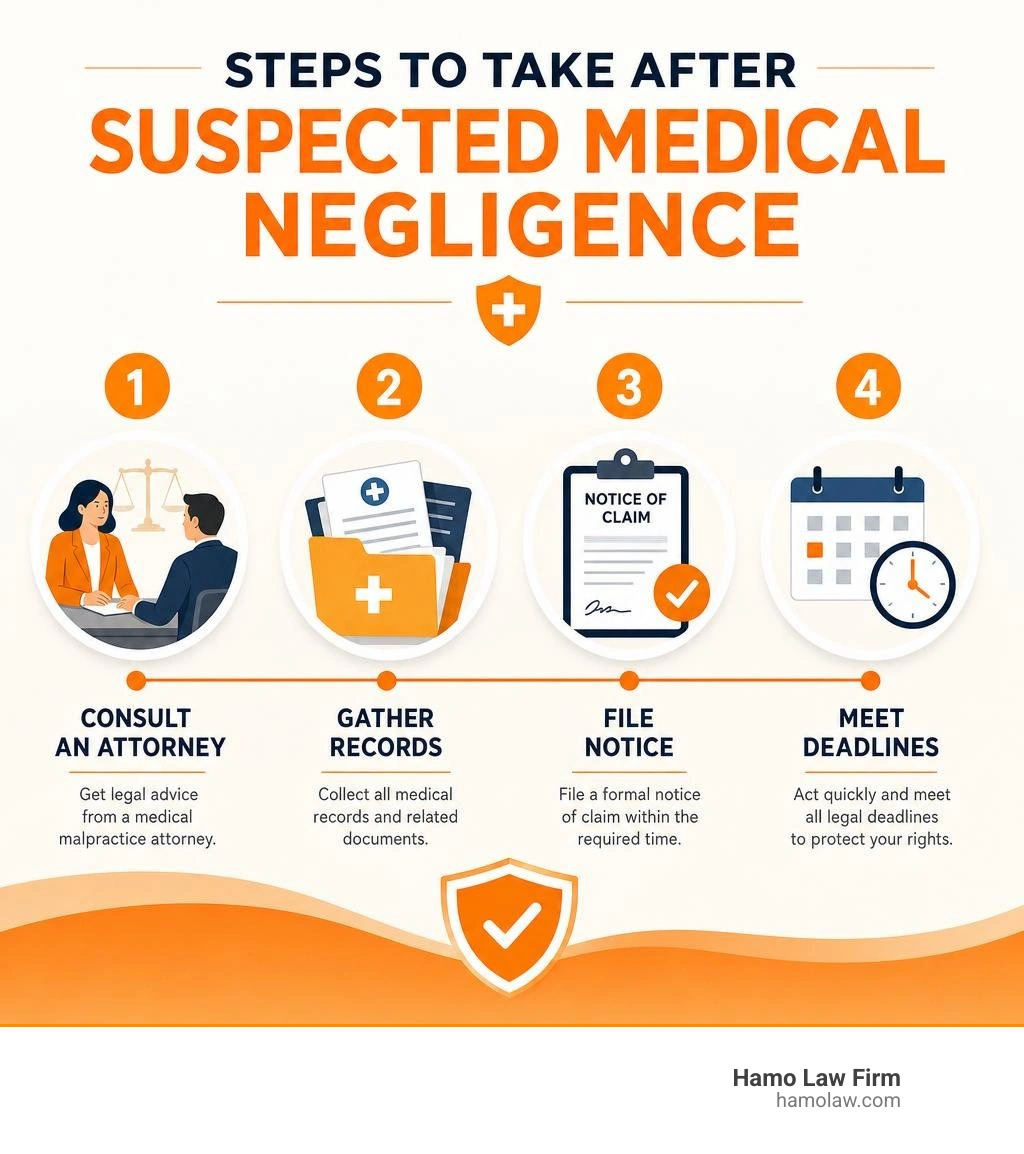
- Prioritize Your Health: Seek a second opinion from a completely independent, unrelated medical professional to get an unbiased assessment of your condition and receive proper corrective treatment.
- Request Your Medical Records: Obtain a complete copy of your medical charts, discharge summaries, and imaging results. Do this quickly, before records can be "misplaced" or altered.
- Keep a Detailed Journal: Write down a daily log of your symptoms, pain levels, limitations, and the specific names of doctors or nurses you spoke with, along with what they told you.
- Do Not Post on Social Media: Never post details about your medical care, injuries, or legal plans online. Insurance defense lawyers actively monitor these platforms to find any statement they can use to undermine your claim.
- Consult an Experienced Attorney: Contact a dedicated malpractice firm right away to ensure you do not miss critical filing deadlines.
What evidence is needed to support a medical malpractice claim?
To build a bulletproof case, your attorney will gather and analyze several types of evidence:
- Comprehensive Medical Records: Including doctor notes, nursing logs, lab results, surgical reports, and prescription histories.
- Audit Trails: Electronic health records contain background digital "audit trails" that show exactly who accessed your file, when they accessed it, and if any records were modified after the fact.
- Expert Medical Testimony: Statements and deposition testimony from board-certified medical experts confirming that your provider breached the standard of care.
- Financial Documentation: Tax returns, pay stubs, and medical bills to prove your exact economic losses.
How do I know if I have a valid medical malpractice case?
Not every bad medical outcome is malpractice. Medicine is an imperfect science, and even with the best care, complications can happen. To have a valid case, you must have:
- Clear evidence of a mistake: A deviation from the standard of care.
- Measurable, severe harm: Minor, temporary discomforts rarely justify the high cost of a malpractice lawsuit.
- A direct link: Proof that the provider's specific mistake—and not your underlying illness—caused your current injuries.
The only way to know for certain if you have a valid claim is to have your records reviewed by an experienced attorney and a qualified medical expert.
Conclusion
When a medical professional's negligence turns your life upside down, you deserve answers, accountability, and the financial support to heal. But you cannot fight hospital boards and multi-billion-dollar insurance companies alone.
At Hamo Law Firm, we have spent more than 40 years fighting for accident and malpractice victims across Michigan. Based in Flint, and proudly serving Genesee County, Wayne County, Detroit, and the surrounding communities, we specialize in taking on tough insurance companies and demanding the maximum compensation our clients deserve.
We operate strictly on a contingency-fee model—which means you pay absolutely nothing upfront, and we collect no fees unless we win your case.
If you or a loved one has been harmed by medical negligence, don't wait until the clock runs out on your rights. Contact us today for a free, no-pressure, confidential consultation at Hamo Law Firm Medical Malpractice Representation. Let our family fight for yours.