
What Michigan No-Fault Insurance Means for You After a Crash

Michigan no-fault insurance is a state-mandated system that requires every driver to carry coverage that pays for their own injuries and damages after a car accident — regardless of who caused the crash.
Here's the quick version of how it works:
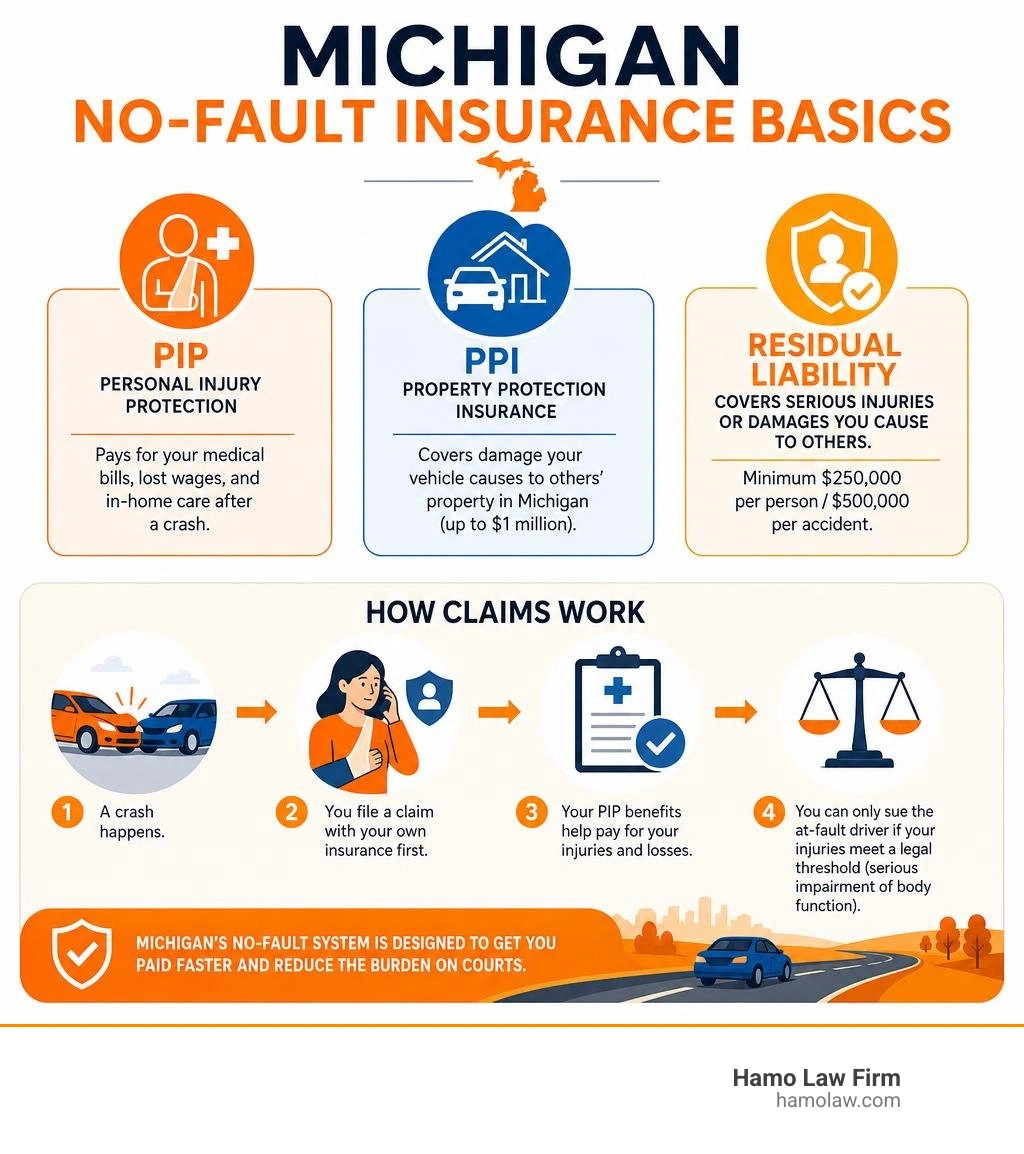
- Personal Injury Protection (PIP) pays your medical bills, lost wages, and in-home care after an accident
- Property Protection Insurance (PPI) covers damage your vehicle causes to others' property in Michigan (up to $1 million)
- Residual Liability covers serious injuries or damages you cause to others (minimum $250,000 per person / $500,000 per accident)
- You file with your own insurer first — not the at-fault driver's
- You can only sue the at-fault driver if your injuries meet a legal threshold (called serious impairment of body function)
Michigan has operated under this no-fault system since October 1, 1973. It was designed to get accident victims paid faster and reduce the burden on courts. But the system is complex — especially after major reforms passed in 2019 changed PIP coverage options, fee schedules, and attendant care rules.
If you were hurt in a crash and you're now dealing with denied claims, delayed payments, or an insurance company that won't pay what you're owed, you're not alone. Michigan's no-fault rules are genuinely complicated — and insurers know how to use that complexity to their advantage.
This guide breaks down everything you need to know: your required coverages, your PIP benefit options, your right to sue, and what to do after an accident to protect your claim.
What is Michigan No-Fault Insurance and How Does It Work?
At its core, michigan no-fault insurance means that if you are in a car accident, you look to your own auto insurance policy to cover your medical treatment, lost income, and certain daily expenses. It does not matter if you were 100% at fault, 0% at fault, or somewhere in the middle. Your insurance company is on the hook for your immediate economic recovery.
This system was established to prevent injured people from having to wait months or years for a lawsuit to resolve before they could pay for emergency medical care. Instead of fighting over who caused the crash before bills get paid, your insurer steps in immediately to cover your "first-party" benefits.
To get a complete picture of the legal rules behind this framework, you can read the official Brief Explanation of Michigan No-Fault Insurance.
Under this law, every owner of a motor vehicle driven on Michigan public roads must maintain this security. If you do not, you lose your right to benefits and expose yourself to severe civil and criminal penalties.
Mandatory Coverages Under Michigan No-Fault Insurance
Every basic auto insurance policy in Michigan must include three mandatory components:
- Personal Injury Protection (PIP): This is the heart of the no-fault system. It pays for your medical expenses, rehabilitation, lost wages, and replacement services if you are injured in a motor vehicle accident.
- Property Protection Insurance (PPI): This coverage pays up to $1 million for damage your car does to other people's property within the state of Michigan. This includes buildings, fences, utility poles, and properly parked vehicles. It does not cover damage to moving vehicles.
- Residual Liability Insurance (Bodily Injury and Property Damage - BI/PD): Even in a no-fault state, you can still be sued under specific circumstances. Residual liability protects you if you are sued for causing a serious injury or death, or if you cause property damage in another state.
To understand how these components interact in the real world, you can read our detailed breakdown on How Michigan No-Fault Insurance Works.
Minimum Coverage Limits for Michigan Drivers
While Michigan requires these coverages, the state also sets strict minimum limits. Following the 2019 legislative reforms, the default and minimum limits for bodily injury liability changed significantly.
The default bodily injury liability limits on a Michigan policy are $250,000 per person and $500,000 per accident. However, drivers are permitted to select lower limits down to an absolute minimum of $50,000 per person and $100,000 per accident if they sign a specific disclosure form acknowledging the financial risks.
| Coverage Type | Default Limit | Absolute Minimum Limit | What It Covers |
|---|---|---|---|
| Bodily Injury Liability (BI) | $250,000 per person / $500,000 per accident | $50,000 per person / $100,000 per accident | Legal defense and damages if you cause a crash resulting in severe injury or death. |
| Property Damage Liability (PD) | $10,000 | $10,000 | Damage you cause to property or vehicles outside the state of Michigan. |
| Personal Injury Protection (PIP) Medical | Unlimited | Varies (down to $0 for Medicare opt-out) | Medical care, rehabilitation, wage loss, and attendant care for your own injuries. |
| Property Protection Insurance (PPI) | $1,000,000 | $1,000,000 | Damage your vehicle causes to physical property (buildings, fences, parked cars) in Michigan. |
Choosing the minimum limits might save you a few dollars on your monthly premium, but it leaves your personal assets highly vulnerable if you cause a serious wreck.
Understanding PIP Benefits, Reforms, and Policy Options

Personal Injury Protection (PIP) is the most critical and often debated portion of your auto policy. Historically, Michigan was the only state in the country that required every driver to carry unlimited lifetime PIP medical benefits. While this provided unmatched medical protection for crash victims, it also made Michigan's auto insurance rates some of the highest in the nation.
To address these soaring costs, the state legislature passed sweeping reforms that went into effect in 2020.
PIP Medical Coverage Options and the 2019-2020 Reforms
Michigan drivers are no longer forced to buy unlimited PIP medical coverage. When you purchase or renew your auto policy, you must select one of several PIP medical options:
- Unlimited Coverage: The gold standard. Your insurer pays all reasonable and necessary medical expenses for your entire life. If you make no selection, this is the default option.
- $500,000 Limit: Caps your medical benefits at half a million dollars.
- $250,000 Limit: Caps your medical benefits at a quarter-million dollars.
- $250,000 Limit with Exclusions: Allows you to exclude certain household members who have health insurance that covers auto accident injuries.
- $50,000 Limit: Only available if the named insured is enrolled in Medicaid and other household members have qualified health coverage or another auto policy.
- No PIP Medical (Opt-Out): Only available if the named insured has Medicare Parts A and B (or Medicare Advantage) and all other household members have qualified health coverage.
To explore these options and see how they might affect your family's financial security, check out the state's official Frequently Asked Questions.
Be careful: if you choose a lower limit like $250,000 and suffer a catastrophic brain or spinal cord injury, you could exhaust your policy limits in a matter of days. Once your PIP limit is reached, you are personally responsible for the remaining medical bills unless you can sue the at-fault driver for excess medical expenses.
Coordinated vs. Uncoordinated Benefits and Deductibles
When purchasing michigan no-fault insurance, you will also be asked to choose between coordinated and uncoordinated benefits:
- Coordinated Benefits (Secondary): Your private health insurance acts as your primary payer for auto accident injuries. Your auto insurer only steps in to cover deductibles, co-pays, and services that your health insurance doesn't cover. This option offers a discounted auto premium, but you must ensure your health insurance does not exclude auto accidents.
- Uncoordinated Benefits (Primary): Your auto insurance is the primary payer. They pay your medical bills from dollar one, regardless of what your health insurance covers. This prevents coordination disputes and ensures you can access specialized auto-rehabilitation care immediately.
For a deeper dive into how these two paths affect your recovery after an accident, see our guide on How Does Michigan No-Fault Insurance Work.
Attendant Care and Family Caregiver Rules
Attendant care is in-home nursing or assistance required by severely injured crash victims. This can include help with bathing, dressing, eating, and basic mobility.
Before the reforms, insurance companies were required to pay family members commercial rates to provide this care, often 24 hours a day. The 2019 reform law placed a strict 56-hour-per-week cap on clinic-level attendant care provided by family members, relatives, or household residents for accidents occurring after the reform's implementation.
If you require more than 56 hours of care per week, the excess hours must be provided by a commercial, third-party nursing service, unless your insurer agrees to waive the cap.
Allowable PIP Benefits Under Michigan Law
Beyond direct medical bills, your PIP coverage includes several other valuable benefits:
- Wage Loss Benefits: If your injuries prevent you from working, PIP pays 85% of your gross lost income for up to three years. This benefit is capped at a monthly maximum that is adjusted annually by the state.
- Replacement Services: Pays up to $20 per day for up to three years to cover ordinary domestic services you can no longer perform, such as housecleaning, yard work, and grocery shopping.
- Medical Mileage: Reimburses you for travel expenses to and from your medical and rehabilitation appointments.
- Survivor’s Loss Benefits: If a fatal crash occurs, PIP provides financial support to the victim's dependents for up to three years, covering lost wages and replacement services.
Filing Claims, Shared Fault, and Suing for Damages
Filing a claim after a car crash can feel like entering a maze. Because Michigan uses a no-fault system, the process of getting your bills paid depends on a strict order of priority.
How Does Michigan No-Fault Insurance Work After an Accident?
If you are injured, you do not automatically file a claim with the other driver's insurance. Instead, you must follow the statutory order of priority to determine which insurance company is responsible for your PIP benefits.
To learn how this priority system functions step-by-step, review our companion article on How Michigan No-Fault Insurance Works After an Accident.
Generally, the order of priority is structured as follows:
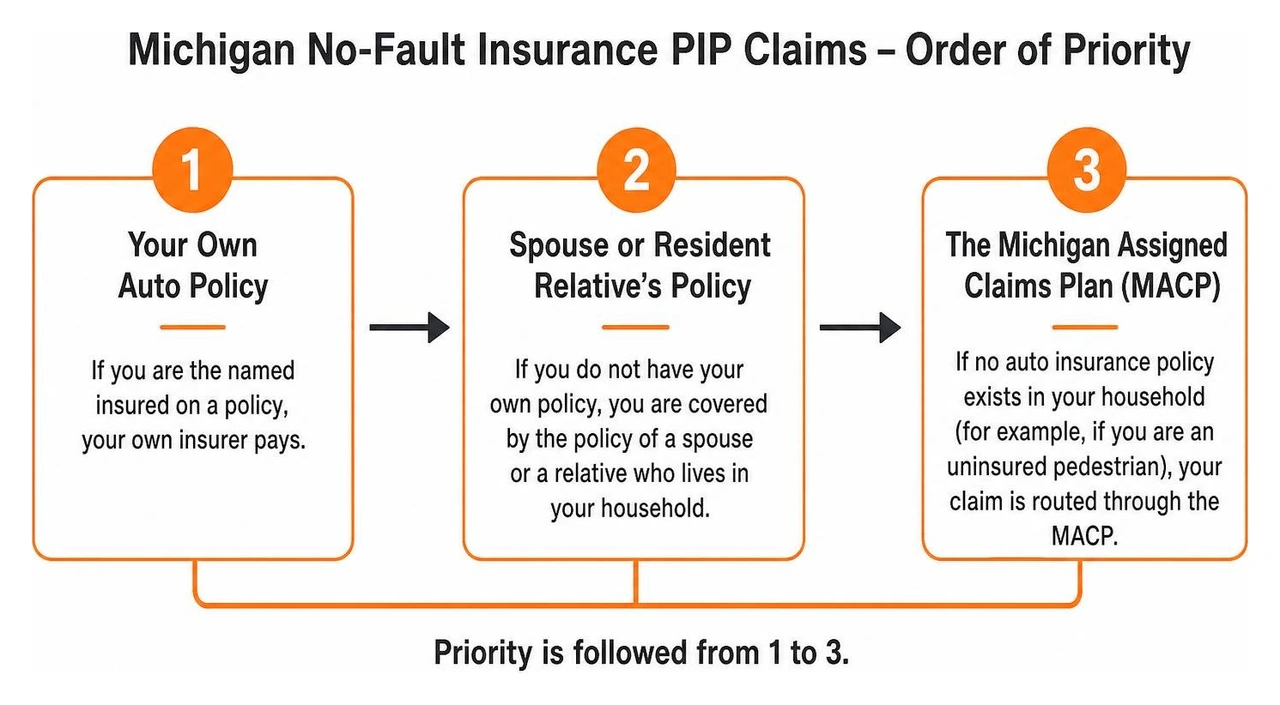
- Your Own Auto Policy: If you are the named insured on a policy, your own insurer pays.
- Spouse or Resident Relative’s Policy: If you do not have your own policy, you are covered by the policy of a spouse or a relative who lives in your household.
- The Michigan Assigned Claims Plan (MACP): If no auto insurance policy exists in your household (for example, if you are an uninsured pedestrian), your claim is routed through the MACP.
You must notify your insurer of the accident and file an application for bodily injury benefits within one year of the crash. Failure to file this written notice within one year will completely bar you from recovering benefits.
Suing for Noneconomic Damages and Shared Fault Rules
While PIP covers your economic losses (medical bills and lost wages), it does not compensate you for physical pain, emotional suffering, or loss of enjoyment of life. To recover these noneconomic damages, you must file a "third-party" lawsuit against the at-fault driver.
However, Michigan law restricts your right to sue. To bring a successful lawsuit for pain and suffering, your injuries must meet the statutory "tort threshold." This means you must have suffered:
- Death,
- Permanent serious disfigurement (such as severe scarring), or
- Serious impairment of body function.
The law defines a serious impairment of body function as an objectively manifested impairment of an important body function that affects your general ability to lead your normal life.
For more details on how to prove this threshold is met, see our guide on How Does Michigan No-Fault Insurance Work After an Accident.
Comparative Negligence in Michigan
Michigan follows a modified comparative negligence rule. If you share blame for the accident, your financial recovery will be reduced by your percentage of fault. For example, if a jury determines you were 20% at fault for a crash and awards you $100,000 in pain and suffering, your award will be reduced to $80,000.
Crucially, if you are found to be more than 50% at fault, you are legally barred from recovering any noneconomic damages from the other driver.
The Michigan Assigned Claims Plan and Statute of Limitations
The Michigan Assigned Claims Plan (MACP) is a safety net for people injured in car accidents who have no other source of no-fault insurance. This often applies to pedestrians, bicyclists, or passengers who do not own a car and do not live with a relative who owns one.
Under the reformed law, MACP medical benefits are strictly capped at $250,000.
The One-Year-Back Rule
When dealing with no-fault lawsuits, the one-year-back rule (MCL 500.3145) is a critical deadline. It states that if you must sue your insurance company for unpaid PIP benefits, you cannot recover benefits for any medical treatment or expense incurred more than one year before the lawsuit was filed. This means you cannot sit on unpaid medical bills; you must take legal action promptly to protect your right to payment.
Exclusions, Penalties, and Post-Accident Steps
Driving in Michigan without proper insurance is not just a bad idea—it is a criminal offense with devastating financial consequences.
Named Driver Exclusion and Driving Without Insurance
Under Michigan law, policyholders can specifically exclude certain high-risk drivers in their household from coverage. If an excluded driver operates the vehicle, all liability and PIP coverage is voided.
For the formal regulatory guidelines on how these exclusions must be written, you can review the state's official administrative bulletin, this /3^ day of August 2015.
If you drive your own vehicle without no-fault insurance, you face severe penalties:
- Criminal Penalties: It is a misdemeanor punishable by a fine of up to $500, up to one year in jail, and a mandatory 30-day driver's license suspension.
- No PIP Benefits: If you are injured in an accident while driving your own uninsured vehicle, you are completely barred from receiving any PIP benefits. You must pay all medical bills out of pocket.
- No Right to Sue: You cannot sue the at-fault driver for pain and suffering, even if they were 100% at fault.
- Personal Liability: You can be held personally liable for all medical bills and property damage suffered by others in the crash.
On average, drivers in Michigan pay $2,123 per year for car insurance, which exceeds the national average. While liability-only coverage averaged $160.15 per month in 2025, high-risk drivers with an SR-22 pay an average of $253 per month for full coverage. For drivers with a DUI, that average climbs to $285 per month. Despite these high costs, going uninsured is a financial risk you simply cannot afford to take.
Uninsured/Underinsured Motorist and Optional Coverages
Because many drivers on the road choose minimum liability limits—or illegally drive without insurance—carrying optional coverages is essential to protect your family.
We highly recommend adding these optional coverages to your policy:
- Uninsured Motorist (UM): Pays for your pain and suffering if you are hit by a driver who has no auto insurance.
- Underinsured Motorist (UIM): Steps in if the at-fault driver has insurance, but their policy limits are too low to cover your severe injuries.
- Collision Coverage: Pays to repair or replace your own vehicle after a crash. (Standard PPI does not cover damage to moving vehicles).
- Comprehensive Coverage: Covers damage to your vehicle caused by non-collision events, such as theft, vandalism, fire, or hitting a deer.
- Mini-Tort Coverage: Under Michigan's mini-tort law, you can sue the at-fault driver for up to $3,000 to cover your out-of-pocket vehicle repair costs or collision deductible.
What to Do Immediately After a Car Accident
If you are involved in a collision in Michigan, taking the right steps immediately can make or break your subsequent insurance claims:
- Move to Safety and Call 911: Ensure everyone is safe and request a police officer to file an official report.
- Seek Medical Attention Immediately: Even if you feel fine, adrenaline can mask serious injuries like concussions or internal bleeding. A delay in treatment gives the insurance company an excuse to deny your claim.
- Gather Evidence: Take photos of the vehicle damage, road conditions, skid marks, and your physical injuries. Collect names and contact info from witnesses.
- Exchange Information: Get the other driver's name, phone number, license plate, and auto insurance policy details.
- Report the Accident to Your Insurer: Notify your insurance company, but stick to the basic facts. Do not give a recorded statement or sign any settlement offers until you speak with a lawyer.
For professional legal help navigating the claims process from day one, explore our Michigan No-Fault Insurance Claims services.
Frequently Asked Questions About Michigan Auto Insurance
Who pays PIP benefits if a pedestrian or cyclist is hit?
If you are a pedestrian or cyclist hit by a motor vehicle, you are still entitled to no-fault PIP benefits. The priority rules dictate whose insurance pays:
- Your own auto insurance policy.
- The auto policy of a spouse or resident relative.
- The insurance company of the owner of the vehicle that hit you.
- The insurance company of the driver of the vehicle that hit you.
- The Michigan Assigned Claims Plan (MACP).
For a detailed breakdown of these scenarios, read our specific guides on Whose Insurance Pays PIP When Pedestrian is Hit, Can Cyclists Receive Michigan No-Fault PIP Benefits, and Do Motorcyclists Receive No-Fault PIP Benefits in Michigan.
Can my insurance rates go up if I am not at fault?
Under Michigan law, auto insurers are generally prohibited from raising your premium rates or assessing a surcharge solely because you were involved in an accident where you were not at fault. However, insurers look at your overall risk profile, and a history of multiple non-at-fault claims can sometimes impact your eligibility for specific tier discounts.
What is the mini-tort provision in Michigan?
Because Michigan is a no-fault state, you generally cannot sue another driver for damage to your car. However, the mini-tort provision is a special exception. If you are 50% or less at fault for an accident, you can recover up to $3,000 from the at-fault driver to cover your vehicle's physical damage or your collision deductible.
Conclusion: Put 40+ Years of Trial Experience in Your Corner
Navigating the aftermath of a car accident is stressful enough without having to fight your own insurance company for the benefits you paid for. Insurance adjusters are trained to save their employers money, and they frequently use the complexity of Michigan's reformed no-fault laws to delay, underpay, or completely deny legitimate claims.
At Hamo Law Firm, we have spent more than 40 years fighting insurance companies on behalf of accident and malpractice victims in Flint, Genesee County, Wayne County, Detroit, and throughout Michigan. We understand the games insurers play, and we have the trial experience necessary to hold them accountable.
We represent injured victims on a contingency-fee model—which means you pay us nothing upfront, and we collect no legal fees unless we successfully win your case.
If you or a loved one has been injured in a crash, don't face the insurance giants alone. Contact us today to schedule a free, confidential consultation, and let us fight for the full compensation and care you deserve. For more information or to start your claim, visit Hamo Law Firm's No-Fault Insurance Claims services.