
When a Swimming Pool Accident Turns Into a Legal Nightmare
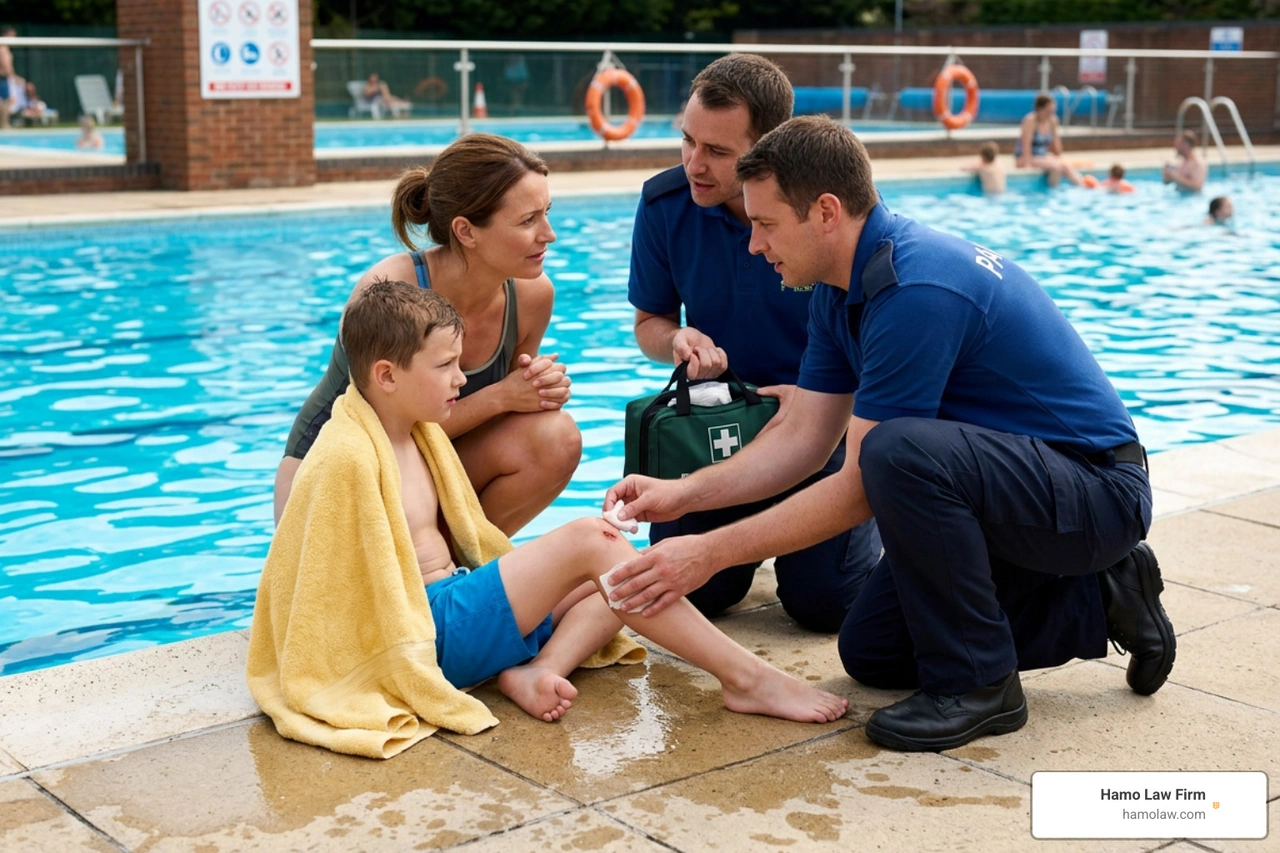
A swimming pool accident can happen in seconds — and the aftermath can last a lifetime. Here is what you need to know right away:
Quick answers for Michigan pool accident victims:
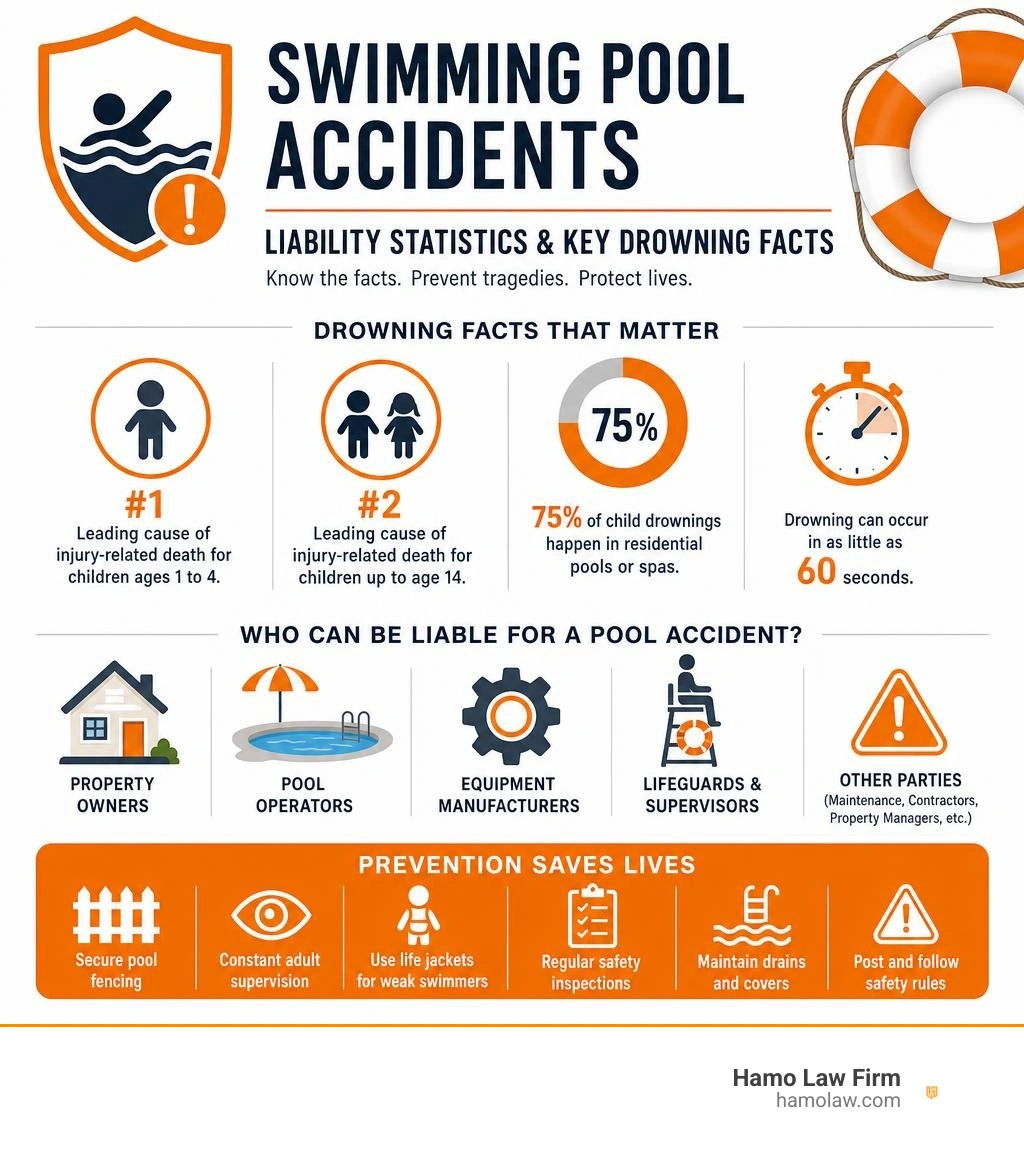
- Who can be liable? Property owners, pool operators, equipment manufacturers, or lifeguards — depending on the cause.
- What compensation can you recover? Medical bills, lost wages, pain and suffering, and wrongful death damages.
- What should you do first? Seek medical care, photograph the scene, gather witness contacts, and report the incident.
- How long do you have to file? Michigan's statute of limitations limits how long you have to act — consult an attorney quickly.
- Does it cost money upfront? Most personal injury attorneys, including Hamo Law Firm, work on contingency — no fees unless you win.
Swimming pools are a staple of Michigan summers. But beneath the surface, they carry serious risks. Drowning is the leading cause of injury-related death for children aged 1 to 4 — and the second leading cause for children up to age 14. And drowning is not the only danger. Slippery decks, faulty drains, chemical burns, and diving injuries send thousands of people to emergency rooms every year.
What makes pool accidents especially complicated is who is responsible. Was it the homeowner who skipped safety fencing? The hotel that failed to post depth warnings? A manufacturer who sold a defective drain cover? The answer shapes everything about your legal claim.
I'm George Hamo, and in this guide I'll walk you through exactly how pool liability works in Michigan — and what you can do to protect yourself.
Common Types and Causes of a Swimming Pool Accident
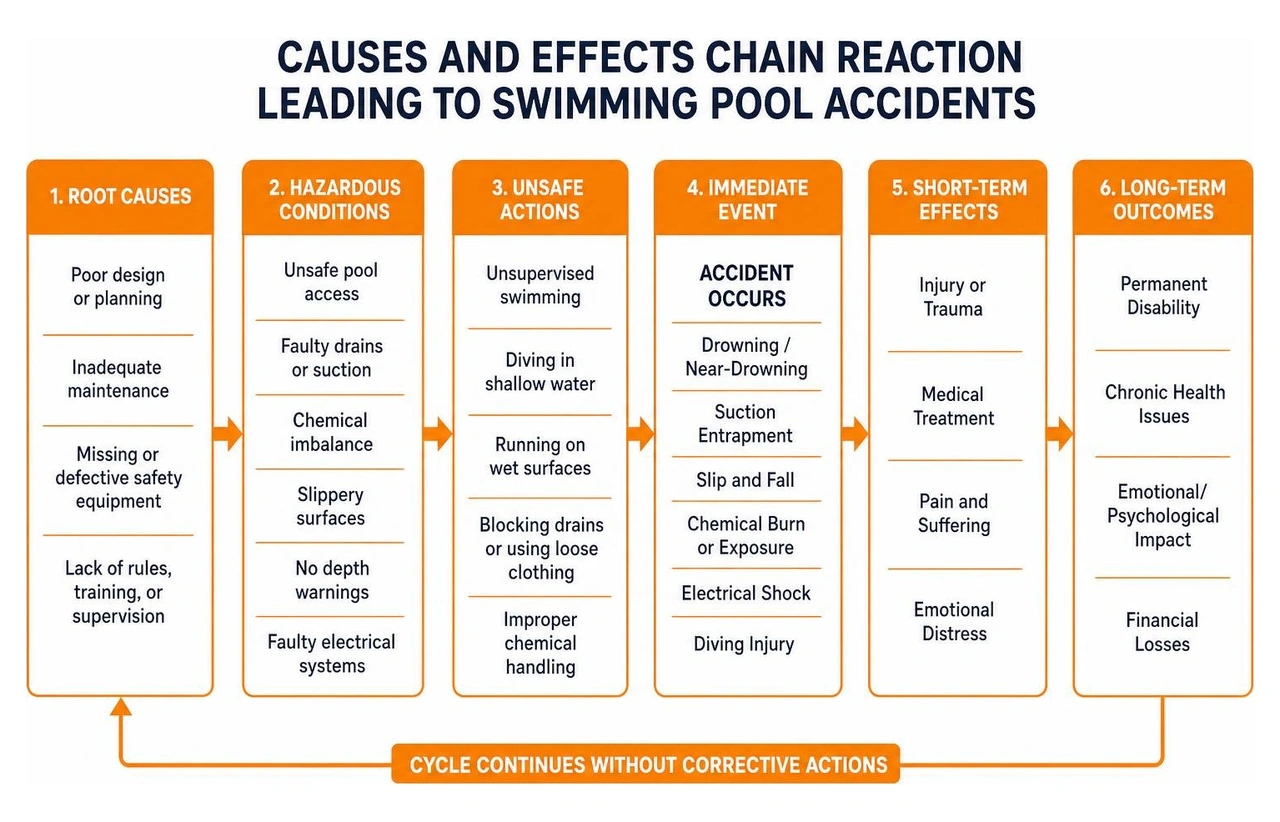
When we think of swimming pool hazards, drowning is often the first thing that comes to mind. However, water safety encompasses a broad range of dangerous conditions. Swimming pool injuries occur in backyards in Flint, apartment complexes in Detroit, and commercial resorts across Michigan. Understanding the primary hazards helps clarify why property owners must exercise rigorous care.
Drowning and Near-Drowning Incidents
Drowning happens quickly and silently. Unlike cinematic depictions featuring dramatic splashing and shouting, a struggling swimmer often sinks without making a sound. For infants and toddlers, it takes as little as one inch of water to cause an accidental drowning incident.
When a non-fatal drowning occurs, oxygen deprivation can cause permanent brain damage, organ failure, or severe neurological deficits within minutes. Active adult supervision is the single most vital factor in preventing these tragedies. Leaving young children unattended near water—even for a few moments to grab a phone or answer the door—can yield devastating outcomes. News reports frequently highlight how quickly unmonitored access turns fatal, such as when a two-year-old child tragically died after accessing a pool through an improperly secured gate.
Shallow water diving is another common trigger for catastrophic aquatic trauma. When individuals dive into unmarked or inadequately lit shallow sections, the collision impact against the pool bottom often results in cervical spine fractures, paralysis, or severe traumatic brain injuries. High-profile lawsuits, including news stories where a teen filed suit after a disastrous pool diving injury left her paralyzed, demonstrate the irreversible harm caused by unsafe diving structures or missing depth indicators.
Drain Entrapment, Chemical Exposure, and Physical Trauma
Beyond submersion hazards, mechanical and structural defect hazards abound around residential and public pools:
- Suction Drain Entrapment: Faulty, broken, or missing drain covers create powerful vacuum forces capable of trapping body parts, clothing, or hair against the bottom of a pool. Tragically, international news reports documented how an 11-year-old girl died after her hair became entangled in a pool drain suction nozzle, and a seven-year-old girl suffered critical injuries when sucked into a pool drain. Federal standards like the Virginia Graeme Baker Pool and Spa Safety Act mandate anti-entrapment drain covers specifically to eliminate this nightmare.
- Chemical Burns and Toxicity: CDC inspection statistics indicate that more than 1 in 10 public swimming pools contained improper chemical levels. Excess chlorine or unbalanced pH levels can lead to chemical burns, severe eye damage, skin lesions, and respiratory illness. Conversely, under-chlorinated pools foster dangerous bacterial growth.
- Slippery Decks and Hard Falls: Standing water mixed with body lotions, algae, or slick tile creates high-risk slip-and-fall environments. Falling onto concrete pool aprons leads to broken bones, concussions, and severe soft-tissue trauma.
- Electrocution Hazards: Faulty underwater wiring, ungrounded lights, or aging electrical setups can electrify pool water. Underwater pool lights should use low-voltage transformers (12 watts or less) to minimize lethal shock risks.
Understanding Premises Liability and Property Owner Responsibilities
When a swimming pool accident occurs on private or commercial property, civil accountability centers around premises liability. In Michigan, property owners have a legal duty to maintain reasonably safe environments for lawful visitors. When a property owner fails to repair known hazards, erect mandatory safety barriers, or warn guests of hidden dangers, they can be held liable for resulting injuries.
Visitor Classifications: Invitees, Licensees, and Trespassers
Under traditional premises liability rules, the extent of a property owner's legal obligation depends on why the visitor was on the property. Determining who is liable for injuries on someone else's property starts with these three legal categories:
- Invitees: These are individuals who enter a property for business purposes or at the public invitation of the owner (such as patrons paying to enter a commercial waterpark, hotel pool, or public fitness facility). Property owners owe invitees the highest standard of care. They must inspect the pool area regularly, fix dangerous conditions immediately, maintain water clarity and filtration systems, hire qualified lifeguards when required, and provide clear warning signs.
- Licensees: These are social guests entering private residential property with express or implied permission (such as friends or family attending a backyard summer barbecue in Flint or Wayne County). Homeowners must inspect or repair non-obvious dangers they know about and warn social guests about unapparent hazards, such as a missing deep-end depth marker, slick algae patches, or a loose pool ladder step.
- Trespassers: A trespasser enters property without permission. Generally, property owners do not owe adult trespassers a duty to maintain a safe environment—they simply cannot intentionally harm them (e.g., setting traps). However, there is a crucial legal exception when it comes to children.
The Attractive Nuisance Doctrine and Child Safety
Because children are naturally curious and unable to recognize the inherent dangers of open water, the legal system applies the Attractive Nuisance Doctrine. Under this doctrine, property owners can be held legally liable for injuries sustained by child trespassers if an artificial condition on their land—such as an appealing, unguarded swimming pool—attracts young children into danger.
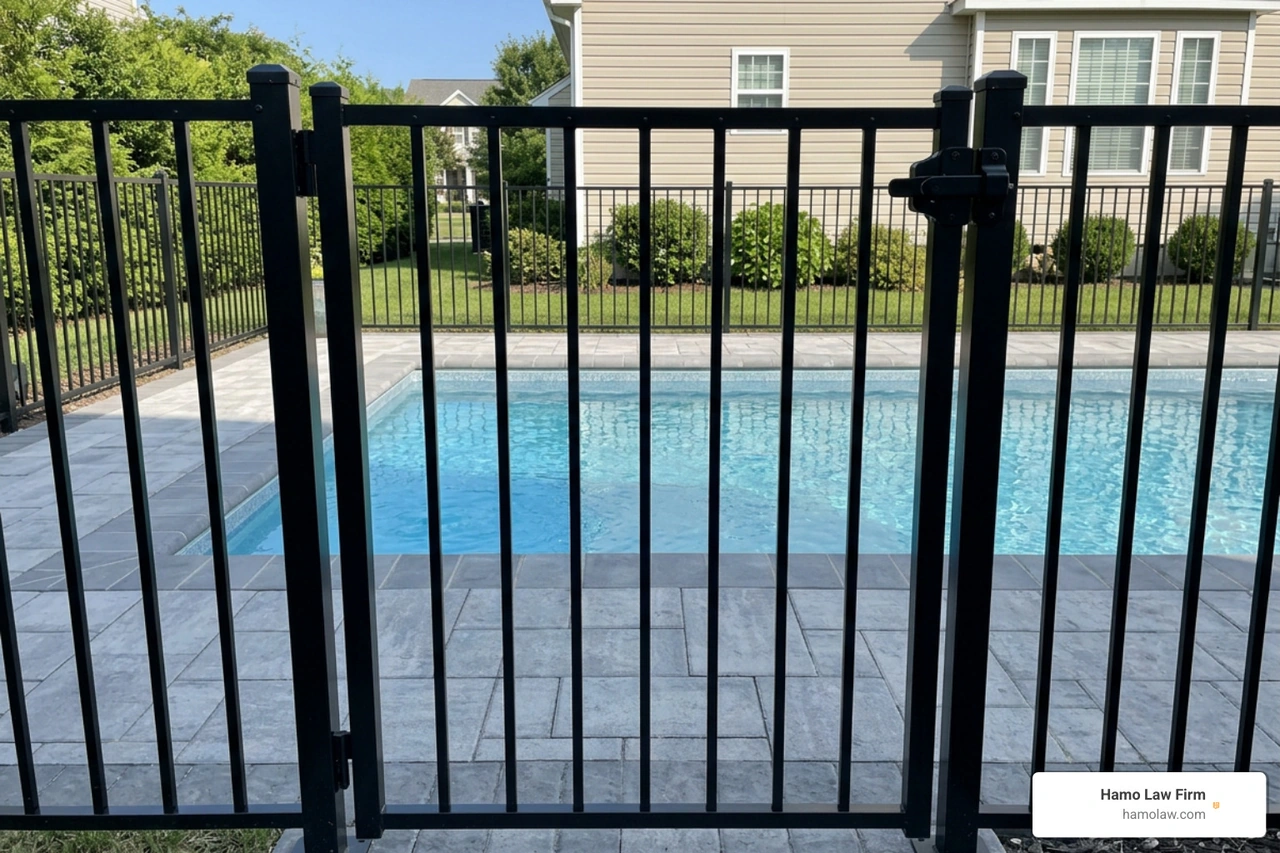
To protect against attractive nuisance claims, residential pool owners must implement physical safety barriers:
- Installing perimeter fencing at least 4 feet tall around the entire pool perimeter.
- Equipping all access gates with self-closing and self-latching devices placed high enough (typically 54 inches) that small children cannot reach them.
- Ensuring the clearance between the ground and the bottom of the fence does not exceed 4 inches.
- Utilizing functional door alarms on house doors leading directly into an enclosed pool deck.
- Covering non-operational pools with heavy-duty, lockable safety covers.
Regulatory Compliance: Residential vs. Commercial Swimming Pools
Both residential homeowners and commercial pool operators must comply with state safety codes, local municipal ordinances, and health regulations. Failing to uphold safety mandates serves as strong evidence of negligence in a personal injury lawsuit.
| Safety Standard / Regulation | Residential Swimming Pools | Commercial / Public Swimming Pools |
|---|---|---|
| Primary Barrier Requirements | Minimum 4-foot perimeter fence or isolation barrier. | Commercial grade perimeter fencing with controlled access gates. |
| Gate Latches & Access Controls | Self-closing, self-latching gates with latches set at 54"+ height. | Keycard, panic bar, or staff-monitored points of ingress/egress. |
| Supervision Requirements | Responsible adult oversight expected during guest use. | Certified lifeguards (Red Cross/YMCA) or explicit "No Lifeguard" warnings. |
| Depth Signage & Markings | Recommended, especially for shallow/deep transitions. | Mandatory clear, highly visible depth numbers on deck and pool walls. |
| Chemical & Water Testing | Periodic manual chemical balancing by homeowner. | Rigorous daily chemical logs, automated chlorination, and health audits. |
| Drain Safety Compliance | Anti-entrapment covers under VGB Safety Act. | VGB anti-entrapment covers, dual main drains, emergency shut-off switches. |
Safety Standards for Home Swimming Pools
In Michigan, home swimming pools require deliberate safety investments. Standard home safety protocols require full isolation fencing surrounding the pool rather than relying on house walls alone. Furthermore, pool alarms that sound when an unexpected disturbance hits the water surface provide vital extra protection. When home pool owners neglect these basic installations, children can easily slide into open water undetected.
Heightened Standards and Lifeguard Duties for Commercial Pools
Commercial facilities—such as hotels, apartment complexes, HOA community pools, municipal centers, and water parks—are held to heightened regulatory oversight:
- Lifeguard Certification and Ratios: If a public facility advertises supervised swimming, lifeguards must possess active certifications in aquatic rescue, CPR, and first aid. Facility managers must maintain proper lifeguard-to-swimmer ratios to prevent overcrowding from distracting staff.
- Operational Staff vs. Lifeguards: Courts distinguish strictly between pool attendants (who handle towels or rule enforcement) and trained lifeguards. Misrepresenting pool attendants as qualified rescue staff creates substantial civil liability when an emergency strikes.
- Mandatory Emergency Equipment: Commercial pools must stock reachable life rings, shepherd’s crooks, functional first aid kits, and easily accessible emergency pump shut-off switches.
- Depth and Safety Warnings: Deep and shallow boundaries must be marked clearly on pool borders and decking tile. Shallow water non-diving signs must be painted conspicuously along edges measuring 6 feet or less in depth.
Determining Fault and Seeking Financial Compensation
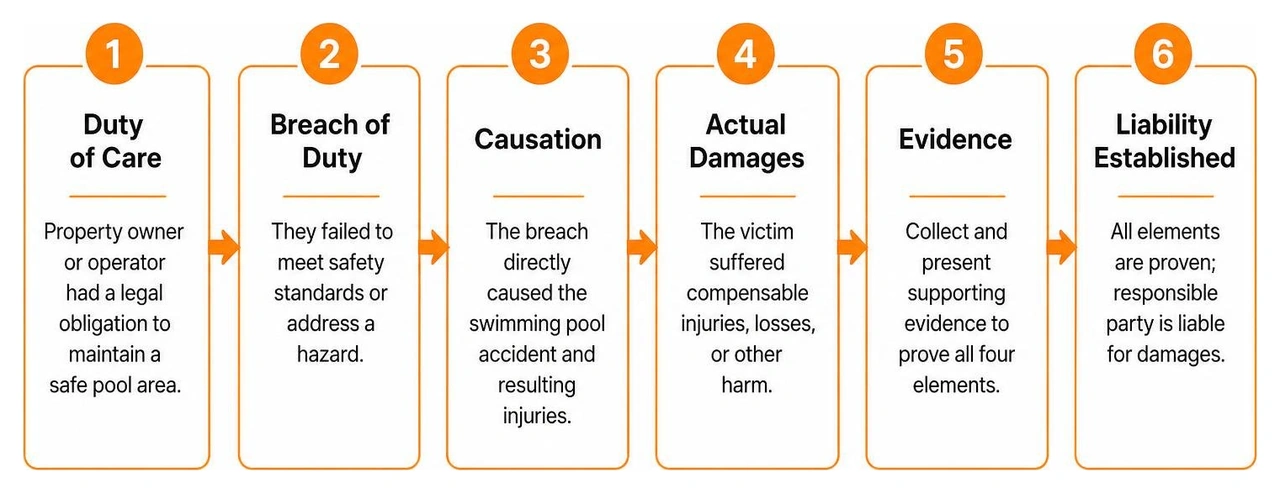
Proving fault after a serious swimming pool accident requires demonstrating that a property owner, pool operator, or equipment maker breached their duty of care, directly causing injury or loss of life. When severe submersion incidents occur, victims frequently face catastrophic injuries requiring lifelong medical intervention and specialized accommodations.
Proving Negligence in a Swimming Pool Accident Lawsuit
To build a compelling premises liability case, an injured party must establish four basic legal elements:
- Duty of Care: The property owner or operator owed a legal obligation to ensure a safe environment.
- Breach of Duty: The owner failed to meet that duty through action or inaction (e.g., ignoring a broken pool gate latch, leaving toxic chemicals unlocked, failing to test water quality, or failing to hire adequate lifeguards).
- Causation: The specific breach directly brought about the victim's injuries.
- Damages: The victim suffered verifiable economic or non-economic harm.
Gathering strong evidence is key when evaluating how do I prove negligence in a slip and fall case or pool accident claim. Crucial proof includes pool maintenance logs, inspection reports, internal surveillance footage, eyewitness testimony, local health department violation records, and expert aquatic safety witness evaluations.
Comparative Negligence and Financial Recovery
In many pool injury lawsuits, defense attorneys try to blame the victim. They may claim the injured person was swimming recklessly, consuming alcohol, or diving despite warnings.
Michigan follows a modified comparative negligence system. Under this framework:
- An injured victim's financial recovery is reduced by their percentage of fault. For instance, if a court determines a slip-and-fall victim was 20% responsible because they ran near the pool, but the owner was 80% at fault for allowing algae to accumulate on untextured deck tiles, the victim recovers 80% of their total evaluated damages.
- However, under Michigan law, if an injured party is found to be more than 50% at fault for their own economic losses, or if specific statutory exceptions apply, non-economic damages (such as pain and suffering) can be barred or substantially limited. Understanding fault distribution directly impacts evaluations of how much a personal injury case is worth.
Damages in Wrongful Death and Severe Injury Claims
When pool accidents cause permanent impairment or death, families face huge financial burdens alongside intense grief. Under Michigan personal injury and wrongful death laws, victims and surviving loved ones can seek compensation across multiple damage categories:
- Past and Future Medical Costs: Emergency hospital transport, intensive care, surgeries, ventilator assistance, neurological rehabilitation, prescription medications, and physical therapy.
- Lifelong Care and Assistive Needs: Home nursing care, specialized wheelchairs, home accessibility modifications, and continuous cognitive therapy for severe brain injuries.
- Lost Income and Reduced Earning Potential: Coverage for missed workdays and lost future earning capacity caused by long-term disability.
- Pain and Suffering: Compensation for physical trauma, emotional distress, anxiety, loss of enjoyment of life, and post-traumatic stress disorder (PTSD).
- Wrongful Death Damages: Funeral and burial expenses, loss of financial support, loss of parental guidance, and loss of companion care and society.
Essential Steps to Protect Your Rights After an Incident
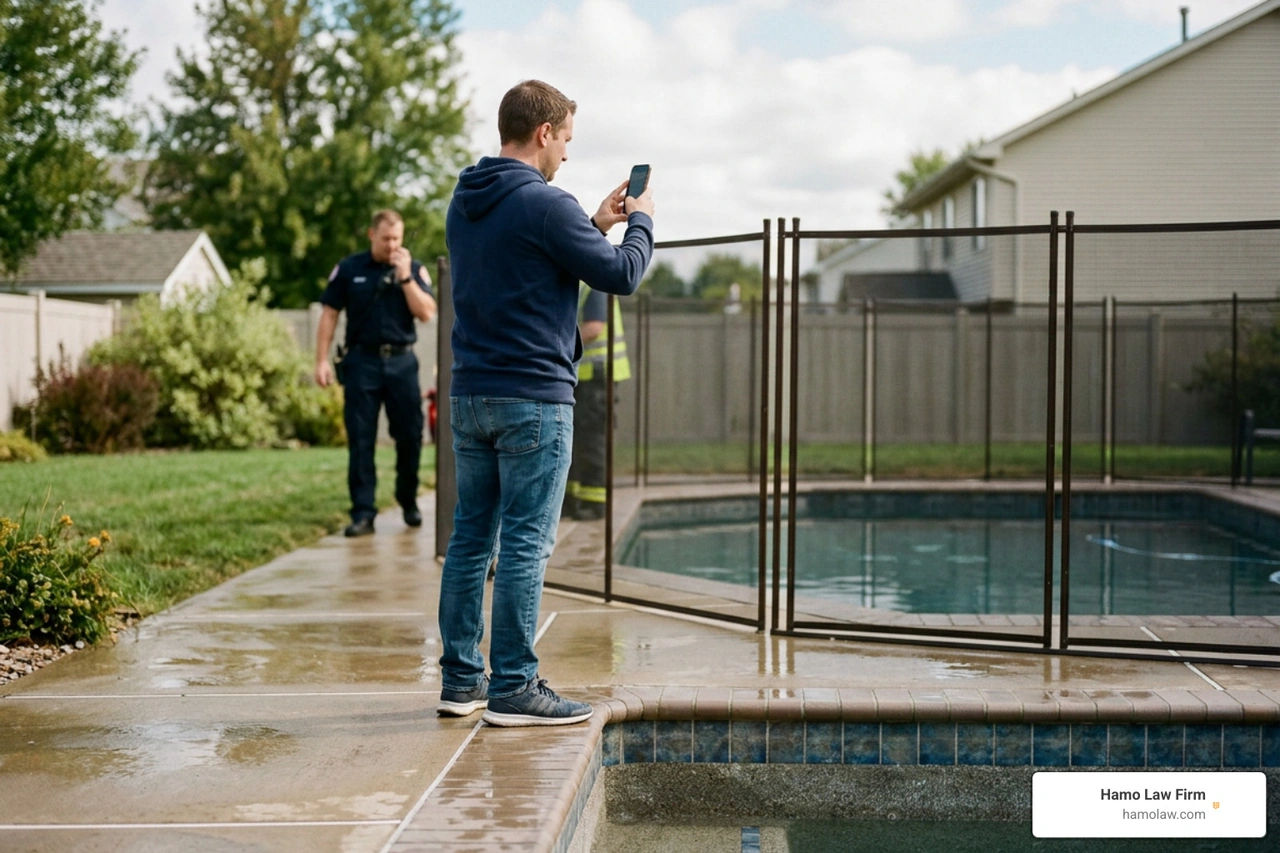
The steps taken immediately following a pool mishap play a central role in your physical recovery and any future legal claim. Preserving evidence right away prevents insurance companies from changing the narrative.
What to Do Immediately After a Swimming Pool Accident
If you or a loved one are involved in a pool emergency, take these legal and medical action steps:
- Seek Emergency Medical Attention: Call 911 immediately. First responders and ER physicians must assess submersion risks, secondary drowning (fluid accumulation in lungs), spinal fractures, or concussions. Medical documentation serves as foundational evidence.
- Document the Scene and Physical Dangers: Take detailed photographs and video clips of the pool area, water clarity, missing depth signs, broken fence gates, damaged drain covers, absent safety equipment, or uncleaned deck spills before anyone alters the scene.
- Gather Contact Information: Collect names, phone numbers, and email addresses of all eyewitnesses, lifeguard staff, and pool managers.
- File an Official Incident Report: Formally notify the property owner, hotel manager, HOA board, or public facility director. Request a written copy of their official incident log.
- Preserve Physical Evidence: Keep the swimwear, footwear, or damaged personal belongings worn during the accident unwashed in a secure location.
- Follow Legal Guidelines for Slip and Fall Events: Review key instructions on what to do after an accident or injury to avoid common mistakes that damage legal claims.
Navigating Insurance Adjusters and Statutory Deadlines
Following a severe pool injury, insurance claims adjusters representing the property owner will likely reach out. Their main objective is to minimize payouts. They may ask for recorded statements, push quick lowball settlements, or try to get you to admit partial fault.
Before signing documents or accepting settlement offers, consult with an experienced trial lawyer. Understanding strategies for dealing with insurance companies after an accident keeps you from waiving your rights to full financial compensation.
Timing is equally critical. Every state establishes strict time frames within which injury lawsuits must be initiated:
- Michigan Statute of Limitations: In Michigan, the standard statute of limitations for personal injury claims is generally three (3) years from the date of the accident.
- Wrongful Death Claims: Wrongful death lawsuits in Michigan must also strictly adhere to statutory filing periods, typically three (3) years from the date of death, with specific notice rules regarding estate administration.
- Claims Against Government Entities: If an accident happens at a public municipal pool, school district facility, or county park, special notice deadlines apply. Victims often must file formal written notice of intent within months of the incident, or forfeit their right to recover compensation entirely.
Frequently Asked Questions about Swimming Pool Accidents
Who is liable if a guest drowns at a residential pool?
Liability depends on whether the homeowner was negligent. If a residential host failed to fix a known hazard, neglected to install mandatory barrier fencing, failed to supervise young guests, or provided excessive alcohol to impaired guests without safety precautions, their homeowner insurance policy can be held financially liable for the resulting harm.
What safety equipment is legally required to prevent pool accidents?
Required equipment varies by jurisdiction and whether the pool is commercial or residential. Typically, requirements include continuous 4-foot safety fencing, self-latching access gates, anti-entrapment drain covers meeting federal VGB guidelines, reachable life preservers or shepherd's hooks, clear depth markings, and functional door entry alarms.
How does the attractive nuisance doctrine apply to pool owners?
The attractive nuisance doctrine holds property owners responsible for injuries to child trespassers if an unsecured swimming pool entices young children who lack the maturity to appreciate the dangers of water. Property owners must prevent unauthorized access by installing self-latching gates, locked fencing, pool alarms, or sturdy safety covers.
Conclusion
A swimming pool accident can transform a joyful summer day into a terrible ordeal. While implementing proper safety barriers, active adult supervision, and strict maintenance routines prevents many aquatic tragedies, property owner negligence still leads to preventable harm every year.
If you or a family member suffered injuries in a pool accident in Michigan, you do not have to navigate insurance negotiations or complex liability laws alone. At Hamo Law Firm, our legal team brings over 40 years of personal injury trial experience to fight for accident victims across Flint, Detroit, Genesee County, and Wayne County. We handle personal injury and wrongful death cases on a contingency fee basis — meaning you pay no upfront legal fees unless we successfully win compensation for you.
Reach out to a skilled premises liability attorney at Hamo Law Firm today to schedule your free, confidential case consultation.