

Detroit roadways like I-75, I-94, and Gratiot Avenue see heavy traffic daily, creating high-risk environments for motorcyclists. Because motorcycles have a smaller visual profile, drivers routinely fail to spot them until it is too late. Understanding what causes most motorcycle accidents in Michigan is crucial when determining who is legally at fault for your injuries.
Some of the most common causes of crashes in Wayne County include:
- Left-Turn Collisions: A passenger vehicle turns left across an intersection directly into the path of an oncoming motorcycle. Drivers often misjudge the motorcycle's speed or fail to see it altogether.
- Distracted Driving: Drivers texting, adjusting navigation systems, or talking on phones fail to notice sudden traffic pattern changes.
- Failure to Yield Right-of-Way: Drivers entering roadways, merging, or changing lanes without checking blind spots properly.
- Road Hazards: Potholes, gravel, uneven pavement, and construction debris pose severe dangers to two-wheeled vehicles.
- Speeding and Reckless Driving: Tailgating or aggressive driving reduces reaction time and increases impact forces.
If you are wondering about specific accident scenarios, our what causes most motorcycle accidents FAQ provides further insight into how negligence is evaluated on Michigan roads.
Michigan Comparative Fault and Fault Allocation
Determining liability in a motorcycle crash isn't always all-or-nothing. In many cases, insurance adjusters try to claim that the rider was speeding or lane-weaving to shift the blame.
Michigan follows a modified comparative fault rule (specifically a 51% bar rule). Here is how it impacts your recovery:
- Under 50% At Fault: You can still recover non-economic damages (such as pain and suffering), but your financial payout will be reduced by your percentage of fault. For example, if you are awarded $100,000 but found to be 20% at fault, you receive $80,000.
- 51% or More At Fault: If a jury determines you are 51% or more responsible for the collision, you are completely barred from collecting any non-economic damages from the other party.
Because insurance carriers frequently try to push a motorcyclist's fault above 50% to avoid paying, having an experienced motorcycle accident lawyer Detroit on your side is critical to protecting your rights.
How a Motorcycle Accident Lawyer Detroit Investigates Your Crash Scene
Building a bulletproof claim requires immediate, thorough investigation. When we take on a motorcycle case, we do not simply rely on the initial police report. We independently gather and analyze evidence by:
- Preserving Black Box & Telematics Data: Extracting electronic control module (ECM) data from the passenger or commercial vehicle involved.
- Securing Surveillance Video: Obtaining footage from nearby Detroit business security cameras, traffic cameras, or dashcams.
- Accident Reconstruction: Partnering with forensic reconstruction engineers to analyze skid marks, point of impact, vehicle rest positions, and crush damage.
- Interviewing Witnesses: Locating neutral eyewitnesses before memories fade or contact details change.
Michigan No-Fault Insurance Rules for Motorcyclists
Michigan’s auto insurance framework is unique, and many riders are surprised to learn that motorcycles are not classified as "motor vehicles" under Michigan’s No-Fault Act. This distinction drastically impacts how medical bills and wage losses are handled after a crash.
To qualify for Michigan No-Fault Personal Injury Protection (PIP) benefits after a motorcycle accident, there must be an involvement of a traditional motor vehicle (a car, truck, van, or bus). If you crash your bike due to a road hazard or to avoid a deer without contacting or involving a motor vehicle, standard PIP benefits do not apply, and you must rely on your private health insurance or optional motorcycle medical payments (MedPay) coverage.
When a motor vehicle is involved, motorcyclists do not look to their own auto policy first. Instead, Michigan law dictates a specific "order of priority" to pay for PIP benefits:
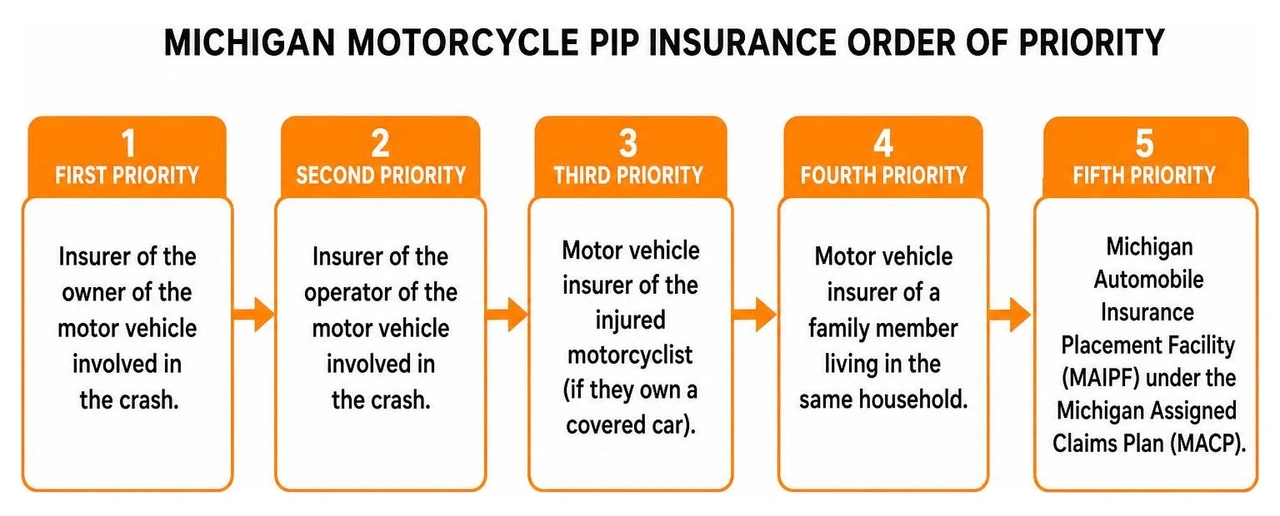
- First Priority: The insurer of the owner of the motor vehicle involved in the crash.
- Second Priority: The insurer of the operator of the motor vehicle involved in the crash.
- Third Priority: The motor vehicle insurer of the injured motorcyclist (if they own a covered car).
- Fourth Priority: The motor vehicle insurer of a family member living in the same household.
- Fifth Priority: The Michigan Automobile Insurance Placement Facility (MAIPF) under the Michigan Assigned Claims Plan (MACP).
To understand how PIP benefits interact with your overall injury claim, read our guide on do motorcyclists receive No-Fault PIP benefits in Michigan.
Michigan Motorcycle Laws and Safety Regulations
Staying legal on Michigan roads is not only essential for safety—it also protects your rights in a court of law. Key statutes include:
- Helmet Laws: Riders 21 and older may legally ride without a helmet only if they carry at least $20,000 in first-party medical benefits coverage and have held a motorcycle endorsement for at least two years (or passed an approved safety course). Passengers must also meet age and insurance requirements.
- Eye Protection: All operators must wear protective eyewear (goggles, face shield, or shatterproof glasses) unless the motorcycle is equipped with an adequate windshield.
- Lane Splitting: Lane splitting—riding between lanes of moving or stopped traffic—is illegal under Michigan law.
- Endorsement: Riding requires a valid "CY" motorcycle endorsement on your Michigan driver's license.
Legal Timeframes: Michigan Statute of Limitations
Timing is everything in personal injury cases. If you miss key statutory deadlines, you lose your right to recover money forever.
- Three-Year Deadline for Third-Party Claims: You generally have three (3) years from the exact date of the crash to file a personal injury lawsuit against the at-fault driver for pain and suffering and excess economic losses.
- One-Year Deadline for No-Fault Claims: Claims for PIP benefits under Michigan’s No-Fault system must be formally submitted to the responsible insurer within one (1) year of the accident date. Furthermore, any lawsuit for unpaid PIP benefits must be filed within one year of when the specific expense was incurred.
Recoverable Damages in Detroit Motorcycle Crash Claims
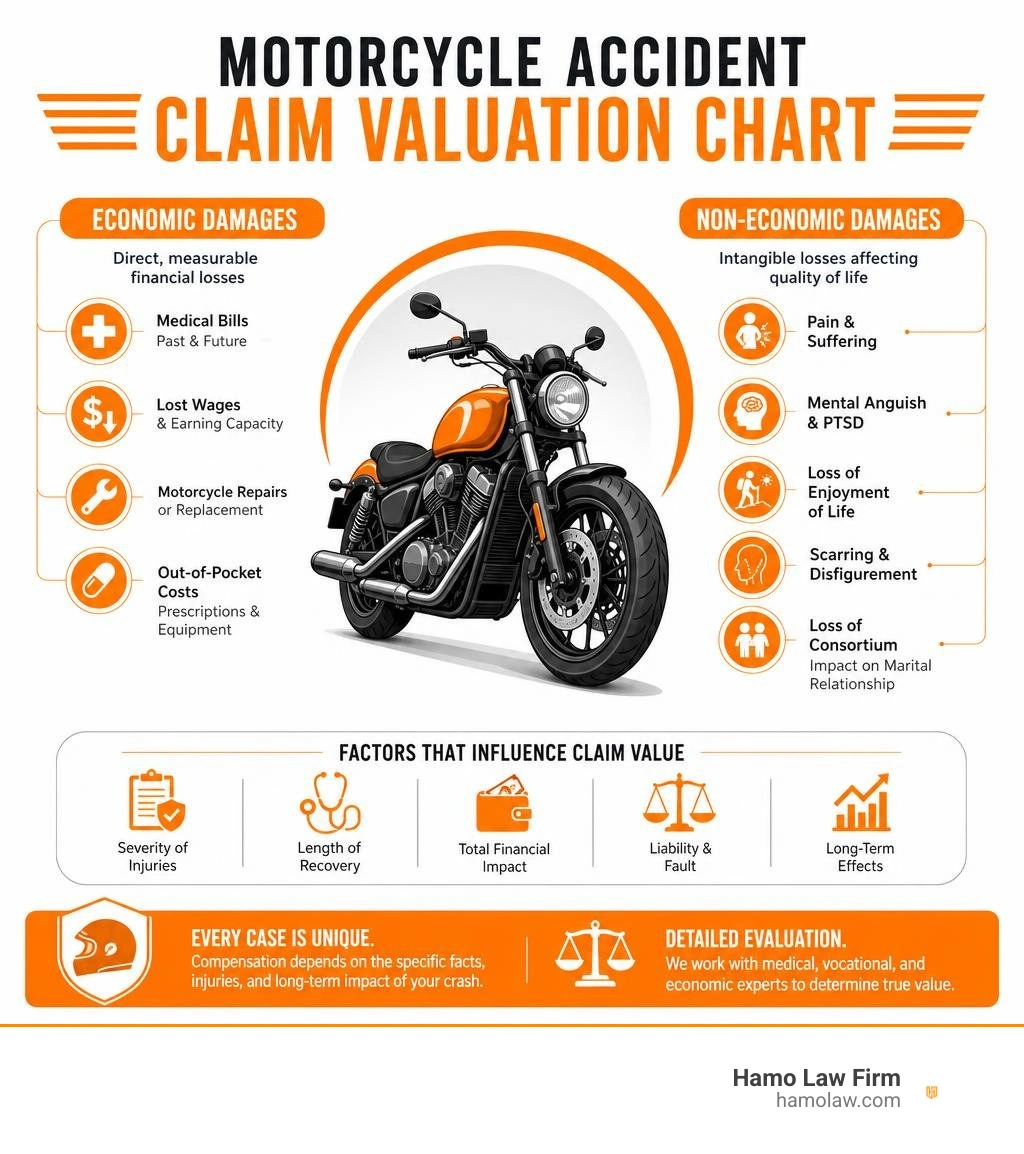
When another driver’s negligence causes a collision, the compensation you can pursue falls into two primary categories: economic and non-economic damages.
| Category | Description | Examples |
|---|---|---|
| Economic Damages | Direct, measurable financial losses caused by the crash | • Past and future medical bills • Lost wages and reduced earning capacity • Motorcycle repairs or replacement • Out-of-pocket prescription & equipment costs |
| Non-Economic Damages | Intangible, subjective losses affecting your quality of life | • Physical pain and suffering • Mental anguish and PTSD • Loss of enjoyment of life • Scarring and disfigurement • Loss of consortium (impact on marital relationship) |
Our team of experienced car, truck, motorcycle accident lawyers in Michigan works closely with medical experts, vocational specialists, and economists to calculate the true value of your losses.
Crucial Steps to Take Immediately After a Crash
What you do in the minutes and days following a motorcycle collision directly affects your ability to collect compensation. Follow these critical steps:
- Move to Safety & Call 911: Prioritize physical safety. Request emergency medical personnel and local law enforcement (Detroit Police or Michigan State Police) to write an official crash report.
- Gather Evidence at the Scene: If physically able, take photos and videos of all damaged vehicles, road hazards, skid marks, traffic signals, and physical injuries.
- Exchange Information: Get names, phone numbers, addresses, driver's license numbers, and insurance policy details from all drivers involved. Collect contact info from eyewitnesses.
- Seek Immediate Medical Attention: Go to an emergency room or urgent care right away—even if you feel fine. Adrenaline often masks severe soft tissue, internal, or traumatic brain injuries.
- Notify Your Insurer (Carefully): Report the incident, but stick strictly to factual details. Do not admit fault or record statements without legal guidance.
- Consult an Attorney: Review our detailed breakdown on what to do after an accident or injury to ensure your legal rights remain intact.
How a Motorcycle Accident Lawyer Detroit Helps Maximize Your Compensation
Navigating the aftermath of a severe crash while trying to heal physically is exhausting. Insurance adjusters take advantage of stressed victims by offering quick, lowball settlements before the true extent of medical costs is fully known.
When you work with our team, we handle every aspect of your claim:
- Shielding You from Insurers: We take over all communications, negotiations, and paperwork so you can focus on recovery.
- Proving Severity: We document the lifelong impact of catastrophic injuries to demand fair financial compensation.
- Uncovering All Insurance Policies: We review all available coverage, including umbrella policies, commercial fleet insurance, and uninsured/underinsured motorist (UM/UIM) endorsements.
- Taking Claims to Trial: If an insurance company refuses to pay a fair settlement, we do not hesitate to present your case to a jury.
Explore our dedicated Motorcycle Accidents Sub-Area and Automobile, Truck, Motorcycle Accidents Practice Area pages to see how we build compelling claims.
Why Hiring a Motorcycle Accident Lawyer Detroit Is Essential
Riders often face an unfair societal bias. Insurance adjusters and defense lawyers love to paint motorcyclists as reckless, speeding risk-takers—even when the passenger vehicle driver was blatantly at fault.
Fighting this bias requires aggressive legal representation backed by hard evidence. A qualified motorcycle accident lawyer Detroit neutralizes adjuster tactics, firmly establishes liability, and aggressively demands the maximum payout you deserve under Michigan law.
Frequently Asked Questions About Detroit Motorcycle Accidents
Do motorcyclists get No-Fault PIP benefits in Michigan?
Yes, but only if a motor vehicle was involved in the collision. Under Michigan’s order of priority, benefits are paid first by the insurer of the motor vehicle owner, followed by the driver's insurer, your auto policy, or the Michigan Automobile Insurance Placement Facility. If no motor vehicle was involved, standard PIP does not apply.
How long do I have to file a motorcycle accident lawsuit in Detroit?
You have three (3) years from the date of the crash to file a third-party personal injury lawsuit against the negligent driver. However, claims for No-Fault PIP benefits must be submitted within one (1) year, and any legal action for unpaid PIP bills must be filed within one year of the expense date.
What happens if I am partially at fault for my Detroit motorcycle crash?
Under Michigan’s modified comparative fault rules, as long as you were 50% or less at fault, you can still collect non-economic damages, though your recovery will be reduced proportionally by your fault percentage. If you are found 51% or more at fault, you cannot collect non-economic damages.
Conclusion
A serious crash can turn your life upside down in seconds. When medical bills accumulate and you are unable to work, you need a legal team that knows how to take on powerful insurance companies and win.
At Hamo Law Firm, we bring over 40 years of trial experience to every case we handle. We operate strictly on a contingency-fee model—which means you pay zero upfront costs and zero attorney fees unless we successfully win your claim. Whether you are dealing with broken bones or life-altering injuries, we provide relentless advocacy every step of the way. Visit our Catastrophic Injuries Practice Area to learn more about how we fight for victims of life-changing accidents, or contact us today to schedule your free consultation.