
What Michigan No-Fault Coverage Means for Every Driver in the State

Michigan no-fault coverage is mandatory auto insurance that every driver in the state must carry — and it works differently from insurance in most other states.
Quick answer: What is Michigan no-fault coverage?
- You file with your own insurer — not the other driver's — after an accident, regardless of who caused it
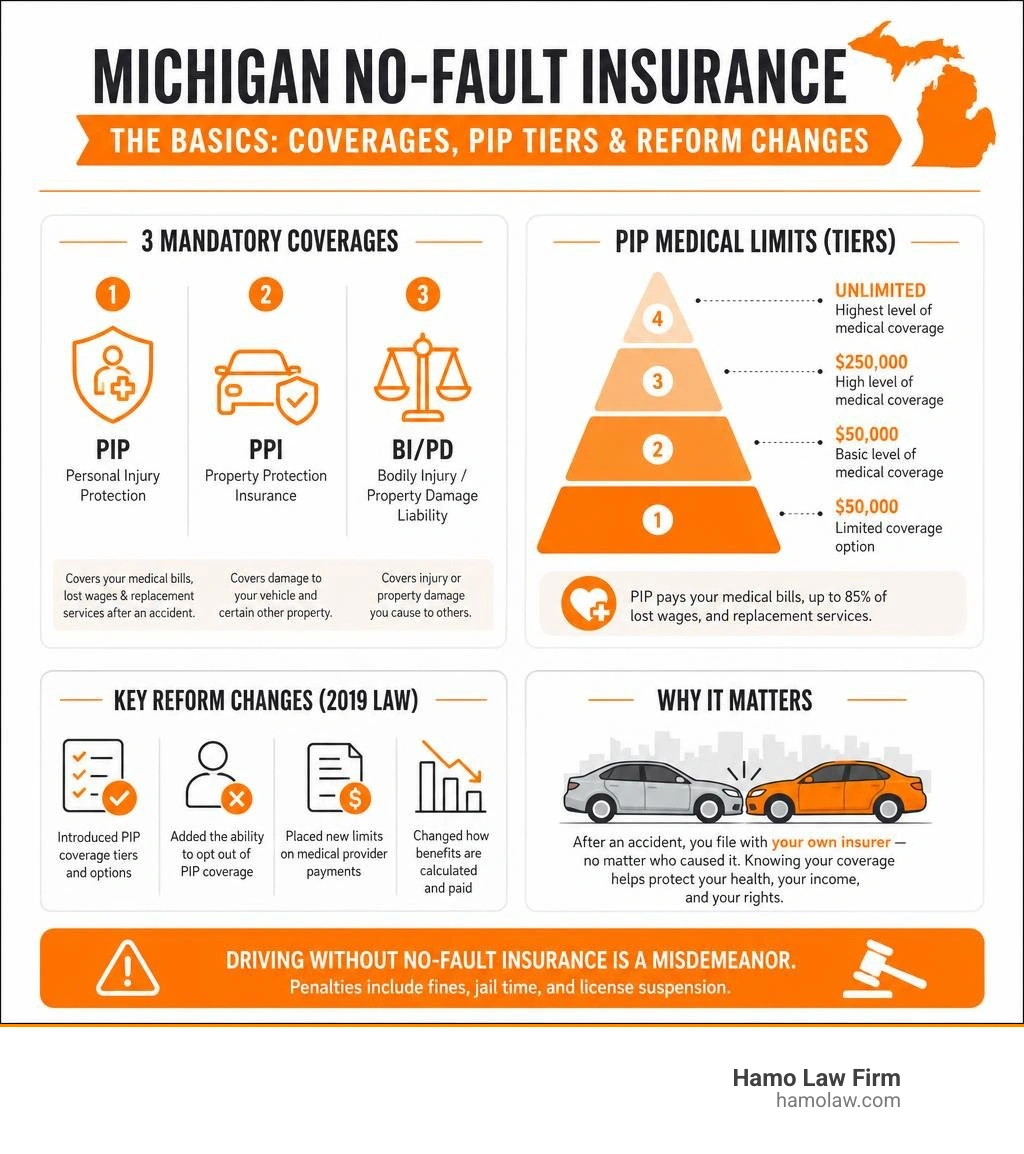
- Three coverages are required: Personal Injury Protection (PIP), Property Protection Insurance (PPI), and Residual Bodily Injury/Property Damage Liability (BI/PD)
- PIP pays your medical bills, up to 85% of lost wages, and replacement services after a crash
- PIP medical limits range from $50,000 up to unlimited, depending on your situation
- Driving without it is a misdemeanor punishable by fines, jail time, and license suspension
Michigan's system has been in place since 1973 — and it's one of the most complex auto insurance frameworks in the country. The 2019 reform law made it even more complicated by adding coverage tiers, opt-out options, and new limits on medical provider payments.
If you've been injured in a crash, what you don't know about your policy can cost you significantly.
This guide breaks down every part of Michigan's no-fault system in plain language — so you know exactly what you're entitled to and what to watch out for.
Understanding Michigan No-Fault Coverage and How It Works
At its core, the Michigan no-fault system means that if you are in a car accident, you look to your own auto insurance company to pay for your medical care, wage loss, and certain daily expenses. This is known as "first-party" benefits. It does not matter if you ran a red light, got rear-ended, or spun out on winter ice in Flint — your insurer is on the hook for these benefits.
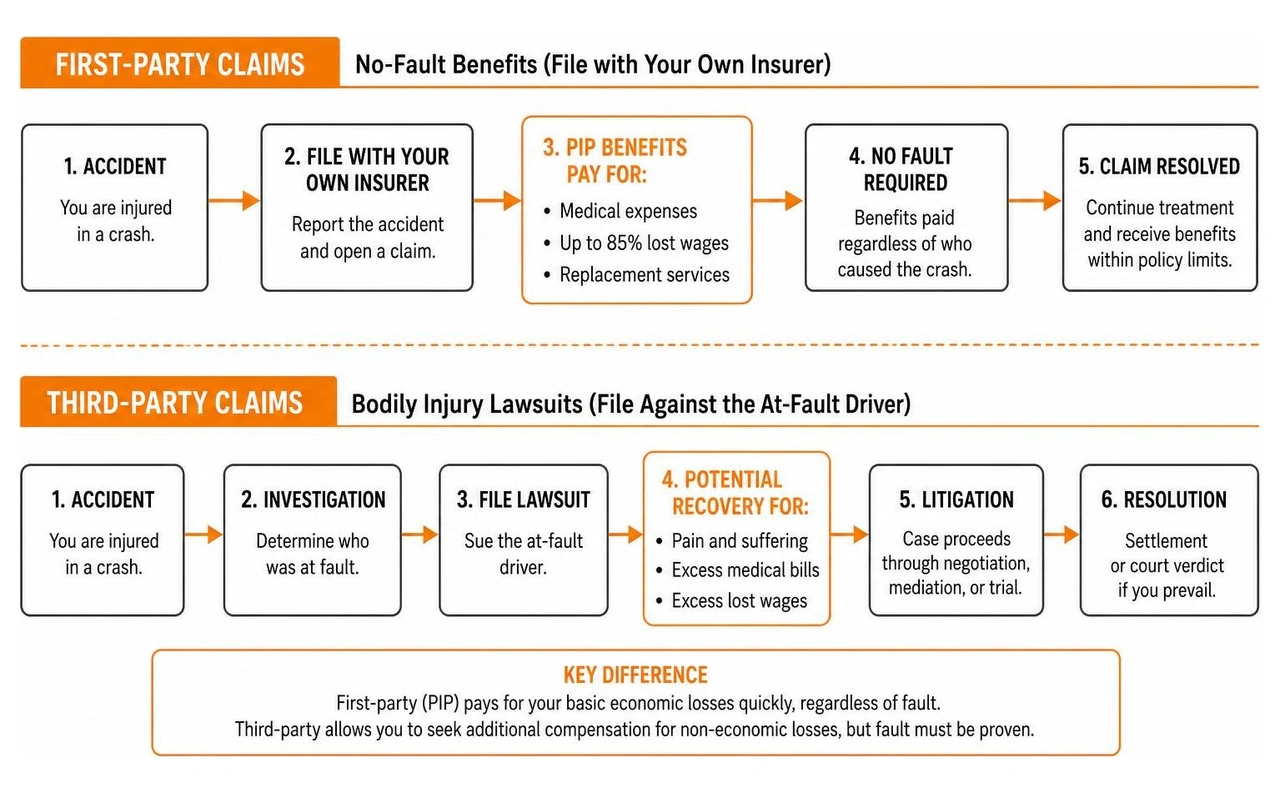
To understand How Michigan No-Fault Insurance Works, you have to realize it splits the legal aftermath of a car crash into two distinct paths:
- First-Party Claims (No-Fault Benefits): Claims made against your own insurance company for medical expenses, lost wages, and replacement services. Fault is entirely irrelevant here.
- Third-Party Claims (Bodily Injury Lawsuits): Lawsuits filed against the at-fault driver for pain and suffering, excess medical bills, or excess lost wages. Fault is the central issue here.
This dual-track system ensures that injured people receive immediate medical attention without waiting for courts or insurance adjusters to argue over who caused the crash.
History and Purpose of the 1973 Law
Before October 1, 1973, Michigan operated under a traditional "tort liability" system. If you got hurt in a car crash, you had to sue the other driver, prove they were at fault, and wait for a settlement or verdict to pay your medical bills. This old system left many seriously injured victims financially ruined, facing long delays, and severely under-compensated.
To solve this crisis, the Michigan Legislature enacted the No-Fault Insurance Act. According to the state's Brief Explanation of Michigan No-Fault Insurance, the primary goals were to assure prompt, adequate compensation for accident victims and to dramatically reduce the volume of auto-related negligence lawsuits clogging the court system. For decades, Michigan was the only state in the country that mandated unlimited, lifetime medical benefits for anyone injured in an auto accident. While this provided unmatched protection, it also contributed to Michigan having some of the highest auto insurance premiums in the United States.
Penalties for Driving Without Insurance in Michigan
Because the state relies on every driver carrying insurance to keep the system functioning, the consequences of driving uninsured in Michigan are exceptionally harsh. If you own and operate an uninsured vehicle in Michigan, you are committing a misdemeanor.
If caught, the legal and financial penalties include:
- A fine of up to $500
- Up to one year in jail
- A driver's license suspension of 30 days (or until you provide proof of insurance)
- Significant court costs and driver responsibility fees
However, the legal penalties pale in comparison to the insurance penalties. If you are injured while driving your own uninsured vehicle, you are completely barred from receiving any PIP benefits. This means you will receive zero help for medical bills, zero wage loss benefits, and zero compensation for replacement services — even if another driver ran a stop sign and slammed into you. Furthermore, you cannot sue the at-fault driver for any medical bills or pain and suffering. You are entirely on your own.
The Three Mandatory Components of Michigan Auto Insurance
To drive legally in Michigan, your auto insurance policy must contain three basic mandatory coverages. If you are missing any of these, you do not have a legally compliant policy.
| Coverage Component | What It Covers | Who It Protects | Statutory Limit / Minimum |
|---|---|---|---|
| Personal Injury Protection (PIP) | Medical care, 85% wage loss, $20/day replacement services, funeral costs | You, your household relatives, your passengers, and pedestrians | Tiered choices: $50k (Medicaid), $250k, $500k, or Unlimited |
| Property Protection Insurance (PPI) | Damage your car causes to stationary property or properly parked vehicles in Michigan | Owners of the damaged property or parked vehicles | $1 Million |
| Residual Liability (BI/PD) | Your legal liability for causing bodily injury, death, or out-of-state property damage | At-fault victims of your driving | Default: $250k/$500k (can be lowered to $50k/$100k) |
Understanding How Michigan No-Fault Insurance Works After an Accident requires looking closely at how these three components interact to protect your physical health, your assets, and the property of others.
The Role of PIP in Your Michigan No-Fault Coverage
Personal Injury Protection (PIP) is the absolute heart of your michigan no-fault coverage. It is designed to take care of your personal recovery. If you are injured in an accident, PIP covers several critical economic losses:
- Allowable Expenses (Medical Bills): This covers all reasonable and necessary charges for your medical care, rehabilitation, and recovery. Depending on the tier you selected when buying your policy, this coverage can range from a capped amount up to unlimited lifetime benefits.
- Work Loss (Lost Wages): If your injuries prevent you from working, PIP will pay up to 85% of your lost income. This benefit is capped at a statutory monthly maximum (which is adjusted annually for inflation) and is paid for up to three years from the date of the accident.
- Replacement Services: If you can no longer perform ordinary domestic tasks — such as cleaning, cooking, mowing the lawn, or driving your kids to school — PIP will pay up to $20 per day to hire help. Like wage loss, this benefit is limited to a maximum of three years.
- Funeral and Burial Expenses: If an accident results in a tragic loss of life, PIP provides a personal benefit to help cover funeral and burial costs, alongside survivor's loss benefits for dependents.
Property Protection Insurance (PPI)
Property Protection Insurance (PPI) pays for damage your vehicle causes to other people's tangible property within the state of Michigan. It carries a mandatory limit of $1 million.
It is important to note what PPI does and does not cover:
- It covers: Damage to stationary objects like buildings, fences, utility poles, and guardrails. It also covers damage to vehicles that were properly parked at the time of the collision.
- It does NOT cover: Damage to moving vehicles, or vehicles that were improperly parked. If you hit a moving car, PPI will not pay a dime for that vehicle's damage — that is handled by collision coverage or the mini-tort system.
Residual Bodily Injury and Property Damage Liability (BI/PD)
Even in a no-fault state, you can still be sued under certain circumstances. Residual Liability insurance protects you financially if you are found legally responsible for an accident that causes serious injury, death, or property damage outside the state of Michigan.
Under THE INSURANCE CODE OF 1956 (EXCERPT), the default minimum liability limits in Michigan are:
- $250,000 for bodily injury to or death of one person in any one accident.
- $500,000 for bodily injury to or death of two or more people in any one accident.
- $10,000 for injury to or destruction of property of others in any one accident (primarily for out-of-state accidents).
While these are the default limits, the law allows drivers to sign a specific waiver to elect lower minimum limits of $50,000 per person and $100,000 per accident. However, choosing these lower limits is incredibly risky. If you cause a catastrophic crash and only carry $50,000 in liability coverage, you could be held personally responsible for any judgments that exceed your policy limits, putting your home, savings, and future wages at risk.
Mini-Tort Claims and Optional Coverages
Because mandatory no-fault coverage does not pay for damage to your own car (unless it was parked), drivers must look to optional coverages to protect their vehicles:
- Collision Coverage: Pays to repair or replace your vehicle if it is damaged in a crash, regardless of fault.
- Comprehensive Coverage: Covers damage to your car caused by things other than collisions, such as hitting a deer, theft, vandalism, fire, or windshield chips.
- Uninsured/Underinsured Motorist (UM/UIM) Coverage: Although optional, we highly recommend this coverage. If you are hit by an uninsured driver (which represents a massive portion of drivers in cities like Detroit) or a driver with minimal liability limits, your own UM/UIM policy will step in to pay for your pain and suffering.
What happens if you don't have collision coverage and someone else causes damage to your car? This is where the mini-tort law comes in. In Michigan, the mini-tort provision allows you to collect up to $3,000 (increased from $1,000 following the 2020 reforms) from the at-fault driver to cover out-of-pocket vehicle repair costs not covered by insurance. You must prove the other driver was more than 50% at fault to collect a mini-tort payment.
Navigating PIP Medical Options and the 2019 Reforms
The historic 2019 Michigan no-fault reform law, which went into full effect for policies issued or renewed after July 1, 2020, completely reshaped the auto insurance landscape. The primary goal of the reform was to lower premiums by giving drivers choices, but it did so by introducing immense complexity and shifting risk directly onto consumers.
Choosing the Right Level of Michigan No-Fault Coverage
Prior to the reforms, every driver had to buy unlimited PIP medical coverage. Today, you have several PIP choice levels when purchasing or renewing your policy:
- Unlimited Coverage: The gold standard. It pays for all reasonable and necessary medical care for your lifetime.
- $500,000 Limit: Caps medical benefits at half a million dollars.
- $250,000 Limit: Caps medical benefits at a quarter-million dollars.
- $50,000 Limit: Only available if the named insured is enrolled in Medicaid and their spouse and household relatives have another qualifying health coverage, Medicaid, or another auto policy with PIP.
- PIP Medical Opt-Out: Available to Medicare beneficiaries (Parts A & B or Medicare Advantage) if their spouse and resident relatives have qualified health coverage or another auto policy with PIP.
Selecting anything less than unlimited means you are capping the medical care your auto insurer will pay for. If you sustain a traumatic brain injury or spinal cord damage, a $250,000 limit can be entirely exhausted within the first few days in an intensive care unit.
Qualified Health Coverage (QHC) and PIP Opt-Outs
To opt out of PIP medical coverage or choose certain exclusions, you must prove you have Qualified Health Coverage (QHC).
To count as QHC, your health insurance must meet two strict criteria:
- It must not exclude or limit coverage for injuries sustained in an auto accident.
- It must have an individual deductible of $6,579 or less (this threshold is adjusted periodically by the Department of Insurance and Financial Services).
Medicare Parts A and B, as well as Medicare Advantage plans, automatically qualify as QHC. If you select an opt-out, you must provide your auto insurer with a official QHC letter from your health insurance provider at every single policy renewal. If you lose your QHC and fail to notify your auto insurer within 30 days, you could be left with absolutely no medical coverage if a crash occurs.
The MCCA, Fee Schedules, and Attendant Care Limits
The 2019 reforms also changed how medical providers are compensated and how catastrophic claims are managed:
- The Michigan Catastrophic Claims Association (MCCA): The MCCA is a private, non-profit association that reimburses auto insurers for PIP claims that exceed a certain threshold — currently $635,000. If you carry unlimited PIP, your insurer pays the first $635,000 of your medical bills, and the MCCA covers everything beyond that. The MCCA fee is charged per vehicle, but starting in July 2020, the assessment dropped to $0 for drivers who choose any PIP option below unlimited.
- The Medicare-Based Fee Schedule: To curb price gouging by medical providers, the reform introduced a fee schedule. Auto insurers are only required to reimburse providers at a set percentage of Medicare rates (which eventually capped at 190% for most services). This has caused many specialized rehabilitation centers to close, making it harder for catastrophically injured patients to find care.
- Attendant Care Limits: Attendant care is in-home nursing or aide care for severely injured victims. The reform capped insurer-paid attendant care provided by family members, friends, or business associates to 56 hours per week. If an injured person needs round-the-clock care, they must secure commercial agency care for the remaining hours, which can be incredibly difficult to coordinate.
Who is Covered: Family, Passengers, and Motorcyclists
Michigan no-fault coverage does not just protect the driver; its reach extends to several groups of people:
- Household relatives: Your PIP policy covers you and any relative living in your household, even if they are injured as a passenger in someone else's car or struck as a pedestrian.
- Passengers: If a passenger is injured in your vehicle and does not have their own auto policy or a spouse/household relative with a policy, they can seek PIP benefits through your insurer.
- Pedestrians and Cyclists: If you are hit by a car while walking or riding a bicycle, you first look to your own auto policy. If you don't have one, you look to policies within your household. If none exist, you are covered under the Michigan Assigned Claims Plan (MACP), which caps medical benefits at $250,000.
Motorcycles occupy a unique, highly complicated space in Michigan law. Under the no-fault act, a motorcycle is not considered a "motor vehicle." Therefore, motorcyclists do not carry PIP coverage on their motorcycle policies. However, we must ask: Do Motorcyclists Receive No-Fault PIP Benefits in Michigan?
The answer is yes — but only if a motor vehicle (like a car or truck) is involved in the accident. If a motorcyclist collides with a car, the order of priority dictates that the motorcyclist receives PIP benefits from the insurer of the owner of the motor vehicle involved, followed by the driver of the motor vehicle, and finally through the MACP. This is also closely related to Whose Insurance Pays PIP When Pedestrian Is Hit?, where the pedestrian's own auto policy is always primary.
Third-Party Lawsuits and the Serious Impairment Threshold
If you were not at fault for an accident, you can sue the negligent driver to recover damages that your PIP coverage does not pay. This is a third-party lawsuit.
To sue for "noneconomic damages" (pain, suffering, mental anguish, and loss of enjoyment of life), your injuries must meet a strict statutory legal standard known as the serious injury threshold. Under Michigan law, this means your injury must result in:
- Death,
- Permanent serious disfigurement (such as severe scarring or loss of a limb), or
- A serious impairment of body function.
The law defines a serious impairment of body function as an objectively manifested impairment (meaning it can be seen on an X-ray, MRI, or through medical observation) of an important body function that affects your general ability to lead your normal, everyday life.
Michigan also operates under a modified comparative negligence system. If you are partially at fault for the accident, your financial recovery will be reduced by your percentage of fault. For example, if a jury determines your pain and suffering damages are worth $100,000, but finds you were 30% at fault for the crash, your final recovery will be reduced to $70,000. If you are found to be more than 50% at fault, you are completely barred from recovering any noneconomic damages from the other driver.
Frequently Asked Questions About Michigan No-Fault Coverage
What happens if I choose a lower PIP limit and get injured?
If you choose a capped PIP limit (like $250,000) and your medical bills exceed that amount, your auto insurer will stop paying once the limit is reached. At that point, your personal health insurance (if you have it) must step in. However, many health insurance plans have high deductibles, co-pays, or completely exclude auto accident injuries.
If you have no other health coverage, you will be personally responsible for those medical bills, which can easily lead to medical debt and bankruptcy. You do have the right to sue the at-fault driver in a third-party lawsuit to recover these "excess medical expenses," but if the at-fault driver has no assets or only carries minimal liability limits, you may never collect a dime.
Can I sue the at-fault driver for vehicle damage?
Yes, but only up to the mini-tort maximum of $3,000. The mini-tort system is designed solely to cover your out-of-pocket expenses, such as your collision deductible or minor repairs if you do not carry collision coverage. If your car is completely destroyed and you do not have collision insurance, you cannot sue the other driver for the full value of the vehicle — you are capped at the $3,000 limit.
How do the 2019 reforms affect my auto insurance premiums in 2026?
The 2019 reforms mandated PIP premium reductions for several years following their passage. However, in 2026, many drivers are finding that their overall premiums have crept back up due to inflation, rising vehicle repair costs, and the need to purchase higher bodily injury liability limits to protect against excess medical lawsuits.
To ensure compliance with the law, the Department of Insurance and Financial Services (DIFS) must approve all auto insurers' rate filings. Additionally, the MCCA assessment fee for unlimited PIP policies has fluctuated, but drivers who choose capped PIP options continue to avoid paying the MCCA catastrophic assessment fee entirely.
Conclusion
Michigan's no-fault auto insurance system is designed to protect you, but navigating the maze of PIP choices, liability limits, and strict filing deadlines can be incredibly overwhelming. A single mistake in your policy selection or claim filing can cost you your physical and financial recovery.
We at the Hamo Law Firm have spent over 40 years fighting insurance companies on behalf of accident and malpractice victims in Flint, Detroit, and across Genesee and Wayne Counties. We understand how insurers try to use the complex post-reform laws to deny or delay legitimate No-Fault Insurance Claims.
We operate on a contingency-fee model — which means you pay absolutely nothing unless we win your case. If you or a loved one has been injured in an accident, don't try to handle the insurance companies alone. Contact us today for a free consultation, and let our experience work for you.