
When You Need a Wrongful Death Lawyer: What to Know First

A wrongful death lawyer helps families seek financial compensation when a loved one dies due to someone else's negligence, recklessness, or misconduct. If you've just lost someone and need quick answers, here's what matters most:
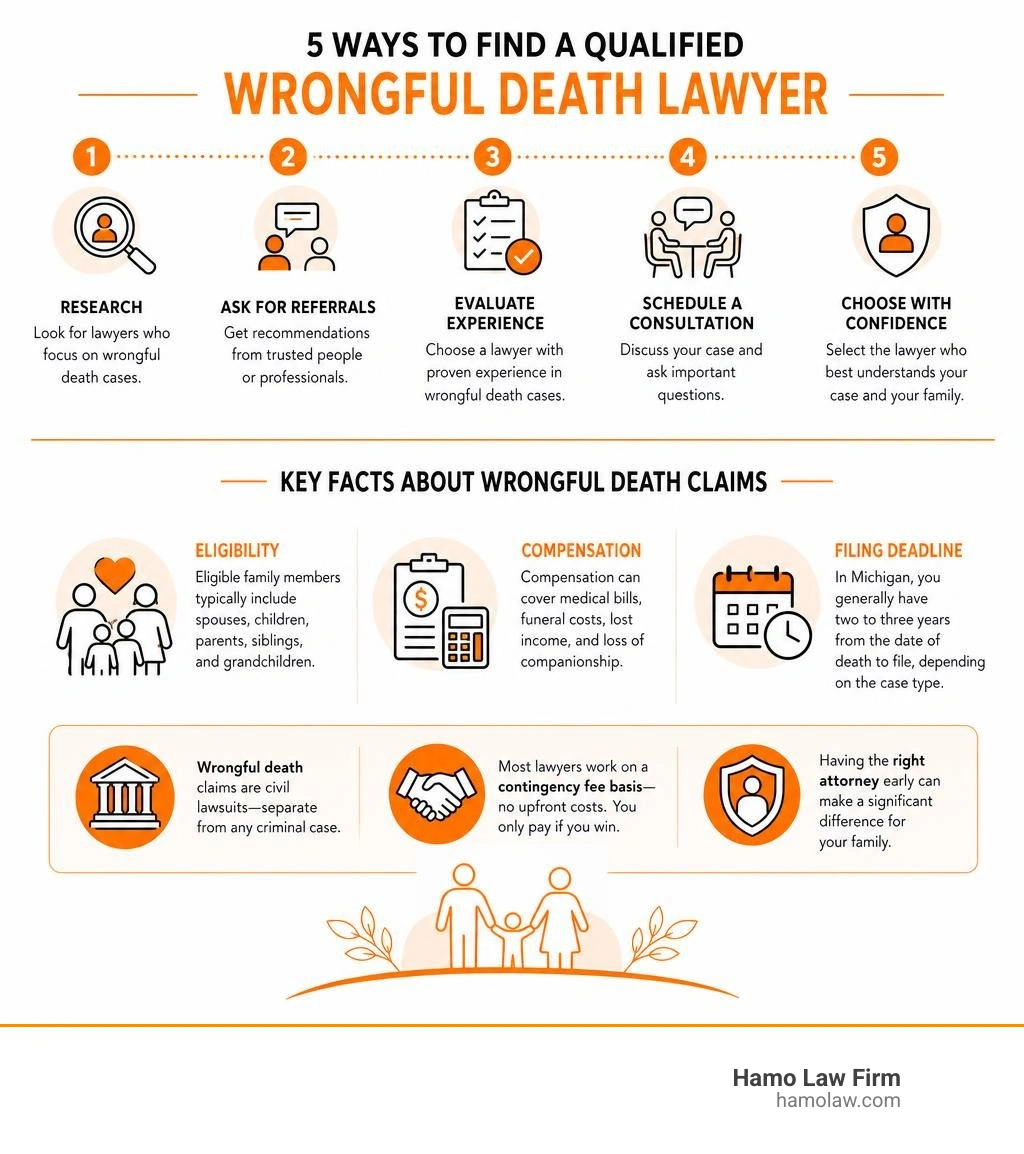
Key facts about wrongful death lawyers:
- They handle civil lawsuits — separate from any criminal case
- Most work on a contingency fee basis (no upfront costs — you only pay if you win)
- In Michigan, you generally have two to three years from the date of death to file, depending on the case type
- Eligible family members typically include spouses, children, parents, siblings, and grandchildren
- Compensation can cover medical bills, funeral costs, lost income, and loss of companionship
Losing someone you love is one of the hardest things a family can go through. When that loss happens because of someone else's careless or reckless actions, the grief is often mixed with anger, confusion, and serious financial pressure.
You may be wondering whether you even have a case — or where to begin. Insurance companies will often move quickly to limit what they pay out. Having the right attorney in your corner early can make a significant difference in what your family ultimately recovers.
This guide walks you through exactly how to find a qualified wrongful death lawyer who can fight for your family.
What Is a Wrongful Death Claim and What Constitutes a Wrongful Death?
At its core, a wrongful death claim is a civil lawsuit brought when a person's death is caused by the wrongful act, neglect, or default of another party. If the deceased person would have been entitled to file a personal injury lawsuit had they survived, then the situation generally meets the criteria for a wrongful death action.
To better understand how this applies to your situation, you can read more about what qualifies as wrongful death in Michigan.
In Michigan, these claims are governed strictly by the Michigan Wrongful Death Act (MCL 600.2922). The law is designed to hold negligent individuals, corporations, or government entities financially accountable for the devastating losses they cause. Because the victim is no longer here to speak for themselves, the law provides a legal pathway for their estate and surviving family members to seek justice.
Common Causes of Wrongful Death Cases in Michigan
While any fatal incident caused by negligence can lead to a lawsuit, we frequently see several common scenarios in our practice across Flint, Detroit, and the surrounding areas:
- Traffic Fatalities: Car, motorcycle, and commercial truck accidents remain some of the leading causes of preventable deaths. In fact, national data highlighted more than 33,000 traffic fatalities in a single year, and Michigan's highways see a tragic share of these losses. If you are dealing with the aftermath of a highway tragedy, understanding what families should know after a fatal car accident in Michigan is a vital first step.
- Medical Malpractice: This occurs when healthcare professionals—such as doctors, nurses, or hospital systems—fail to provide the standard of care expected of them, resulting in fatal surgical errors, misdiagnoses, or medication mistakes.
- Workplace and Industrial Accidents: Construction site falls, machinery malfunctions, and exposure to toxic substances can lead to sudden, tragic fatalities.
- Premises Liability: Fatal slip-and-fall accidents or drownings due to unsecured property hazards fall under this category.
- Defective Products: Manufacturers who release unsafe vehicles, medical devices, or consumer goods can be held liable if their product causes a fatal injury.
What Should I Do If I Suspect a Wrongful Death?
If you suspect that your loved one’s passing was preventable and caused by someone else's mistakes, the steps you take in the immediate aftermath can protect your family's legal rights:
- Request the Death Certificate: This official document is necessary to initiate any legal or estate proceedings.
- Preserve Evidence: Keep any physical evidence, documents, medical records, accident reports, and even the deceased’s personal effects. If the death involved a motor vehicle, securing the vehicle and any electronic logging data is critical.
- Avoid Speaking to Insurance Adjusters Alone: Insurance companies are businesses focused on minimizing payouts. They may offer a quick, lowball settlement hoping you will sign away your rights before you understand the true value of your claim.
- Consult an Experienced Attorney: Contact a dedicated wrongful death lawyer as soon as possible. An early investigation is often the key to uncovering vital evidence before it disappears.
How Do I Know If I Have a Valid Wrongful Death Case?
To determine if you have a valid legal claim, our legal system looks for four fundamental elements of negligence:
- Duty of Care: The defendant owed the deceased a legal duty to act reasonably (e.g., a driver must obey traffic laws; a doctor must follow medical standards).
- Breach of Duty: The defendant failed to uphold that duty through action or inaction.
- Causation: This specific breach directly caused the accident or injury that led to the victim's death.
- Damages: The death resulted in measurable financial and emotional losses for the surviving family and the estate.
During a free initial evaluation, we will review the accident reports, medical documentation, and witness statements to determine if these four elements are clearly present.
How Does a Wrongful Death Lawsuit Differ from a Criminal Case?
It is common to confuse civil wrongful death claims with criminal prosecutions, but they are entirely separate legal processes with different rules, standards, and outcomes:
| Feature | Criminal Case | Civil Wrongful Death Lawsuit |
|---|---|---|
| Who Files? | The government (prosecutor) | The personal representative of the estate |
| Purpose | To punish the offender (jail, fines) | To secure financial compensation for survivors |
| Burden of Proof | "Beyond a reasonable doubt" (very high) | "Preponderance of evidence" (more likely than not) |
| Outcome | Conviction, probation, or acquittal | Monetary judgment or settlement |
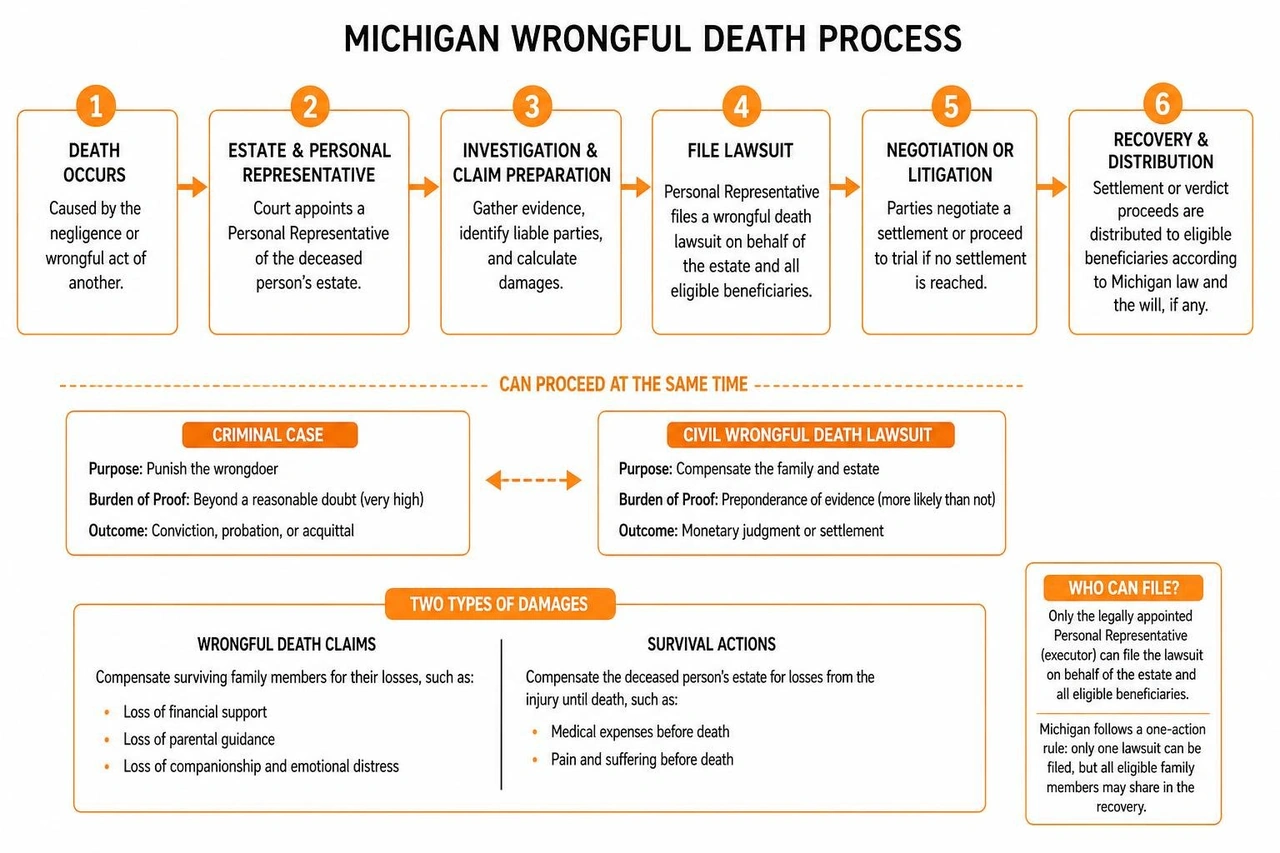
A classic example of this distinction is when a drunk driver is acquitted in criminal court but still held financially liable in a civil wrongful death lawsuit. Both cases can proceed at the same time, though civil cases are sometimes paused until the criminal trial concludes.
What Is the Difference Between Wrongful Death Lawsuits and Survival Actions?
In Michigan, the legal framework combines elements of both wrongful death claims and survival actions under a single statute, but they represent two different types of losses:
- Wrongful Death Claims: These focus on the losses suffered by the surviving family members after the death. This includes the loss of financial support, loss of parental guidance, and the deep emotional pain of losing a companion.
- Survival Actions: These focus on the losses suffered by the deceased person from the moment of the injury until their passing. This allows the estate to recover damages for the medical bills incurred before death, as well as the conscious pain and suffering the deceased experienced before they died.
Who Can File a Wrongful Death Lawsuit in Michigan?
Unlike some states where any close relative can file a lawsuit directly, Michigan law has a very specific procedure.
Under the Michigan Wrongful Death Act, only the legally appointed Personal Representative (executor) of the deceased person’s estate can file the lawsuit.
While the Personal Representative files the suit, they do so on behalf of the estate and all eligible beneficiaries. To learn more about who is legally entitled to share in a recovery, read our detailed guide on who can file a wrongful death claim.
Typically, the court-appointed representative will distribute the proceeds of a settlement or verdict to:
- The surviving spouse and children
- Parents and siblings
- Grandparents and grandchildren
- Anyone named as a beneficiary in the deceased’s will
Can Multiple Family Members File a Wrongful Death Lawsuit?
No. To prevent courts from being flooded with multiple lawsuits over the same tragedy, Michigan enforces a "one-action" rule. Only one lawsuit can be filed by the Personal Representative. However, all eligible family members have the right to submit their claims for a share of the damages within that single lawsuit.
What Types of Compensation Are Available in Wrongful Death Cases?
When a family loses a loved one, the financial and emotional toll can be overwhelming. The law categorizes the compensation you can pursue into economic and non-economic damages. You can explore the specifics of these recoveries in our guide on damages in Michigan wrongful death claim.
Economic Damages (Financial Losses)
- Medical Expenses: The cost of emergency care, surgeries, and hospital stays prior to the deceased's passing.
- Funeral and Burial Costs: Reasonable expenses associated with honoring your loved one.
- Lost Wages and Benefits: The financial support, including future earnings and pension benefits, that the deceased would have provided to their family over their expected working life.
Non-Economic Damages (Intangible Losses)
- Loss of Companionship and Society: Compensation for the loss of love, care, guidance, and companionship.
- Pain and Suffering: The conscious physical and mental suffering the deceased endured before passing away.
According to IRS Rule 1.104-1, the proceeds of a wrongful death settlement are generally not taxable as income, providing peace of mind that the recovery secured for your family remains yours.
How Is the Value of a Wrongful Death Case Determined?
Calculating the value of a wrongful death claim is a complex process. Juries and insurance companies evaluate several key factors:
- The age, health, and life expectancy of the deceased.
- Their earning capacity and past income.
- The age and circumstances of their dependents (e.g., minor children who require long-term support).
- The total medical bills and funeral expenses incurred.
- The strength of the evidence proving the defendant’s liability.
Experienced attorneys work closely with economists, accident reconstructionists, and medical experts to project these long-term financial impacts accurately.
What Is the Statute of Limitations for Filing a Wrongful Death Claim in Michigan?
Time is of the essence when pursuing legal justice. In Michigan, the standard statute of limitations for a personal injury or wrongful death claim resulting from general negligence (such as a car accident) is three years from the date of the accident.
However, there are critical exceptions:
- Medical Malpractice: Claims involving medical errors generally have a shorter two-year statute of limitations.
- Estate Administration Extension: Because a Personal Representative must be officially appointed by a Michigan probate court before a lawsuit can be filed, the law sometimes allows a grace period to open the estate. However, relying on exceptions is highly risky.
Missing these strict deadlines will permanently bar your family from seeking justice.
The Legal Process: Timeline, Difficulty, and Who Pays
How Hard Is It to Prove a Wrongful Death Case?
Wrongful death cases are notoriously complex. Because the primary witness—the victim—cannot testify, defense attorneys and insurance companies will often attempt to shift the blame onto the deceased. Proving liability requires meticulous investigation, expert testimonies, and a deep understanding of Michigan's comparative negligence rules (where a recovery can be reduced by the victim's percentage of fault).
How Long Does It Take to Settle a Wrongful Death Claim?
There is no set timeline. A straightforward case with clear liability might settle within several months, while complex cases involving medical malpractice or commercial trucking companies can take 18 months to three years or longer to resolve, especially if the case goes to trial.
Who Pays for a Wrongful Death Lawsuit or Settlement?
In the vast majority of cases, the compensation is paid by the defendant’s insurance company (such as auto liability insurance, malpractice insurance, or commercial general liability policies). If a large corporation or government entity is at fault, they may pay out of self-insured retention funds.
3 Ways to Find a Qualified Wrongful Death Lawyer
Finding the right legal advocate during a time of deep grief can feel overwhelming. Here are the most effective ways to identify a qualified attorney to represent your family:
1. Look for Deep Local Roots and Trial Experience in Michigan
You need an attorney who understands the local courts, judges, and legal community in your specific area—whether that is Flint, Genesee County, or Wayne County.
For broader research, families often consult directories like Best Personal Injury Lawyers in Genesee County, MI - Justia to understand the landscape of Michigan personal injury law.
At Hamo Law Firm, we bring over 40 years of trial experience fighting insurance companies directly in Flint and the surrounding communities. We don't just settle for the first low offer; we prepare every case as if it is heading to trial.
2. Verify the Fee Structure (The Contingency-Fee Model)
Grieving families should never have to worry about hourly attorney fees or upfront legal costs. Ensure the firm you choose operates on a contingency-fee basis. This means:
- You pay $0 upfront to start your case.
- The attorney advances all litigation costs (court filing fees, expert witness fees, investigations).
- The firm only receives a percentage of the final settlement or jury verdict if they win your case. If they don't win, you owe nothing.
3. What to Ask a Wrongful Death Lawyer During a Consultation
When you meet with a potential attorney for a free consultation, treat it as an interview. Do not hesitate to ask tough questions to ensure they are the right fit for your family:
- How many wrongful death cases have you personally taken to trial?
- Do you specialize in fighting insurance companies, or do you mostly handle quick settlements?
- Who will be my primary point of contact? Will I speak directly with you, or will my case be passed to an assistant?
- What is your assessment of the challenges we might face in proving liability in our case?
Partner with Hamo Law Firm for Justice and Accountability
At Hamo Law Firm, we understand that no amount of financial compensation can ever replace the loved one you have lost. However, holding the negligent party accountable can provide your family with the financial security needed to face the future and find a sense of closure.
We specialize in helping families navigate the complex probate and civil court systems in Flint, Genesee County, Wayne County, and throughout Michigan. With our 40+ years of trial experience and a compassionate, contingency-fee approach, we handle the heavy legal lifting so you can focus on healing.
If you suspect your loved one's death was preventable, let us help you explore your options. Visit our practice areas - wrongful death page or contact a dedicated Michigan wrongful death lawyer Hamo Law Firm today to schedule your completely free, confidential consultation.
To get started, reach out directly through our main portal at https://www.hamolaw.com/practice-areas/wrongful-death. We are here to stand by your side.