
Why Cheap No-Fault Car Insurance in Michigan Is Harder to Find — and How to Get It

Finding cheap no fault car insurance in Michigan is genuinely harder than in most other states. Michigan's unique no-fault system requires drivers to carry coverages that simply don't exist anywhere else in the country — and that drives premiums up.
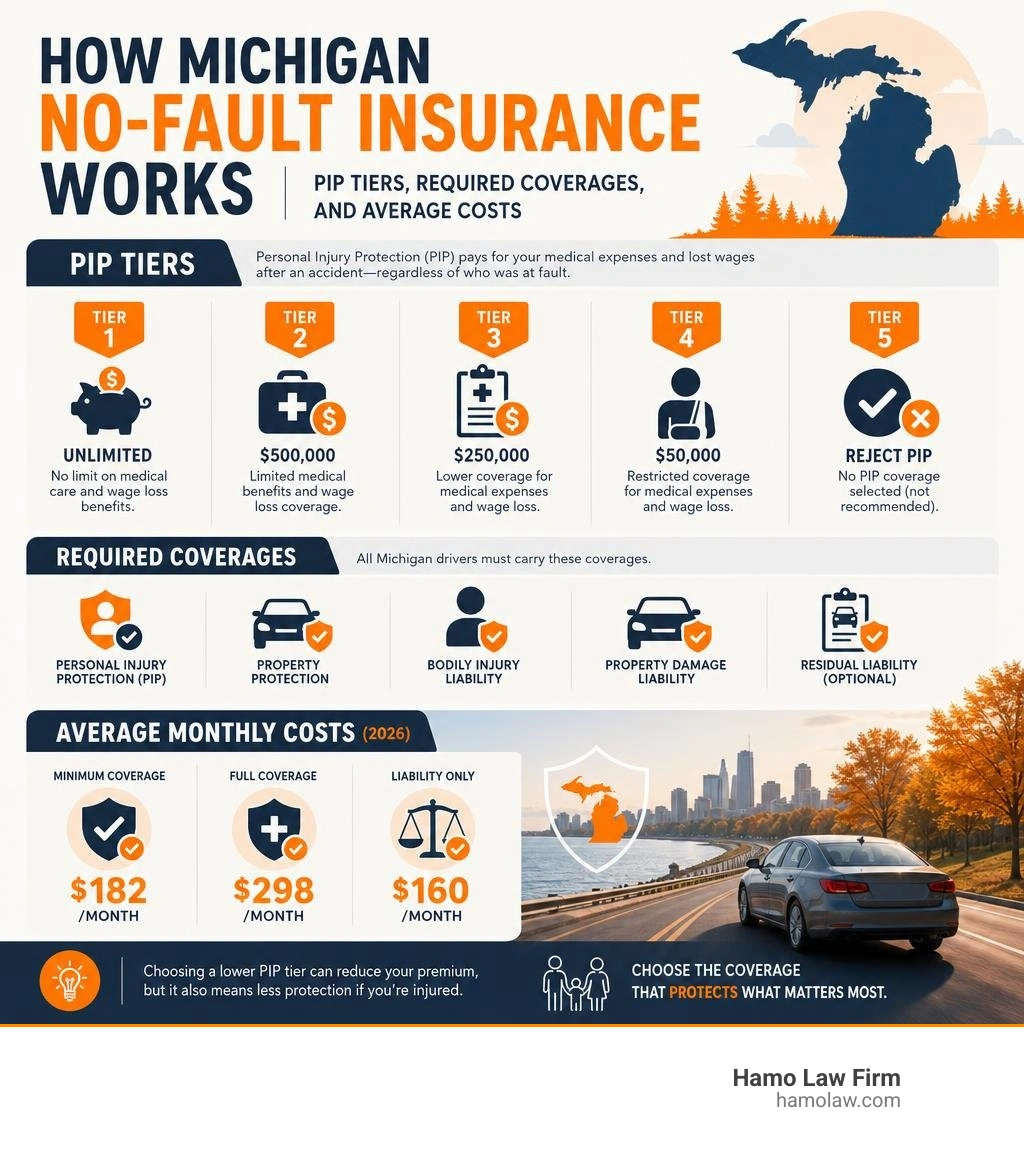
Quick answer: The cheapest no-fault car insurance options in Michigan by coverage type (2026 averages):
| Coverage Type | Average Monthly Cost | Cheapest Provider |
|---|---|---|
| Minimum coverage | $182/month | AAA (~$70/month) |
| Full coverage | $298/month | Progressive (~$173/month) |
| Liability only | $160/month | Varies by ZIP code |
The cheapest insurers for most Michigan drivers are:
- Progressive - best for full coverage and drivers with violations
- AAA - best for minimum coverage
- Auto-Owners - best for teens and customer service
Michigan drivers pay an average of $235 a month — well above the national average. In cities like Detroit, that number can climb to $607 a month or more. Even minimum coverage averages $182 a month, which shocks most new shoppers.
Why so expensive? Michigan is one of only 12 no-fault states in the U.S., and it's the only state that still offers unlimited lifetime medical benefits as an option. That's powerful protection — but it comes at a cost.
The 2019 no-fault reform gave drivers more choices, including lower PIP tiers that can cut premiums significantly. But those choices come with real tradeoffs that aren't always explained clearly when you're just trying to get a lower bill.
This guide breaks down exactly how the system works, which companies offer the best rates, and what you need to know before you trade coverage for savings.
Understanding Michigan’s No-Fault Insurance System
To secure truly cheap no fault car insurance in Michigan, you first have to understand the rules of the road. Michigan has operated under a no-fault auto insurance system since October 1, 1973. The system was designed to ensure that anyone injured in a motor vehicle accident receives quick medical care and wage compensation without waiting for courts to decide who caused the crash.
According to Insurify's guide on Michigan's no-fault status, your own insurance company is responsible for paying your medical bills and certain financial losses, regardless of who was at fault for the accident. While this means you rarely have to fight another driver's insurer just to get your hospital bills paid, it also means every insurance policy in the state must carry robust, mandatory coverages.
To learn more about how this impacts you immediately after a collision, see our detailed guide on How Michigan No-Fault Insurance Works.
Mandatory Coverages: PIP, PPI, and Residual Liability
Every legal auto insurance policy in Michigan must contain three fundamental components:
- Personal Injury Protection (PIP): This is the core of the no-fault system. PIP pays for all reasonable and necessary medical expenses resulting from an auto accident up to your selected limit. It also covers up to 85% of your lost wages (for up to three years) and $20 per day for replacement services (like house cleaning or yard work) that you can no longer perform. To understand how these benefits are processed, read about How Michigan No-Fault Insurance Works After an Accident.
- Property Protection Insurance (PPI): PPI provides up to $1 million in coverage for damage your car causes to other people's property within the state of Michigan. This includes buildings, fences, utility poles, and properly parked vehicles. It does not cover damage to moving vehicles.
- Residual Liability Insurance (BI/PD): This protects you if you are sued. If you cause an accident that results in serious injury, disfigurement, or death, or if you cause an accident out of state, this coverage kicks in. The default legal limit is $250,000 per person and $500,000 per accident for bodily injury, though you can choose to lower this to a absolute minimum of $50,000 per person and $100,000 per accident by signing a specific disclosure form.
If you are trying to piece together what happens during a claim, you can explore How Does Michigan No-Fault Insurance Work After an Accident to see how these three pillars interact under pressure.
The 2019 No-Fault Reform and Its Impact in 2026
For decades, Michigan forced every single driver to purchase unlimited PIP medical coverage. This made Michigan's medical benefits the most generous in the nation, but it also made our insurance premiums incredibly expensive.
To combat this, the state passed historic bipartisan reforms that took effect on July 1, 2020. As we look at the insurance landscape in 2026, these reforms have completely reshaped how drivers shop for coverage. Drivers are no longer locked into unlimited medical coverage; instead, they can choose from tiered PIP options to lower their bills.
The state also established a medical fee schedule to control what hospitals and clinics can charge auto insurers for treatments, and implemented strict consumer protections. For a complete look at these rules, you can review the state's Frequently Asked Questions.
Here is how the PIP choices stack up in 2026:
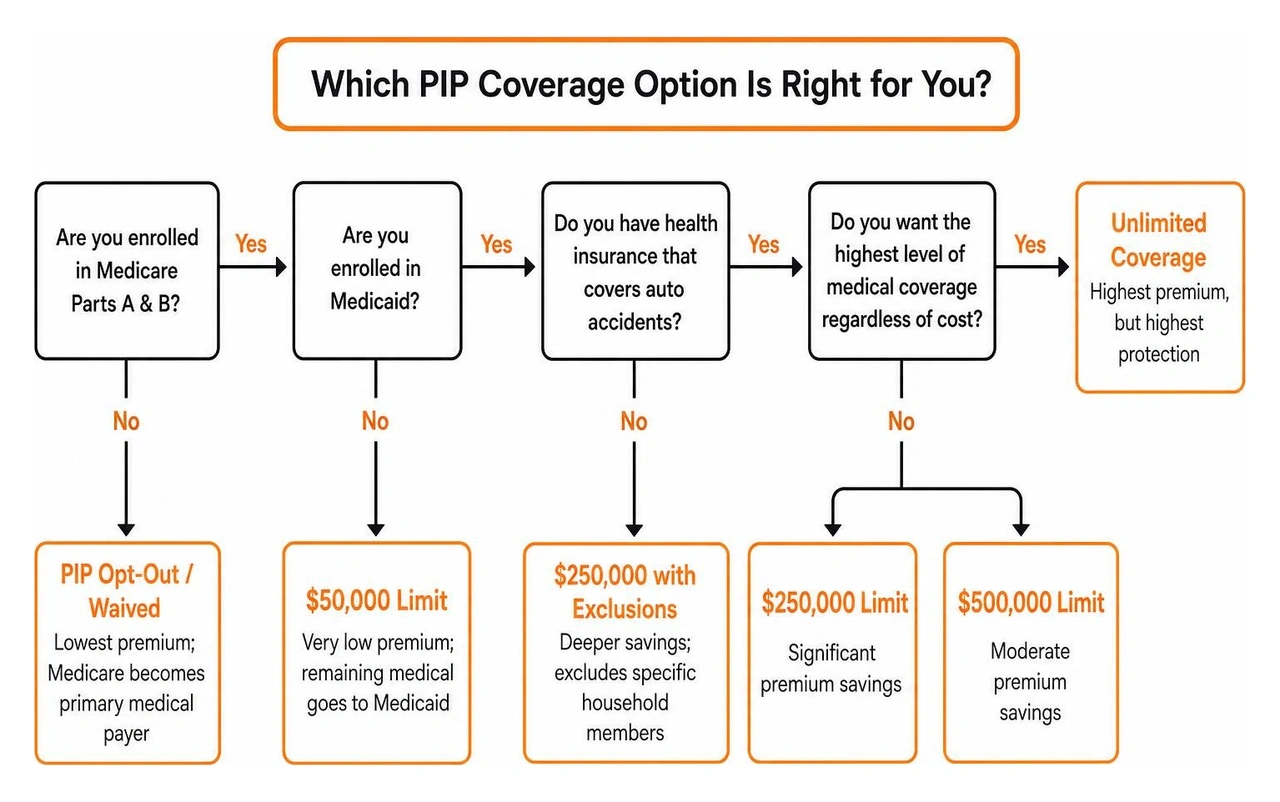
| PIP Medical Option | Who Qualifies? | Impact on Premium |
|---|---|---|
| Unlimited Coverage | Anyone | Highest premium, but highest protection |
| $500,000 Limit | Anyone | Moderate premium savings |
| $250,000 Limit | Anyone | Significant premium savings |
| $250,000 with Exclusions | Drivers with health insurance that covers auto accidents | Deeper savings; excludes specific household members |
| $50,000 Limit | Anyone enrolled in Medicaid | Very low premium; remaining medical goes to Medicaid |
| PIP Opt-Out / Waived | Anyone enrolled in Medicare Parts A & B | Lowest premium; Medicare becomes primary medical payer |
To visualize how you should navigate these choices when shopping for a policy, refer to this simple decision path:
How to Find Cheap No-Fault Car Insurance in Michigan

Now that you know the rules, let's talk strategy. Finding cheap no fault car insurance in michigan requires a blend of smart coverage selection and aggressive shopping. Because rates vary wildly by ZIP code, age, and driving history, you cannot rely on a single company to always be the cheapest.
According to data compiled in the Best Cheap Car Insurance Quotes in Michigan 2025 - ValuePenguin, shopping around is the absolute best way to lower your costs. For example, while the state average for full coverage is $3,573 per year ($298 per month), drivers in Shoreham pay an average of $206 per month, while those in Hamtramck face a staggering $683 per month.
To start comparing rates, you can get a customized quote directly through Michigan Car Insurance: Get a Quote | Progressive or use a comparison platform like Car insurance michigan – Auto insurance quote | Nsure.com to view multiple carriers side-by-side.
Choosing the Right PIP Limit for Cheap No-Fault Car Insurance in Michigan
The single fastest way to slash your auto insurance premium is to lower your PIP medical limit. If you move from "Unlimited" PIP to a $250,000 limit, you will see an immediate drop in your monthly bill.
However, we must urge caution. Lowering your PIP coverage is a major financial decision. If you choose a $250,000 limit and suffer a catastrophic brain or spinal cord injury that requires $1 million in care, you are personally responsible for the remaining $750,000 once your PIP is exhausted.
If you have a robust, private health insurance policy that does not exclude auto accidents and has a deductible of $6,500 or less, you may safely opt for a lower PIP tier or opt out entirely if you have Medicare. But if your health insurance has high deductibles or excludes motor vehicle injuries, keeping Unlimited PIP is the only way to avoid catastrophic medical debt.
Top Strategies to Secure Cheap No-Fault Car Insurance in Michigan
Beyond adjusting your PIP limits, you can use these proven tactics to keep your premiums as low as possible:
- Bundle Your Policies: You can save upwards of 25% on average by combining your auto insurance with home, renters, or condo insurance.
- Enroll in Telematics Programs: Most major insurers offer discount programs that track your driving habits via a mobile app. Programs like Liberty Mutual's RightTrack can save safe drivers up to 30% on their premiums. You can learn more and start a quote through Get a Michigan car insurance quote.
- Maintain a Clean Driving Record: A single speeding ticket can raise your full coverage rates by an average of $46 a month, while an at-fault accident can raise them by 28% ($73 a month). A DUI is even more damaging, pushing average monthly costs up to $285.
- Ask About Group and Professional Discounts: Many carriers offer discounts for seniors, college students, active military, educators, and members of certain credit unions or professional organizations.
- Review Your Policy Annually: Don't let your policy auto-renew without shopping around. The cheapest carrier for you this year might not be the cheapest next year.
The Real Cost of Lowering Your Coverage Limits

It is incredibly tempting to check the minimum boxes on an insurance website just to get the lowest price. But as personal injury lawyers who have spent over 40 years fighting insurance companies, we have seen the devastating consequences of being underinsured.
Before you sign away your coverage, you need to understand the practical reality of how claims are handled. Insurers are businesses, and their primary goal is to minimize their payouts. For an insider's look at this dynamic, read our guide on Dealing with Insurance Companies After an Accident What You Need to Know. If you ever find yourself in a dispute with your carrier, you should also be prepared for what to do What If My Insurance Company Denies My Claim.
The Financial Risks of PIP Opt-Outs
Opting out of PIP medical coverage or choosing the bare minimum $50,000 limit (for Medicaid recipients) sounds like a great deal until you are in a serious wreck.
If you opt out of PIP and rely entirely on your health insurance, you are subject to that health plan's copays, deductibles, and network restrictions. If your health insurance plan requires you to see specific doctors, you lose the freedom to choose your own specialists or rehabilitation facilities.
Furthermore, standard health insurance does not cover "attendant care" (in-home nursing care), which can easily cost tens of thousands of dollars a month if you require 24/7 assistance after a severe crash. Unlimited PIP covers these lifetime care costs; standard health insurance does not.
If you have questions about how these limits affect your rights after a crash, consulting an experienced Michigan No-Fault Lawyer Hamo Law Firm can help clarify your options.
When to Seek Legal Help After a Michigan Accident
Because Michigan is a no-fault state, many drivers assume they can never sue another driver. This is a common misconception. Under Michigan law, you can file a "third-party" lawsuit against the at-fault driver if:
- You suffered a "threshold injury" (serious impairment of body function, permanent serious disfigurement, or death).
- You have medical bills or lost wages that exceed your selected PIP coverage limits.
- The at-fault driver was an out-of-state resident or the accident occurred out of state.
If you are injured, taking the right steps immediately after the crash is vital to protecting your health and your potential legal claim. Review our step-by-step checklist on What Should I Do After a Car Accident in Michigan to make sure you don't accidentally damage your case.
If you are wondering whether your situation warrants professional legal assistance, you can read about When Should I Contact a Lawyer After an Accident and find out how attorneys calculate How Much Is My Michigan Car Accident Case Worth.
Frequently Asked Questions About Michigan Auto Insurance
What is the minimum car insurance required in Michigan?
To drive legally in Michigan, you must carry:
- Bodily Injury Liability: $50,000 per person and $100,000 per accident (though policies default to $250,000/$500,000 unless you sign a waiver).
- Property Damage Liability: $10,000 minimum for out-of-state accidents.
- Property Protection Insurance (PPI): $1 million for in-state property damage.
- Personal Injury Protection (PIP): You must select a medical coverage limit (ranging from $50,000 to Unlimited, or opt out if qualified).
Can I opt out of PIP if I have Medicare or health insurance?
Yes, but only under strict conditions. To opt out of PIP medical coverage, you must prove that you are enrolled in Medicare Parts A & B (or a Medicare Advantage plan).
If you have commercial health insurance, you cannot opt out entirely, but you can choose a $250,000 PIP limit with exclusions if your health plan is a "Qualified Health Coverage" (QHC). To qualify as QHC, your health policy must not exclude auto accident injuries and must have an individual deductible of roughly $6,500 or less.
What is Michigan's mini-tort law and how does it work?
Because no-fault insurance does not cover physical damage to your own vehicle, Michigan created the "mini-tort" law. If you are not at fault for an accident, and your car is damaged, you can recover up to $3,000 from the at-fault driver to cover your out-of-pocket expenses (such as your deductible). To collect this, the other driver must be found at least 50% at fault for the collision.
Conclusion
Finding cheap no fault car insurance in Michigan is a balancing act. While it is entirely possible to lower your monthly premiums by choosing tiered PIP limits, doing so exposes you and your family to significant financial risk if a catastrophic accident occurs.
If you or a loved one has been injured in an auto accident, do not let the insurance companies dictate what your recovery is worth. At Hamo Law Firm, we bring more than 40 years of trial experience to the fight. Based in Flint and serving clients across Genesee County, Wayne County, and the broader Detroit metro area, we operate on a contingency-fee model — which means you pay absolutely nothing unless we win your case.
Before you sign any insurance settlement or give up on your rights, contact us today for a free consultation regarding your No-Fault Insurance Claims. Let us put our experience to work for you.