
Why Knowing How to Divide a Wrongful Death Settlement Matters

Grieving families often face overwhelming legal questions during an already devastating time, including how to divide a wrongful death settlement fairly among surviving relatives.
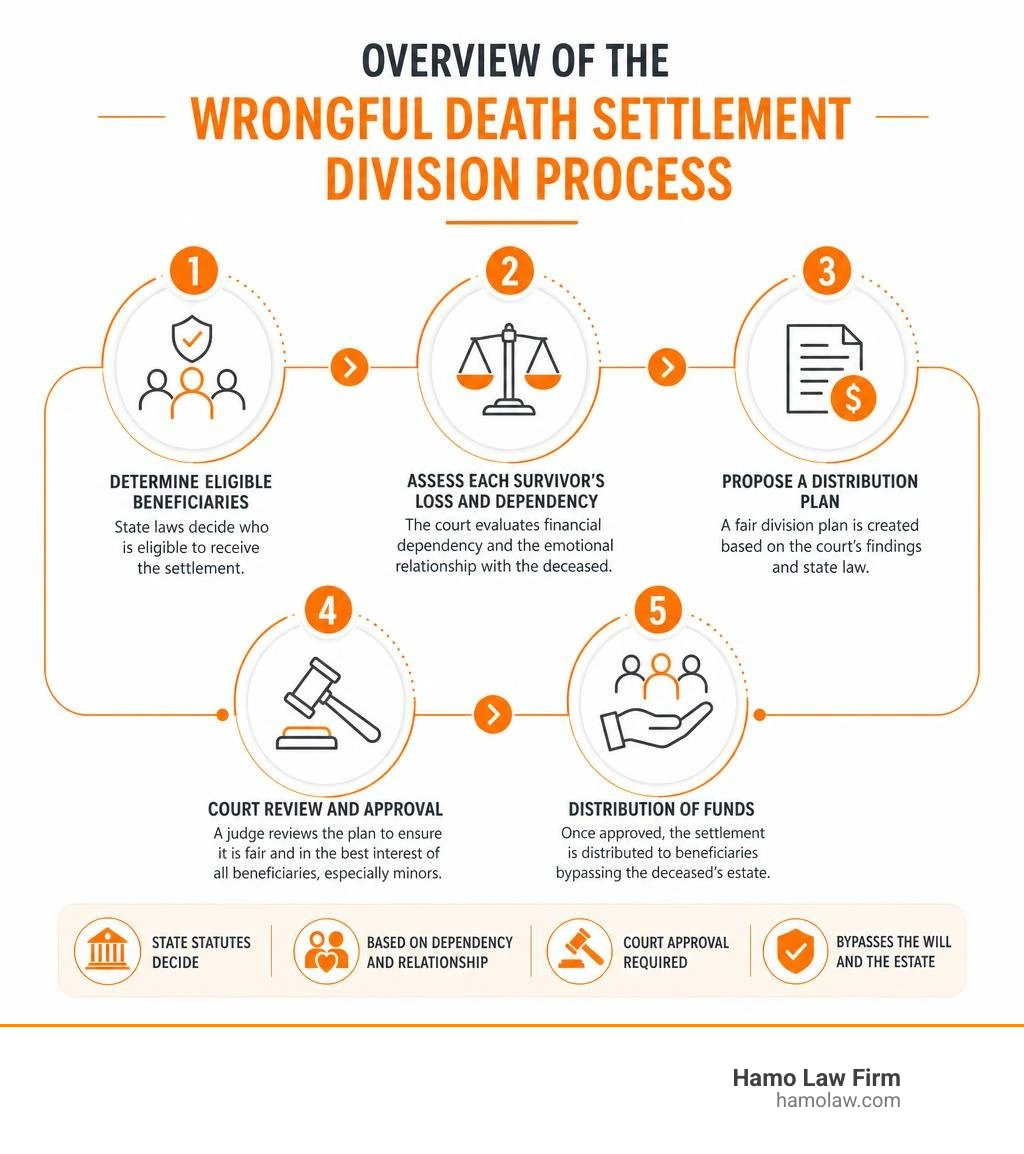
If you are looking for a quick answer, wrongful death settlements are generally divided using these core rules:
- State Statutes Decide: State laws—not the deceased person's will—usually dictate who is eligible and how funds are distributed.
- Financial Dependency: Courts typically distribute money based on each survivor's level of financial dependency and emotional relationship with the deceased, rather than a simple equal split.
- The Role of the Court: A judge must approve the final distribution plan to ensure it is fair, especially when minor children are involved.
- Bypassing the Will: True wrongful death damages go directly to the beneficiaries to compensate for their personal losses. This means the money usually bypasses the deceased's estate and is protected from estate creditors.
Losing a loved one to someone else's negligence is a terrible tragedy. The emotional pain is heavy enough on its own. But when you add sudden medical bills, funeral costs, and lost household income, the financial stress can feel impossible.
When a legal settlement finally comes, new questions arise. Deciding how to split the money can cause real tension among family members. Understanding the rules of distribution can help your family avoid disputes and protect everyone's future.
Who Is Eligible to Receive a Wrongful Death Settlement?

When we handle wrongful death cases in Michigan, one of the first things we must establish is who actually has the legal right to receive a share of the settlement. Under Michigan law (specifically MCL 600.2922), only certain family members are considered eligible survivors.
These eligible individuals typically include:
- The surviving spouse of the deceased.
- The children and descendants of the deceased.
- The parents of the deceased.
- The siblings of the deceased.
- Anyone to whom the deceased left property in their will (devises), if there are no surviving family members.
It is important to note that while these family members are eligible to receive a portion of the settlement, they cannot all file individual lawsuits. In Michigan, only the personal representative (or executor) of the deceased's estate can formally file a claim. To understand this legal role better, you can read our guide on who can file a wrongful death claim.
Furthermore, to successfully recover any compensation, the death must meet specific legal criteria. You can learn more about what qualifies by reading what qualifies as wrongful death in Michigan.
Adopted Children vs. Stepchildren: Who Qualifies?
Family structures are often beautifully complex, but when it comes to the law, clear boundaries are drawn.
- Adopted Children: Legally adopted children hold the exact same rights as biological children. In the eyes of Michigan courts, there is no difference. An adopted child is fully eligible to receive a share of a wrongful death settlement.
- Stepchildren: Stepchildren face a much higher legal hurdle. Under default state rules, stepchildren are not automatically considered "next of kin." To receive a portion of a wrongful death settlement, stepchildren must typically prove they were financially dependent on the deceased or that a unique, legally recognized parental relationship existed.
Because stepfamily dynamics can complicate a legal claim, it is vital to document all financial support and parental bonds early in the process.
How to Divide a Wrongful Death Settlement: State Laws and Distribution Methods

Every state has its own unique framework for distributing wrongful death proceeds. If you want a broad overview of how different jurisdictions handle these rules, you can review the Wrongful Death Settlement Distribution Laws by State - FindLaw.
Some states rely on strict, math-based formulas tied to their default inheritance (intestacy) laws. For example:
- New York: If there is a surviving spouse and children, the spouse receives $50,000 plus 50% of the remaining balance, and the children split the other 50% equally.
- Pennsylvania: The surviving spouse receives the first $30,000 plus half of the remaining settlement, with the rest divided equally among the children.
- Georgia: A surviving spouse is guaranteed at least one-third of the total recovery, regardless of how many children share the remainder.
In Michigan, the process is highly individualized. Rather than using a rigid, one-size-fits-all mathematical formula, Michigan courts require the personal representative to file a formal motion to distribute the proceeds. The court then holds a special hearing to evaluate the specific losses of each beneficiary. For local representation, working with an experienced wrongful death attorney is the best way to ensure your family's rights are protected under our state's specific laws.
| State | Distribution Method | Surviving Spouse Share (with Children) |
|---|---|---|
| Michigan | Court-ordered equitable distribution | Based on individual loss and dependency |
| New York | Intestacy-based formula | First $50,000 + 50% of remaining balance |
| Pennsylvania | Intestacy-based formula | First $30,000 + 50% of remaining balance |
| Georgia | Proportional split | Guaranteed at least 1/3 of total recovery |
| Kentucky | Statutory split | 50% of the settlement |
Statutory vs. Need-Based Allocation
When deciding how to divide a wrongful death settlement, courts generally look at two primary methods:
- Statutory (Intestacy) Distribution: This approach treats the settlement like an estate where there was no will. The money is split among heirs using fixed percentages, regardless of how close they were to the deceased or what their financial situation looks like.
- Need-Based (Equitable) Distribution: This is the model Michigan favors. The court evaluates the actual financial reliance, age, and emotional loss of each beneficiary. For instance, a minor child who lost a parent's lifetime of financial support and guidance will receive a significantly larger share than an independent, adult sibling who lived in another state.
Does the Deceased's Will Affect How to Divide a Wrongful Death Settlement?
A common point of confusion is whether a person's will dictates who gets the wrongful death money. The simple answer is no.
A wrongful death claim is not an asset of the deceased person’s estate. It is a legal action brought to compensate the survivors for their personal, individual losses. Therefore, the instructions in a will do not automatically control how a wrongful death settlement is split.
However, there is a major exception: survival actions. If the settlement includes compensation for the deceased person's conscious pain and suffering before they passed, those specific funds do belong to the estate. Consequently, survival action proceeds are distributed according to the deceased's will (or state intestacy laws if there was no will), and they can be subject to estate debts and taxes.
Key Factors That Influence the Division of a Settlement
When we help families present a distribution plan to a Michigan court, we must gather evidence to show how the loss impacted each person. The court will closely examine several key factors to determine a fair split:
- Financial Dependency: Who relied on the deceased for housing, food, healthcare, and education? A stay-at-home spouse or a young child will have a much stronger claim for financial loss than self-sufficient relatives.
- Loss of Companionship: This is a non-economic damage that measures the destruction of the relationship. The court will look at the closeness, daily contact, and emotional bond between the survivor and the deceased.
- Future Earnings: If the deceased was the primary breadwinner, the settlement will heavily account for their lost future income, which is typically allocated to those who would have benefited from that income.
- Medical and Funeral Bills: Outstanding hospital bills and burial costs must be paid out of the settlement before the remaining funds are distributed to family members.
To understand the full scope of what can be recovered, read our detailed breakdown of damages in Michigan wrongful death claim. If the tragedy involved a motor vehicle, it is also highly beneficial to review what families should know after a fatal car accident in Michigan.
How to Divide a Wrongful Death Settlement with Minor Children Involved
When minor children are beneficiaries, the court takes on a protective role. A judge will not simply hand a large sum of cash to a parent or guardian.
To safeguard the child's financial future, the court will often:
- Appoint a guardian ad litem—an independent attorney whose sole job is to advocate for the child's best interests during the settlement split.
- Mandate that a substantial portion (frequently 70% to 80%) of the minor's share be placed into a structured settlement or a restricted trust fund. These funds are locked away, earning interest, and are set up to pay out over time for college tuition, housing, or general support once the child reaches adulthood.
The Legal Process, Payout Methods, and Resolving Disputes
To help you visualize how a wrongful death claim moves from the initial tragedy to the final payout, we have outlined the standard legal workflow below:
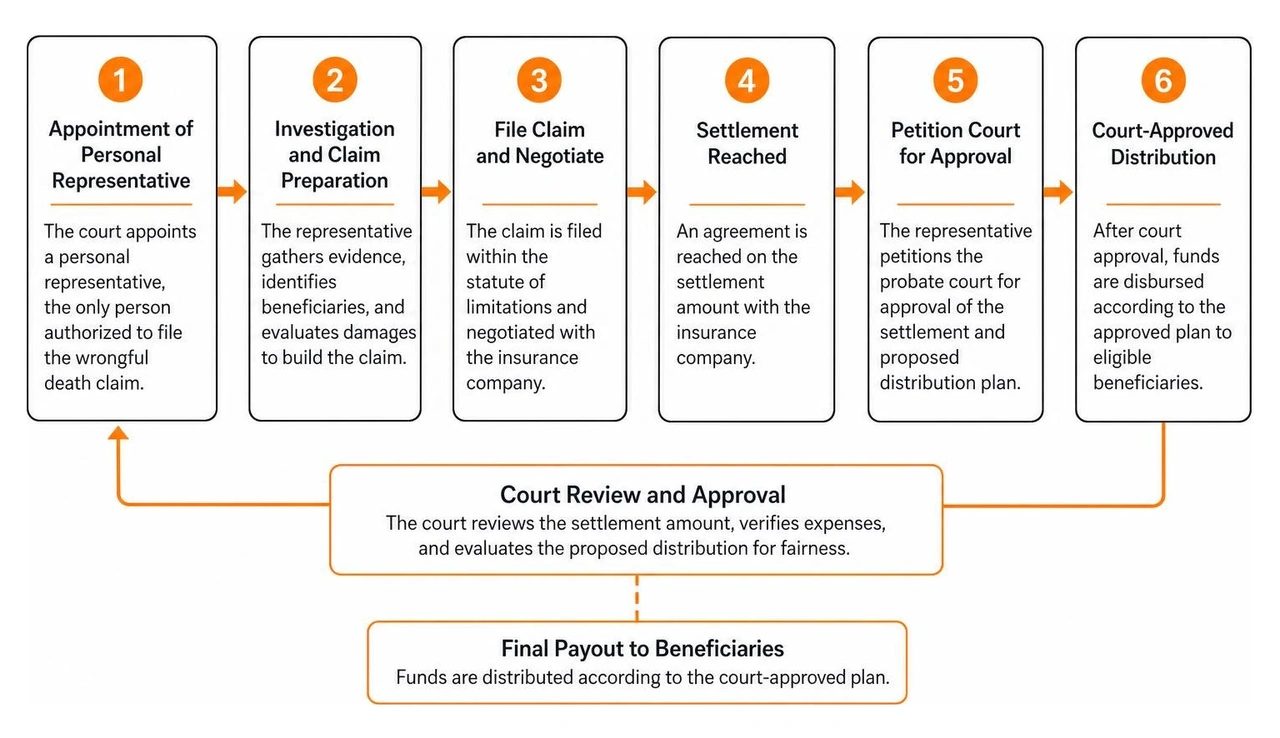
The legal path begins with the appointment of a personal representative, who is the only person authorized to file the claim. This representative must keep in mind the strict statute of limitations Michigan personal injury rules, which generally require a personal injury or wrongful death lawsuit to be filed within three years of the incident (though specific exceptions can apply under probate law).
If the death was caused by a motor vehicle collision, consulting a dedicated fatal car accident lawyer Michigan is essential to preserve evidence and negotiate with auto insurance carriers.
Once a settlement is reached with the insurance company, the personal representative cannot simply write checks to the family. They must petition the probate court for approval.
At this stage, the family must decide on a payout method:
- Lump-Sum Payout: The entire settlement is paid out at once. This is useful if the family has immediate, heavy financial burdens, such as outstanding medical bills or a mortgage to pay off.
- Structured Settlement: The money is placed into an annuity that provides guaranteed, periodic payments over years or decades. This is highly recommended for securing long-term income replacement or protecting minor children.
Resolving Family Disputes and the Role of Mediation
Grief is a heavy burden, and when combined with financial stress, it can unfortunately bring long-simmering family tensions to the surface. Disagreements over who deserves what portion of a settlement are common.
To avoid a bitter, expensive, and public courtroom battle, we always recommend mediation. A professional, neutral third-party mediator can sit down with family members to help them voice their concerns, evaluate their actual losses, and reach an amicable, private agreement.
Working together cooperatively not only preserves family relationships but also keeps litigation costs from eating away at the funds your family needs to heal. Navigating these delicate family conversations with empathy and open communication is key to reaching a fair resolution.
Frequently Asked Questions about Wrongful Death Settlements
Are wrongful death settlements taxable?
Under federal IRS rules, compensatory damages received in a wrongful death settlement are generally not taxable. Because these funds are designed to replace a loss (such as lost income, loss of companionship, and medical bills), they are not considered earned income.
However, there are two important exceptions:
- Punitive Damages: If the court awards punitive damages to punish the wrongdoer for extreme negligence, that portion of the award is taxable.
- Interest Accrued: If the settlement funds sit in an interest-bearing account for a long period before being distributed, the interest earned on that money is subject to income tax.
Note: We always advise consulting with a certified tax professional to review your specific settlement structure.
What is the difference between a wrongful death claim and a survival action?
While they are often filed together, they serve two entirely different legal purposes:
- Wrongful Death Claim: This compensates the surviving family members for their personal losses resulting from the death (such as loss of financial support, loss of parental guidance, and mental anguish). These funds belong directly to the survivors and bypass the deceased's estate, meaning they are protected from the deceased's creditors.
- Survival Action: This is a legal continuation of the personal injury claim the deceased could have filed if they had survived. It covers damages suffered by the deceased prior to death, such as conscious pain and suffering, medical bills incurred before passing, and lost wages up to the date of death. These funds go directly into the deceased's estate, are distributed according to their will, and can be used to pay off estate debts.
How long does it take to distribute the settlement funds?
Once the insurance company and the personal representative agree on a settlement amount, the timeline is largely determined by court scheduling.
The personal representative must notify all potential beneficiaries of the settlement and the date of the distribution hearing. After the judge signs the formal order approving the allocation, the insurance company typically issues the funds within four to six weeks. However, if family members are actively disputing the split, the process can be delayed by several months while mediation or court hearings take place.
Secure Your Family's Future with Hamo Law Firm
Navigating the emotional aftermath of a sudden loss is difficult enough without having to worry about complex probate laws, insurance negotiations, and courtroom distribution hearings.
At Hamo Law Firm, we have spent more than 40 years helping families in Flint, Detroit, Genesee County, and Wayne County fight for the justice and financial security they deserve. We operate on a strict contingency-fee model, meaning you pay absolutely nothing out of pocket—we only get paid if we win your case.
Let us carry the legal burden so you can focus on healing. If you have questions about a potential claim or need assistance distributing a settlement, visit our wrongful death practice area page or contact an experienced wrongful death lawyer Michigan at Hamo Law Firm today for a free, compassionate consultation.