
When Seconds Change Everything: What a Motorcycle Accident Firm Does for Injured Riders

A motorcycle accident firm is a law firm that specializes in helping injured riders investigate crashes, prove fault, fight insurance company bias, and recover full compensation — without any upfront legal fees.
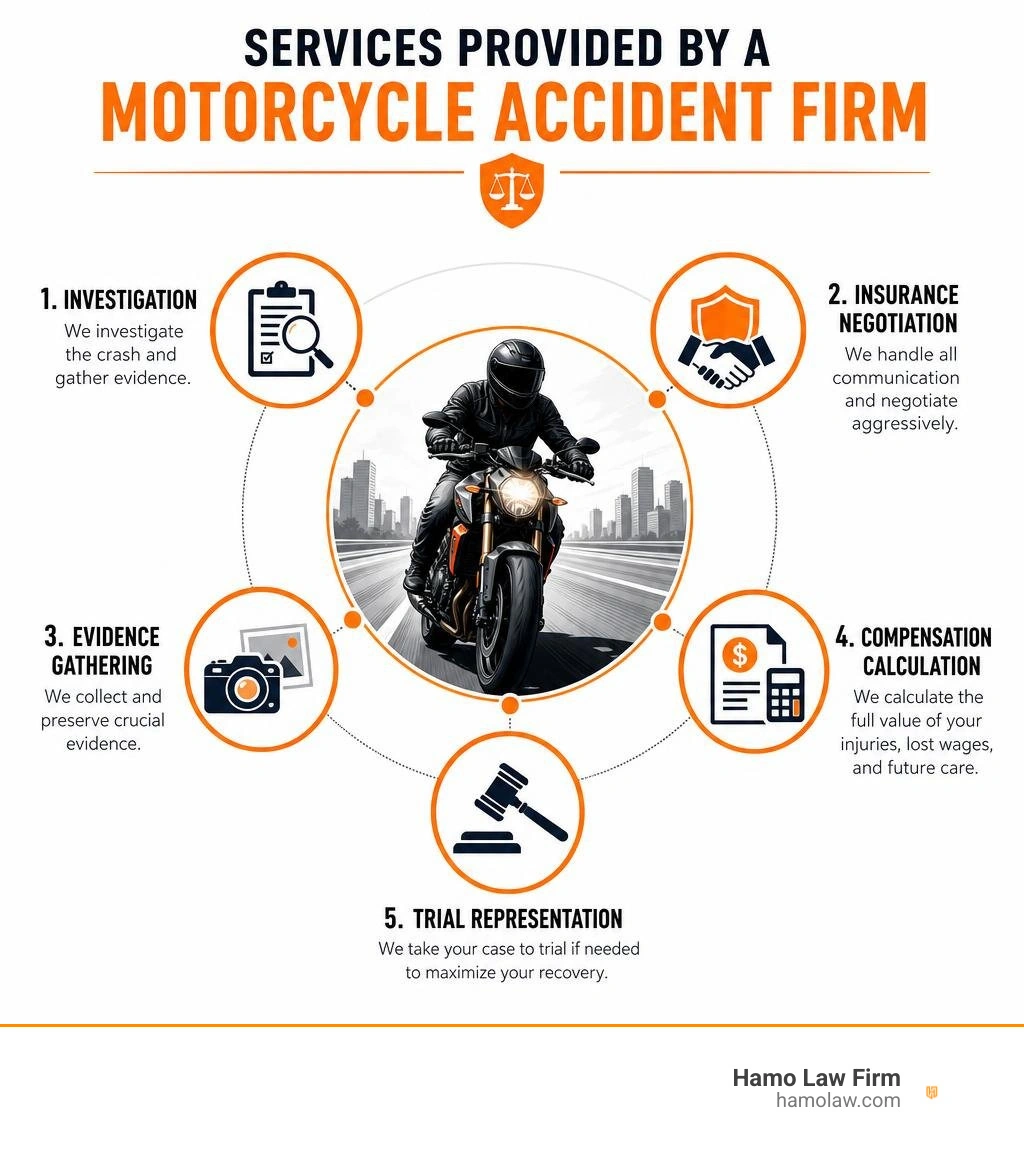
Here's what a motorcycle accident firm typically does for you:
- Investigates the crash and gathers evidence before it disappears
- Identifies all liable parties and insurance policies
- Handles all communication with insurance adjusters on your behalf
- Calculates the full value of your injuries, lost wages, and future care
- Negotiates aggressively — or takes your case to trial — to maximize your recovery
Motorcycle riding carries risks that most drivers never face. When something goes wrong, the consequences are severe. According to safety data from the National Highway Traffic Safety Administration, riders are 28 times more likely to die in a crash than passengers in a car. Eighty percent of motorcycle accidents result in serious injury. And in roughly 60 percent of two-vehicle crashes, the motorcyclist had the right-of-way.
Yet insurance companies often treat riders as the problem — not the victim.
That gap between what riders deserve and what insurers offer is exactly where a motorcycle accident firm steps in.
I'm George Hamo, and in this guide I'll walk you through exactly what these firms do and how the right legal team can make the difference in your recovery.
How a Dedicated Motorcycle Accident Firm Fights for Injured Riders
When a motorcyclist is involved in a collision with a passenger car or truck, the physical and legal playing fields are rarely equal. A standard automobile weighs between 3,000 and 5,000 pounds, whereas a motorcycle typically weighs around 400 to 800 pounds. When these forces collide, the rider absorbs the brunt of the kinetic impact.
A dedicated motorcycle accident firm acts as your frontline shield. From the moment you retain legal counsel, an experienced personal injury attorney assumes complete control of the legal and administrative burdens surrounding your crash. This allows you and your family to focus entirely on physical healing and rehabilitation.
Legal representation in a motorcycle injury case goes far beyond filing paperwork. It involves a systematic, multi-phase approach designed to protect your rights, establish liability, and force insurance companies to deliver fair compensation.
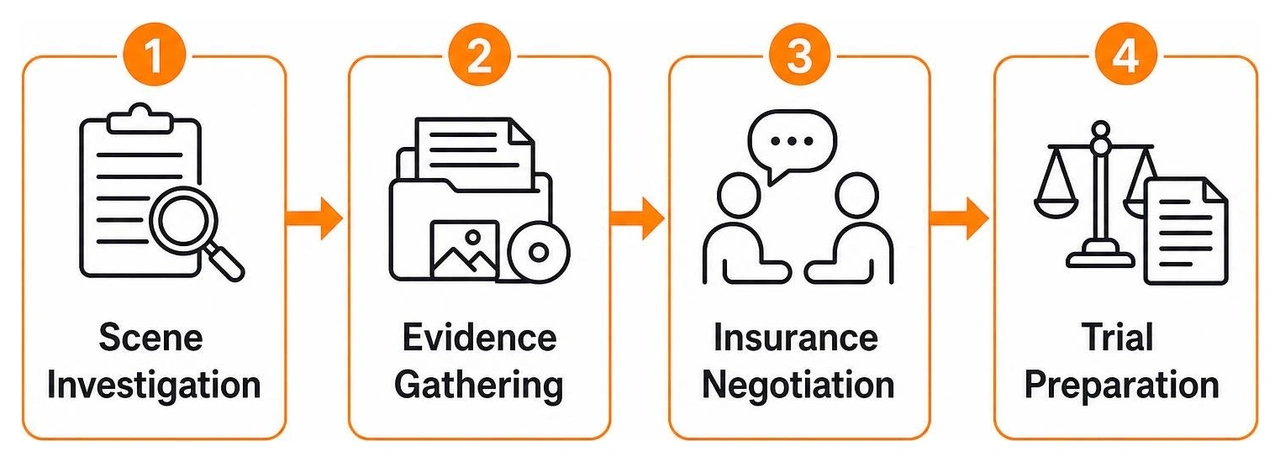
- Immediate Crash Investigation: Preserving physical evidence from the collision site before skid marks fade, weather changes road conditions, or physical debris is cleared.
- Evidence Preservation: Subpoenaing traffic camera recordings, dashcam footage, black box data from passenger vehicles, and cellular phone records.
- Insurance Shielding: Managing all communications with insurance adjusters to prevent deceptive recorded statements or premature lowball settlement offers.
- Comprehensive Damage Valuation: Working directly with treating physicians, orthopedic specialists, and economic experts to calculate lifelong care expenses and financial losses.
- Aggressive Negotiation and Litigation: Presenting a fully backed demand package to insurance carriers, and taking the case directly to trial before a jury if the insurer refuses to pay what you are owed.
Investigating Crash Causes with a Specialized Motorcycle Accident Firm
Understanding why an accident occurred is the cornerstone of establishing legal liability. Passenger vehicle drivers routinely fail to recognize motorcycles on roadways across Michigan, leading to devastating side-impact and head-on collisions.
Research shows that approximately three-fourths of all motorcycle crashes involve collisions with another motor vehicle. In the vast majority of these two-vehicle collisions, the passenger vehicle driver violated the motorcyclist’s right-of-way.
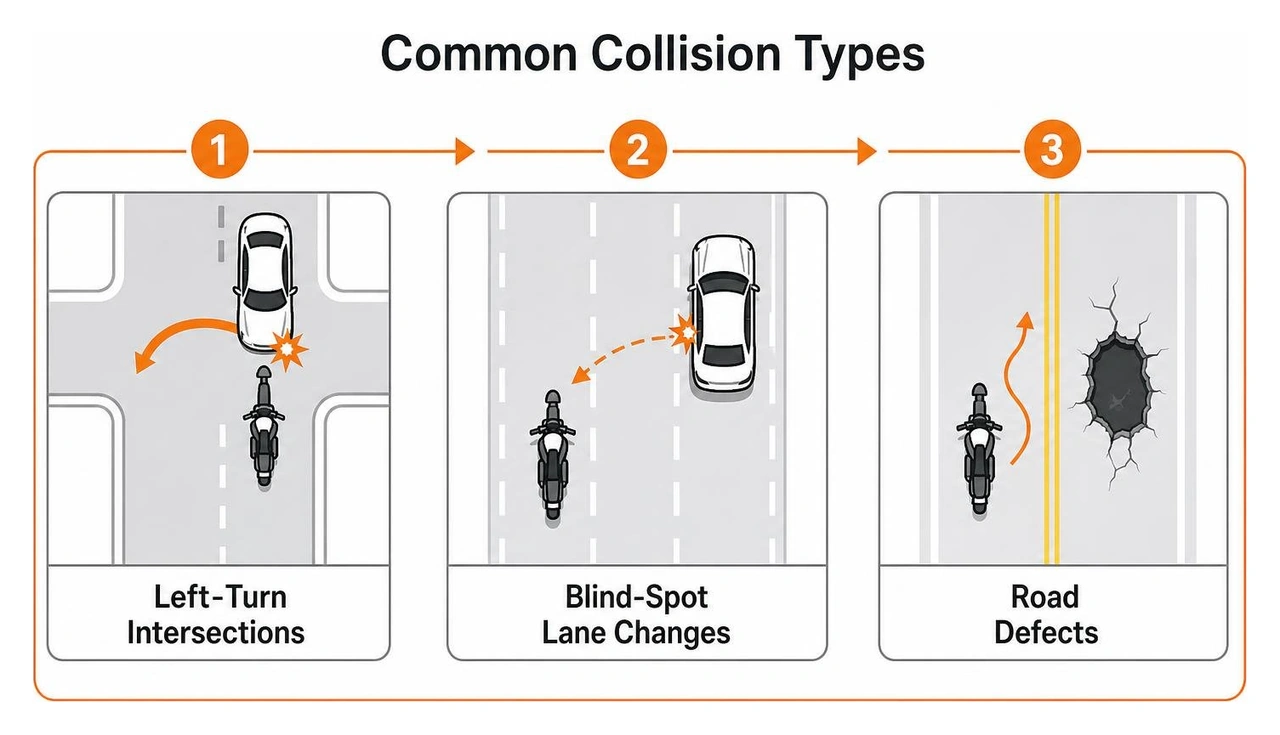
The most common causes of motorcycle accidents include:
- Left-Turn Collisions: Left-turn accidents account for roughly 36 to 42 percent of all fatal motorcycle collisions. Passenger vehicle drivers making left turns at intersections frequently misjudge the approaching motorcycle's speed or fail to notice the rider altogether, pulling directly into the motorcycle's path.
- Blind-Spot Accidents and Lane Changes: Because motorcycles have a smaller profile than cars, drivers frequently fail to perform head checks before switching lanes, driving motorcycles off the road or sideswiping them.
- Failure to Yield at Intersections: Drivers emerging from side streets, driveways, or parking lots regularly pull out directly in front of ongoing motorcycle traffic.
- Distracted and Impaired Driving: Texting, adjusting dashboard touchscreens, or driving under the influence of alcohol or drugs severely degrades a driver's reaction time and spatial awareness.
- Road Hazards and Poor Maintenance: Loose gravel, unpatched potholes, grooved pavement, standing water, or obscured traffic signs represent minor inconveniences for four-wheeled automobiles, but they create immediate, life-threatening hazards for motorcyclists.
To read an in-depth breakdown of collision factors on local roadways, explore our comprehensive guide on What Causes Most Motorcycle Accidents in Michigan.
Overcoming Insurance Bias with an Experienced Motorcycle Accident Firm
One of the most frustrating obstacles an injured rider faces is anti-biker prejudice. Insurance claims adjusters are trained to minimize company payouts, and they routinely leverage systemic societal stereotypes that portray motorcyclists as reckless, speeding risk-takers.
Before the police report is even finalized, insurance adjusters may assume the motorcyclist was at fault. They use specific tactics to compromise your claim:
- Prompting Recorded Statements: Adjusters contact injured riders in the hospital or early in recovery—when victims are heavily medicated or in shock—hoping to capture statements that can be twisted into admissions of fault.
- Offering Early, Lowball Settlements: Insurers frequently offer quick lump sums that seem helpful immediately but cover only a fraction of the actual long-term medical bills and lost wages.
- Delaying and Denying Claims: Insurance carriers may stretch out investigations or deny valid claims altogether, betting that financial pressure will force the rider to accept a fraction of their claim's value.
An established motorcycle accident firm counters these bad-faith tactics directly. By conducting an independent investigation, preserving biological and physical evidence, securing accident reconstruction analysis, and sending formal legal notices to insurers, your attorney eliminates anti-biker bias from the equation. When insurance adjusters know a firm has over 40 years of trial experience and is fully prepared to present the facts to a jury, their settlement offers change dramatically.
Proving Fault and Navigating Complex Motorcycle Laws
Establishing financial recovery in a personal injury lawsuit requires clear proof of negligence. Under civil law, you must establish four core elements:
- Duty of Care: The defendant owed you a legal duty to operate their motor vehicle safely.
- Breach of Duty: The defendant breached that duty through action or inaction (e.g., speeding, failing to yield, texting while driving).
- Causation: The defendant's breach directly caused the collision and your injuries.
- Damages: You suffered verifiable financial, physical, or emotional losses as a direct result.
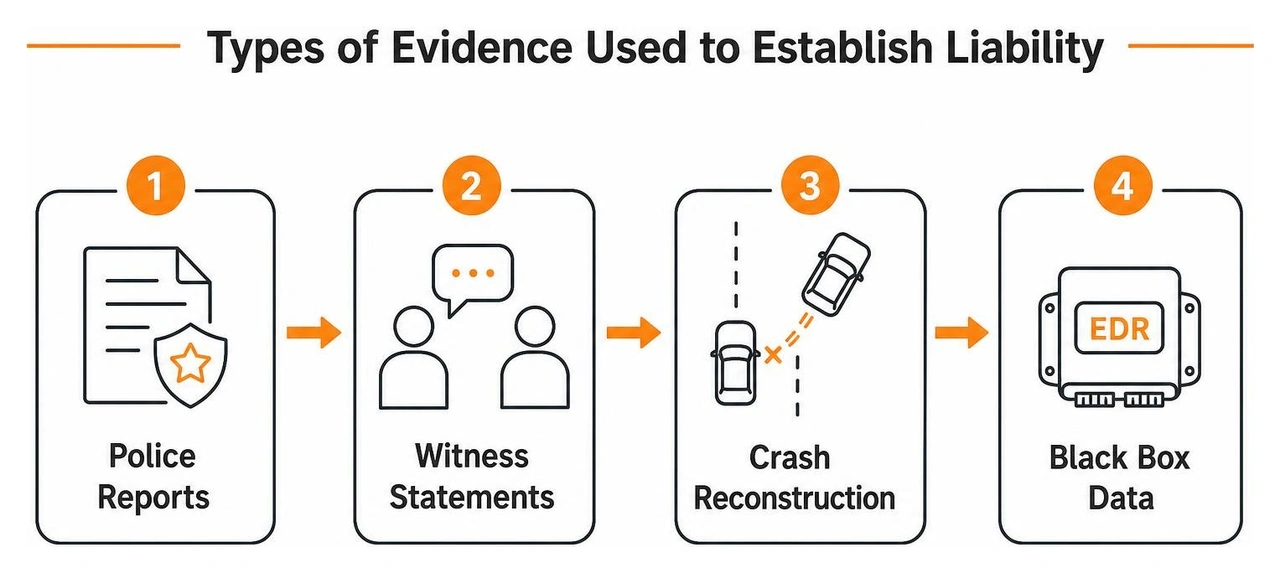
Proving these elements requires compelling, objective evidence gathered quickly after the crash.
Determining Comparative Negligence and Fault
In many motorcycle collisions, the defendant's insurance company will allege that the rider contributed to the crash through excessive speed, improper lane positioning, or failing to avoid the collision. How fault is allocated depends on your state's comparative negligence framework.
Michigan operates under a modified comparative fault rule (MCL 600.2959):
- Reduction of Damages: If you are found partially at fault for an accident, your financial recovery is reduced by your percentage of fault. For example, if total damages are assessed at $500,000 and a jury finds you 20 percent at fault, your final award is reduced by $100,000, leaving you with $400,000.
- The 51 Percent Bar Rule: If you are found to be more than 50 percent at fault for the accident, you are legally barred from recovering any non-economic damages (such as pain, suffering, and mental anguish).
Because even a minor percentage of allocated fault can cost an injured rider tens or hundreds of thousands of dollars, having a specialized law firm combat comparative fault arguments is crucial. Learn more about local representation by reviewing our Car, Truck & Motorcycle Accident Lawyers Michigan page.
Unique Legal Issues: Helmet Laws, Lane Splitting, and PIP Exclusions
Motorcycle injury claims involve complex statutory nuances that do not apply to standard automobile accidents.
Lane Splitting
Lane splitting—the practice of riding a motorcycle between lanes of stopped or slow-moving traffic—is illegal in Michigan. If a collision occurs while a rider is filtering or lane splitting, defense attorneys will attempt to use this action as conclusive proof of negligence. An experienced attorney must carefully analyze whether the driver's actions (such as opening a car door or changing lanes without signaling) were the primary cause of the crash regardless of position.
Helmet Laws and the "Helmet Defense"
Under Michigan law (MCL 257.658), riders over the age of 21 are permitted to ride without a helmet if they carry at least $20,000 in first-party medical benefits coverage and have held a motorcycle endorsement for at least two years or passed an approved safety course.
If an unhelmeted rider suffers a traumatic brain injury (TBI) in a crash caused by a negligent driver, defense lawyers frequently assert the "helmet defense," claiming the rider's injuries are their own fault for not wearing protective gear. To counter this defense, your lawyer must hire biomechanical experts to evaluate crash mechanics and prove whether a helmet would have actually prevented or reduced the specific head injury sustained.
Calculating Maximum Compensation for Severe Motorcycle Injuries

Due to the lack of structural enclosure, seatbelts, and airbags, 98 percent of motorcycle riders involved in multi-vehicle collisions suffer injuries. Ninety-six percent of riders in single-vehicle crashes are also injured.
A skilled motorcycle accident firm ensures that every physical injury and financial burden is thoroughly evaluated and included in your legal demand.
Evaluating Common Injuries and Economic Damages
Motorcycle collisions regularly cause severe, life-altering physical trauma, including:
- Traumatic Brain Injuries (TBIs): Concussions, cerebral contusions, and permanent cognitive impairment.
- Spinal Cord Injury and Paralysis: Damage to the spinal column causing paraplegia or quadriplegia.
- Severe Road Rash: Traumatic skin abrasion requiring surgical skin grafts, leaving permanent disfigurement.
- Orthopedic Fractures: Compound fractures of the femur, tibia, radius, pelvis, and facial bones requiring surgical hardware implantation.
- Amputations and Nerve Damage: Traumatic loss of limbs or severe "biker’s arm" (brachial plexus nerve damage causing permanent paralysis of the arm).
Economic damages cover all measurable financial costs incurred due to the collision. The table below outlines the core categories of economic and non-economic damages available in a personal injury claim:
| Damage Category | Economic Damages (Verifiable Financial Losses) | Non-Economic Damages (Quality of Life Impacts) |
|---|---|---|
| Medical Expenses | Emergency transport, hospitalizations, surgeries, prescriptions, physical therapy | Pain and suffering endured during treatment and recovery |
| Future Care Costs | In-home nursing assistance, home modifications, specialized medical equipment | Permanent physical disability, loss of mobility, chronic pain conditions |
| Income Loss | Back pay for lost wages, used sick leave, missed business opportunities | Mental anguish, post-traumatic stress disorder (PTSD), severe anxiety |
| Earning Capacity | Diminished long-term earning power due to permanent disability | Loss of enjoyment of life, inability to participate in hobbies or riding |
| Property Damage | Replacement or repair of motorcycle, helmet, custom accessories, protective gear | Loss of consortium (impact on marital relationship and companionship) |
Pursuing Non-Economic and Long-Term Recovery
While medical bills and lost wages are proven through receipts and pay stubs, non-economic damages address the human cost of a crash. A catastrophic crash alters every aspect of a rider’s daily life.
Proving non-economic damages requires documenting how your injuries restrict your ability to work, enjoy family life, play with your children, or engage in active hobbies. Your legal team works closely with mental health professionals, vocational specialists, and life-care planners to build a comprehensive narrative that demonstrates the true lifetime impact of your injuries to an insurance adjuster or jury.
For more details on comprehensive representation options, consult our Automobile, Truck & Motorcycle Accidents Practice Area page.
What to Do Immediately After a Crash to Protect Your Claim

The actions you take immediately following a motorcycle crash can significantly impact the strength of your future legal claim. If you are physically capable of doing so, take these vital steps:
- Call 911 Immediately: Request emergency medical services and law enforcement. Ensure officers complete an official police report.
- Seek Immediate Medical Attention: Go directly to an emergency room or urgent care facility, even if you feel fine. Adrenaline can mask severe internal injuries, concussions, and internal bleeding.
- Document the Crash Scene: Take high-resolution photos and videos of all damaged vehicles, license plates, skid marks, road conditions, traffic signals, weather conditions, and visible injuries.
- Gather Witness Information: Collect names, phone numbers, and email addresses of anyone who witnessed the collision or the events leading up to it.
- Preserve Your Riding Gear: Do NOT wash, clean, or discard your damaged helmet, jacket, gloves, or boots. Physical damage to gear serves as physical evidence proving impact force and injury mechanics.
- Report to Your Insurer, But Do NOT Give Recorded Statements: Notify your insurance company that a crash occurred, but decline to give recorded statements to any insurance adjuster until you have consulted a lawyer.
- Contact a Dedicated Motorcycle Accident Firm: Engage an experienced firm promptly to begin evidence preservation before traffic camera footage is erased or physical evidence degrades.
Frequently Asked Questions About Hiring a Motorcycle Accident Firm
How long do I have to file a motorcycle accident lawsuit in different states?
In Michigan, the standard statute of limitations for personal injury negligence lawsuits is three years from the date of the crash (MCL 600.5805). If you fail to file a lawsuit within this three-year window, you permanently lose your right to seek financial recovery in court.
However, certain exceptions enforce significantly shorter deadlines:
- Claims Against Government Entities: If your accident was caused by a dangerous road design, missing signage, or a municipal/state vehicle (such as a city bus or road maintenance truck), you may be required to file formal written notice within 60 days to 120 days of the accident.
- Wrongful Death Claims: If a loved one lost their life in a fatal crash, specific procedural timelines govern the appointment of a personal representative and the filing of a wrongful death action.
How does Personal Injury Protection (PIP) coverage apply to motorcycle crashes?
In Michigan, motorcycle accident PIP rules differ drastically from standard automobile collisions. Under the Michigan No-Fault Act (MCL 500.3101), motorcycles are not defined as "motor vehicles." Consequently, motorcycle owners are not eligible to purchase standard No-Fault Personal Injury Protection (PIP) medical benefits directly for their bikes.
Instead, when a motorcyclist is injured in an accident involving a motor vehicle (a car, truck, or van), PIP medical benefits are provided through the insurance policy covering the motor vehicle involved in the crash.
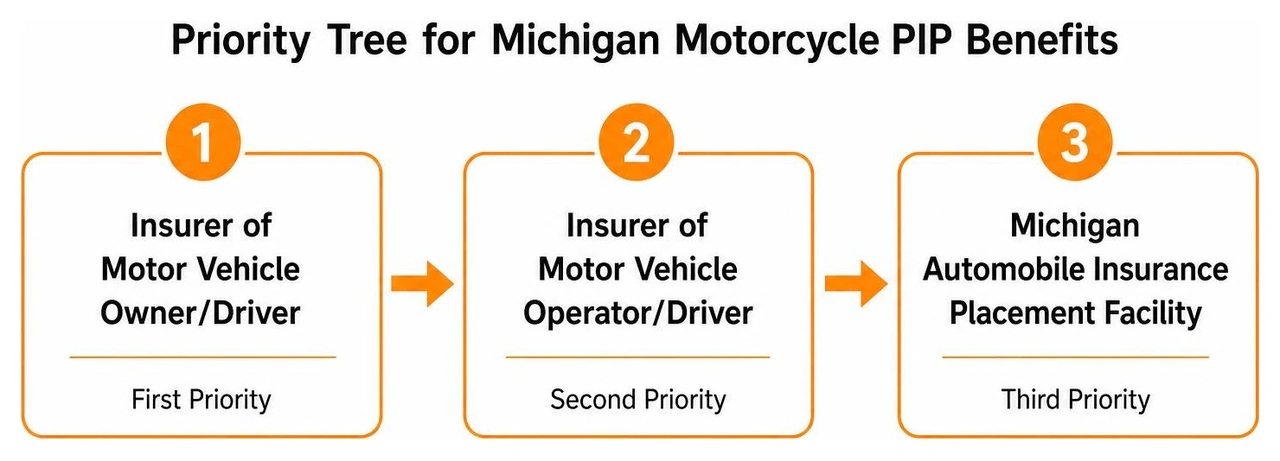
The order of priority for obtaining PIP benefits after a motorcycle-automobile crash is:
- The insurer of the owner of the motor vehicle involved in the crash.
- The insurer of the operator of the motor vehicle involved in the crash.
- The motor vehicle insurer of the motorcycle operator.
- The motor vehicle insurer of the owner of the motorcycle.
- The Michigan Automobile Insurance Placement Facility (MAIPF) if no insurance policy exists in the chain.
For a thorough breakdown of how No-Fault medical coverage applies to riders, visit our detailed resource: Do Motorcyclists Receive No-Fault PIP Benefits in Michigan. Additional general crash questions are covered in What Causes Most Motorcycle Accidents.
How much does it cost to retain legal representation after a bike wreck?
Reputable motorcycle accident firms operate on a contingency fee basis. This means:
- Zero Upfront Costs: You pay no retainer fees, hourly rates, or out-of-pocket expenses to retain legal representation.
- Case Expense Coverage: Your law firm advances all costs associated with investigating the crash, filing fees, hiring expert witnesses, and obtaining medical records.
- No Fee Unless We Win: The firm receives a pre-agreed percentage of the final financial recovery (settlement or trial verdict). If your lawyer does not successfully recover compensation for you, you owe nothing in legal fees.
Conclusion
A serious motorcycle crash can upend your life in an instant. Facing painful medical procedures, rising medical bills, missed work, and hostile insurance adjusters is overwhelming—but you do not have to fight this battle alone.
At Hamo Law Firm, we have provided compassionate, relentless legal representation to injured riders across Flint, Detroit, Genesee County, and Wayne County for over 40 years. We understand motorcycle mechanics, the intricacies of Michigan No-Fault law, and how to dismantel anti-biker insurance bias to secure maximum financial compensation.
If you or a loved one has been injured in a motorcycle collision, reach out to a trusted Biker Accident Lawyer Michigan today. We handle every case on a contingency-fee basis—there are no fees unless we win.
Contact us today to schedule your free, confidential case evaluation and learn how our Motorcycle Accidents Legal Support can help you move forward.