
What You Need to Know About Car Accident Liability
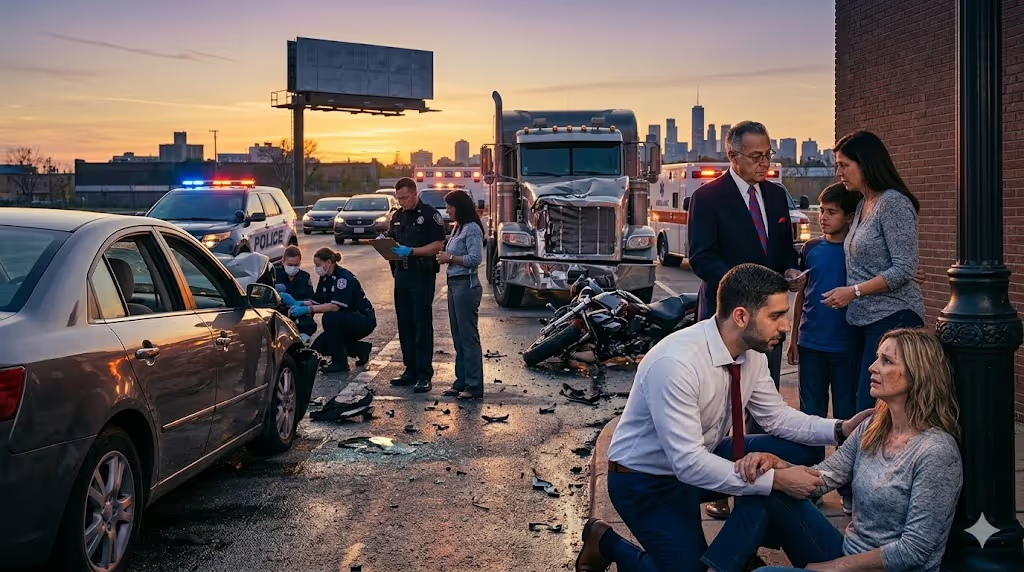
Understanding car accident liability can mean the difference between recovering your losses and walking away with nothing. Here is a quick breakdown:
- Who pays? In most states, the at-fault driver's insurance covers the other party's injuries and property damage. In no-fault states like Michigan, your own Personal Injury Protection (PIP) covers your medical bills first, regardless of who caused the crash.
- How is fault decided? Insurance adjusters review police reports, witness statements, photos, and traffic laws to assign responsibility.
- What if you share fault? Depending on your state, partial fault can reduce — or completely eliminate — your compensation.
- How long do you have to file? Deadlines vary by state and claim type. Missing them can bar your recovery entirely.
Car accidents can turn your life upside down in seconds. Medical bills pile up. Your car sits in a lot. The insurance company starts calling — and not always to help you.
Knowing your rights before you talk to an adjuster matters more than most people realize. The rules around liability, fault, and compensation differ significantly depending on where you live, how the crash happened, and what coverage is in place.
This guide walks you through everything — from how fault is determined to how to protect your claim from day one.
I'm George Hamo, and as an attorney who has helped Michigan accident victims fight back against insurance companies, I'll break this down in plain language so you know exactly where you stand.
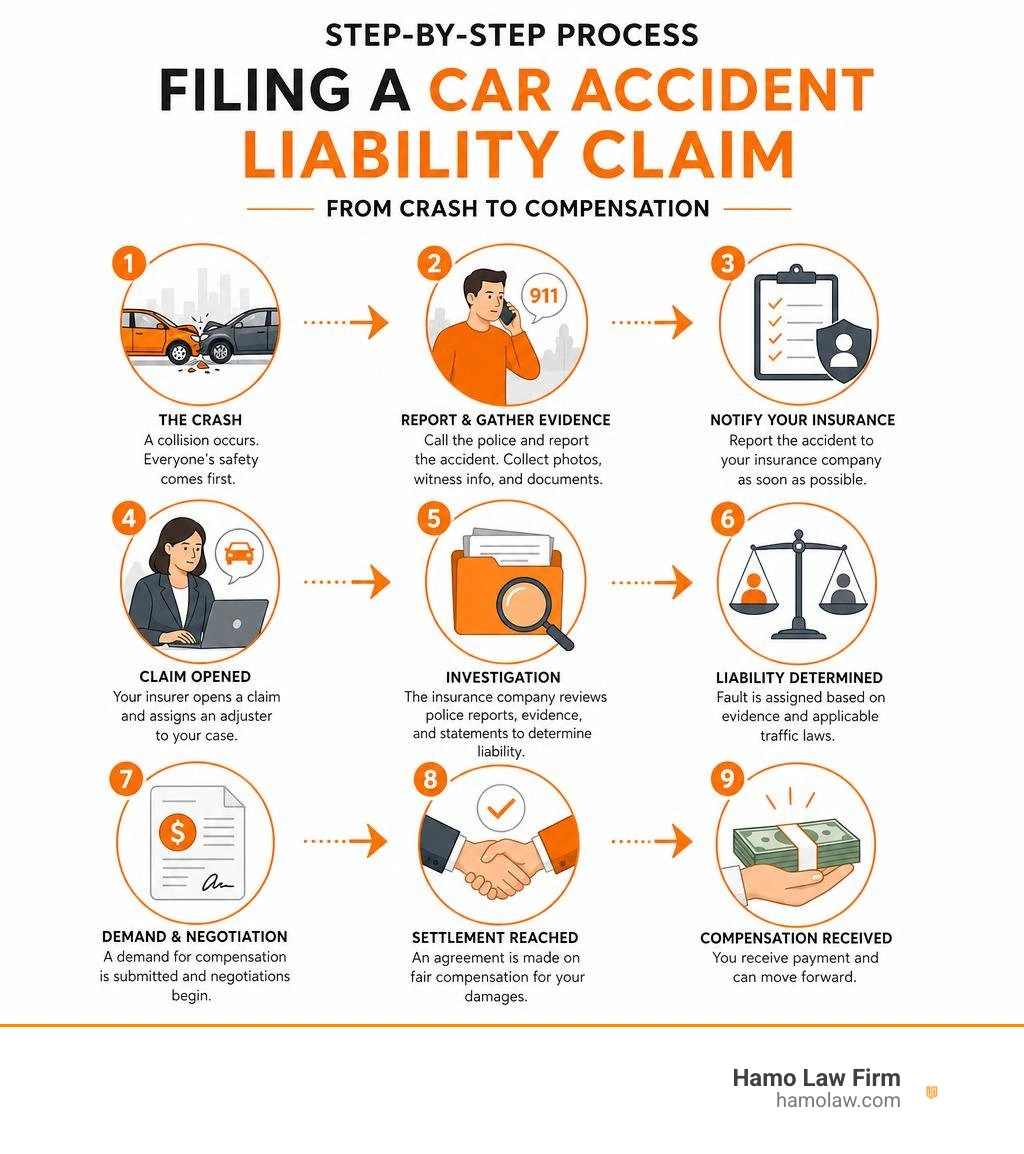
Understanding Car Accident Liability: At-Fault vs. No-Fault Systems
When you are involved in a collision, establishing car accident liability—legal responsibility for the financial and physical damages caused by the crash—is the cornerstone of securing fair financial recovery. Motor vehicle insurance systems in the United States generally divide into two primary categories: traditional at-fault (tort) systems and no-fault insurance systems.
In traditional at-fault systems, the driver who caused the crash is legally obligated to pay for all resulting damages, including medical expenses, lost wages, and property repairs. In contrast, no-fault systems require involved drivers to turn to their own insurance policies first to pay for immediate medical treatment and wage losses, regardless of who was at fault for the crash.
To help visualize how these systems handle claims, consider the differences below:
| Feature | At-Fault Systems | No-Fault Systems (e.g., Michigan) |
|---|---|---|
| Primary Claims Coverage | At-fault driver's liability policy covers bodily injury & property damage | First-party Personal Injury Protection (PIP) covers your own medical bills & lost wages |
| Property Damage Claims | Paid by at-fault driver's property damage liability insurance | Paid through collision coverage or limited mini-tort claims |
| Pain and Suffering Claims | Direct lawsuit permitted against the at-fault driver immediately | Lawsuit permitted only if injuries meet a legal "serious impairment threshold" |
| Fault Determination Required? | Yes, required before bodily injury claims are paid | No, PIP benefits pay out regardless of fault |
How At-Fault Insurance Systems Work
In standard at-fault states, liability operates under strict legal tort principles. If another driver acts carelessly—such as running a stop sign or rear-ending your vehicle—their insurance carrier is financially liable for your damages. To collect compensation, you file a third-party claim against the responsible party's auto insurance policy.
Insurance adjusters evaluate the incident details, inspect damage, review police reports, and apply state traffic statutes to establish legal responsibility. State laws mandate minimum financial responsibility limits. For instance, some states require minimum bodily injury liability limits like $25,000 per person and $50,000 per accident, alongside minimum property damage limits. However, if total losses exceed these policy thresholds, the negligent driver can be held personally liable for the remaining balance. You can review broader rules in this detailed resource on Determining Liability After a Car Accident.
Personal Injury Protection (PIP) and No-Fault Rules
In a no-fault system, the claims process operates quite differently. Under these laws, your own insurer provides Personal Injury Protection (PIP) coverage to pay for reasonable and necessary medical care, allowable rehabilitation expenses, attendant care, and a percentage of lost wages—no matter who caused the crash.
However, no-fault coverage does not completely eliminate driver liability. If an accident victim suffers severe, life-altering injuries—often defined legally as permanent disfigurement, serious impairment of an important body function, or death—they cross what is known as the "injury threshold." Once this statutory threshold is met, the injured party retains the legal right to file a third-party pain and suffering lawsuit against the driver who caused the collision.
Understanding how PIP benefits operate alongside third-party tort claims is vital for any crash victim. To explore the nuances of these laws in detail, read our guide on How Michigan No Fault Insurance Works.
How Insurance Claims Work: First-Party vs. Third-Party Filings

Navigating auto insurance after a crash requires knowing the difference between first-party and third-party claims. Filing under the correct coverage type ensures your medical treatment and vehicle repairs are handled efficiently.
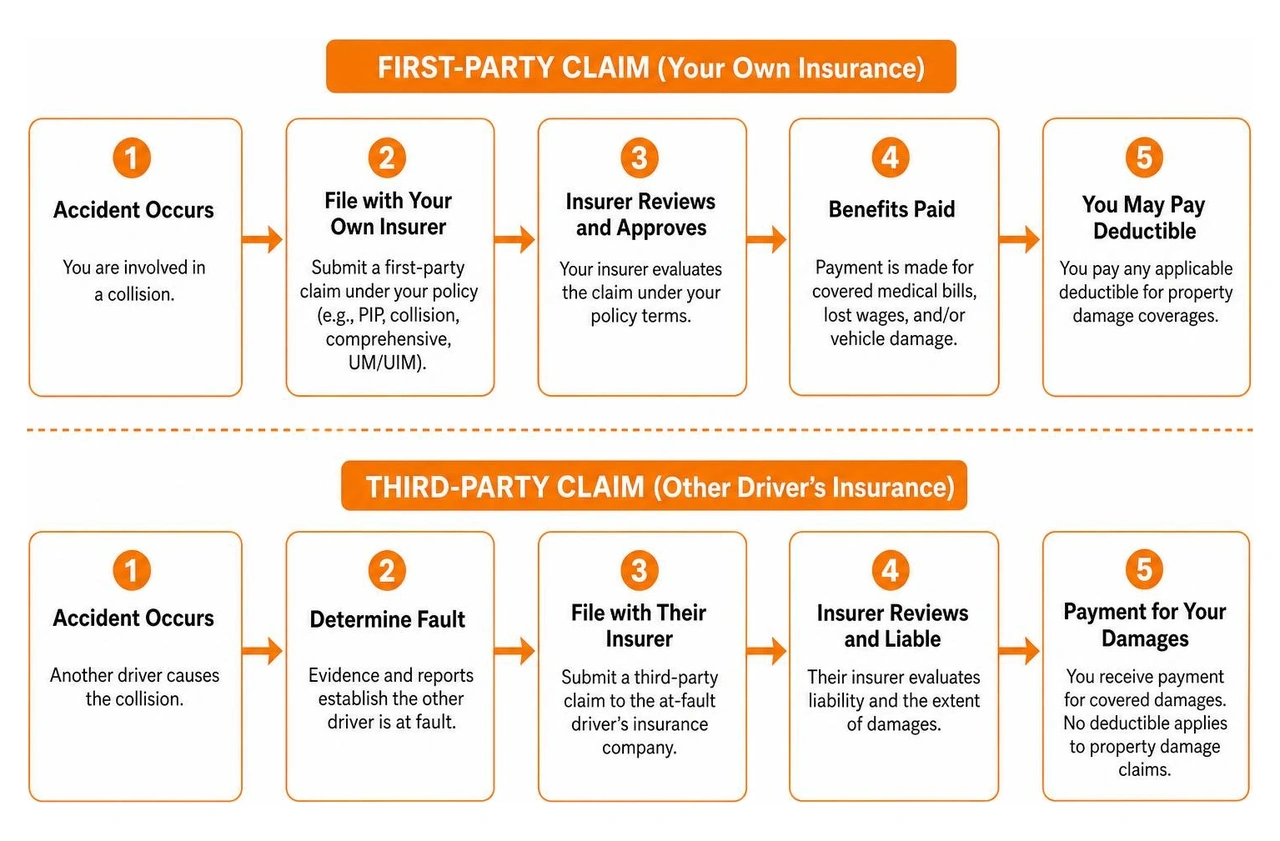
First-Party vs. Third-Party Claims Explained
- First-Party Claims: A first-party claim is submitted directly to your own insurance carrier under the coverages included in your auto policy. This includes Personal Injury Protection (PIP), comprehensive, collision, and Uninsured/Underinsured Motorist (UM/UIM) coverages. First-party claims are bound by your contractual agreement, meaning you may have to pay an out-of-pocket deductible before your insurer reimburses vehicle repairs or property loss.
- Third-Party Claims: A third-party claim is brought against another driver's insurance provider. You file a third-party claim when the other driver is responsible for causing the crash and you are seeking compensation for your vehicle damage, out-of-pocket expenses, or non-economic pain and suffering. Notably, when filing a third-party property damage claim against an at-fault driver's insurance, you do not pay a policy deductible.
When dealing with severe injury crashes or complex fault disputes, understanding how to structure your claims makes a tremendous difference. Learn more about pursuing full recovery after a crash on our Car Accidents resource page.
Uninsured and Underinsured Motorist Coverage
What happens when the driver who causes your crash doesn't have automobile insurance or carries policy limits that are far too low to cover your hospital bills? This is where Uninsured Motorist (UM) and Underinsured Motorist (UIM) coverages become critical legal lifesavers.
- Uninsured Motorist (UM) Coverage: Protects you if you are hit by a driver who carries no auto insurance, or if you are the victim of a hit-and-run driver (sometimes called a "phantom driver") whose identity cannot be established.
- Underinsured Motorist (UIM) Coverage: Steps in when the at-fault driver has insurance, but their policy limit is exhausted before all your medical expenses and economic losses are fully paid.
Carrying adequate UM/UIM limits guarantees that you and your passengers are financially protected even when negligent drivers ignore mandatory liability laws.
Determining Fault and Proving Negligence in Crash Claims
Establishing car accident liability requires demonstrating legal negligence. In personal injury law, negligence means that a driver failed to act with the level of reasonable care that a prudent person would exercise under similar circumstances.
To prove driver liability, four core legal elements must be established:
- Duty of Care: The driver owed a legal obligation to operate their vehicle safely and follow traffic laws.
- Breach of Duty: The driver failed to fulfill that obligation through a careless or illegal action.
- Causation (Proximate Cause): The driver's breach directly caused the crash and resulting injuries.
- Damages: The victim suffered measurable losses, such as physical injury, wage loss, or property damage.
Common Examples of Driver Negligence
Driver carelessness takes many forms on the road. Some of the most frequent acts of negligence that establish liability include:
- Distracted Driving: Texting, adjusting navigation devices, eating, or talking on the phone while operating a vehicle.
- Speeding and Reckless Driving: Exceeding posted speed limits or driving too fast for adverse weather and traffic conditions.
- Failure to Yield Right-of-Way: Disregarding stop signs, red lights, or failing to yield to oncoming traffic during left turns.
- Impaired Driving (DUI): Operating a vehicle under the influence of alcohol, drugs, or intoxicating prescription medications.
- Tailgating: Following another vehicle too closely, making it impossible to stop safely when traffic suddenly slows.
- Unsafe Lane Changes: Merging or changing lanes without signaling or checking blind spots, leading to dangerous sideswipe collisions.
Establishing Car Accident Liability Through Evidence
Insurance adjusters and trial juries do not assign liability based on guesswork. They rely heavily on objective physical and documentary evidence collected following the crash.
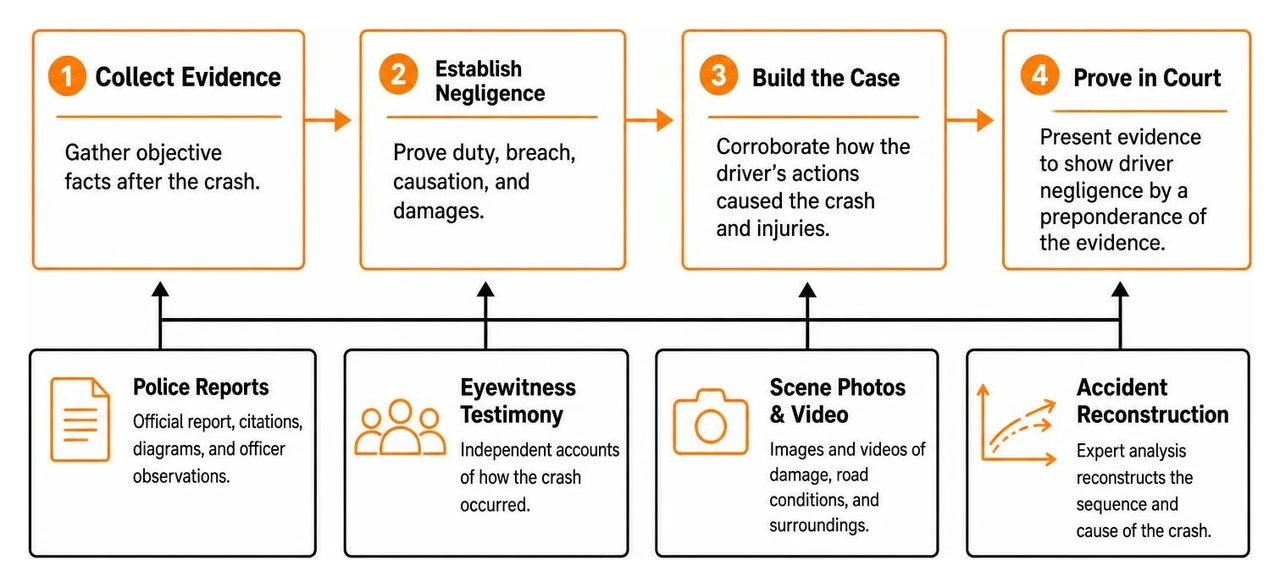
Key pieces of evidence used to establish fault include:
- Police Reports: Official crash reports completed by responding law enforcement officers contain crucial observations, traffic citations issued, diagrams, and initial fault evaluations.
- Eyewitness Testimony: Independent witness accounts provide neutral, unbiased verification of how the collision took place.
- Scene Photos and Video Footage: Photographs of vehicle damage, point of impact, tire skid marks, road conditions, and dashcam or surveillance video offer compelling visual proof.
- Accident Reconstruction Analysis: In complex or multi-vehicle collisions, forensic reconstruction experts analyze vehicle telemetry, crash energy, and physical debris to reconstruct the exact sequence of events.
If you want to dive deeper into how fault is formally investigated and calculated in Michigan, read our detailed FAQ on How Fault Is Determined In A Michigan Car Accident.
How Comparative Negligence Affects Car Accident Liability Claims
Often, collisions are not entirely one-sided. What happens if both drivers contributed to the accident? Legal claims are resolved using state-specific comparative negligence frameworks.
Different jurisdictions evaluate shared fault through distinct rules:
- Pure Comparative Fault: A driver can recover compensation regardless of their share of fault, even if they are 99% responsible. However, their monetary recovery is reduced by their direct percentage of fault. For example, if you sustain $100,000 in damages but are found 25% responsible due to minor speeding, your net recovery is capped at $75,000.
- Modified Comparative Fault (50% or 51% Bar Rules): In these jurisdictions, an injured driver can only recover damages if their share of fault is below a specific statutory limit (typically 50% or 51%). In states enforcing a 51% bar rule, an injured party who is 50% at fault recovers half their total damages, but if they are found 51% or more at fault, they are completely barred from receiving any financial recovery.
- Pure Contributory Negligence: Under this strict rule, if an injured party contributed even 1% to the crash, they are completely barred from recovering any compensation.
For a broader look at national fault standards and thresholds, explore this reference guide on Who Is at Fault in a Car Accident? State-by-State Rules (2026).
Essential Steps and Time Limits After an Automobile Crash
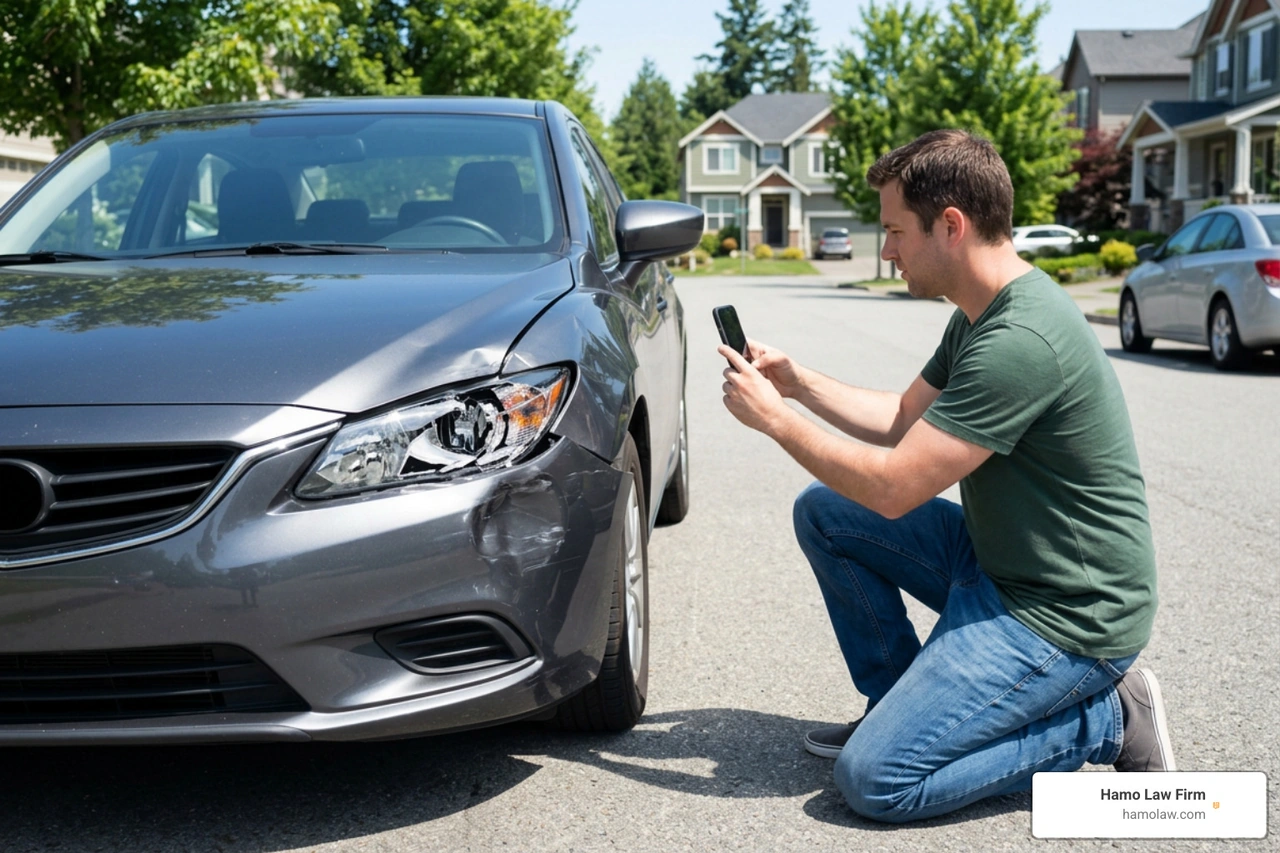
What you do in the minutes, days, and weeks following a motor vehicle collision directly affects your health and your ability to secure compensation.
Immediate Actions to Protect Your Legal Rights
If you are involved in a collision, take these steps to preserve your well-being and protect your claim:
- Check for Injuries and Call 911: Prioritize safety. Seek immediate emergency medical care for anyone who is injured, and request law enforcement at the scene.
- Move to Safety: If vehicles are movable and traffic poses a hazard, carefully pull off to the shoulder or side of the road.
- Document the Scene: Take photos and videos showing vehicle damage, license plates, traffic signals, road hazards, skid marks, and visible physical injuries.
- Exchange Contact and Insurance Details: Collect names, phone numbers, driver's license numbers, insurance policy details, and vehicle VINs from all involved drivers.
- Gather Witness Contact Information: Ask neutral witnesses for their names and phone numbers before they leave the scene.
- Seek Prompt Medical Care: Even if you feel fine due to adrenaline, undergo a complete medical evaluation. Internal trauma, concussions, and soft-tissue injuries often take hours or days to display painful symptoms.
- Notify Your Insurance Carrier: Report the crash to your insurance provider promptly, but avoid making recorded statements assuming fault or speculating about your injuries until you speak with legal counsel.
For a step-by-step post-crash guide, read our detailed article on What Should I Do Immediately After A Car Accident In Michigan.
Statute of Limitations and Deadlines for Filing
Every state establishes strict deadlines—known as statutes of limitations—for filing lawsuits arising from auto accidents. Missing these legal deadlines permanently forfeits your right to seek financial compensation through the courts.
- Bodily Injury Lawsuits: State statutes typically give injured victims between two and three years from the date of the crash to file a personal injury lawsuit against a negligent driver. In Michigan, the standard statute of limitations for personal injury claims is three years.
- First-Party No-Fault PIP Claims: Statutory deadlines for filing first-party insurance claims are often much shorter. In Michigan, you must give formal notice to your no-fault insurer and file a lawsuit for unpaid PIP medical benefits within one year of the date the expense was incurred (under the "one-year-back rule").
- Property Damage Claims: Timeframes for filing property damage lawsuits vary by state, often ranging from two to five years.
To ensure your legal deadlines are met, consult our breakdown on the Statute Of Limitations Michigan Personal Injury.
Frequently Asked Questions About Vehicle Collision Claims
What happens if both drivers share fault in an accident?
When fault is shared, insurance adjusters, attorneys, or juries examine the evidence to assign a specific percentage of fault to each driver. Under comparative negligence laws, your compensation is reduced by your allocated percentage of fault. For instance, if Automobile A changes lanes unsafely and Automobile B is speeding, Automobile A might be assigned 80% fault while Automobile B is assigned 20% fault. Automobile B can still recover 80% of their total losses from Automobile A's insurer. However, if your fault exceeds your state's modified comparative fault threshold (such as 50% or 51%), you may be barred from recovering non-economic damages entirely.
How do I handle a settlement dispute with an insurance company?
Insurance adjusters are trained to minimize payouts and protect their company's profit margins. Common insurer tactics include offering lowball settlements early on, denying the severity of injuries, or claiming you were responsible for the collision. If an insurance carrier denies your claim or offers an unfair settlement, you do not have to accept their decision as final. You can submit additional evidence, dispute their fault calculations, file a formal complaint with state regulatory authorities, or retain an experienced personal injury attorney to negotiate on your behalf or file a lawsuit. Learn more about protecting your rights in our article on How Insurance Companies Try To Minimize Injury Claims And What You Can Do.
Will an at-fault accident cause my auto insurance rates to increase?
In traditional at-fault systems, being found responsible for a collision almost always leads to an auto insurance premium surcharge upon policy renewal. Rates increase because insurers view at-fault crashes as evidence of higher future risk. However, the exact rate increase depends on your driving record, the total payout amount, and whether your auto policy features "accident forgiveness." In contrast, filing a first-party PIP claim in a no-fault state for medical benefits generally should not trigger a premium penalty if you were completely innocent of fault in the crash.
Conclusion
Understanding car accident liability is essential for protecting your financial stability, health, and legal rights after a crash. Whether navigating first-party PIP claims, dealing with complex comparative fault rules, or confronting uncooperative insurance adjusters, having accurate knowledge empowers you to pursue the full compensation you deserve.
Insurance companies have teams of adjusters and lawyers dedicated to reducing what they pay out. You deserve a dedicated trial team fighting just as hard for you. At Hamo Law Firm, we bring over 40 years of trial experience to the table, fighting tirelessly for accident victims in Flint, Detroit, Genesee County, Wayne County, and across Michigan. Operating on a contingency-fee model, we handle the legal burden so you can focus on healing—you pay no legal fees unless we win your case.
If you or a loved one has been injured in a collision, do not face the insurance companies alone. Contact our experienced legal team today for a free consultation through our Automobile Truck Motorcycle Accidents practice page.