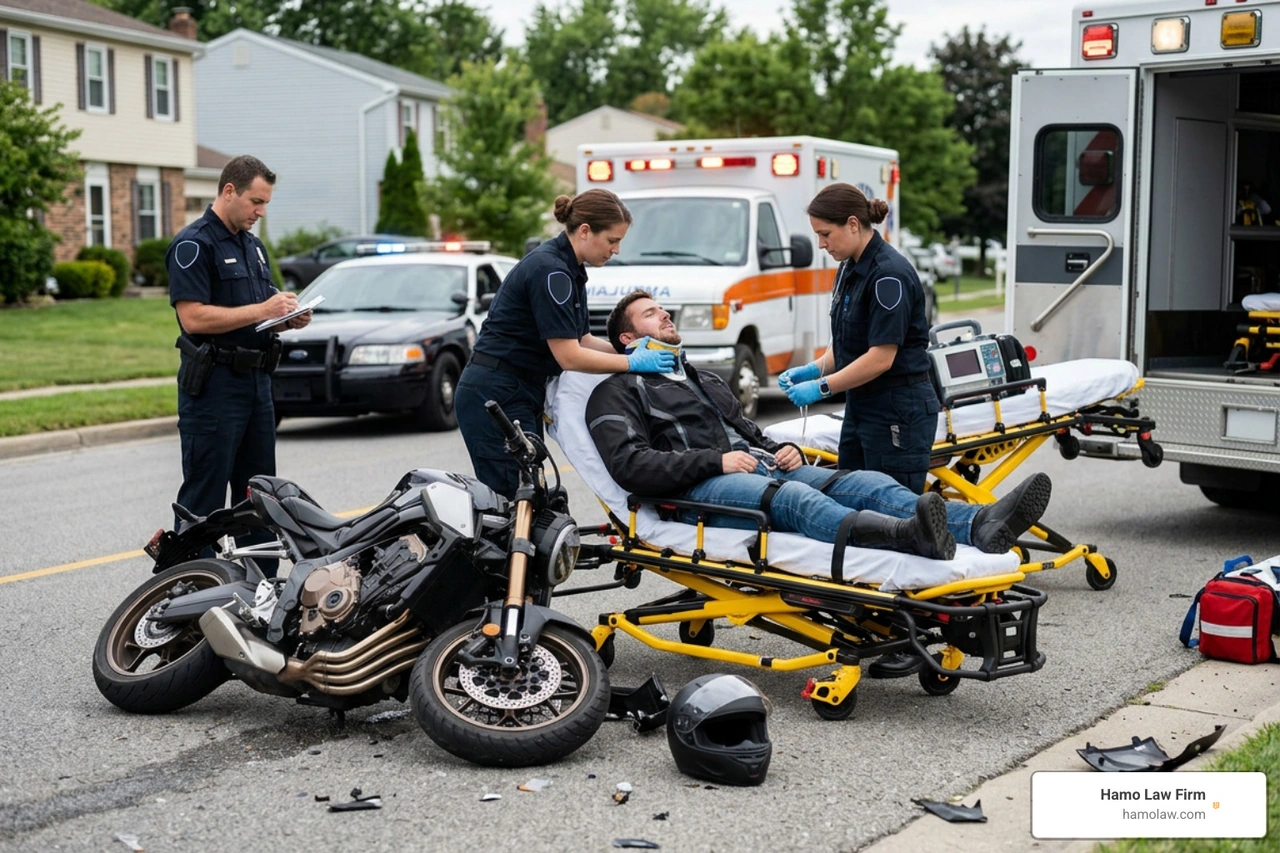
The Common Injuries From Motorcycle Accidents at a Glance
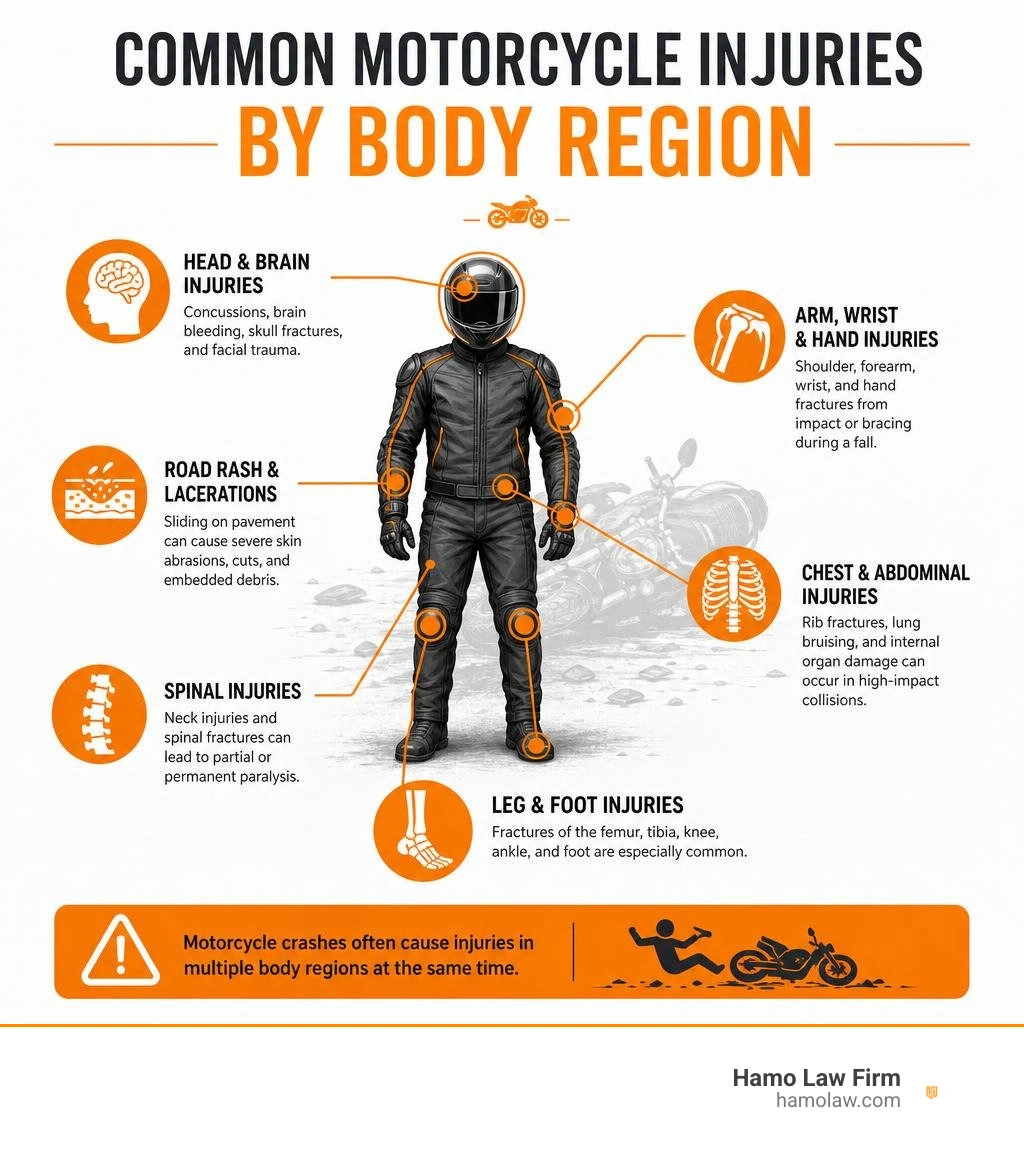
The common injuries from motorcycle accidents include road rash, broken bones, leg and foot trauma, head and brain injuries, spinal injuries, and internal chest or abdominal injuries. Because a motorcycle has no enclosed frame, airbags, or crumple zone, a rider's body often takes the direct force of the crash.
- Leg and foot injuries: Fractures of the tibia, femur, knee, ankle, and foot are especially common. About 30% of nonfatal motorcycle injuries involve the legs and feet.
- Head and brain injuries: Concussions, brain bleeding, skull fractures, and facial trauma can be life-changing. Brain injury is a leading cause of death in motorcycle crashes.
- Arm, wrist, and hand injuries: Riders often brace during a fall, causing shoulder, forearm, wrist, and hand fractures.
- Road rash and lacerations: Sliding across pavement can remove layers of skin, leave embedded debris, and create a serious infection risk.
- Chest, abdominal, and spine injuries: Rib fractures, lung bruising, internal-organ damage, neck injuries, and spinal fractures can occur in high-force impacts.
Motorcycle crashes often cause more than one injury at once. In one large hospital study, roughly two-thirds of injured riders had trauma in more than two body regions. The injury pattern can also reveal how the collision happened, whether the rider struck another vehicle, a fixed object, the motorcycle itself, or the pavement.
I am George Hamo, and the sections below explain these injuries in clearer detail, including what they can mean for long-term recovery after a Michigan crash.
Understanding the Most Common Injuries From Motorcycle Accidents by Body Region
When a collision occurs, the laws of physics are uncompromising. Motorcyclists face roughly 29 to 30 times the risk of mortality per mile traveled compared to occupants of passenger cars. Furthermore, riders are 6 times more likely to be involved in an accident overall, with over 71% of hospitalized crash victims requiring orthopaedic consultations.
Data from trauma centers highlights a staggering reality: 67.1% of admitted motorcyclists suffer multi-system trauma, meaning they sustain severe injuries across more than two body regions simultaneously. Understanding how common injuries from motorcycle accidents affect different anatomical structures helps medical providers triage trauma faster and enables legal teams to build comprehensive claims for long-term care.
Lower Extremity Trauma: The Most Frequent Non-Fatal Injuries
Lower extremity trauma represents the single most frequent category of non-fatal injuries in motorcycle collisions. Clinical studies and trauma registry data reveal that lower extremity injuries occur in 40% to 60% of all motorcycle crashes, and affect 47% of patients admitted to Level I and Level II trauma centers with moderate-to-severe trauma.
The specific bone structures most vulnerable during a crash include:
- Tibia and Fibula: Tibia fractures are the most frequent orthopaedic injury, accounting for 20% to 30% of all lower limb fractures. These often present as open, compound fractures due to the thin layer of soft tissue covering the shinbone.
- Proximal Femur and Hip: High-energy impacts against vehicle bumpers or pavement frequently shatter the upper thigh bone or dislocate the hip joint.
- Patella, Ankle, and Foot: Complex crush injuries to the ankle and calcaneus (heel bone) regularly occur when a bike drops onto the rider's leg during a slide.
Riders often attempt "crash modifying manoeuvres"—instinctively extending a leg to stabilize a tipping bike. This foot-plant under immense momentum subjects the foot and ankle to extreme hyperdorsiflexion and external rotation. Additionally, blunt impacts with motorcycle fuel tanks force the rider's pelvis forward, causing severe pelvic ring fractures and soft-tissue shearing. For more details on clinical data and financial impacts, review the comprehensive NHTSA report on lower extremity motorcycle injuries.
Traumatic Brain Injuries and Skull Trauma: The Leading Cause of Fatality
While leg injuries are the most frequent, head and brain injuries are by far the most dangerous. Traumatic brain injury (TBI) remains the leading cause of death among motorcyclists nationwide. Clinical data indicates that head injuries occur in 59.7% of admitted motorcycle trauma patients and are present in 85.4% of crash fatalities.
The force of an impact can cause the brain to collide violently against the interior walls of the skull, leading to devastating injuries:
- Concussions and Diffuse Axonal Injury (DAI): Rapid acceleration-deceleration forces stretch and tear nerve fibers throughout the brain tissue, causing systemic cognitive dysfunction.
- Brain Contusions and Intracranial Hemorrhage: Direct impact causes localized tissue bruising, epidural hematomas, or subdural hematomas that create life-threatening swelling and pressure within the cranium.
- Skull Base and Facial Fractures: Severe direct force can fracture the orbit, mandible, or base of the skull, leading to cerebrospinal fluid leaks and secondary nerve damage.
Even when surviving a head-first ejection, riders face chronic neurocognitive deficits, personality changes, and physical impairment. Those suffering head or head-adjacent trauma should seek specialized care immediately. You can read more about options for long-term neurological care through our guide on Traumatic Brain Injuries TBI.
Upper Extremity Fractures and "Motorcycle Thumb"
Upper extremity injuries occur in approximately 40% of moderate-to-severe motorcycle crashes and account for up to 78.8% of soft tissue and skeletal injuries in broader trauma center reviews. When a rider is thrown from a bike, human reflex commands the arms to extend to break the fall.
This bracing response creates what orthopaedic surgeons call the "crumple zone effect." Outstretched hands and forearms absorb vast amounts of kinetic energy. While this reaction can shield the chest or head from direct strike, it subjects the arm bones to tremendous stress, leading to:
- Forearm and Hand Fractures: Radius and ulna fractures (often called "motorcycle radius") account for 41.7% of upper extremity fractures, while hand bone fractures represent 42.6%.
- Acromioclavicular (AC) Joint Dislocations and Clavicle Fractures: Shoulder girdle dislocations account for 22.7% of upper extremity joint injuries, often resulting from broadside shoulder strikes against the ground.
- Motorcycle Thumb: Transmitted collision forces travel directly through locked handlebars into the base of the thumb, tearing the ulnar collateral ligament or fracturing the carpometacarpal (CMC) joint in roughly 50% of direct handlebar strikes.
To learn more about upper extremity clinical studies, consult the SICOT-J study on upper extremity trauma in crashes.

Thoracic, Abdominal, and Spinal Injuries
High-velocity impacts introduce severe blunt forces to the body's torso, damaging internal organs and the spinal trunk:
- Thoracic Trauma: Chest injuries appear in 31% to 34% of trauma registry cases. Rib fractures frequently occur alongside pulmonary contusions (bruised lungs) and pneumothorax (collapsed lungs). High-speed deceleration can violently stretch the mobile aortic arch against the fixed descending aorta, causing fatal aortic lacerations.
- Abdominal Organ Shearing: Direct impact with motorcycle handlebars causes localized organ destruction. Handlebar strikes to the left upper quadrant commonly rupture the spleen, while strikes to the center abdomen can tear the pancreas or liver.
- Spinal Column Damage: Vertebral fractures and spinal cord dislocations affect 20% of severe trauma victims. Cervical spine injuries co-occur in 3% to 8% of head injury cases, risking permanent quadriparesis or paralysis.
Victims facing severe back or neck trauma can learn about rights and medical options under our dedicated resource for Spinal Cord Injuries.
Biomechanical Crash Mechanisms and How They Dictate Injury Patterns
Every motorcycle collision follows physical mechanics that dictate how trauma is distributed across the rider's body. Forensic specialists and accident reconstruction experts classify motorcycle crashes into four primary biomechanical mechanisms:
- Lowside Collisions: The motorcycle loses traction on its leaning side during a turn. The bike falls and slides across the road, catching the rider's lower leg underneath the motorcycle frame or footpeg, producing severe crushing, spoke entrapment, and deep road rash.
- Highside Ejections: The rear wheel temporarily loses traction during a lean but suddenly regains grip. This snaps the motorcycle upright, catapulting the rider high over the vehicle. The rider experiences high-velocity tumbling, leading to severe shoulder girdle trauma, thoracic spinal fractures, and diffuse head injuries upon pavement contact.
- Topside / Over-the-Handlebar Flips: The front wheel strikes an obstacle or locks under sudden braking, pitching the motorcycle forward. The rider is launched head-first over the handlebars, striking the fuel tank with the pelvis before hitting the pavement arms-first.
- Direct Collisions: A broadside or head-on impact with an oncoming automobile or fixed barrier. The rider absorbs direct vehicle contact, suffering poly-trauma including bilateral femur fractures, flail chest, and blunt abdominal lacerations.
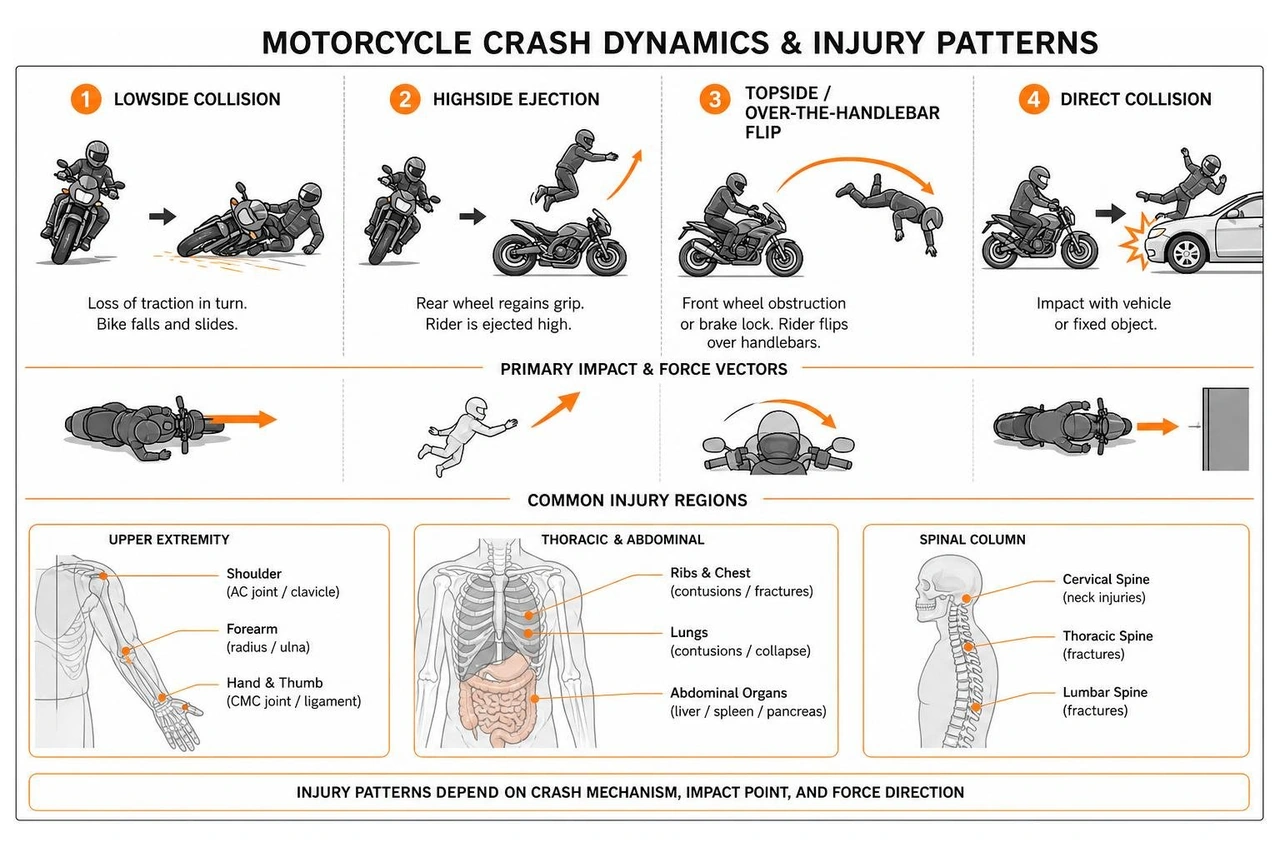
Understanding these dynamic force vectors is vital when evaluating physical evidence. Forensic experts use these crash movements to reconstruct the sequence of impact and confirm how injuries occurred. Read more on this in the Systematic forensic review of motorcycle injuries.
Injury Clusters Identified in Collision Analysis
Trauma research demonstrates that motorcycle injuries do not occur at random; rather, they form distinct statistical "clusters" based on crash physics. An exploratory factor analysis study analyzing Level 1 trauma registries identified four primary latent injury clusters:
- Cluster 1 (Head & Cervical Spine): Concussions, skull fractures, facial bone fractures, and upper cervical spine subluxations frequently co-occur during head-first impacts.
- Cluster 2 (Extremity Factor): Outstretched hand/wrist fractures co-occur with lower extremity tibia and ankle fractures as the body tumbles.
- Cluster 3 (Pelvis, Abdomen & Upper Extremities): Fuel tank impacts force pelvic fractures while simultaneous handlebar contact ruptures the spleen or liver.
- Cluster 4 (Shoulder Girdle & Thorax): Direct lateral ground strikes cause clavicle fractures, rib fractures, and lung contusions together.
Recognizing these injury pairings helps emergency room personnel look for non-obvious internal trauma during secondary surveys. Medical teams and legal analysts can review the full research via the PMC study on motorcycle injury clusters.
Environmental and Protective Factors Influencing Injury Severity
Environmental conditions and rider choices significantly alter crash outcome data. Surprisingly, federal crash statistics show that the vast majority of fatal motorcycle accidents occur under seemingly ideal driving conditions:
- Weather: 94% of fatal motorcycle crashes happen in clear or good weather.
- Road Types: 65% of fatal crashes take place on urban roads where complex intersections present high turning-vehicle hazards.
- Lighting: 49% occur during daytime, though early morning hours (around 7:00 AM) exhibit higher fatality rates due to lighter traffic density encouraging higher speeds.
In Michigan, driver distraction and right-of-way violations at urban intersections remain primary crash triggers. To explore local crash factors further, see our article on What Causes Most Motorcycle Accidents in Michigan.
| Safety Factor / Gear Choice | AIS Severity Impact | Head & Brain Protection | Soft Tissue & Extremity Protection |
|---|---|---|---|
| Full-Face Helmet | Lowers overall ISS significantly | High (reduces facial fractures & contusions) | Minimal |
| Open-Face / Half Helmet | Moderate protection | Partial (protects vault, leaves face vulnerable) | None |
| No Helmet | High mortality & ISS score | None (35%+ reach severe AIS 4+ head trauma) | None |
| Leather / Kevlar Suit | Reduces abrasion depth | None | High (prevents full-thickness road rash) |
| Armored Boots & Gloves | Lowers orthopaedic fracture risk | None | High (protects CMC joints, ankles, feet) |
Protective Gear, Road Rash, and Severe Skin Complications
Road rash is often minimized as a simple scrape, but medical professionals treat severe road rash as an abrasion burn injury. When a rider slides across asphalt at 45 mph, friction generates thermal heat while stripping away skin layers:
- First-Degree Road Rash: Surface reddening and light scraping affecting the epidermis.
- Second-Degree Road Rash: Damage extending into the dermis, exposing underlying nerves and producing severe bleeding, blistering, and deep debris embedment.
- Third-Degree Road Rash: Complete destruction of skin, exposing subcutaneous fat, muscle tissue, and bone.
Deep road rash carries extreme risks of secondary bacterial infection (such as MRSA) and severe scarring. Treatment frequently requires surgical debridement under anesthesia, antibiotic therapy, and skin grafting procedures similar to those used for fire victims. For information on how skin trauma claims are handled legally, visit our page on Burn Injuries.
Financial Recovery and Long-Term Consequences of Crash Injuries
Recovering from motorcycle accident injuries is often a long, costly journey. Acute trauma care charges alone reflect the serious nature of these collisions. National hospital data shows median acute hospital charges for motorcycle trauma victims:
- Isolated Single Lower Extremity Injury: $20,745
- Multiple Lower Extremity Injuries: $38,608
- Lower Extremity + Multi-Region Body Trauma: $56,288+
When severe brain injuries, complex spinal surgeries, or intensive care stays are involved, total acute medical bills regularly exceed six figures.
Long-Term Disability and Financial Impact of Common Injuries From Motorcycle Accidents
Beyond initial hospitalization, long-term costs accumulate over years. Motorcyclists who sustain severe trauma often suffer permanent limitations:
- Chronic Pain and Mobility Impairment: Tibia non-unions, crushed heel bones, and pelvic hardware can leave riders with permanent limps, requiring chronic pain management or joint replacement later in life.
- Cognitive Deficits: TBI victims may face permanent memory loss, speech barriers, executive function challenges, and emotional changes, preventing a return to their career.
- Lost Earnings and Earning Capacity: Extended time away from work during physical therapy depletes savings, while permanent physical impairment can lower lifetime earning potential.
Securing continuous rehabilitation, adaptive medical devices, and home modifications requires a legal strategy designed to pursue full compensation from responsible parties.
Forensic Accident Reconstruction and Documentation for Legal Claims
Reconstructing a motorcycle crash requires forensic expertise. Because insurance adjusters often harbor unfair biases against motorcyclists, proving liability demands clear physical evidence:
- Vehicle Friction and Trajectory Analysis: Measuring tire skid marks, gouge marks in the pavement, and final resting locations of vehicles establishes pre-collision speeds and braking actions.
- Damage Matching: Comparing paint transfer and contact marks on an automobile to the motorcycle's handlebars, footpegs, or fairings confirms impact angles.
- Handlebar and Helmet Impression Analysis: Matching rider bone fractures or abdominal lacerations to specific vehicle parts validates how the body traveled during impact.
Severe crashes across Michigan—such as this reported Genesee Township motorcycle collision—highlight the need for immediate site preservation and forensic investigation before physical evidence disappears.
Documenting Common Injuries From Motorcycle Accidents for Personal Injury Claims
To overcome insurance company tactics aimed at downplaying injuries, accident victims must build a clear medical and legal record:
- Maintain Treatment Continuity: Never skip medical appointments, physical therapy sessions, or specialist follow-ups. Unexplained gaps in treatment give insurers room to claim your injuries healed or were caused by something else.
- Preserve Physical Evidence: Keep your damaged helmet, torn riding leathers, armored gloves, and boots in an unwashed state. These physical items serve as proof of impact force and friction dynamics.
- Understand Michigan Insurance Nuances: Motorcycle coverage under Michigan's motor vehicle laws is unique. Motorcyclists involved in a crash with a motor vehicle may be entitled to No-Fault Personal Injury Protection (PIP) benefits, but the order of priority depends on specific statutory rules.
To understand how Michigan insurance policies apply to your situation, read our detailed guide on Do Motorcyclists Receive No-Fault PIP Benefits in Michigan.
Frequently Asked Questions About Motorcycle Collision Injuries
What is the most common injury in non-fatal motorcycle crashes?
Lower extremity injuries are the most common non-fatal trauma in motorcycle collisions, occurring in 40% to 60% of all crashes. Specifically, fractures of the tibia and fibula represent the most frequent orthopaedic injuries, followed by ankle, foot, patella, and femur trauma. Approximately 30% of all non-fatal motorcycle injury hospital visits involve leg and foot injuries.
How does helmet use affect head and neck injury outcomes?
Wearing a certified full-face helmet drastically reduces the risk of severe traumatic brain injuries, facial bone fractures, and brain contusions. Hospital data shows non-helmeted riders are far more likely to arrive with critically low Glasgow Coma Scale scores and severe Injury Severity Scores (ISS $\ge$ 30). While heavy helmets under extreme force transmit energy down to the neck in rare instances, helmeted riders consistently experience far higher survival rates overall.
Why do motorcycle accidents result in higher injury severity than car crashes?
Unlike passenger cars, motorcycles lack protective metal cabins, seatbelts, airbags, and crumple zones designed to absorb impact energy. When a collision occurs, kinetic energy transfers directly into the motorcyclist's body. Additionally, riders are frequently ejected from the bike, exposing them to a secondary impact against the pavement, fixed objects, or other moving vehicles, leading to multi-system body trauma.
Conclusion
Motorcycle crashes can change a life in a fraction of a second. From painful road rash and fractured limbs to life-threatening brain and spinal trauma, understanding common injuries from motorcycle accidents highlights the vital importance of wearing proper protective gear and seeking immediate emergency medical care.
If you or a family member has suffered injuries in a motorcycle crash in Flint, Detroit, Wayne County, Genesee County, or anywhere in Michigan, securing seasoned legal representation early can protect your future.
At Hamo Law Firm, our legal team brings over 40 years of trial experience fighting insurance companies for injury victims. We handle cases on a contingency-fee model—meaning you pay no attorney fees unless we win your case. Contact us today for a free evaluation through our dedicated Motorcycle Accidents team to protect your rights and pursue the financial recovery you deserve.
.jpg)