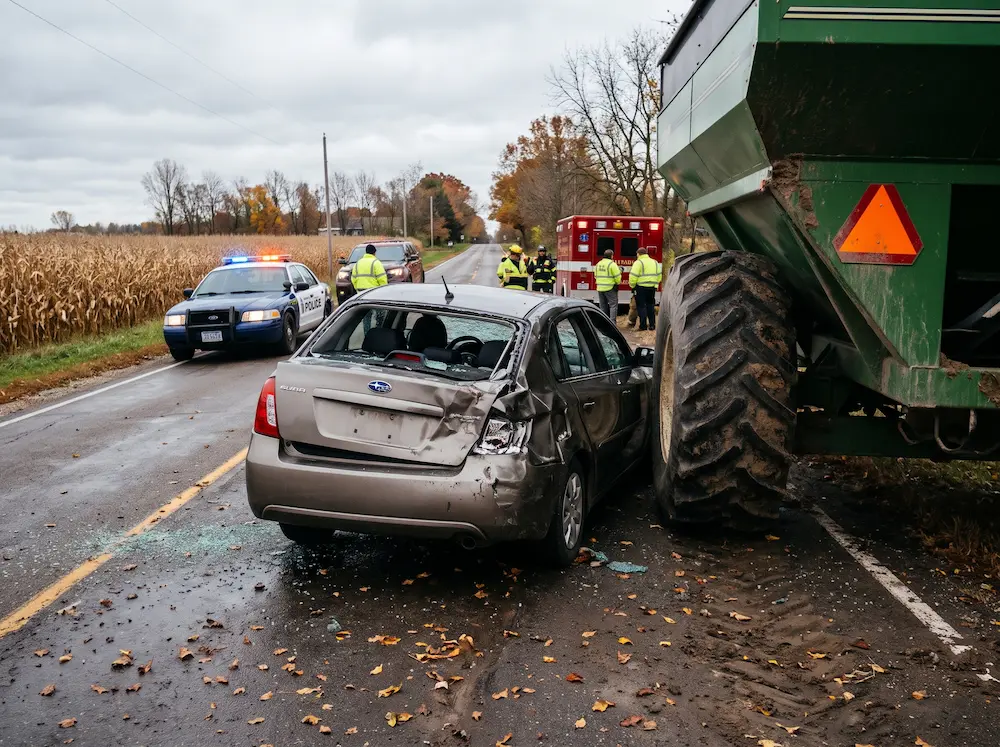
Picture an October evening on a county road outside Lapeer. The sun sits low and orange, right in your eyes. You crest a hill at 55, and there it is: a combine wider than your lane, crawling at jogging speed.
Most of the time, a driver brakes hard, mutters something, and goes home shaken but fine. Some families aren't that lucky. We hear from them every harvest season, and their stories stay with us long after the case is over.
Harvest Season Puts Big Machines on Small Roads
What Fall Looks Like in Rural Michigan
Fall is the busiest stretch of the farming year. Corn, soybeans, and sugar beets come out of fields across Genesee, Lapeer, Saginaw, Tuscola, and the Thumb. Farmers rarely own one big block of land. Their fields are scattered, so their equipment has to travel public roads to get from one to the next.
That means tractors, grain carts, and combines share two-lane roads with commuters, school buses, and semi trucks. Add shorter days and dusty air, and the risk climbs.
The Closing-Speed Problem
Here's the math that catches people off guard. A car going 55 approaches a tractor going 15 at a difference of 40 miles per hour. That works out to roughly 59 feet every second.
Even a properly mounted warning emblem is designed to be seen from about 600 feet. At that closing speed, a driver may have only about 10 seconds to notice, understand, and react. A hill, a curve, or a low sun can shrink that window to almost nothing.
The Rules Farm Equipment Must Follow in Michigan
What the Law Calls an "Implement of Husbandry"
Michigan law uses an old-fashioned phrase for farm machinery: "implement of husbandry." It covers equipment such as:
- Farm tractors
- Combines and other harvesting machines
- Sprayers and fertilizer applicators
- Farm wagons, grain carts, and other towed equipment
The Orange Triangle and What It Means
You know the reflective orange triangle on the back of a tractor. Michigan rules require it on any vehicle on a public road built to travel 25 mph or less.
The rules get specific. The emblem must be:
- A fluorescent yellow-orange triangle with a dark red reflective border
- Mounted point up, centered on the rear, and 2 to 6 feet off the ground
- Visible day and night from 600 feet down to 100 feet behind it
- Kept clear of advertising and other markings
Lights, Reflectors, and Wide Loads
According to Michigan State University Extension, state law also requires additional reflectors on farm tractors and implements of husbandry. Lighting matters most at dusk and after dark, when harvest crews often push to finish a field. A muddy emblem or a burned-out lamp can turn a manageable situation into a deadly one.
Passing Rules for Everyone Else
Drivers have duties too. A slow tractor doesn't make a no-passing zone legal to pass in. Patience on a double yellow line can save a life.
Myth vs. Fact
- Myth: If you rear-end a tractor, the crash is automatically your fault.
- Fact: Fault depends on the facts. A missing emblem, dead lights, or an unsignaled turn can shift some or most of the responsibility onto the equipment operator or the farm.
How These Crashes Usually Happen
Certain patterns come up again and again in rural Michigan:
- The left-turn pass. A driver starts to pass just as the tractor swings left into a field drive. The car hits the equipment broadside.
- The hidden hilltop. A driver crests a hill or rounds a curve and finds the machine with no room to stop.
- The centerline squeeze. Wide equipment drifts over the centerline on a narrow road, causing sideswipes or head-on crashes.
- The invisible machine. Faded, missing, or mud-caked emblems and lights leave a dark shape on a dark road.
- The slick spot. Mud and crop debris tracked onto the pavement send a car into a skid.
Sorting Out Who Is Responsible
How Michigan Weighs Shared Fault
Michigan uses a comparative fault system. A jury may assign each person a percentage of the blame. Your recovery may then be reduced by your share. In many cases, a person found more than 50 percent at fault may lose the right to noneconomic damages, like pain and suffering.
The Operator's Duties
The person driving the equipment may be responsible for:
- Displaying a clean, properly mounted emblem
- Using working lights and reflectors
- Signaling turns clearly
- Staying as far right as safely possible
- Pulling over to let traffic pass when practical
Farm Owners, Employers, and Custom Harvesters
The operator is often an employee, a family member, or a hired harvesting crew. In those situations, the farm business or the harvesting company could share responsibility. Their insurance coverage may also be very different from a typical auto policy.
Equipment and Maintenance Failures
Sometimes the problem is the machine itself. Defective lighting systems, failed hitches, or poorly maintained equipment may point to a manufacturer or repair shop.
Where Michigan No-Fault Fits In
Your Own PIP Benefits Come First
If you were hurt in your car, your own auto insurance is usually your first source of help. Personal Injury Protection (PIP) benefits may cover medical care, lost wages for up to three years, and replacement services. Your PIP coverage level depends on the option you chose when you bought your policy.
Why Farm Equipment Is a Different Animal Under the Law
Here's a wrinkle many people don't know. Under Michigan's No-Fault provisions, most farm vehicles aren't treated as "motor vehicles." They generally aren't required to carry No-Fault auto insurance either.
Stepping Outside No-Fault for Pain and Suffering
PIP doesn't pay for pain, suffering, or the loss of the life you used to have. A separate claim against the at-fault party may cover those losses. In auto cases, Michigan generally requires a serious impairment of body function or permanent serious disfigurement for that kind of claim.
When the Injuries Change Everything
Size Mismatch, Catastrophic Results
A modern combine can weigh many tons. When a car strikes one, the people inside take the brunt of the force. These crashes may cause:
- Traumatic brain injuries (TBI)
- Spinal cord injuries and paralysis
- Amputations
- Severe fractures and internal injuries
Families Who Lose Someone on a Country Road
Some crashes take a life. Michigan's wrongful death law allows the personal representative of the estate to bring a claim for the family. That claim may include funeral costs, lost financial support, and the loss of companionship. We treat these families with patience, because no lawsuit can carry their grief for them.
Mini FAQ: Farm Equipment Crashes
- Who is responsible when a slow-moving farm vehicle causes a rear-end collision? It depends on what happened. If the equipment lacked a proper emblem or working lights, the operator or farm may be responsible.
- Can I still recover if I was passing when the crash happened? Possibly. Michigan's comparative fault system may reduce your recovery, but it doesn't always eliminate it.
- Does the farm's insurance pay, or does mine? Your own PIP coverage usually pays your medical and wage benefits first. A claim against the farm's insurance may cover other losses.
- How long do I have to act in Michigan? Many injury claims must be filed within three years. PIP deadlines are often just one year, so act quickly.
Sharing the Road With the People Who Feed Us
Michigan farmers are some of the hardest-working people we know. Many are our neighbors, our clients, and the folks we see at Friday night football. Holding someone accountable after a crash isn't an attack on farming.
Accountability is how roads get safer. A clean emblem, a working light, and a little patience on a hill can bring everyone home for supper. When those simple things fail and someone gets hurt, the injured family deserves a fighter in their corner.
From a Country Road to Our Kitchen Table in Flint
If farm equipment changed your life on a Michigan road, we'd like to hear your story. You'll talk directly with George or Alex, not a call center. Contact Hamo Law for a free case evaluation.
Hamo Law Firm
614 S. Grand Traverse Street,
Flint, Michigan 48502
Phone: 810-234-3667
Email: ahamo@hamolaw.com
Website: hamolaw.com
Follow Hamo Law
Facebook: facebook.com/HamoLawFirm
Instagram: instagram.com/hamolawfirm
LinkedIn: linkedin.com/company/hamo-law
YouTube: youtube.com/@HamoLawFirm
TikTok: tiktok.com/@hamolawfirm
Disclaimer: The information provided here is for educational purposes and is not intended as legal advice. Every case is unique, and past success does not guarantee future results.