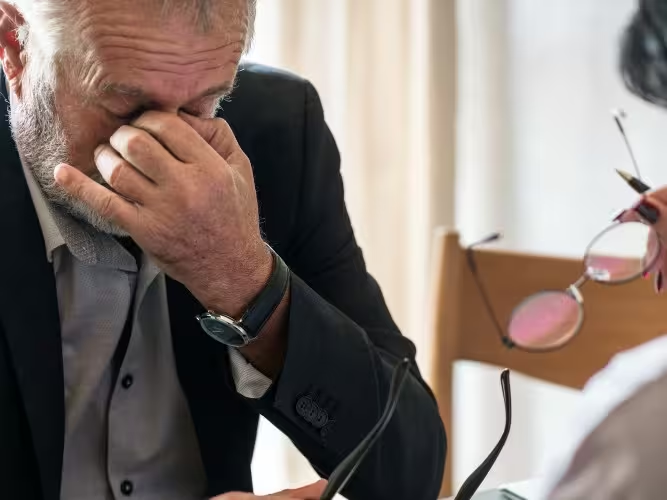
You did everything right. You downloaded the app, booked a ride, buckled your seatbelt, and trusted a stranger to get you where you needed to go. And then, in a matter of seconds, everything changed. Whether the driver ran a red light, another car came out of nowhere, or something else entirely went wrong, you're now sitting with real injuries and a very real question: who is responsible for this?
That question is harder to answer with rideshare accidents than most people expect. We've been handling serious injury cases in Michigan for over 40 years, and we've watched rideshare claims become one of the most confusing corners of personal injury law. The reason is simple: there are multiple parties, multiple insurance policies, and rules that don't always line up neatly. Insurance companies know this, and they use that complexity to their advantage. Our job is to cut through it on your behalf.
Rideshare Accidents Are More Complicated Than a Standard Car Crash
Why the "Who Pays?" Question Gets Complicated Fast
When an Uber or Lyft driver is behind the wheel, there are potentially three different sources of coverage in play: the driver's personal auto insurance, the rideshare company's commercial policy, and in some cases the insurance of a third-party driver who caused the crash. Which policy applies, and to what extent, depends entirely on what the driver was doing at the exact moment the accident happened. That's where things get complicated fast.
The Three Coverage Phases Uber and Lyft Use
Both Uber and Lyft structure their insurance coverage around what they call "periods" or phases of the trip. Here's how they break down in plain English:
- Phase 1 (App Off): The driver is using their personal vehicle for personal reasons. The rideshare company provides zero coverage. Only the driver's personal auto insurance applies, and many personal policies have exclusions for commercial activity.
- Phase 2 (App On, No Passenger Yet): The driver has the app running and is waiting for or driving toward a ride request. Uber and Lyft provide limited contingent liability coverage, typically up to $50,000 per person and $100,000 per accident, but only if the driver's personal policy doesn't cover the loss first.
- Phase 3 (Passenger in the Vehicle): From the moment a passenger enters the vehicle until they exit, Uber and Lyft provide up to $1 million in commercial liability coverage. This is the most protective phase for injured passengers.
If you were a passenger in the vehicle when the crash happened, you were almost certainly in Phase 3, which means that $1 million policy was active. That's meaningful coverage, but getting access to it is another matter entirely.
How Michigan's No-Fault Law Applies to Rideshare Accidents
You Still Have No-Fault PIP Rights as a Passenger
Michigan is a no-fault state, which means that after most motor vehicle accidents, your own Personal Injury Protection (PIP) benefits are the first source of coverage for your medical expenses and lost wages, regardless of who caused the crash. This applies to you even as a rideshare passenger.
Under the 2019 Michigan No-Fault reforms, drivers now choose their PIP coverage level, which means the benefits available to you may depend on what was selected on the policies involved. Medical expense coverage, wage loss benefits, and attendant care are all potentially available through PIP. However, the coverage level you elected on your own auto policy, or in some cases the policy of a resident relative, will govern what you can access.
When You Can Step Outside No-Fault and Sue
Michigan's no-fault system limits your ability to sue for pain and suffering in most cases, but there is an important exception. If your injuries meet Michigan's serious injury threshold, you may be able to bring a claim against the at-fault driver or the rideshare company directly for non-economic damages.
The threshold requires that your injuries constitute one of the following:
- Death
- Serious impairment of an important body function
- Permanent serious disfigurement
What Insurance Actually Covers You as an Uber or Lyft Passenger
Uber's and Lyft's $1 Million Policy
When you are an active passenger during a trip (Phase 3), both Uber and Lyft maintain up to $1 million in third-party liability coverage. This policy is designed to cover bodily injury and property damage caused by the driver during a trip. It applies on top of, or instead of, the driver's personal policy depending on the circumstances.
The existence of this policy does not mean the money flows to you automatically. The insurers behind these policies are experienced at contesting claims, and they will look for every available argument to minimize what they pay.
Underinsured and Uninsured Motorist Coverage
Both Uber and Lyft also carry UM/UIM coverage during active trips. If a third-party driver caused your accident and either had no insurance or not enough to cover your losses, this coverage can step in to fill the gap. Given that a meaningful number of drivers on Michigan roads carry inadequate coverage, this protection matters and should not be overlooked.
Your Own Auto Insurance and PIP Election
Your own Michigan auto insurance policy may play a role even though you weren't driving. The PIP coverage level you selected will govern your first-party medical and wage loss benefits. If you chose a lower PIP level to reduce your premium, that decision affects what you can collect after an accident. It's one of many reasons why understanding your own policy before an accident happens is so important.
Steps to Take After an Uber or Lyft Accident in Michigan
The moments and days after a rideshare crash are critical. What you do, and what you don't do, can have a lasting impact on your claim.
- Get medical attention immediately. Even if you feel okay at the scene, accept EMS evaluation or go to an emergency room. Injuries like traumatic brain injury and soft tissue damage don't always announce themselves right away. A gap in treatment gives insurance companies ammunition to argue your injuries weren't serious.
- Call the police. A police report creates an official record of what happened and where. Do not leave the scene without one.
- Report the accident through the Uber or Lyft app. Both platforms have in-app accident reporting. Use it, but understand that what you say there is being preserved.
- Document everything at the scene. Screenshot your ride receipt, photograph the vehicles and any visible injuries, and get the names and contact information of any witnesses.
- Do not give a recorded statement to any insurance adjuster before you talk to an attorney. Insurance adjusters, including those working for Uber's and Lyft's carriers, are trained to ask questions in ways that can reduce or eliminate your recovery. You are not required to give a recorded statement, and you should not do so without legal guidance.
You Didn't Choose to Be in That Car. Choose Carefully Who Fights for You.
We've spent more than four decades walking Michigan families through moments exactly like this one. George and Alex Hamo have built this firm on one belief: that when a good person gets hurt through someone else's negligence, they deserve a disciplined, experienced team fighting in their corner. We don't shuffle clients through a system. We carry them across the bridge from the chaos of a crash to a real result, and we stay by their side for every step of that journey.
Rideshare accident claims move quickly in some ways and drag in others. Evidence needs to be preserved early. Insurance policies need to be identified and put on notice. Recorded statements need to be avoided until you have counsel. The longer you wait, the harder it becomes to protect what you're owed.
Get the Answers You Deserve: Talk to a Michigan Rideshare Accident Lawyer Today
If you or someone you love was injured in an Uber or Lyft accident in Michigan, we want to hear what happened. A free case evaluation costs you nothing, and our firm works on a contingency fee basis, which means you pay nothing unless we recover for you. You don't have to navigate this alone.
Call us. Tell us your story. We'll tell you honestly where you stand.
Hamo Law Firm 614 S. Grand Traverse Street, Flint, Michigan 48502
The information provided in this blog is for general educational purposes only and does not constitute legal advice or create an attorney-client relationship. Every case is unique, and past results do not guarantee future outcomes. Michigan No-Fault laws and rideshare insurance regulations are subject to change. Please contact a qualified attorney to understand your specific rights.
.jpg)